

Plot Summary
The Stag on the Road
Mike Carter, a recent business graduate, is heading to Hearthstone Cottage with his girlfriend Helen, his university friend Alex, and Alex’s girlfriend, Kay. Their joking journey already exposes Mike’s easygoing evasions: he smokes despite Helen’s objections and burns the rental car’s seat. Near the cottage, Alex looks away from the road, and the vehicle swerves to avoid a stag, striking it and crumpling the bonnet.
The others emerge shaken; Mike finds the animal still alive, then turns away from its accusing gaze. While helping Alex patch the damaged engine, he pockets a broken piece of the stag’s antler. The car makes it onward, but Mike carries the collision’s guilt with him, along with a piece of the animal he has helped leave dying.
The accident turns the group’s holiday into a reckoning before they have even reached their destination. Mike’s casual smoking and the group’s teasing make the collision feel like the consequence of ordinary carelessness, not deliberate cruelty, which complicates his guilt rather than relieving it. His decision to pocket the antler is a small but revealing act: instead of confronting the animal’s death, he carries its remains into the place where his avoidance will become harder to sustain. The dead stag also establishes the book’s central pressure point, the uneasy boundary between human convenience and the lives, histories, and landscapes it treats as disposable.
A Fire Without a Host
At the cottage, smoke rises from the chimneys although nobody was meant to be there. Alex finds the entrance locked and its key missing, while a fire burns inside. His sister Meggie arrives from the hillside with kindling and Oscar, her lively Border collie, explaining that she has been warming the place in the studio.
She introduces herself to Helen and Kay, then needles Alex’s impatience and accepts his teasing about leaving art school. Inside, the old hearthstone draws Mike’s attention, while carved Haelu charms above the bedroom doors promise health, prosperity, luck, and blessing.
Meggie explains their local tradition. The group settles in, but the cottage’s welcome is already mixed with tension: Meggie feels overlooked, Alex belittles her choices, and Mike notices the charged distance between them.
The cottage initially offers warmth, but its hospitality arrives through Meggie, whose role in the family is both intimate and undervalued. Alex treats her artistic detours as irresponsibility; Meggie responds with humor that only partly conceals her hurt. Mike’s attention to her begins as observation, but the story quietly positions him as someone who notices emotional distress without knowing how to answer it. The Haelu charms introduce a local vocabulary of protection, yet the group treats them as decoration. That gap between inherited meaning and casual modern use foreshadows how the visitors will misread the cottage’s history while relying on its comforts.
The Laughing Hearth
After their first evening by the fire, Mike cannot sleep. He hears a child laughing downstairs and finds the dead stag stretched across the hearth, breathing its last. The antler shard he carried back lies in the fire; when he reaches for it, flames burst up and he cuts his palm. The beast seems to rise over him, but Mike jolts awake beside Helen with no wound and no blood.
By morning, he has dismissed the episode as a nightmare. Then a crow strikes the conservatory window. Meggie rescues the injured bird and nurses it in her studio, while Mike and Helen help make a nest. Meggie’s care for the creature unsettles them with her insistence that compassion should not depend on whether an animal is considered food.
The nightmare translates Mike’s guilt into a physical assault: the animal he left behind returns to the hearth, the domestic center he associates with comfort. The injury disappears on waking, but the fear does not, and the crow’s arrival gives the question of animal suffering a real, fragile body. Meggie’s treatment of the bird sets her ethics against the group’s casual habits, especially Mike’s jokes and Helen’s defensiveness. Her care is not presented as serene virtue; it carries anger at a culture that grants tenderness selectively. The scene makes the cottage’s warmth morally unstable, a refuge built around a fire that may also conceal what has been harmed.
The Loch Gives Back
On a fishing trip with Alex, Mike glimpses a pale body beneath the loch’s surface. Its red hair and face look unmistakably like Meggie, though she is safely away in the village with Helen and Kay. The apparition vanishes, leaving Alex’s catch as the only thing in the net. Later, while preparing the trout, Mike sees black fluid and maggots spill from its belly; when he looks again, the fish appears normal.
Helen returns with a handcrafted black scrying mirror, which she places above the hearth. Kay finds a local history describing an executed witch and a stone circle used for animal and child sacrifices. Mike’s visions, the tainted fish, and the new mirror begin to connect the loch, the cottage, and the old violence in the landscape.
The successive images make uncertainty itself a source of horror. Mike sees Meggie dead while she is elsewhere, then encounters corruption inside a fish that seems to vanish when challenged. The novel does not yet permit him to decide whether these are hallucinations, supernatural warnings, or the return of buried history. The scrying mirror gives that uncertainty a focal object, while Kay’s book supplies a narrative frame that may be true, distorted, or both. Meanwhile, Meggie’s absence from the loch vision does not make her safer; it makes the image feel like a prophecy. The landscape appears to remember what the visitors cannot yet explain.
A Child on the Way
At the jetty, Helen tells Mike she is pregnant. He is stunned, reaches for a joint, and suggests abortion as one possible choice before trying to reassure her that he will respect her decision. Helen is frightened about her studies and their uncertain prospects, while Mike retreats into jokes and postponement.
Later, Kay accidentally lets the news slip to the others. Alex celebrates; Meggie responds with unexpected tenderness toward Helen, while Kay’s questions about Helen’s career carry an edge.
As they discuss the witch and the Spindle Stones, Mike watches the map fall into the fire. The antler shard and black mirror sit together above the hearth. Their holiday has become a test of responsibility, but Mike still hopes drink and distraction can postpone his answer.
The pregnancy converts the abstract future into an immediate obligation, exposing the different strategies the group uses to manage uncertainty. Helen seeks shared decision-making, even as she fears the cost to her education; Mike hears a demand for commitment and tries to preserve his options. His suggestion of abortion is not framed as cruelty so much as reflexive escape, yet its impact is real: Helen must carry both the pregnancy and his hesitation. The accidental disclosure makes the private crisis communal, and the burning map hints that their route through the landscape is being erased. The fire’s symbolism is not simply destructive; it consumes the guide that might have made the past legible.
Oscar’s Hidden Grave
When Oscar fails to return, Meggie organizes a search. Mike and Alex take the higher path and find the dog dead, his body torn open. They decide not to tell Meggie, partly to spare her the sight and partly to avoid disrupting their holiday. With no tools, they cover Oscar with stones and brush. While working, Mike realizes the dark stones around them form the remains of a circle, likely the Spindle Stones from Kay’s book.
Oscar lies buried at its center. Alex dismisses the coincidence, but Mike cannot separate the dog’s death from the stories of sacrifice they have just heard. The men return without telling Meggie what they found, converting a painful discovery into a secret that will soon injure their friendship and deepen her grief.
The concealment is the story’s first clear moral betrayal. Mike and Alex tell themselves they are protecting Meggie, but their decision also protects them from having to witness or share her grief. Their improvised burial places Oscar at the center of the ancient circle, making the act seem to repeat the very sacrificial pattern they have just discussed. Whether or not the stones exert supernatural force, the men’s practical choice gives the past a new victim and gives their guilt a physical location. Mike’s unease marks a shift: he is beginning to recognize that avoiding discomfort does not remove its consequences. It merely transfers them to someone else.
Names Among Graves
The next day, Mike helps distribute Meggie’s missing-dog posters in Drinton. At Saint Andrew’s church, a child’s laughter draws him into the graveyard, where he finds headstones bearing his own name. The cemetery seems to multiply around him until he escapes back to the street. Later, in the pub, two local hunters, Jamie and Edward, invite Mike and Alex to join a grouse shoot on land owned by Alex’s father.
Mike buys an unlabeled bottle of local whisky from the shopkeeper, unaware of its grim reputation. Back at the cottage, Meggie objects to the hunt, but Alex and Mike drink to it anyway. Mike’s vision of his own burial and his decision to ignore Meggie’s protest leave him more isolated than he admits.
The graveyard turns Mike’s fear from vague unease into a direct image of personal extinction. His name appears repeatedly, as if the place has already written him into its dead. Yet the vision does not immediately change his behavior: he retreats, drinks, and agrees to a hunt that Meggie opposes. This contradiction matters. Mike is frightened by the idea of consequence but still organizes his choices around immediate comfort. The two hunters’ coarse hospitality also introduces a social version of the novel’s threat: cruelty can arrive dressed as tradition and camaraderie. Mike’s increasing isolation is therefore both supernatural and self-authored.
The Hunt in White Fog
Mike’s hangover and inexperience make the grouse shoot miserable. He accidentally fires at a flock of pigeons, scattering the birds and angering Jamie and Edward. A bank of fog then separates him from the others. Tall figures with antlers move through the whiteout as gunshots sound around him. Mike stumbles upon a stone altar where a gaunt woman cuts open newborn puppies inside Oscar’s corpse, demanding further sacrifice.
He flees through the fog and is stopped by what feels like a shotgun pressed against his back. The voice sounds like Alex’s and accuses Mike of a hidden wrong, then disappears. Mike returns soaked and shaken, convinced Alex and the hunters staged the terror, though he cannot account for what he saw at the altar.
The hunt collapses the distinction between sport and sacrifice. Mike’s accidental shot is comic until the fog strips away the group’s shared reality and turns the landscape into a place where animals and humans are hunted alike. The altar vision is especially disturbing because Oscar’s concealed body returns in a new, impossible form; the cover-up has not contained the death but magnified it. The unseen gunman’s accusation points toward guilt without naming its source, making Mike’s suspicion of Alex a convenient defense. He interprets terror as a prank because that explanation preserves his friendship and avoids asking what, precisely, he has done.
The Bird in the Box
Back at the cottage, Mike argues with Alex about the apparent prank, but the others dismiss his account as drunken paranoia. Angry and overwhelmed by Helen’s pregnancy, he storms outside to smoke in Meggie’s studio. The injured crow begins thrashing in its box; when Mike handles it, a swarm of flies bursts from its body and the bird dies.
Meggie enters moments later, sees the blood, and believes Mike has crushed the creature. She accuses him of ruining what he touches, while Helen witnesses the confrontation and leaves. That night, Mike dreams that fire consumes the cottage and Meggie is trapped behind the conservatory glass. He wakes in the garden, half-dressed, with the house unharmed and his friends laughing at his sleepwalking.
The dead crow turns Mike’s desire to be helpful into another injury, though his account cannot persuade Meggie. The scene’s force comes from the mismatch between intention and consequence: he may not have killed the bird, but his carelessness, smoke, and secrecy make him look culpable. Meggie’s accusation also lands on a deeper fault line, since Mike has repeatedly escaped the aftermath of his actions. The fire dream extends this pattern into helplessness: he sees Meggie in danger but cannot reach her. When he wakes to laughter instead of flames, the social embarrassment compounds his fear and makes retreat into alcohol feel easier than apology.
The Village Goes Missing
After drinking heavily, Mike wakes to learn Helen has taken Meggie’s car into Drinton. He sets out to find her, passing a kitchen vision of the dead crow and discovering that the general store and pub now look long abandoned. Meggie’s posters have changed into grotesque images of Oscar’s corpse. A crowd of silent, decaying villagers gathers in the sleet and chases Mike from the street into the trees.
He escapes and follows the road toward the cottage, where he finds Meggie’s car overturned beside the loch, with blood on its door and no sign of Helen. The abandoned village and the crash turn Mike’s private disturbances into an urgent search: he no longer knows whether Helen is missing, injured, or caught in the same nightmare.
Drinton’s transformation makes the built environment behave like a memory that has surfaced through the present. The store and pub are familiar places rendered decades older, while the villagers’ pursuit turns the town’s silence into accusation. Mike’s first instinct remains to flee, but the missing car changes the stakes: his fear now has someone else’s safety attached to it. The blood on the door is an ambiguous clue, especially after so many unreliable visions, yet it demands action regardless of certainty. The scene also links the village’s decay to Mike’s earlier discovery of the stone circle, suggesting that the haunting is not confined to the cottage.
Blood at the Stones
Jamie and Edward drive Mike back to the cottage, where he finds Alex and Kay together and reports the wreck. The group sets out to search the lochside, with Meggie joining them. Mike hears a faint cry and leads the others uphill to the Spindle Stones.
Helen is there, digging frantically in the earth with bloodied hands. She has uncovered Oscar’s rotting body, and Meggie realizes that Mike and Alex hid his death from her. While Meggie grieves, Mike pulls Helen away and sees blood between her legs.
Kay wraps her in a blanket; Helen is pale, freezing, and scarcely responsive. Mike understands that she has miscarried. Their return to the cottage becomes an emergency, while Meggie’s anger and the exposed dog’s grave leave the group’s secrets impossible to contain.
The discovery brings two forms of loss into the same clearing, but they are not interchangeable. Meggie’s grief over Oscar is sharpened by the realization that her friends denied her the chance to mourn openly. Helen’s miscarriage, meanwhile, forces Mike to face the physical cost of the future he had been trying to defer. The setting makes the sequence feel ritualized, yet the causes remain human as well as supernatural: concealment, exhaustion, fear, and exposure all matter. Mike’s first response is to rescue Helen, a genuine movement toward responsibility. But it arrives after choices that have already narrowed the possibilities for everyone around him.
A Child in the Chimney
At the cottage, Kay and Meggie tend to Helen while Mike waits helplessly. Smoke begins pouring back down the chimney, so Mike uses the broken antler to dislodge a blockage. A cloth bundle falls from the flue, revealing the bones of an infant. Helen sees them and breaks down. That night, Mike dreams that he is having sex with Helen, then Meggie, before waking in Alex and Kay’s room with Kay beneath him.
Alex punches him, and Mike falls down the stairs. In the morning, Helen, Kay, and Alex leave for medical care without him. Mike wakes bruised, alone, and uncertain what he did while sleepwalking. The bones, his assault on Kay, and the departure of his friends leave the cottage as his only remaining company.
The infant bones make the cottage’s hidden history physically undeniable, but their discovery comes when Helen is least able to bear another shock. Mike’s sleepwalking episode then converts his confused desires into an actual violation of Kay’s safety. The horror does not excuse the harm; the uncertainty around his agency makes accountability more difficult, not less necessary. When his friends leave, Mike is deprived of the social protections that had repeatedly helped him minimize events. The empty rooms reflect a consequence he can no longer joke away. The cottage becomes both prison and mirror, isolating him with the damage he has caused and the parts of himself he has refused to examine.
Meggie Underwater
With his friends gone, Mike finds Meggie’s painting of the Spindle Stones and sees the old witch depicted with hair the same red as Meggie’s. During a violent storm, he spots Meggie rowing into the loch with weights tied to her ankles. She drops them overboard and falls into the water. Mike dives after her, finds her body on the lochbed, and frees her from the rope.
When she grabs him, the underwater world turns inside out: the water hangs above them like a sky, and the drowned streets of an old village appear below. Meggie explains that the visible Drinton is a replacement for the settlement flooded to make way for a dam. The lost community, its dead, and its stolen ground now stand at the center of Mike’s haunting.
The drowned village expands the story’s geography and its moral scale. What seemed like a localized haunting is rooted in a civic decision that erased a community and left its dead beneath the water. Mike’s father is implicated through the dam project, linking the protagonist’s personal recklessness to inherited institutional harm. Meggie’s attempted drowning also changes the meaning of his earlier visions: the image of her dead in the loch has been tied to an actual death, though Mike has not yet understood when or why it occurred. The revelation asks whether recognition can matter when it arrives too late, and whether inherited guilt can be answered by a different choice.
The Cottage Chooses
The scrying mirror reveals the past Mike has forgotten. During an earlier visit, he slept with Meggie, left without knowing she was pregnant, and ignored her attempts to contact him. She later miscarried at the cottage, then accepted the witch Elsa’s offer to ease her pain in exchange for her child’s soul and her own service. Elsa’s altar stone became the cottage hearthstone, and the dam drowned the village.
Meggie explains that the cottage turns desire and fear into visions, then offers Mike a choice: return to the sinking car and save himself, or let Helen and their unborn child live. In the replayed crash, Mike chooses Helen. She kicks out a window and escapes with Alex and Kay, while Mike remains trapped inside the car as it sinks.
The revelation recasts Mike’s hallucinations as more than random punishment: they expose the past he has denied and the fantasies through which he evades responsibility. His forgotten encounter with Meggie is not simply a secret affair; it is a history of abandonment whose consequences include a lost child and Meggie’s bargain with Elsa. The hearthstone binds those private failures to public violence, making the cottage an archive that refuses separation between personal and collective harm. Mike’s final choice is meaningful because it reverses his habitual self-protection. He gives Helen and the child the future he once treated as an inconvenience, though the decision cannot undo what he did to Meggie.
A Life Beyond Glass
The mirror shows the survivors receiving help beside the loch. Helen, Alex, and Kay are wrapped in thermal blankets; the stag is being guided away from the road, and Oscar runs to greet Helen. Meggie walks into the water holding the hand of a child, while Mike watches from inside Hearthstone Cottage. He presses his palm to the window and sees Helen glance toward him, though she turns away.
The ending grants the living a reprieve: the stag survives, Oscar is safe, and Helen’s pregnancy has another chance. Mike, however, remains bound to the cottage, separated from the people he chose to save. His sacrifice protects them, but it does not absolve his earlier betrayals or restore the lives already lost.
The ending refuses the comfort of a clean redemption. Mike’s final act saves Helen and preserves the possibility of their child’s life, but his own survival is surrendered, and the story does not suggest that this sacrifice repairs the harm he caused Meggie. The rescued animals offer a pointed counter-image to the opening collision: the stag lives, and Oscar returns to a person who loves him. Yet Mike can only witness that repair through glass. The cottage remains a repository for the past, and his confinement makes responsibility permanent rather than triumphant. The novel closes with care achieved at a terrible price, not with guilt erased.
Analysis
Hearthstone Cottage makes evasion the mechanism through which private and collective harm converge. Mike’s central habit is not simple selfishness but postponement: he smokes, drinks, jokes, and tells himself he will address consequential matters later. That strategy works socially until other people inherit its costs. Helen must make pregnancy concrete; Meggie is denied honest grief; Oscar becomes a secret buried beneath the stones. The supernatural world gives these deferrals physical form, returning the dead as images Mike cannot comfortably dismiss.
The cottage’s architecture is crucial. Its hearthstone joins a domestic refuge to a ritual site, while the mirror makes memory visible without making it easy to interpret. A home built from displaced sacred stones becomes an instrument that exposes the violence hidden beneath ordinary comfort. The flooded village extends this logic beyond individual psychology. The dam’s erased community reflects the same structure as Mike’s personal failures: those with power move forward, while the people and lives they leave behind are treated as costs already paid.
The novel also complicates inherited guilt. Mike is implicated in his father’s corporate legacy, but inheritance alone does not determine his final choice. His decision to let Helen and their child escape is meaningful precisely because it interrupts his established self-protection. It does not repair his abandonment of Meggie or restore the drowned villagers. The ending therefore resists the fantasy that one noble act can settle a history of harm. Mike can choose differently at the point of crisis, but accountability remains inseparable from consequence.
Animal suffering binds the book’s ethical and supernatural threads. The stag, Oscar, the crow, and the trout make violence tangible before the dead village is revealed. The story repeatedly asks whether empathy counts when it is expressed only after damage is done. Its bleak answer is that compassion matters, but it cannot substitute for responsibility. The final rescue offers a future to the living, not a clean slate to the person who chose it.
Review Summary
Hearthstone Cottage received mixed reviews, with an average rating of 3.68/5. Readers praised the atmospheric Scottish setting and creepy premise of four friends vacationing in a remote cottage. Many found the story suspenseful and enjoyed the folklore elements. However, some felt the characters were unlikable and the plot became confusing. Critics appreciated the eerie tone but wanted more scares and a clearer resolution. Overall, readers found it an entertaining but not exceptional horror novel, with a divisive ending.
Characters
Mike Carter
The evasive new graduateMike is a recent business graduate who treats uncertainty as something he can postpone with jokes, cannabis, alcohol, and an easygoing performance. He loves Helen, but often mistakes her requests for shared responsibility as attempts to control him. His friendship with Alex gives him a familiar model of male ambition and competition, while his parents’ strained marriage has taught him to associate family life with financial entrapment. Mike is observant, especially when other people are hurting, but his attention rarely becomes useful action. The gap between his capacity for empathy and his habits of avoidance drives the story’s central psychological tension. His journey tests whether he can recognize the consequences of his choices before they become irreversible.
Helen
The practical partnerHelen is Mike’s girlfriend, a law graduate with a disciplined manner and a strong investment in her future. She dislikes Mike’s smoking and disorganization, but her insistence on order is not mere fussiness: she wants a partner who will share the work of building a life. Pregnancy confronts her with a conflict between education, autonomy, and an unexpected family. She can be guarded and sharp, particularly when Mike evades difficult conversations, yet she also tries to make room for his feelings and choices. Helen’s directness exposes the imbalance in their relationship: she is often required to name the practical consequences that Mike would rather leave abstract.
Meggie Buchanan
The fiercely attentive artistMeggie is Alex’s younger sister, an art student who has stepped away from formal study to travel and find her own direction. She lives close to the landscape and its traditions, cares deeply for animals, and speaks with conviction when she sees hypocrisy. Her warmth toward vulnerable creatures contrasts with her impatience toward people who treat harm as an abstraction. Alex’s teasing and parental disapproval have left her sensitive to being dismissed, though she answers condescension with wit and independence. Meggie’s complicated closeness to Mike unsettles the group’s easy social arrangements. She embodies both a different way of living and the emotional costs of being unseen by those who claim to care.
Alex Buchanan
The ambitious loyal friendAlex is Mike’s longtime university friend, a law graduate, and Meggie’s older brother. He is competent, protective of his position, and often quick to take charge, especially when a practical problem needs solving. His gruff teasing masks affection but also gives him a way to belittle Meggie without acknowledging the effect. Alex’s plans tend to follow the routes laid out by his successful father, and he is more comfortable with conventional security than Mike is. His relationship with Kay is affectionate, though their shared future remains largely unspoken. Through Alex, the story examines how loyalty can coexist with complicity, particularly when preserving social comfort requires hiding a painful truth.
Kay
The bookish observerKay is Alex’s girlfriend, an American classics graduate with a strong interest in folklore and ancient sites. She notices patterns others overlook and supplies the group with the local history that makes the landscape newly unsettling. Her care can be practical and decisive, especially when someone is hurt, but she also has opinions about what choices will cost women professionally. Her closeness to Alex is evident, while her response to Helen’s pregnancy suggests that private hopes and comparisons may lie beneath her composure. Kay’s curiosity helps turn the cottage’s legends from background decoration into a force the group must reckon with.
Oscar
Meggie’s devoted collieOscar is Meggie’s Border collie and constant companion. Energetic, affectionate, and prone to chasing wildlife, he gives Meggie a source of uncomplicated companionship in a family where she often feels judged. His disappearance brings the group into the surrounding hills and toward the Spindle Stones. Oscar also anchors the story’s recurring question about whose lives receive care and whose suffering is treated as incidental.
Elsa
The village’s accused healerElsa is the woman at the center of Drinton’s old witch legend. The villagers remember her through accusations of poisoning, failed crops, and missing children, while the surviving accounts hint at a healer whose community turned against her. Her story carries the history of gendered suspicion and the ease with which fear can be redirected toward a scapegoat. She remains a shadow over the cottage before the visitors understand how closely her past is tied to its foundations.
Jamie
The local hunting regularJamie is one of two older Drinton men who invite Mike and Alex on a grouse shoot. He is a seasoned hunter, fond of rough humor, and comfortable treating the countryside as a place for sport. His banter makes him seem merely abrasive, though his familiarity with the land and the cottage gives him a practical role in the group’s movements.
Edward
The cottage’s local caretakerEdward accompanies Jamie on the hunt and has helped maintain Hearthstone Cottage for Alex’s family. He shares the older man’s teasing manner and knows the village’s informal customs, including where spare keys are kept. His connection to the property gives him access to a world the young visitors only partly understand.
Mike’s father
The absent corporate patriarchMike’s father works in business development and expects his son to choose a stable, profitable career. His frustration with family costs and workplace politics shapes Mike’s fear that adulthood means becoming trapped in obligations. His role is mostly remembered through Mike’s anxious interpretations, making him both a real parent and an internal voice of pressure.
Plot Devices
The scrying mirror
A window into buried memoryHelen buys the black, bowl-shaped mirror in Drinton and places it above the cottage hearth. At first it appears to be an unusual decorative object, but Mike sees scenes within it that do not match the room: the cottage under construction, a birth, and later the drowned village. The mirror gives the haunting a visual center and gradually connects personal memory to the property’s history. It also makes Mike confront scenes he has suppressed or misread. Its reflections are not neutral records; they press his fears and desires into images, blurring the boundary between recollection, dream, and supernatural event.
The hearthstone altar
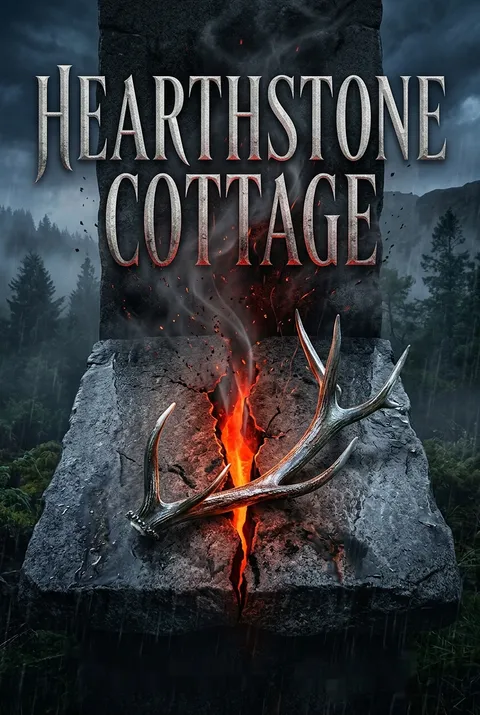
The cottage’s buried foundationThe hearthstone first appears as an old, impressive slab at the center of the cottage’s warm living room. Later, smoke forces Mike to clear the chimney, and a wrapped infant skeleton falls from the flue. The mirror eventually reveals that the hearthstone came from the Spindle Stones and was laid over the altar’s inscriptions. This object connects the witch’s rituals, the infant remains, the cottage, and the supernatural force that keeps drawing the characters into visions. It turns the domestic hearth from a simple symbol of shelter into the physical point where private grief and a community’s violence have been concealed.
The Spindle Stones
A landscape of repeated sacrificeThe Spindle Stones are an ancient circle partly dismantled for local buildings, including Hearthstone Cottage. Kay’s folklore book associates the site with an accused witch and stories of animal and child sacrifice. Mike and Alex discover the circle while hiding Oscar’s body at its center; later, the stones appear whole and become the setting for visions of ritual violence. The site makes the characters’ decisions feel caught in an older pattern, but it does not erase their agency. Their concealments and acts of care determine how that history repeats in the present.
The drowned village
A debt beneath the presentBeneath the loch lies the former village, flooded to make way for the Kintail dam project. The new Drinton stands in its place, but Mike encounters empty shops, decaying streets, and spectral inhabitants that suggest the replacement has never healed the loss. The drowned settlement broadens the novel’s haunting from a family’s holiday to an act of institutional displacement and neglect. Its connection to Mike’s father turns inherited privilege into a concrete legacy: the cottage and the dam are not separate settings, but parts of the same history.
The Haelu charms
A traditional sign of protectionWooden Haelu symbols hang above the cottage bedroom thresholds. Meggie identifies their meanings as health, prosperity, luck, and blessing, and Kay recognizes them as part of local folklore. Their placement suggests that the house has long been treated as a place requiring protection. The visitors joke about the charms and do not investigate their purpose, so the carvings act as an early sign that the cottage’s history exceeds its role as a holiday rental. Their promise of safety also stands in pointed contrast to the increasingly dangerous events inside.
Download PDF
Download EPUB
.epub digital book format is ideal for reading ebooks on phones, tablets, and e-readers.








