

Plot Summary
A Body at the Guilford
Detective Nikki Heat arrives at the Guilford, a grand apartment building on the Upper West Side, to find real estate developer Matthew Starr dead beneath his balcony. Heat’s new ride-along, journalist Jameson Rook, trails her through the crime scene, where the broken café station and Starr’s injuries make a fall look anything but simple.
Starr’s wife, Kimberly, insists he would never have taken his own life, and Heat promises to find whoever killed him. On the balcony, her detectives find torn denim on the railing and scuff marks leading to it. As Heat orders a background check on Kimberly, a man attacks her on the street. She escapes his grip, and Heat pursues him into the Museum of Natural History with Rook close behind.
The first scene sets Heat’s central discipline against the disorder of homicide: she pauses before approaching each body, then makes herself observe rather than assume. Starr’s wealth offers no protection from the physical fact of his death, while the torn fabric gives the investigation its first material foothold. Rook’s jokes and celebrity distract from the crime, but his presence also unsettles Heat’s practiced solitude. The attack on Kimberly widens the case before the first scene is even secure. A widow who might be a suspect is also a target, forcing Heat to hold competing explanations open.
The Widow's Missing Hour
Heat catches the fleeing attacker, Barry Gable, after he injures Rook in the planetarium. In interrogation, Gable admits that he has been having an affair with Kimberly and that she failed to meet him on the day Starr died.
The story she gave Heat about taking her son to an ice-cream shop is also false: Kimberly dropped the boy and his nanny there, then left. A background check reveals that the polished widow grew up in Queens, once worked as a dancer under another name, and inherited money from an older husband.
The medical examiner, Lauren Parry, adds a stronger reason to reject suicide: Starr’s body bears patterned bruises, including a mark that resembles a ring. Heat orders further checks rather than arresting Kimberly on suspicion alone.
Kimberly’s shifting identity tempts the detectives to treat biography as proof, but Heat refuses that shortcut. The facts establish deception and possible motive, not murder. This distinction is part of her professional ethics: suspicion must be converted into evidence before it can carry weight. The bruises complicate the apparent simplicity of a fatal fall, suggesting that Starr was beaten before he went over the balcony. Heat’s restraint also contrasts with Rook’s instinct to turn each new detail into a story. Their different methods begin to complement each other, even as their attraction makes professional distance less stable.
Starr's Fortune Unravels
Heat and Rook find Starr’s corporate headquarters abandoned, though his name still gleams across its polished lobby. Financial adviser Noah Paxton explains that Starr’s company had been failing well before the recession: projects stalled, debts mounted, and Starr’s gambling and expensive escorts drained his personal fortune.
He had even let his life insurance lapse. Kimberly knew, and had reacted with anger, but a payout could not explain the murder. Heat also questions Omar Lamb, a rival developer who had threatened Starr, and visits a stalled construction site where mob-connected labor fixer Fat Tommy Nicolosi says Starr stopped paying his crew.
These leads expose pressure from several directions. Paxton’s disclosures point Heat toward Starr’s bookies, while the empty offices make the developer’s public image look like an elaborate façade.
The deserted office and the luxurious home form a deliberate contrast: Starr’s public success persists as branding even after the business beneath it has emptied out. His fortune is not a stable motive but a maze of conflicting pressures, from gambling debts to labor stoppages. Heat’s task becomes less about identifying who disliked Starr than about understanding which pressure produced the violence. Paxton earns her trust by speaking plainly, yet his position near the center of Starr’s finances also makes him an important witness. The section’s irony is material: the man who built a skyline could not keep his own enterprise standing.
The Bookie and His Muscle
Kimberly identifies a man known only as Miric as Starr’s bookie, and the Guilford doorman confirms that Miric visited with a powerful companion nicknamed Iron Man. Heat and Rook search for bookmakers until their squad spots Miric near an off-track betting shop.
Raley arrests the bookie while Ochoa pursues the companion. Heat intercepts Iron Man at a subway station and brings him down before he can escape. The man is Vitya Pochenko, whose violent record makes him a plausible source of Starr’s bruises.
In separate interviews, Miric admits visiting Starr but denies seeing him; Pochenko’s injured hand bears a mark consistent with the ring that could have caused the bruising. Rook loses his temper when Pochenko sexually threatens Heat, giving her an opening to examine his hands.
This pursuit converts an abstract financial lead into bodies, names, and injuries. Miric treats debt collection as ordinary business, while Pochenko makes physical intimidation part of his presence. The contrast reveals how violence can be organized and then disavowed as routine. Rook’s outburst disrupts the controlled interrogation, but it also breaks Pochenko’s attempt to dominate the room. Heat uses that disruption rather than retaliating, returning attention to the evidence on his hand. Her judgment is neither emotionless nor governed by emotion: she recognizes the threat and still makes the next move as an investigator.
Pochenko Finds Her Home
Surveillance video places Miric and Pochenko at the Guilford hours before Starr’s death, not at the time he was killed. With no proof to hold them, the pair are released. Pochenko leaves Heat with a menacing promise, then follows her through the city and breaks into her apartment that night. Heat is alone, naked, and unable to reach her service weapon when she finds him holding her off-duty gun.
She disarms him, but the fight turns brutal: Pochenko chokes her on the kitchen floor, where Heat’s mother was murdered when Heat was nineteen. Near blackout, Heat grabs the cord of a hot iron and burns his face, forcing him to flee. The next morning, Rook gives her a framed Sargent print he noticed she admired.
The attack makes Heat’s professional danger intimate and bodily. The kitchen is not merely a vulnerable location; it is the site of her unresolved trauma, so Pochenko’s assault collapses past and present into one struggle for breath. Heat survives through training, improvisation, and a remembered object, but survival does not restore a simple sense of safety. Rook’s gift offers a different kind of response: he has paid attention to what steadies her, not only to what excites or irritates her. The print cannot erase the violence, yet it shows Heat that being seen need not always mean being exposed.
A Blackout Opens the Door
Before the city loses power, Heat returns to Paxton for more information. He admits that he secretly diverted money from Starr’s accounts, claiming he meant to protect Starr’s son’s college fund, and says Kimberly had been hiding money of her own.
Heat also interviews Morgan Donnelly, Starr’s former marketing executive and lover, who left corporate life to open a bakery and is now engaged. Morgan’s account of abandoning a convenient affair to pursue a fuller life unsettles Heat, who recognizes her own habit of keeping desire at a safe distance.
During the blackout, Rook follows Heat home to make sure she is safe. After she kicks him by mistake in the dark, they share a drink by candlelight and finally sleep together. Their new intimacy begins amid the city’s sudden darkness.
The blackout removes the familiar machinery that helps Heat manage both the city and herself. Morgan’s career change gives Heat a concrete mirror: another woman has recognized that success can become a shelter from intimacy. Rook does not persuade Heat with a grand declaration; his attentiveness and playfulness let her risk a small sequence of choices, from sharing a drink to letting him stay. The darkness is therefore not simply atmosphere. It temporarily suspends the habits by which Heat keeps desire under control, while the next morning will test whether this opening survives ordinary work and danger.
A Ring in the Impound
The morning after the blackout, Lauren Parry calls Heat to an impound lot, where a tow driver has found a strangled woman in a car without plates or identification. Beneath the seat lies a hexagonal ring matching the distinctive mark on Starr’s bruises and the injury on Pochenko’s finger.
Heat recognizes the victim from the Guilford lobby surveillance footage. She is Barbara Deerfield, an art appraiser who visited Starr on the morning of his death. At the same time, Rook alerts Heat that burglars have stripped the paintings from Starr’s apartment during the outage.
The night doorman, Henry, explains that men in coveralls bound him before entering. Their short visit seems too brief to remove such a large collection, and the two crimes begin to look connected.
The ring is a small object with an unusually large reach: it joins Starr’s beating, Pochenko’s injured hand, and a second victim’s final struggle. Barbara’s presence in the lobby turns coincidence into a question of sequence and access. Meanwhile, the blackout creates a second apparent crime, theft, whose scale does not fit the time available. Heat’s method depends on resisting the easy solution, whether that is blaming the visible intruders or treating the murders as separate. Henry’s guilt about failing to protect the building recalls Heat’s own painful belief that vigilance might have prevented her mother’s death.
The Truck Carries Nothing
A witness records the license plate of a van leaving the Guilford, and Heat leads a police raid on the auto body shop connected to it. The crew scatters; Heat pursues a biker, Brian Daniels, while Rook tackles him before he can shoot.
The truck contains only moving blankets, and Daniels insists the paintings had disappeared before his crew entered the building. A lineup produces a false identification from Henry, so Heat declines to force the case through a bad witness.
She instead questions overnight doorman Gerald Buckley, whose missed shift coincided with the burglary. A staged encounter with Daniels makes Buckley panic. After Heat arrests him, detectives find Barbara’s Sotheby’s camera hidden in his apartment, linking the doorman to the appraiser and to the missing artwork.
The empty truck is a productive failure. It disproves the assumption that the men caught at the body shop carried the art away, but Daniels’s claim gives Heat a reason to investigate a prior removal. Her handling of Henry’s mistaken identification protects the case from a convenient but unreliable answer. Buckley’s exposure depends on social pressure rather than physical evidence alone: when he sees Daniels, he realizes the police can make his accomplice turn against him. Barbara’s camera then converts the failed burglary into a chain of evidence, carrying the investigation from the building’s service routines toward the appraisal itself.
The Appraiser's Last Visit
The camera’s photographs confirm that Barbara documented Starr’s art collection on the morning she vanished. Forensics also matches the denim fiber from Starr’s balcony to Pochenko’s jeans, while surveillance footage shows Pochenko wearing the hexagonal ring.
Those clues place him in both deaths, although they do not yet explain who directed him. Heat consults Casper, a retired art thief whom Rook knows, and learns that one painting supposedly in Starr’s collection had been sold two years earlier.
The date troubles Heat because the work was still displayed in the apartment. She asks Paxton for the insurer’s records, then obtains the archived photographs that can establish what the collection looked like before the policy was canceled. The art, like Starr’s fortune, may not be what it appears.
The investigation now has two kinds of proof: physical traces that place Pochenko at violent scenes and historical records that can test the identity of the art. The former narrow the mechanism of the murders; the latter challenge the assumption that the paintings are authentic. Casper’s knowledge is valuable precisely because he understands the market’s unofficial routes, though Heat keeps his expertise separate from proof she can use in court. Rook’s access to Casper also demonstrates his unusual usefulness: his world of sources can open doors that police procedure alone cannot, provided Heat verifies what comes through them.
The Originals Were Swapped
Heat compares the insurer’s old photographs with Barbara’s recent images and discovers that the works on Starr’s walls are forgeries. Paxton had been removing genuine paintings over time and storing them in a rented, climate-controlled unit.
The revelation gives him a motive to silence Barbara: her appraisal could expose the substitution just as Starr had decided to sell the collection. Heat’s inquiry also uncovers the separate deception by Kimberly, who used a piano delivery crate to remove the displayed paintings and hide them in the building’s basement, believing them valuable.
Those pieces are fakes. Buckley identifies Paxton as the man who hired his crew, and surveillance from the storage unit shows Paxton moving a painting with Pochenko. Heat secures warrants and prepares a monitored call to draw Paxton back to the Guilford.
The forged collection makes wealth itself an unreliable surface. Starr’s art had functioned as proof of taste and power, but its monetary value depended on authenticity that he never suspected was gone. Paxton exploits that gap between appearance and knowledge, while Kimberly repeats the same mistake for personal gain, stealing objects whose worth she cannot verify. Their schemes are not equivalent: Paxton’s is a sustained fraud tied to two murders, while Kimberly’s theft grows from resentment and financial appetite. The piano crate embodies the novel’s central investigative principle: ordinary objects become evidence when detectives ask what purpose they serve.
The Guilford Becomes a Trap
With Kimberly in custody, Heat arranges for her to call Paxton under police supervision and claim she still has the paintings. Paxton rushes to the Guilford, where detectives have restored the genuine works to the walls as bait.
Heat explains that Barbara’s appraisal would have exposed the forgeries and that Paxton used Pochenko to kill her and Starr. Storage footage places the two men together with the stolen originals, and evidence points to Paxton arranging Pochenko’s attack on Heat as well.
When Heat moves to arrest him, Paxton pulls a gun and escapes into the hall, where he seizes Rook as a shield. Rook’s sudden lunge draws a shot into his shoulder. Heat tackles Paxton before he can fire again and pins him until her team secures the weapon.
Paxton’s methodical self-control collapses when the evidence makes his private fraud visible. The restored paintings transform the Guilford from the scene of his original crimes into a stage where his own hidden history is displayed back to him. Rook’s impulsive intervention is dangerous, but it also breaks the hostage standoff long enough for Heat to act. She does not confuse courage with safety: she waits for a viable opening, then uses force decisively. The capture resolves the central question of who orchestrated the murders, while Rook’s wound makes the cost of his proximity to Heat unmistakable.
Rain Ends the Heat
After Paxton is taken away, Heat tells him that his gun is the same small caliber used to kill Pochenko, and investigators will test it against the bullet. She confirms that Kimberly was arrested after police found the paintings she hid in the basement, and reveals that the monitored call was designed to bring Paxton back. Rook survives his shoulder wound.
With the case cleared and a storm breaking the oppressive heat, Heat drives him home. He tries to define what their night together means and whether their work makes a relationship impossible. Instead of answering with another boundary, Heat kisses him, admits she wants to continue, and takes his hand as they run through the rain toward his building.
The resolution closes the material case through evidence rather than confession alone: the gun links Paxton to Pochenko’s murder, while the recovered art explains the financial scheme. Heat’s emotional resolution is less procedural. She does not promise that work will become easy or that intimacy will eliminate risk; she simply stops treating desire as a distraction that must be postponed indefinitely. The storm breaks the heat wave, but the more important change is behavioral. After years of making herself untouchable, Heat chooses a shared next step with Rook, even while the future remains undefined.
Analysis
Heat Wave builds its mystery around the gap between what people display and what they actually possess. Starr’s branded towers, lavish apartment, and art collection advertise authority, but his company is failing, his debts are growing, and the paintings on his walls are not authentic. Paxton exploits this gap methodically, converting privileged access into a long-running theft. Kimberly also acts on appearances, stealing what she assumes is a fortune without knowing that someone has already replaced it. Their crimes differ in scale and consequence, yet both depend on treating objects as valuable because of the story attached to them.
Heat’s investigative style counters that economy of appearances. She listens to witnesses, checks alibis, returns to surveillance footage, and refuses to let a satisfying hunch stand in for proof. Even her attention to emotional behavior is disciplined: grief, shame, and anger provide context, not verdicts. Objects become meaningful through comparison. Denim links a balcony to a suspect; the ring links separate assaults; archived photographs expose the art fraud. The novel’s detective work is therefore not simply the discovery of a hidden villain. It is the reconstruction of relationships among material traces that people believed would remain unseen.
The personal plot gives this method an emotional counterpart. Heat has survived her mother’s murder by making control a daily practice, from combat training to carefully managed relationships. Rook unsettles that practice because he is both unreliable in procedure and perceptive about what Heat avoids. His humor becomes more than relief when it helps her recover playfulness, and his gift shows that attention can be intimate without being invasive. By the end, Heat has not abandoned discipline or solved grief. She has instead made room for desire beside responsibility. The case closes through evidence; her movement toward Rook remains an act of choice rather than a promise that danger, work, or vulnerability has disappeared.
Review Summary
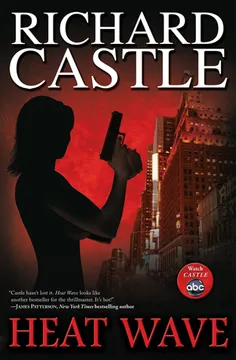
Heat Wave is a tie-in novel to the ABC show Castle, credited to fictional author Richard Castle. Reviews are mixed, averaging 3.58/5. Fans of the show generally enjoy its familiar tone, banter, and character dynamics, comparing it to watching a TV episode. Critics cite weak prose, underdeveloped characters, an obvious mystery, and a pale imitation of the show's charm. The infamous Chapter Ten receives frequent mention. Most agree it's light, disposable entertainment best appreciated by dedicated fans of the series.
Characters
Nikki Heat
Disciplined homicide detectiveHeat leads a New York homicide squad with a precise eye for physical evidence and a strong instinct for how grief behaves. Before each body, she pauses to remember the loss of her mother, murdered when Heat was nineteen, then turns that private wound into attention for the victim’s family. Martial arts training gives her physical confidence, while years of emotional discipline have taught her to defer her own wants. She expects facts to withstand scrutiny and dislikes conclusions built from charm or intuition alone. Rook’s wit frustrates her, but his curiosity and warmth expose how much of her life has been arranged around control. Her central tension is not whether she can do the job, but whether she can remain open while doing it.
Jameson Rook
Restless journalist ride-alongRook is an acclaimed magazine journalist assigned to shadow Heat’s squad, a role he pursues with the confidence of someone accustomed to crossing boundaries. He is funny, socially agile, and prone to turning a tense moment into a performance. His reporting experience gives him useful instincts about people and connections, though he often leaps toward theories before the evidence is ready. Beneath the celebrity ease is a man capable of loyalty and attention: he notices what moves Heat and responds with care rather than demanding explanations. Their attraction grows through irritation, humor, and shared danger. Rook’s challenge is to respect the limits of a police investigation and recognize that being close to Heat means accepting her work, not merely enjoying its excitement.
Matthew Starr
Image-conscious developerStarr is a prominent real estate developer whose name is attached to buildings, offices, and a carefully cultivated public image. His appetite for status appears in his lavish apartment and art collection, while his business and personal finances are far less secure than outsiders assume. Starr’s authority over employees and family is shaped by a need to remain the person in control, even as his choices undermine the empire he built. The people around him encounter different versions of him: employer, husband, father, lover, and debtor. His death launches the investigation, but reconstructing his hidden life is essential to understanding why so many people had reason to approach him.
Kimberly Starr
Polished, volatile widowKimberly is Starr’s much younger wife and the mother of their son, Matty. She presents herself as a composed society figure but can turn abruptly angry when detectives question her marriage or her circumstances. Her background is far removed from the wealthy life she now inhabits, and she has worked hard to remake both her name and appearance. Kimberly values comfort, money, and the status they provide, yet she is also capable of grief and fear when events exceed her control. Heat must distinguish between her evasions, her self-interest, and the facts of her whereabouts. Kimberly’s role exposes how a performed identity can become both a survival strategy and a trap.
Noah Paxton
Starr's financial adviserPaxton is the trusted financial adviser who manages Starr’s business and personal accounts. He is competent, restrained, and initially appears relieved when he can finally describe how badly Starr’s finances have deteriorated. His modest office stands in sharp contrast to the developer’s grand apartment, and his orderly manner suggests someone who has spent years keeping other people’s crises from spilling outward. Paxton understands the books, the artwork’s value, and the practical arrangements surrounding Starr’s household. His relationship with the family is professional but emotionally complicated, especially where Starr’s son is concerned. He is an important source of information because he knows how the company functioned behind its polished public face.
Vitya Pochenko
Violent Russian enforcerPochenko is a large, intimidating man with a record of threats and violence, known to accompany the bookmaker Miric. He carries himself as someone who has learned to survive by making other people retreat first. His physical confidence and deliberate silences make him difficult to read in an interrogation room, while his contempt for boundaries exposes a predatory sense of entitlement. Heat’s combat skill disrupts the control he expects to have over her, and that loss of control becomes central to their conflict. Pochenko is not merely a source of force; his connection to Miric gives him access to Starr’s debts and private life.
Lauren Parry
Heat's medical examiner friendParry is the medical examiner who works closely with Heat and remembers the details of the bodies she examines. Their weekly friendship gives both women room to discuss the strain of working in traditionally male professions without performing toughness for colleagues. Parry is exact about what an autopsy can establish and careful to separate observation from speculation. Her findings on Starr’s bruises, Barbara’s strangulation, and the ring help Heat turn suspicions into physical evidence. She also notices the wear that danger leaves on Heat, offering care without treating her as fragile.
Detective Raley
Patient squad investigatorRaley is one of Heat’s homicide detectives and part of the partnership nicknamed Roach with Ochoa. He is dependable in surveillance work, witness interviews, and the unglamorous checking that makes a case hold together. His sweat-soaked shirts and dry humor make him an easy target for his partner, but he stays focused when the investigation turns dangerous. Raley’s work on the Guilford footage and the burglary leads repeatedly gives Heat the detail she needs to move forward.
Detective Ochoa
Quick-witted squad detectiveOchoa is Heat’s other principal squad detective and Raley’s partner. He handles background checks, witness work, and rapid coordination, often pairing practical competence with a stream of jokes. His humor is part of the squad’s way of surviving grim work, not a sign that he takes victims lightly. Ochoa follows Heat’s leads through the city and helps turn small discoveries into coordinated police action.
Barry Gable
Widow's secret loverGable is a wealthy hedge-fund operator who has been having an affair with Kimberly. He is physically imposing but nervous when Heat questions him, and his history of minor assaults suggests a temper he has not learned to manage. Gable’s account gives Heat an important lead into Kimberly’s private life and exposes the weakness in her initial alibi. He is an early suspect whose connection to the victim’s family proves more personal than criminal.
Miric
Starr's street bookieMiric is a small, slippery bookmaker who collects debts and presents himself as a businessman rather than a violent criminal. He is practiced at avoiding direct answers and has enough experience with police questioning to recognize familiar pressure tactics. His financial connection to Starr explains why he visited the Guilford with Pochenko, but his account is self-serving and must be checked against video and physical evidence.
Brian Daniels
Biker called DocDaniels, known as Doc, is a biker involved in the crew that enters the Guilford during the blackout. He is rough, defensive, and more concerned with his injuries and possessions than with cooperating. Heat’s pressure finally makes him consider whether his associates will sacrifice him to protect themselves. His account of arriving after the paintings were gone gives the investigation a crucial reason to look beyond the men caught at the body shop.
Gerald Buckley
Guilford night doormanBuckley works overnight at the Guilford and knows the building’s routines, access points, and residents. His shift schedule gives him opportunities to notice who enters and leaves, while his own financial needs make him vulnerable to people willing to pay for access. Under questioning, he tries to protect himself by withholding information, but Heat’s careful use of pressure reveals how much he knows.
Agda Larsson
Starr family's Swedish nannyAgda is the Swedish nanny who cares for Matty and lives within the Starr household. She is young, open in conversation, and accustomed to Kimberly’s abrupt demands. Her affection for Matthew Starr is shaped by his kindness toward her, including gifts and attention that blur the boundaries of her employment. She offers a view of the family’s daily life that differs from the polished version presented to detectives.
Morgan Donnelly
Former mistress turned bakerDonnelly was a senior marketing executive at Starr’s company and his former lover. After their affair ended, she left the corporate world and built a small bakery around a childhood pleasure. She is frank about the pain and limits of the relationship, and her account of choosing a different life gives Heat an unwelcome but useful mirror. Donnelly is engaged and has no evident reason to harm Starr.
Casper
Retired art thiefCasper is a cultivated former art thief who now runs an antiques business and keeps connections in the city’s art world. He knows how valuable works circulate outside official channels, and his expertise helps Heat interpret a suspicious sale. His friendship with Rook gives the journalist a way to arrange the meeting, but Casper shares information selectively and expects his favor to be respected.
Fat Tommy Nicolosi
Mob labor fixerNicolosi manages labor pressure for a New York crime family and has ties to a stalled Starr construction site. He knows Rook from a previous reporting project and speaks about the construction shake-down as routine business. His information adds another source of pressure on Starr without making him the obvious answer to the murder.
Omar Lamb
Starr's bitter rivalLamb is a competing developer who once made explicit threats against Starr. He is proud, combative, and eager to diminish Starr’s business achievements. Heat uses his wounded ego to draw out the rivalry, then checks his claims against the financial realities of Starr’s stalled projects.
Captain Montrose
Heat's steady commanderMontrose supervises Heat’s squad and balances her urgency against the procedures and resources of the department. He trusts her judgment but reminds her that warrants, staffing, and public safety impose limits. His support becomes especially important when the danger reaches Heat’s own home.
Henry
Guilford day doormanHenry is the longtime day doorman at the Guilford, proud of his responsibility for the building’s entrance. He is distressed that intruders slipped past him before Starr’s death and later feels responsible when a burglary crew overpowers him. Heat recognizes that his guilt echoes her own struggle to accept that vigilance cannot prevent every tragedy.
Matty Starr
Starr's young sonMatty is Matthew and Kimberly Starr’s seven-year-old son. He loves movies and has a close everyday bond with Agda, who cares for him. His presence makes the consequences of Starr’s death immediate, even while the adults conduct an investigation around him.
Don
Heat's combat trainerDon is a former Navy SEAL who trains Heat in close-quarters fighting. Their relationship is casual and physical, giving Heat a familiar way to manage stress without asking for emotional commitment. His instruction helps explain the skill she relies on when danger becomes personal.
Plot Devices
The Hexagonal Ring
Links the violent scenesA distinctive ring leaves a geometric mark among the bruises on Matthew Starr’s torso. A similar mark appears on Pochenko’s injured finger, and the ring later turns up beneath the seat of Barbara Deerfield’s car. Heat uses the pattern to connect injuries that could otherwise be dismissed as unrelated, then combines it with surveillance footage and fiber evidence. Its value is not that it identifies the killer by itself, but that it makes several timelines and locations answer to the same physical object.
Guilford Surveillance
Tests alibis against timeLobby video records visitors entering and leaving the Guilford, including Miric and Pochenko. Its timestamp initially appears to clear them because they leave hours before Starr’s fall, but closer viewing catches the ring on Pochenko’s hand and identifies Barbara as a visitor on the morning of Starr’s death. The footage also becomes important when detectives check whether the two men returned. Heat’s insistence on reviewing it carefully shows how a recording can both undermine an attractive theory and strengthen a more precise one.
The Art Photographs
Expose the swapped collectionBarbara’s camera preserves images from her appraisal, while the insurer’s archive preserves older photographs of the same room. Comparing the sets reveals that the paintings on Starr’s walls are not the original works. This discovery turns the art collection from background luxury into the center of the murders, giving Paxton a reason to hide his long-running theft. The contrast between the pictures also supplies a practical investigative method: Heat can prove substitution by comparing details in the images rather than relying on anyone’s memory or claims about authenticity.
The Piano Crate
Conceals a mistaken theftKimberly arranges for a piano to be delivered in a large crate, using the delivery as cover to move paintings from the apartment. She believes the works are valuable, but the displayed collection has already been replaced with forgeries. The crate therefore hides the paintings she has taken while also preserving the evidence of Paxton’s substitutions. Its ordinary purpose makes the scheme plausible to people focused on the new piano and the family’s chaos, illustrating why Heat treats mundane logistics as potential evidence.
Nikki Heat Series
Download PDF
Download EPUB
.epub digital book format is ideal for reading ebooks on phones, tablets, and e-readers.








