

Key Takeaways
Treat extreme weather as an accelerant on Britain’s existing social tinder.
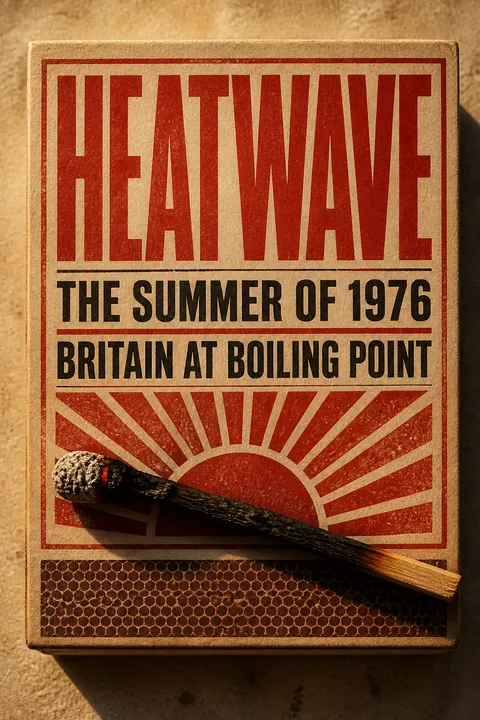
Heat exposed the fault lines. The summer of 1976 brought Britain’s worst drought in 250 years. After a dry winter and spring, temperatures climbed above 30°C for weeks; by August, London had about 90 days of water left. Standpipes, forest fires, melted roads, and exams disrupted by fainting made the crisis impossible to ignore. But the heat did not create the country’s conflicts from nothing. Economic decline, strikes, racist attacks, homophobia, and Northern Ireland’s violence were already part of daily life.
A season of collision. The book argues that months of unusual heat helped intensify a country already under strain. During the same summer, workers fought for equal pay, Asian youths organized against racist violence, gay men resisted police harassment, and punk began to challenge an exhausted music culture. The season moved from drought warnings to mass confrontation, then ended in rain and a changed political and cultural landscape.
The weather works here as a material condition, not a convenient master explanation. Environmental psychology finds links between heat stress and irritability, but those links do not make heat a cause of political violence in any simple sense. Crowding, deprivation, policing, and existing grievances matter enormously. The book’s stronger claim is that heat altered the tempo of events and made everyday strain harder to absorb. That distinction is useful beyond this case: climate pressure rarely invents a society’s fault lines, but it can expose how little room institutions have left for people to endure them.
Build a coalition before crisis: Trico’s women turned equal-pay law into leverage.
A law was not enough. At London’s Trico factory, women on the assembly line discovered that five men doing the same work earned £6.50 more each week. The Equal Pay Act had come into force in 1975, but management argued that men’s greater flexibility justified the difference, then tried to settle the dispute with small increases instead of equal pay. In May 1976, about 400 women walked out. Most had never taken part in a strike before.
Solidarity made pressure. The women picketed for 21 weeks, organized hardship payments, raised money, and persuaded other unions to block deliveries. The company tried to break the strike with lorries escorted by police, but footage of women being pushed aside damaged its public standing. Trade unions, local supporters, and women’s groups helped keep the strikers going. In October, Trico agreed to equalize the pay. The strike showed that a right written into law can remain theoretical until people organize to enforce it.
The strike is a vivid example of resource mobilization: a movement needs more than a just claim. It needs food money, leadership, communication, and allies who can impose costs on the opposing side. The women’s success also challenges the idea that legal reform naturally changes workplace behavior. Yet coalition strength is not a substitute for legal protection. Without the Equal Pay Act, the dispute would have had a different foundation. The durable lesson is the combination: rights establish a standard, while organized people make it difficult for employers to ignore that standard.
When institutions fail to protect minorities, organize locally and make refusal visible.
A murder became a turning point. In June, 18-year-old Gurdip Singh Chaggar was fatally stabbed during a fight in Southall. The immediate circumstances were complicated: a group of white and mixed-race youths had antagonized Asian people outside a café, and violence escalated on a crowded street. But the killing landed in a community already facing assaults, racist intimidation, and a school-bussing policy that sent many Asian children away from local schools, where some were bullied.
Young people rejected passivity. Community elders urged restraint, while many youths argued that turning the other cheek had left them vulnerable. A huge march followed, and young activists formed the Southall Youth Movement to oppose racist violence and demand equal treatment. The police described the murder as unrelated to race, a judgment that angered many residents. The movement’s importance lay in making a clear public claim: Asian Britons were not merely asking to be tolerated, but asserting their right to safety and citizenship.
Collective efficacy, the shared belief that a community can act to protect itself, often grows when official responses seem inadequate. Southall illustrates how a local tragedy can convert private fear into organization, although the process is neither peaceful nor morally simple. The violence that followed Chaggar’s death included attacks on people who had not taken part in the original confrontation. That complexity matters: recognizing the conditions behind anger does not require treating every act of retaliation as justified. The lasting political change came from turning outrage into durable organizing, not from violence alone.
Demand evidence before accepting a confession: bad police work destroyed Stefan Kiszko’s life.
A confession hid a failure. Stefan Kiszko, a socially isolated young man with learning difficulties, was convicted of murdering 11-year-old Lesley Molseed. After prolonged questioning, he signed a confession that he soon withdrew. The case also relied on weak circumstantial evidence and claims that hormone treatment had changed his behavior. Meanwhile, detectives had failed to connect the murder to attacks on other girls, including one survivor who had described a similar assailant.
The forensic facts were decisive. Kiszko spent 16 years in prison before a review found that sperm recovered from Lesley’s body could not have come from him. He had a condition that prevented him from producing sperm. His conviction was overturned, but his health had been badly damaged, and he died less than two years after release. The actual killer, taxi driver Ronald Castree, was convicted in 2007. The same senior detective had overseen both the flawed investigation and Kiszko’s prosecution.
Kiszko’s case shows how confirmation bias can turn investigation into a search for support for an early theory. Once police treated the confession as proof, evidence that should have redirected the inquiry lost force. Research on false confessions identifies familiar risks in coercive questioning, including vulnerability, exhaustion, and a suspect’s desire to escape an overwhelming situation. A confession can be evidence, but it is not self-authenticating. The case also exposes a structural danger: when investigators control both the theory and the evidence, independent review is essential, especially when forensic findings contradict the story that produced the conviction.
Turn visibility into collective resistance when police treat queer presence as provocation.
Public life brought danger. By 1976, gay men had legal meeting places, publications, and a visible community, especially around Earl’s Court in London. But police harassment and assaults by queer-bashers remained common. Men could be arrested for supposedly obstructing the pavement outside a pub, while victims often avoided reporting attacks for fear of being exposed. Greater visibility offered connection, but it also made people easier to target.
The crowd pushed back. On a sweltering June night outside the Coleherne pub, plainclothes officers tried to arrest a man. Other gay men, uncertain whether the incident was an arrest or an attack, surrounded the officers. More people joined in, and police eventually withdrew. Musician Tom Robinson, who had written an initially optimistic song about being gay, changed his approach as the summer’s violence mounted. His sharper, more confrontational song gave voice to a demand for pride that did not depend on staying quiet.
This episode captures a central tension in minority visibility: being seen can build solidarity while increasing exposure to harm. Social movements therefore need more than symbolic affirmation. They need places to gather, ways to share information, and collective responses when authorities abuse their power. The Coleherne confrontation was not a wholesale change in police practice, and the book is careful to present it as a limited moment rather than a clean victory. Still, even a temporary withdrawal can alter expectations. It demonstrates that routine harassment is not inevitable when the targeted group acts together.
Make culture yourself: punk spread when outsiders stopped waiting for industry approval.
The old sound felt spent. At the start of the summer, the Sex Pistols were a little-known London band, and punk was not yet a mass movement. The Ramones’ first album supplied a brisk, stripped-down musical example: 14 songs in 29 minutes. Music papers, John Peel’s late-night radio show, and the Pistols’ small, often rowdy gigs helped connect the sound to an attitude of defiance.
A scene formed through action. The Pistols played dozens of shows, including two in Manchester that helped inspire future members of Buzzcocks and Joy Division, as well as observers such as Steven Morrissey. The Clash and the Damned emerged from the same small network. Fanzines such as Sniffin’ Glue gave listeners a way to publish their own writing instead of waiting for established critics. Punk did not invent amateur music or independent culture, but it made the barrier to entry seem lower, and gave alienated young people permission to start.
Punk’s most consequential innovation may have been social rather than musical. A three-chord song, a photocopied magazine, or a small local gig could make cultural production feel accessible to people excluded from professional institutions. This resembles the logic of open-source communities: participation matters because it lets people create, learn, and revise together. But origin stories centered on a few celebrated bands can hide the networks that made a scene possible, including women, regional musicians, record shops, and earlier subcultures. The book’s useful distinction is that punk’s musical legacy may be limited while its permission-giving effect was substantial.
Let artists define themselves: Black British success needn’t mimic American templates.
A new sound reached number one. Liverpool group the Real Thing became the first Black British group to top the singles chart, with ‘You to Me Are Everything’ in July. Their success followed years of club work and earlier performances under another name. The group had wanted to make socially conscious soul, but a bright, accessible pop song opened the door to a much wider audience. Their achievement mattered not only as a hit, but as proof that Black British musicians could succeed without simply copying American groups.
Autonomy took another form. Joan Armatrading’s 1976 album became a critical and commercial success, despite her refusal to dress or present herself according to the music industry’s expectations for women. She preferred the songs to speak for themselves and resisted being treated as a representative of any single identity. The Real Thing and Armatrading followed different paths, but both expanded the picture of who could be heard in British popular culture.
These careers reveal two distinct routes through a market that often rewards familiarity. A catchy chart single can secure attention, while a singular performer can make the audience adjust to a less familiar image. Neither route guarantees artistic freedom: success may bring pressure to repeat what sold. The deeper shift is representational. Black British artists were not confined to a single genre, political role, or marketable identity. That point connects to cultural sociology’s idea of boundary change: audiences revise their sense of what belongs in the mainstream when artists repeatedly appear there on their own terms.
Do not mistake heavy policing for public safety at a community celebration.
Carnival became a confrontation. Notting Hill Carnival had grown from a neighborhood celebration into a major event shaped by Caribbean music, food, and local community organizing. In 1976, the police arrived in unusually large numbers and used formations designed to contain crowds. Organizers and residents were already concerned about stop-and-search practices and a growing police presence. On the second day, officers moved into the crowd to arrest youths, and people resisted. The resulting riot spread across nearby streets.
The aftermath exposed a conflict. Police figures recorded 325 officers and 131 members of the public injured, with 101 arrests. Of those arrested, 85 were Black. Only three shops were reported looted, despite official claims that pickpocketing justified the scale of the operation. Residents described the confrontation as resistance to a police force they saw as routinely harassing young Black people. The Carnival survived, but the episode left a lasting question about whether the police were protecting the event or treating the community as a threat.
Crowd control can become self-fulfilling: authorities anticipate disorder, deploy tactics that communicate hostility, and then interpret resistance as proof that the crowd was dangerous all along. The book’s account makes this dynamic visible without pretending the crowd was uniformly peaceful or that no crime occurred. The arrest and injury figures also deserve scrutiny because official counts can measure police injuries more consistently than civilian harm. A celebration in a marginalized neighborhood is not automatically a security problem. Policing choices shape whether public space feels shared or occupied.
Watch who controls the game: West Indian fast bowling remade English cricket.
A sporting contest carried history. Cricket offered the West Indies a public arena in which former colonies could claim status on Britain’s own field. In 1976, captain Clive Lloyd assembled an unusually fast bowling attack after the team had been badly beaten in Australia. Before the series, England captain Tony Greig said he intended to make the West Indians ‘grovel’, a remark that landed especially badly because he was a white South African playing for England.
The balance of power shifted. At Old Trafford, Michael Holding and his teammates battered England’s batsmen with short-pitched bowling. Forty-five-year-old Brian Close and veteran John Edrich survived an 80-minute onslaught, but England eventually lost by 425 runs. The West Indies won the series 3-0. The match was both a display of skill and a symbolic reversal: a team formed from Britain’s former empire dominated the sport in England. The book also preserves Close’s extraordinary courage, refusing to flatten the match into a single political allegory.
Sport carries political meaning because it turns abstract questions of status into visible contests with rules, winners, and spectators. The West Indies’ victory challenged the old imperial assumption that England set the terms of cricket. Yet the match is richer when it is not treated as a simple allegory of revenge. The players were athletes pursuing excellence, and Close’s courage mattered even in defeat. Postcolonial analysis helps explain why the series resonated, while the details of technique, strategy, and individual risk keep the story from becoming merely symbolic.
Give radical education structure before its opponents define it as chaos.
Freedom needs organization. At William Tyndale primary school in Islington, teacher Brian Haddow let pupils choose from a wide range of activities and move between spaces. Some children, including a pupil who later became a headteacher, remembered the approach as liberating and motivating. Others saw weak discipline and too little emphasis on reading and basic skills. Teachers were divided, communication with parents failed, and the school’s library was broken up without an effective alternative.
Implementation shaped the verdict. A public inquiry criticized the school’s managers, inspectors, and teachers, not only the progressive experiment itself. But the controversy became a powerful argument against that style of education. The school’s teachers were dismissed, and Prime Minister Jim Callaghan soon questioned progressive methods in a national speech. The episode showed how an ambitious reform can lose public trust when its aims are not matched by clear routines, evidence of learning, and honest engagement with families.
Educational research often distinguishes autonomy from laissez-faire. Students can benefit from meaningful choice, but choice works best when paired with explicit instruction, clear expectations, and feedback. William Tyndale’s experiment therefore resists two easy conclusions: that progressive teaching is inherently chaotic, or that good intentions excuse poor organization. The political lesson is equally important. When reformers fail to explain what children are learning and how they know, critics can define the experiment before its supporters do. Public confidence is part of educational infrastructure, not a decorative extra.
Analysis
Heatwave is both social history and cultural memoir: it uses the four months from May to August 1976 to ask how a familiar national memory of sunshine can coexist with violence, organizing, and cultural rupture. Its structure moves month by month, jumping between weather, politics, music, sport, television, and individual lives. That range is its distinctive strength. The Trico strikers, Southall’s young activists, gay men facing police harassment, and the crowds at Notting Hill Carnival do not form one unified movement. They reveal different groups confronting institutions that treated their claims as marginal or their presence as a problem.
The book’s central argument is persuasive when understood as a claim about acceleration, not climatic determinism. Drought made strain visible and heat may have sharpened tempers, but neither explains the political conflicts of 1976. Economic decline, racism, sexism, homophobia, and imperial afterlives supplied the underlying conditions. The heatwave becomes a narrative device that links events otherwise filed in separate categories. It also gives the account a strong physical texture: parched reservoirs and packed swimming pools sit alongside strikes and riots, reminding readers that history happens in bodies and public spaces.
Williams is especially effective at restoring agency to people often reduced to background figures. The Trico women are not simply symbols of equal pay; their organizing, financial hardship, and collective decision-making explain how a legal right became enforceable. The same attention to lived experience complicates cultural nostalgia. Songs and television may be more readily remembered than economic crisis, but pop culture is not merely a distraction. It offers evidence of who was becoming audible, visible, and influential.
The book’s personal perspective is an asset and a limit. It brings energy to its account of youth culture and popular memory, while inevitably favoring stories that resonate with its narrator’s interests. Its best corrective is the breadth of its voices, though the focus remains Britain and the summer’s most visible struggles. The resulting portrait is not a definitive account of every community or consequence. It is a compelling argument that the summer’s meaning lies in the collision between ordinary pleasures and people who had decided they would no longer accept the old terms.
Glossary
Sus
Suspicion-based stop and searchStreet shorthand for police use of laws that allowed a person to be stopped or arrested on suspicion of intending to commit an offence, or of possessing stolen goods. The practice was widely resented by Black and Asian youths, who experienced it as arbitrary and discriminatory. In the book, Sus becomes a symbol of how policing could make ordinary presence seem criminal.
Costa Del Trico
The strikers’ roadside picketThe nickname for the encampment of women striking outside the Trico windscreen-wiper factory in Brentford. Chairs, a settee, tea-making equipment, and daily pickets transformed the pavement beside the Great West Road into a base for a 21-week equal-pay campaign. The name captured the contrast between the hot, sociable scene and the difficult industrial struggle taking place there.
Southall Youth Movement
Youth-led anti-racist organizationAn organization formed by young people in Southall after the 1976 killing of Gurdip Singh Chaggar and amid repeated anti-Asian attacks. Its members rejected the expectation that Asian communities should respond to violence only with patience and restraint. The movement demanded safety and equal rights, and helped inspire similar Asian youth organizations in other British cities.
Rock Against Racism
Anti-racist music movementA movement launched after Eric Clapton publicly praised Enoch Powell and urged support for him during a 1976 concert. Photographer and activist Red Saunders responded by calling for a grassroots campaign against racism in rock music. The movement brought musicians and audiences together through concerts and public organizing, later attracting strong support from punk bands.
Soul boys
Fashion-led soul music subcultureA youth subculture centered on soul, funk, disco, dancing, and distinctive clothing. In 1976, London soul boys gathered at clubs such as Crackers and traveled to seaside events in Margate. The scene included Black and white participants and, in some venues, gay and straight dancers. Its style helped shape the changing fashions that overlapped with early punk.
Notting Hill Carnival
Caribbean-rooted London street festivalA neighborhood festival that began in 1966 and developed into a major celebration of Caribbean culture in west London. Its music, costumes, food, and sound systems reflected the area’s changing communities and local organizing. In 1976, a large police deployment and confrontations with young Black people turned the Carnival into a major public-order crisis and a debate about policing and community rights.
Download PDF
Download EPUB
.epub digital book format is ideal for reading ebooks on phones, tablets, and e-readers.








