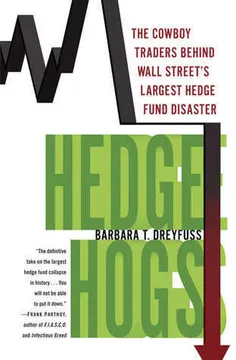


Key Takeaways
A diversified fund can become a one-trader wager
Diversification became a label. Amaranth began in 2000 as a multistrategy hedge fund, built by Nick Maounis, a careful trader whose earlier portfolio had performed steadily through market turmoil. The idea was to spread money across different strategies, so one bad bet would not sink the whole fund. But assets surged beyond Maounis’s original ambitions, and the firm expanded into areas beyond his expertise. By 2006, energy trading consumed about half its capital, with Brian Hunter’s natural gas book dominating results.
One portfolio ruled. Amaranth’s energy gains could make the whole firm look successful, even as the rest of its investments lagged. When Hunter’s positions turned against him, the firm had few effective buffers. The central warning is simple: a fund’s name and menu of strategies do not prove that its risks are diversified.
What's striking is how easily organizational variety can conceal financial concentration. A company may have many departments, products, or investment labels while depending on one source of revenue or one decision-maker. The useful question is not how many strategies appear in a portfolio, but how each performs under the same adverse conditions. Diversification can fail precisely when its supposed safeguards are most needed, especially if positions respond to a common shock. Amaranth’s story also shows that growth can quietly alter a firm's identity: the original strategy remains in the pitch, while the engine of returns changes underneath it.
Design pay so traders share the downside they create
Upside was personal. Hedge funds commonly charged a management fee on assets and a larger share of profits, a model often called two and twenty. The manager earned fees even when returns disappointed, while investors absorbed losses. Amaranth charged a 1.5 percent management fee, a 20 percent performance fee, and sometimes passed additional expenses to clients. The rewards for Hunter became more concentrated after he threatened to leave: he received 15 percent of his trading profits and a guaranteed $10 million retention payment.
Risk had a price. In 2005, after natural gas bets paid off, Hunter received a reported $113 million bonus. Yet a trader’s gains could be temporary, and Amaranth’s investors bore the cost if those positions later collapsed. Deferred bonuses and loss carryforwards offered some restraint, but they did not make the trader liable for the fund’s full losses.
This is a principal-agent problem in unusually visible form. The person choosing the risk is rewarded for successful outcomes, while clients bear much of the damage from failure. That structure can reward boldness even when the boldness is not skill. Deferred compensation and clawbacks can improve alignment, but only if they are large enough, long enough, and enforceable. Performance fees also invite an important distinction: a high return is not necessarily evidence of good risk-adjusted judgment. Investors need to ask how much was earned by repeatable decisions, and how much by a risk that happened to pay off.
Treat risk models as maps, not guarantees against the unmapped
Mathematics has boundaries. Financial engineering made it possible to price options and other complex contracts using assumptions about how prices move. Those tools helped recruit mathematicians and physicists to Wall Street, but the book shows the danger of mistaking a model’s precision for certainty. Long-Term Capital Management relied on historical patterns and heavy borrowing; during the 1998 Russian crisis, prices moved together in unexpected ways, and the fund lost $550 million in one day, far beyond its estimate for a month.
A risk estimate is not a ceiling. Value-at-risk, or VAR, estimates a potential loss over a chosen period using specified assumptions. At Amaranth, the risk model put Hunter’s potential loss near $350 million before the fund lost more than $1 billion in May 2006. The model had measured a scenario, not the full range of possible outcomes.
Models are most useful when they clarify what they omit. The danger is not mathematical sophistication itself, but the organizational authority that can attach to a clean number. A single risk estimate can become a permission slip if decision-makers treat it as a maximum rather than a conditional forecast. Good practice therefore pairs models with scenarios that stress liquidity, correlated positions, and events outside the historical sample. Yet no stress test can enumerate every shock. The model should discipline judgment, not replace it, and disagreement with its assumptions should be treated as information rather than inconvenience.
Deregulated gas markets let financial bets move a household necessity
Trading rules changed the arena. Natural gas had once been sold and transported under extensive price regulation. During the 1980s and early 1990s, that system was dismantled, and producers, pipelines, and customers negotiated more freely. Futures and derivatives helped businesses protect themselves against price swings, but they also created a way to speculate on future gas prices without handling physical gas.
Oversight developed gaps. The Commodity Futures Modernization Act of 2000, passed as an attached provision during a crowded legislative session, exempted important electronic and over-the-counter energy trading from federal oversight. ICE, the electronic exchange used by Hunter and others, faced fewer limits than NYMEX. This did not mean every energy market was wholly unregulated, but it left major parts beyond strong scrutiny. By 2006, traders and funds had become much larger participants in gas contracts.
The shift matters because financial markets do not sit outside the real economy when their contracts shape prices used by consumers and businesses. A market designed to help producers and users manage risk can acquire a second purpose, attracting capital that seeks profit from price movement itself. That can add liquidity, but it can also amplify swings when trading becomes concentrated. The book makes a strong case that rules failed to keep pace with new trading venues. Its broader claim about speculation and prices deserves care: the existence of large speculative trades does not, by itself, establish that speculation explains every price spike.
Do not confuse a trader's winning streak with a durable edge
Success changed the scale. Brian Hunter grew up in Alberta, studied physics and mathematical finance, and built a reputation as an aggressive natural gas trader. At Amaranth, he made large bets on prices rising after Hurricanes Katrina and Rita damaged Gulf Coast energy infrastructure in 2005. His trading helped turn the fund’s year around, and he received a reported $113 million bonus. The windfall strengthened his confidence and the firm’s dependence on him.
The contest tightened. Hunter’s rival John Arnold, an Enron veteran who built Centaurus, combined market research with close attention to trading psychology. A spread is a linked position that bets on the price difference between two contracts, rather than only on either contract’s absolute price. Hunter favored the March-April gas spread, nicknamed the widow maker because a severe winter could send March prices sharply above April’s. His growing positions helped move prices, making the contest partly about the traders’ own influence.
A winning streak can create a feedback loop: profits attract capital, capital enlarges positions, and enlarged positions can temporarily move prices in the trader’s favor. That makes it harder to distinguish market insight from market impact. The contrast between Hunter and Arnold is useful because both were capable and competitive, yet their approaches differed in research, risk tolerance, and the capital available to endure losses. Neither performance nor personality alone explains the outcome. When success depends on a market staying favorable, the crucial test is whether the trader can exit without destroying the price that made the position look profitable.
Give risk officers authority before profits silence their warnings
Warnings arrived early. Amaranth’s energy manager, Harry Arora, worried that Hunter’s bets were too concentrated. Risk officers also questioned the size of his positions and asked for timely records. In April 2006, managers told Hunter to reduce his exposure. He believed the market would turn in his favor and resisted cutting back. His profits made others hesitant to challenge him.
The May test failed. When gas prices moved against Hunter, Amaranth lost more than $1 billion in May, roughly three times the risk team’s earlier VAR estimate. The firm sold holdings in other portfolios to meet cash demands. Its executives discussed exiting Hunter’s positions but chose to wait, fearing a forced sale would lock in enormous losses. Hunter’s positions then grew again. The core failure was not simply that the forecast was wrong; it was that management could not make its own risk limits stick.
Risk oversight is weak when it can advise but cannot constrain. The book’s most revealing organizational detail is that people saw the danger, yet the trader’s profits made intervention seem costly. This resembles a broader governance trap: successful leaders accumulate informal authority, so formal controls become hardest to enforce exactly when they matter most. A credible system needs preset position limits, independent valuation, and escalation rules that do not depend on whether a trader is currently making money. Still, strict limits have tradeoffs. They can force premature exits, so controls should be designed in advance rather than improvised during a crisis.
In illiquid markets, a forced exit can become the catastrophe
Collateral made time scarce. Margin is money or other collateral a trader must post to support open positions. If prices move against those positions, the exchange or broker can demand more cash, often quickly. In August 2006, Amaranth’s margin requirement rose from about $1.3 billion to $2 billion. The fund had too few buyers for its enormous holdings at prices it could accept, and selling heavily would push prices further against itself.
The final squeeze. On August 29, Hunter stopped trading before the closing period for the expiring September gas contract. Arnold continued buying, and the contract price rose sharply. Amaranth lost nearly $600 million in roughly an hour. The fund later struggled to meet margin demands, and prospective buyers demanded steep payments to take the energy book. A deal with Goldman Sachs failed over access to collateral; Citadel and JPMorgan Chase ultimately took over positions in a costly rescue.
This is a classic liquidity spiral: falling values trigger demands for cash, which force sales, which depress values further. A position can be theoretically sound over a long horizon and still be fatal if its owner cannot finance the wait. The episode also shows why counterparties matter. Brokers and banks are not neutral pipes when they control collateral, credit, or access to a transaction. The dramatic closing-day contest should not obscure the deeper vulnerability: Amaranth had become too large relative to the market’s capacity to absorb its exit. The book’s account also records disputed claims about the bank negotiations, not a single uncontested explanation.
Demand transparency when pension money enters opaque strategies
Public savings chased higher returns. After stock-market losses, pension funds and endowments sought hedge funds to help meet ambitious return targets. San Diego County’s pension plan invested $175 million in Amaranth, partly to support a targeted annual return of 8.25 percent. The plan’s consultants assessed the fund, but Amaranth restricted what the pension itself could see, citing the risk of revealing proprietary information.
The pitch hid concentration. At a July 2005 meeting, Maounis described Amaranth’s many strategies and risk controls without mentioning Hunter’s growing energy operation. The fund charged a 1.5 percent management fee, a 20 percent performance fee, and additional expenses. When Amaranth collapsed, the pension recovered only about $84 million of its original investment. A fund of funds, which invests clients’ money across multiple hedge funds, could diversify managers, but added fees and another layer between beneficiaries and decisions.
Public institutions face a difficult mismatch: their obligations are long-term and politically visible, while the products they buy can be opaque, leveraged, and hard to value. Higher return targets do not make risk disappear; they can make risk-taking seem compulsory. Delegating analysis to consultants may provide expertise, but it also creates a chain of accountability in which each party can rely on another’s judgment. The practical standard should be intelligibility: trustees need enough information to explain what could go wrong, how quickly money can be withdrawn, and who has authority to act. A sophisticated strategy that cannot be monitored is not made safe by a prestigious manager.
Judge speculation by who bears the volatility, not who books gains
The costs traveled outward. Natural gas supports home heating, electricity, hospitals, restaurants, and manufacturing. The Municipal Gas Authority of Georgia estimated that Amaranth’s trading cost it $18 million because it had bought winter gas contracts when prices were high. Smaller businesses faced the same problem: volatile prices made it harder to forecast expenses or compete, even when they never chose to speculate.
Accountability came slowly. A federal energy regulator’s judge found that Hunter had manipulated settlement prices on specified trading days, a finding the commission affirmed in 2011 with a $30 million penalty. Amaranth and other parties settled separate cases without admitting the allegations. Congress expanded oversight of electronic commodity trading in 2008 and later gave the CFTC broader authority over over-the-counter trading and position limits. Those changes followed the disaster, while arguments over the proper limits of regulation continued.
The social question is not whether every speculative trade is harmful. Speculators can make it easier for a farmer, utility, or manufacturer to find a counterparty and hedge future costs. The sharper question is whether trading serves those users or subjects them to price swings driven by concentrated financial positions. The book persuasively links Amaranth’s conduct to specific market mechanisms and consumer exposure, while broader claims about speculation’s role in commodity prices remain contested. That distinction matters for policy: rules should target concentration, opacity, and manipulation without assuming that removing all speculation would produce stable or fair prices.
Analysis
Hedge Hogs works as both a trader-versus-trader narrative and an institutional history. The contest between Hunter and Arnold gives abstract market mechanisms human stakes: one trader’s confidence compounds into a position so large that he helps shape the prices on which his own success depends. The book’s strongest insight is this reflexivity. Trading is not always a passive bet on external supply and demand; a dominant trader can alter the market, influence competitors, and then mistake favorable price movement for confirmation of a forecast. The story also resists a simple morality play. Hunter’s expertise and early success were real, Arnold’s analysis and staying power mattered, and Amaranth’s executives faced a genuine dilemma once losses made exit expensive. Yet the firm’s governance failed before the final crisis: warnings were softened by profit, investors had limited visibility, and risk estimates could not capture the liquidity consequences of an enormous position. The collapse therefore belongs neither to one reckless trader nor to one defective formula. It emerges from incentives, weak oversight, market concentration, and credit dependence reinforcing one another.
The regulatory argument is forceful, but its evidentiary levels should remain distinct. The book documents specific market practices, traces how trading positions influenced prices, and recounts official findings about settlement-day manipulation. Those points support scrutiny of concentrated trading and gaps in oversight. They do not, by themselves, settle how much speculation explains every movement in natural gas or other commodities. The most durable lesson is narrower and more powerful: a market can become dangerous when participants who bear little direct cost from volatility gain the ability to impose it on people who cannot step away. Oversight should therefore focus not only on fraud, but also on leverage, liquidity, transparency, and the public consequences of concentrated positions.
Review Summary
Reviews of Hedge Hogs are generally positive, with readers praising the book's accessible explanations of complex financial instruments, its engaging narrative about the rise and fall of Amaranth Advisors, and its portrayal of trader hubris. Many highlight the fascinating dynamic between traders Brian Hunter and John Arnold. Some critics note uneven pacing and limited deeper insights, while others compare it favorably to classics like Barbarians at the Gate. The book's exploration of how speculative trading impacts everyday investors and pension funds is frequently commended.
Glossary
Hedge fund
Flexible private investment poolA privately organized investment pool that can use strategies restricted or limited in mutual funds, including short selling, leverage, derivatives, and rapid trading. Hedge funds commonly serve wealthy individuals and institutions, charge management and performance fees, disclose less publicly, and restrict when investors can withdraw. Their flexibility can support specialized strategies, but it can also make risk and valuation harder for clients to monitor.
Two and twenty
Assets fee plus profit shareA common hedge fund compensation arrangement that charges an annual management fee, often 2 percent of assets, plus 20 percent of investment profits. The management fee can continue even when returns are poor, while the performance fee rewards gains. The structure can motivate managers to seek high returns, but may encourage excessive risk when managers capture much of the upside and investors absorb most losses.
Value-at-risk (VAR)
Model-based potential loss estimateA risk measure estimating how much a portfolio might lose over a specified period under stated assumptions. In the book’s example of Enron’s approach, the estimate represented a loss that might occur about once every twenty trading days. VAR is not a guaranteed maximum loss. It can understate danger when markets move in unfamiliar ways, assets become hard to sell, or risks that seemed separate suddenly move together.
Spread
Linked bet on price differenceA trading position based on the difference between prices of related contracts, such as natural gas for March and April. A trader may buy one month and sell the other, aiming to profit if the price gap widens or narrows. Spreads can require less collateral than holding both contracts separately, but a large or crowded spread can still lose heavily when the relationship shifts.
Widow maker
Risky March-April gas spreadA natural gas trade focused on the price gap between March, near the end of the winter heating season, and April, when storage refilling begins. Cold weather or supply disruption can make March gas much more expensive than April gas. The spread is called the widow maker because its price can shift dramatically, inflicting large losses on traders who misjudge the season or their ability to hold the position.
Margin
Collateral backing open tradesCash or other collateral that a trader deposits to support futures and derivatives positions. Exchanges and clearing brokers adjust requirements as prices and perceived risk change. When positions lose value, a trader may have to provide additional funds quickly. If the trader cannot pay, positions may be liquidated, potentially worsening losses when many contracts must be sold into a market with few buyers.
Fund of funds
Portfolio of investment fundsAn investment vehicle that pools client money and allocates it among multiple hedge funds. It offers access to several managers and may diversify some manager-specific risks. Investors pay the fund-of-funds manager in addition to the underlying hedge fund fees. The extra layer can also make responsibility less direct, as clients rely on an intermediary to select, monitor, and withdraw from managers.
The Enron loophole
Exemption for electronic energy tradingA nickname for provisions in the Commodity Futures Modernization Act of 2000 that exempted important electronic and over-the-counter commodity trading from parts of federal oversight. The exemptions benefited EnronOnline and electronic exchanges including ICE. They left regulators with less visibility and authority over some energy trades, even as those contracts increasingly influenced prices paid by consumers and businesses.
Download PDF
Download EPUB
.epub digital book format is ideal for reading ebooks on phones, tablets, and e-readers.








