

Key Takeaways
Stop collecting advice and test one recommendation in real life.
Reading felt like progress. Marianne Power had shelves of self-help books, but rarely followed their instructions. They comforted her by making private anxieties feel shared, and let her imagine a more confident, successful version of herself. The first book that changed her life did so because she acted: she quit a temporary job, pursued a newspaper opportunity, and began a journalism career.
Action exposed the gap. Years later, a miserable, hungover Sunday pushed her to try a different experiment: follow one self-help book each month, rather than simply read it. Her plan promised a perfect new self, but its deeper question was more useful: what happens when advice meets ordinary life?
The distinction between consuming advice and testing it resembles the difference between knowing a principle and building a skill. A useful experiment makes a claim observable: try a behavior, notice what changes, and revise. That approach can turn self-help into practical learning rather than a comforting fantasy. The limitation is that a year-long transformation project can make ordinary setbacks feel like failed experiments. The most informative result may be modest: one action helps, another does not, and neither outcome defines the person attempting it.
Choose fears that expand your life, not stunts that merely scare you.
Avoidance shrinks confidence. Following Susan Jeffers, Marianne began doing feared things, from parallel parking and talking to a man on the Tube to public speaking and stand-up comedy. Some attempts were awkward; others went well. The key shift was discovering that embarrassment passed, and that she could act without first feeling fearless. Even mundane tasks she had avoided began to feel manageable once she faced them.
Not every fear needs conquering. A winter swim made her feel vividly alive, but skydiving mostly frightened her without addressing a limitation in daily life. She came to distinguish social fears, such as rejection or looking foolish, from reasonable physical caution. Facing a fear matters most when avoidance is keeping a person from something they value.
This is close to exposure therapy, a clinical approach that gradually helps people face feared situations rather than escape them. The useful element is not extremity but repetition in a meaningful context: small social risks can teach that anxiety is survivable. The distinction between social and physical fear also matters. Fear can flag danger, not merely personal growth, and an exhilarating stunt is not automatically therapeutic. A sound test is whether the action expands valued participation, not whether it produces the biggest adrenaline rush.
Open the statements before trying to repair your relationship with money.
Avoidance hid the scale. Marianne's childhood mixed sudden wealth, guilt about privilege, and the eventual loss of her family's money. As an adult, she spent to appear successful, treated generosity as a way to secure affection, and avoided checking her accounts. Writing out her money history helped her recognize patterns, but the turning point came when she examined six months of statements.
The number was concrete. She discovered £15,109.60 in debt, including money owed to her sister, and found recurring costs she had barely noticed: expensive coffees, beauty treatments, and a phone bill averaging £143 a month. Tracking spending made the problem visible. Positive thoughts could not replace budgeting, earning, and dealing with the accounts she had avoided.
Money habits often carry emotional meanings, including security, status, shame, and belonging. Naming those meanings can help explain why a purely numerical budget feels difficult to follow. But the book's self-love explanation should not become another verdict on people in debt. Financial hardship can reflect low income, emergencies, or structural constraints as well as personal behavior. The strongest lesson is practical and humane: reduce avoidance, gather accurate information, and choose a next step without treating a balance as a measure of character.
Use visualization to name a desire, not to pretend reality obeys it.
Dreaming clarified the wish. The Secret promised that thoughts attract matching outcomes, and Marianne tried its methods: imagining wealth, writing a pretend cheque for £100,000, and creating a board of desired images. The claim that thought alone brings money or romance struck her as implausible, especially when it suggested that people cause their own suffering by thinking incorrectly.
The exercise still revealed something. While assembling her vision board, Marianne noticed that a glamorous house and expensive car were less important than peace, travel, friendship, and creative work. Images of green juice and yoga coincided with later writing assignments, but such coincidences could reflect her work, attention, or chance, rather than a force delivering wishes. The useful part was permission to imagine, not proof of magic.
Visualization can help translate a vague wish into a more legible goal, and attention to a goal can make relevant opportunities easier to notice. Neither effect requires the universe to arrange events. That distinction protects the useful practice from a damaging implication: if outcomes depend on thought, misfortune becomes the sufferer's fault. The board works best as a prompt for reflection and planning. It cannot guarantee a partner, income, health, or safety, and it should not displace concrete effort or compassion for people facing circumstances beyond their control.
Stop rejecting yourself before anyone else gets a chance.
Anticipated rejection kept her safe. In Rejection Therapy, Marianne deliberately made requests that might be refused. At first, she asked for small things, such as a discount or a chance to try a musician's instrument. Many people responded kindly. More consequentially, she pitched article ideas to editors, received some rejections, and won a small newspaper column.
The larger obstacle was self-exclusion. She eventually approached a man in a coffee shop, despite hours of anxiety. The conversation became a date. The point was not that every approach would succeed, but that she had spent years avoiding opportunities in work and romance to escape a possible no. She also learned to distinguish useful practice from inconveniencing small businesses just to provoke a refusal.
A rejection is information about a particular request, moment, or fit. It is not a reliable measurement of someone's total worth, though shame can make it feel exactly that way. Repeated, tolerable practice may reduce the power of anticipated judgment, especially when the action serves a real aim. Still, deliberately seeking rejection can become a game that substitutes for meaningful risk. The stronger application is to make the email, invitation, or honest request that matters, then let the response be specific rather than turning it into a global identity claim.
Let go of outcomes without abandoning responsibilities.
Relaxing the grip helped. At a retreat inspired by John Parkin's F k It, Marianne tried an exercise in which she stopped straining against a partner's grip and reached a sweet in her pocket more easily. The lesson was not to stop wanting things, but to loosen the tension around controlling exactly how they must happen. In the retreat, rest, honest conversation, and shared emotion gave her relief from relentless striving.
The slogan had limits. Back home, she used the idea to dismiss work, appearance, and other people's concerns. She distanced herself from her friend Sarah and let professional and financial tasks slide. What began as permission to rest became a defense against responsibility. Acceptance can ease needless pressure, but it does not make unpaid bills, neglected friendships, or important choices disappear.
The retreat's exercise captures a useful paradox: intense control can interfere with flexible action. In psychology, acceptance is often distinguished from resignation. Acceptance recognizes what is happening; resignation gives up on influencing what can still be changed. That distinction helps keep a liberating idea from becoming an excuse. Rest and reduced perfectionism can restore energy, while commitments still deserve attention. A practical question is whether letting go makes a person more present and capable, or merely postpones a difficult conversation or task.
Treat self-improvement as help, not another performance standard.
The pursuit became consuming. At Tony Robbins's costly event, Marianne joined thousands of people in high-energy exercises, walked over hot coals, and left feeling capable of anything. She then tried to copy an extreme ten-day routine of early rising, restrictive eating, exercise, and constant motivational practices. The burst of enthusiasm did not last. Her spending worsened, work suffered, and she felt ashamed when she could not maintain the ideal.
Distress needed more than a book. Later, she became ill, withdrew from friends, struggled to work, and experienced persistent self-loathing and frightening thoughts. A therapist and supportive friend helped her recognize that her self-experiment had become overwhelming. Her story is not evidence that self-help causes depression; she had experienced depression before. It does show that worsening symptoms deserve real support, not a tougher challenge.
The book sharply exposes how improvement culture can turn care into another test of worth. A costly seminar can generate intense motivation without supplying durable change, especially when its intensity and sales pitch encourage people to interpret hesitation as weakness. At the same time, this memoir cannot establish that self-help generally harms mental health. Depression has multiple causes, and her prior history matters. The responsible conclusion is narrower: when functioning declines or distress escalates, self-help should not stand in for appropriate clinical care and trusted human support.
Notice the inner critic without mistaking its story for reality.
The mind's running commentary is not a fact report. Reading Eckhart Tolle's The Power of Now, Marianne began noticing repetitive thoughts about her body, work, money, and desirability. Tolle calls the accumulated emotional pain that shapes reactions the pain body. Marianne recognized how familiar self-criticism could become: it hurt, yet also reinforced the identity she had built around being inadequate.
Attention returned her to the present. She practiced noticing thoughts without automatically following them, and used physical sensations, quiet walks, and the details around her to interrupt spirals. One ordinary lunch became vivid as she noticed food, light, and the room. This did not solve every practical problem. It gave her a way to stop treating each anxious thought as an urgent command.
Decentering, the ability to notice thoughts as mental events rather than literal truths, is also used in contemporary approaches to stress and depression. The memoir makes that idea memorable by showing how an inner critic can sound like an objective narrator. Present-moment attention can create space for choice, but it is not a universal cure, and some thoughts accurately point to problems needing action. The useful balance is to notice the thought, check the situation, then decide whether the next step is acceptance, problem-solving, or support.
Vulnerability turns private shame into a shared human problem.
A hidden belief surfaced. During the Hoffman Process, an intensive group program, Marianne told strangers that she feared nobody could love her. Their responses showed her that this shame was not uniquely hers. People with very different lives described feeling flawed and unworthy too. Being met with care, rather than rejection, made honesty feel less dangerous.
Connection required repair. Marianne had shut Sarah out while pursuing self-improvement. After recognizing the damage, she apologized, and the two friends began rebuilding their friendship. Their conversation was uncomfortable, but it restored a relationship that advice and private analysis could not replace. Vulnerability here does not mean telling everyone everything. It means sharing something real with people who have earned trust and can respond with care.
Social support can change how a stressful experience is understood: what feels like proof of personal defect may become recognizable as a common human fear. The group offered something a book could not, an immediate experience of being heard while imperfect. That does not make every group exercise or disclosure safe for everyone. Trust, skilled facilitation, and personal boundaries matter. The principle is not maximal exposure. It is selective honesty, paired with relationships where listening and repair go both ways.
Measure a good life by connection, not an imaginary perfect self.
Ordinary care changed the scale. After months of self-absorption and distress, Marianne visited an elderly neighbor, listened to her, and helped clear leaves. She also noticed the affection surrounding an ordinary birthday cake her mother had made for her sister. These moments made her see how much she already had: family, friends, work, shelter, and the ability to care for others.
Acceptance ended the chase. In front of a mirror, she practiced accepting her body and naming qualities she valued, without waiting to become thinner, richer, or partnered. She finished the experiment without achieving her original fantasy of perfection. Instead, she returned to friendship, work, and daily life with more self-respect. The book's answer is not that self-help is useless, but that improvement loses its purpose when it replaces living.
The ending reframes well-being as participation rather than a private optimization score. Close relationships and small acts of care can offer meaning that no personal milestone guarantees. Gratitude, in this account, is not denial of debt, loneliness, or illness; it is attention to real sources of support alongside real difficulties. The balance matters because gratitude can be misused to silence legitimate needs. Here it helps Marianne stop treating an imagined future self as the price of belonging in her present life.
Analysis
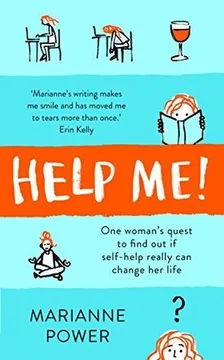
Help Me! is a memoir structured as an experiment: Marianne Power applies one self-help prescription after another to the anxieties that make her feel stuck. The sequence moves from concrete action to magical thinking, deliberate rejection, spiritual surrender, performance-driven optimization, mindfulness, dating advice, and finally vulnerability and self-acceptance. Its comedy comes from the gap between grand promises and mundane reality: a pretend cheque beside unpaid bills, a motivational seminar followed by a declined card, and an ambitious search for transformation interrupted by ordinary friendships.
The experiment's most useful finding is not that one doctrine wins. Different ideas help in different ways. Fear-facing turns avoidance into action; financial scrutiny replaces vague dread with information; present-moment attention interrupts self-attack; and honest connection counters the isolation that private self-analysis can deepen. The failures matter just as much. Visualization can clarify wants while its supernatural claims encourage magical thinking. Letting go can ease rigidity but also rationalize neglect. Intensive self-improvement can generate energy while setting an impossible standard that magnifies shame.
The memoir also complicates the easy conclusion that self-help fails because readers do not try hard enough. Power's attempt to follow advice literally exposes a market that can sell both the cure and the next course, while shifting responsibility for outcomes onto the consumer. Yet her story is not a controlled test of books, and her worsening depression cannot be attributed to self-help alone. Prior depression, financial stress, and the intensity of the project all matter. Its strongest claim is experiential: advice has value when it leads to grounded action, clearer self-understanding, or connection, and becomes counterproductive when it displaces those things. The finish is deliberately modest. She does not become perfect; she becomes less convinced that perfection is the ticket to a life worth living.
Glossary
Rejection Therapy
Practice tolerating rejectionA game developed by Jason Comely in which a person deliberately makes requests likely to be refused, aiming to experience rejection often enough that it becomes less intimidating. Power uses small requests and then more meaningful risks, including approaching editors and a potential date. The useful lesson is reduced avoidance, not rejection for its own sake.
law of attraction
Thoughts attract matching outcomesThe claim, popularized in The Secret, that thoughts emit a matching force and attract corresponding events. Its recommended practice is to name a desired outcome, believe it is coming, and imagine receiving it. Power finds that visualization can clarify what she wants, while the stronger claim that thoughts alone produce outcomes is unsupported in her experience and can blame people for hardship.
F**k It
Release excessive attachmentJohn C. Parkin's phrase for loosening one's grip on worries and outcomes. In the retreat Power attends, it means pursuing a desire without making self-worth depend on success, and sometimes resting instead of forcing action. Power also shows the risk of treating the phrase as permission to neglect obligations or relationships.
Six Human Needs
Motives behind repeated behaviorTony Robbins's framework proposes six needs that shape behavior: certainty, variety, significance, love and connection, growth, and contribution. At his seminar, participants consider how even an unwanted pattern may satisfy a need, such as gaining security or attention. The framework can prompt reflection, but it is a motivational model rather than a clinical diagnosis.
pain body
Accumulated emotional painEckhart Tolle's term for old, unprocessed emotional pain that can influence present reactions and draw a person toward familiar negative states. In Power's account, noticing this pattern helps explain why self-critical thoughts can feel compelling even when circumstances do not support them. Tolle's spiritual explanation is distinct from a clinical account of memory or mood.
Hoffman Process
Intensive group self-examinationA residential personal-development program that uses group discussion, emotional exercises, and reflection on family relationships. Power attends an eight-day session and shares fears she had kept private. The experience gives her a direct sense of acceptance and belonging. It is a named program in the memoir, not a substitute for individualized mental-health care.
Financial Freedom Date
Regular money review ritualKate Northrup's suggested weekly appointment for reviewing income, expenses, and bills. The practice turns financial administration into a deliberate routine rather than an avoided crisis. Power adapts it by organizing paperwork and canceling unwanted charges. Its practical value comes from regular attention and follow-through, not from the spiritual language attached to the exercise.
Download PDF
Download EPUB
.epub digital book format is ideal for reading ebooks on phones, tablets, and e-readers.








