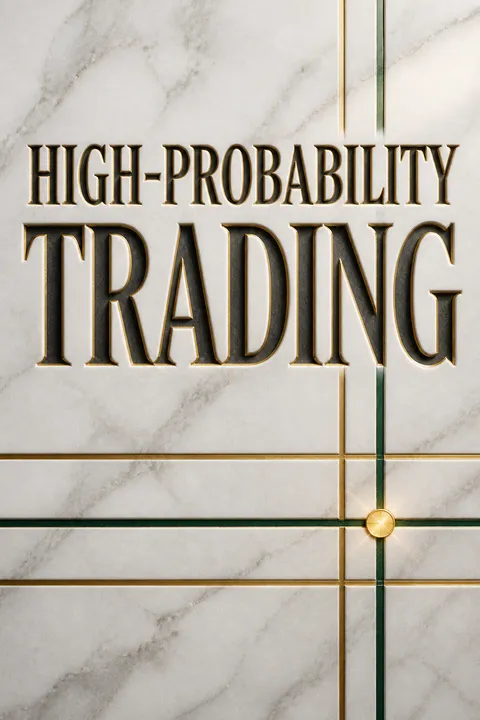


Key Takeaways
Trade only when the likely reward clearly outweighs a defined risk
Choose the right bet. Link calls high-probability trading a method for selecting setups with a favorable risk-to-reward profile, evidence of positive expectancy, and risk limits decided in advance. It is not a promise that any particular trade will win, or a demand for a high win rate. A strategy that wins less than half the time can still make money if its winners sufficiently outweigh its losers.
Wait for the opening. Link's cat, Sophie, ignores a group of pigeons, then patiently waits for a small bird to come within reach. Her lesson for traders is to pass on tempting but risky opportunities until a better setup appears. A trade should have a clear reason, a defined way out, and enough potential reward to justify the possible loss.
The strongest idea here is a shift from prediction to decision quality. A sound bet can lose, just as a poor bet can win by chance, so results from one trade cannot establish whether the process was good. Expected value offers a useful test: estimated win frequency and average win must together outweigh likely losses and trading costs. The caution is that calling a trade high-probability does not make it so. The label earns credibility only through evidence, realistic assumptions, and repeated review.
Treat your first trading years as apprenticeship, not an income plan
Pay tuition carefully. Link describes his first seven years as a losing trader and argues that trading skill develops through experience, mistakes, and deliberate review. He estimates that a trader may need three to five years to learn the craft, and he presents $25,000 to $50,000 as a more realistic starting range for futures than a few thousand dollars. These are his estimates, not universal or current requirements. His deeper point is to avoid staking money needed for bills or life outside trading.
Start small. Paper trading can teach order entry and chart reading, but it cannot reproduce the fear of losing real money, slippage, or the temptation to abandon a rule. Link recommends beginning with small positions, limiting the number of markets, and treating early capital as money for learning rather than expecting immediate income.
The apprenticeship framing counters the fantasy that access to a trading screen equals professional readiness. It also makes a useful distinction between capital for trading and capital for living: financial pressure can distort the decisions that a strategy is meant to govern. Link's dollar estimates belong to a 2003 book and should not be mistaken for present-day benchmarks. Appropriate funding depends on the instrument, costs, and the trader's circumstances. The durable advice is to size any experiment so that a learning mistake does not end the experiment.
Journal decisions, not just dollars, to discover your personal edge
Record the reasoning. Link recommends writing down each trade's instrument, direction, time, reason for entry, planned target, stop, result, and whether the rules were followed. This record helps distinguish a bad decision that happened to profit from a good decision that happened to lose. A lucky outcome can reinforce a dangerous habit if the trader never examines how it was produced.
Look for patterns. Link received performance reports showing that he traded poorly in the first half-hour, performed better later in the day, and favored certain less volatile stocks. He used this information to trade less during weak periods and focus on situations that suited him. Review the journal regularly, identify repeated errors and strengths, and adjust the plan based on evidence rather than memory.
A trading journal turns vague self-criticism into observable behavior. That is useful because memory tends to preserve dramatic wins and losses while losing the details that explain them. The process resembles a feedback loop in engineering: measure performance, locate a recurring failure, change one input, and see what follows. One caution is that personal patterns can be noise, especially when based on a small sample. A journal should guide questions and experiments, not turn a few lucky Tuesdays into a supposedly permanent rule.
Trade the market's reaction, not the headline's promised direction
Price reflects expectations. Link warns that widely reported news may already be reflected in prices by the time a retail trader sees it. In February 1999, a magazine portrayed crude oil below $10 as a market with little reason to recover. Prices soon rose by nearly $30. The example illustrates why a confident public narrative can be a poor trading signal, especially if the market is already positioned around it.
Watch what happens next. If bad news fails to push a market lower, or the market rallies, Link treats that response as potentially bullish. If good news fails to lift prices, it may be bearish. For scheduled reports, he advises reducing exposure beforehand and waiting for the first volatile reaction to settle. The market's response, rather than a trader's opinion about what ought to happen, guides the decision.
This approach focuses attention on expectations, not merely facts. A report matters partly through the gap between what participants anticipated and what they received, so a seemingly negative announcement can coincide with rising prices. That is a sharper question than asking whether the headline sounds good or bad. Still, a muted reaction is not a guaranteed reversal signal. Prices can pause before continuing, and a move can reflect forces unrelated to the report. The principle is best used as evidence to weigh, not as a mechanical rule.
Let higher time frames choose direction and shorter ones choose entry
Read the whole chart. Link's framework uses long-term charts to identify the major trend and important support or resistance, intermediate charts to monitor the setup, and shorter charts to time an entry. A crude-oil trader he admired kept views ranging from two-minute bars to monthly charts, rather than relying on one screen or one horizon. The goal is not to collect more charts, but to prevent a small move from disguising the larger market context.
Avoid the misleading snapshot. Link describes Intel looking weak on a five-minute chart even though its daily chart showed an uptrend and its 60-minute chart suggested the sell-off was nearing support. A short-term trader looking only at the small chart could have mistaken a routine pullback for a new downtrend. Higher time frames can also help set stops and targets; smaller ones can refine timing.
Multiple time frames are a practical form of context control. They reduce the chance that a trader will confuse a local fluctuation with a durable change in direction, much as maps at different scales answer different navigation questions. The method does not remove ambiguity: two horizons can conflict, and a trader can always find a chart that appears to confirm a preferred view. A useful discipline is to assign each time frame a specific job before trading, then treat disagreement as a reason to reduce size or wait.
Use oscillators to time pullbacks, not to declare every extreme a reversal
Match tools to conditions. Link favors trendlines, channels, moving averages, volume, stochastics, RSI, and the Average Directional Index, or ADX. The ADX measures trend strength, not direction. In his rule of thumb, readings above 30 suggest a strong trend, while readings below 20 suggest choppy conditions. Trend-following methods suit stronger trends; oscillators that measure momentum can be more useful in sideways markets.
Confirm, do not predict. An overbought oscillator does not mean prices must fall. In a strong uptrend, it may stay elevated while the market continues upward. Link's preferred use is often to wait for a pullback in the major trend, then use an oscillator to help time entry. For breakouts, he also looks for supporting volume and confirmation across time frames, and warns against chasing a move after it has already run.
The important contribution is not a particular indicator, but the insistence that tools depend on market regime. A momentum reading can mean exhaustion in one setting and strength in another. That prevents the familiar error of treating an indicator threshold as a forecast. The approach also invites restraint: when conditions are choppy, a trend system may repeatedly reverse its signal; when a trend is strong, fading every overbought reading can be costly. Indicator cutoffs are conventions, however, and need testing in the instrument and time frame being traded.
Plan exits first, then size the trade around the stop
Define failure before entry. Link argues that exits deserve at least as much attention as entries. A stop should mark a level where the trade idea is invalidated, such as beyond support, resistance, a trendline, or a previous high or low, with enough room to avoid ordinary market noise. A random dollar stop can be too close in a volatile market or unnecessarily far away in a quiet one. Stops can also be based on time: Link, for example, uses 45 minutes as a guide for day trades that are not working.
Let risk set size. First estimate the loss per share or contract if the stop is reached. Then compare that amount with the risk budget to determine position size. As a trade moves favorably, a trailing stop can protect some gains; scaling out can book part of a profit while leaving some exposure for a larger move. Stops cannot prevent losses beyond their level when markets gap or move rapidly.
This turns risk management into a calculation made before emotion enters the trade. Position size is not a declaration of confidence; it is the consequence of the distance to a defensible exit and the amount of capital at risk. The distinction matters because a trader can keep risk stable while using wider stops by trading fewer units. A stop is not insurance against every market event, and a stop that is technically sensible can still be financially unaffordable. In that case, passing is a legitimate decision.
Backtest on unseen data, with costs, before trusting a system
Test the idea honestly. A trading system is a repeatable set of rules for entries and exits. Link advises evaluating more than total profit or win percentage: consider average trade, average win versus average loss, drawdown, losing streaks, number of trades, and consistency of returns. He recommends testing at least 30 trades and exposing the method to different market conditions and instruments.
Keep a final test untouched. Curve fitting means adjusting rules until they match historical data unusually well, creating a system that may fail on new prices. Link recommends reserving roughly one-third of the data as an out sample, meaning data not used to create or tune the system. Include commissions and slippage, the cost of getting a worse fill than expected. A system that looks profitable before costs may lose money afterward.
Backtesting is valuable because it makes a trading claim vulnerable to evidence before real capital is exposed. The out-sample principle is a basic defense against mistaking a historical pattern for a durable edge. But 30 trades are a starting threshold, not strong proof of reliability; rare market events and changing conditions can remain invisible in a small sample. The same caution applies to simulated fills and costs. Robustness across modest variations in rules and across separate periods is more persuasive than a spectacular result from one carefully tuned history.
Cap total exposure, especially when several positions share one risk
Protect the account. Link's money-management plan sets limits for risk per trade, total open risk, daily losses, markets traded, and position size. He describes 2% of at-risk capital per trade as preferable and 5% as an upper limit, while suggesting that traders keep some capital in reserve. These are his guidelines, not universal formulas. The purpose is to survive ordinary losing streaks instead of making one mistake fatal.
Count related bets together. Positions in crude oil and heating oil, or in several semiconductor stocks, may behave like one larger position when their markets move together. Link cautions that apparent diversification can conceal concentrated exposure. He also recommends scaling into winners cautiously: start with the largest portion of a position and add smaller amounts as the trade develops, rather than building the largest exposure at the latest, highest price.
The key insight is that risk lives at the portfolio level as well as inside each trade. Several individually modest positions can create one oversized bet if their outcomes are linked. This is a useful corrective to counting tickers instead of measuring exposure. Fixed-percentage rules can also reduce position size after losses, which helps preserve the account, but no single percentage suits every strategy or instrument. The book's numerical limits should be treated as prompts to build explicit rules, not as evidence that those exact thresholds are optimal.
Treat boredom, revenge, and euphoria as signals to stop trading
Make patience part of the method. Link describes overtrading as a costly mix of impulse and transaction expenses. One customer turned a $10,000 account into more than $30,000 in two months, while generating over $25,000 in commissions; after trading turned against him, losses and costs quickly erased the gains. Online access makes it easy to keep clicking, but convenience is not an edge. Choppy, low-volume periods can also produce frequent false moves and poor fills.
Reset before reacting. Fear of missing a move, boredom, revenge after a loss, stubbornness, and overconfidence after a winning streak can all push a trader away from the plan. Link recommends stepping away after a bad run, clearing the mind, reviewing the rules, and returning with smaller size if needed. Every trade should be considered on its own merits, not as a way to repair the day's profit and loss.
The behavioral insight is unusually concrete: emotions show up not only as feelings, but as changes in trading frequency, size, and willingness to follow rules. That makes them measurable. A preset daily loss limit or a mandatory pause after repeated rule violations can function like a circuit breaker, interrupting the escalation from frustration to revenge trading. Yet simply stepping away cannot repair a flawed system. A useful reset separates two questions: Is the strategy sound, and is the trader executing it as designed?
Analysis
High-Probability Trading is best understood as a manual for controlling decisions under uncertainty, not as a collection of price patterns that promise reliable prediction. Its strongest through-line is selection: wait for a setup with a defensible reason, define where the idea fails, calculate the exposure, and decline trades that do not justify their cost. The recurring stories make this behavioral argument memorable. Link's early losses, the customer overwhelmed by commissions, and Sophie waiting for an attainable catch all dramatize the same point: activity can feel productive while quietly worsening the odds.
The book's practical architecture joins market analysis to personal operations. Charts and news suggest opportunities, but a journal tests whether a trader handles them well. A system makes choices repeatable, backtesting examines whether those choices had an edge, and money management limits the damage when the edge fails. Discipline connects each layer. This is a notable strength because many trading guides emphasize entries while treating costs, exits, and execution as afterthoughts.
The limits matter too. The text's loss-rate claims, capital recommendations, and market examples reflect its 2003 context; they are not timeless estimates. Technical indicators and chart patterns are presented as useful guides, but their effectiveness depends on definitions, data quality, transaction costs, and market conditions. A 30-trade test can reveal obvious weaknesses without establishing statistical confidence, and a backtest can still misrepresent real execution. Nor does having professional-grade tools erase differences in capital, access, or skill.
The most credible reading is therefore procedural rather than prophetic. The framework cannot establish that a setup will work today. It can require the trader to state what would count as evidence, how much failure is affordable, and what behavior must be avoided. That shift from being right about the market to being consistent about decisions is the book's most durable contribution. Its central promise is not certainty, but a better chance of surviving long enough for a genuine edge to matter.
Review Summary
High Probability Trading receives mostly positive reviews, with readers praising its comprehensive coverage of trading concepts, psychology, and risk management. Many find it valuable for beginners and intermediate traders, appreciating its practical advice and examples. Some experienced traders, however, feel it lacks depth in specific high-probability techniques. The book is lauded for its focus on discipline, systematic approaches, and avoiding common mistakes. Readers appreciate the clear organization, end-of-chapter summaries, and real-life trading examples. While some consider it basic, most agree it provides a solid foundation for aspiring traders.
People Also Read




Glossary
High probability trading
Selective, risk-defined tradingLink's term for taking trades with a favorable relationship between potential reward and risk, a strategy with positive expectancy based on testing, and money-management limits set in advance. It emphasizes waiting for favorable conditions, trading mainly with the larger trend, and exiting when the trade thesis fails. It does not mean that every trade, or even most trades, must win.
Positive expectancy
Average profit over timeA strategy has positive expectancy when its average gains, weighted by the proportion of winning trades, exceed its average losses, weighted by the proportion of losing trades. A system can therefore be profitable while winning fewer than half its trades, provided its winners are large enough relative to its losers. Commissions and slippage must be included when judging whether the expectancy is meaningful.
Trading plan
Rules for tradingA trader's durable operating plan. Link describes it as combining a trading method with money-management rules, including entry and exit conditions, stop placement, position size, markets to trade, risk limits, and performance review. It should fit the trader's style and be written clearly enough that its rules can be followed consistently rather than improvised during volatile market conditions.
Game plan
Daily trading scenariosThe day-to-day preparation used to carry out a broader trading plan. A game plan identifies markets and price areas of interest, possible actions under different conditions, and likely stops or exits. Link recommends preparing it before the market opens and revisiting it if conditions change. Its purpose is to make decisions more deliberate and reduce trades driven by surprise, boredom, or emotion.
Average True Range (ATR)
Average market movementA measure of a market's average price range over a chosen number of periods. Link uses ATR to estimate how far a stock or futures market typically moves, judge whether a profit target is realistic, compare volatility across markets, and inform stop placement and position size. Because market volatility changes, the measure needs to be updated rather than treated as a permanent property.
Average Directional Index (ADX)
Trend-strength measureAn indicator used to estimate whether a market is trending strongly or moving without clear direction. It does not show whether the trend is up or down, so price action or another tool must establish direction. Link treats readings above 30 as evidence of a stronger trend and readings below 20 as a sign of choppy conditions, using the result to choose between trend-following and range-oriented approaches.
Out sample
Untested validation dataData held back from the creation and tuning of a trading system, then used to test its performance after the rules have been set. Because the system has not been adjusted to match this data, it offers a more demanding check than testing only on the historical prices used during development. It is not a guarantee of future performance, but it can expose some forms of overfitting.
Curve fitting
Overmatching historical dataThe process of adjusting a trading system's rules or parameters until they match a particular set of past prices unusually well. The resulting system may capture chance patterns rather than a persistent market behavior, so its historical performance can fail to continue on unseen data. Link warns that excessive complexity and repeated optimization increase this risk.
Fixed-fraction money management
Fixed capital-risk percentageA position-sizing approach that limits the amount risked on each trade to a chosen fraction of trading capital. As the account changes, the corresponding dollar risk changes while the percentage stays constant. Link discusses 2% as a preferred risk level and 5% as an upper guideline, while emphasizing that traders need limits suited to their strategy, market, and financial capacity.
Preserving Precious Capital (PPC)
Protect trading capitalLink's reminder to prioritize keeping capital available over pursuing large immediate profits. The idea is that smaller losses and restrained position sizes give a trader more chances to learn, withstand losing streaks, and remain active when favorable opportunities appear. It favors survival and disciplined risk control over trying to recover losses quickly or maximize every trade.
FAQ
What's High Probability Trading about?
- Focus on Success: High Probability Trading by Marcel Link is centered on understanding the mindset and behaviors of successful traders. It aims to teach readers how to make high probability trades while avoiding common pitfalls.
- Experience Matters: Link emphasizes the importance of experience in trading, suggesting that initial losses should be viewed as tuition for learning.
- Comprehensive Coverage: The book covers setting realistic goals, technical analysis, trading plans, and self-control, equipping traders with essential skills and tools.
Why should I read High Probability Trading?
- Practical Insights: The book offers practical advice based on Link's personal experiences and observations, helping readers avoid common trading mistakes.
- Mindset Focus: Link stresses the psychological aspects of trading, teaching readers to adopt the mindset of a successful trader for long-term success.
- Structured Learning: Organized into clear sections, the book guides readers through essential trading components, making it easy to understand and apply.
What are the key takeaways of High Probability Trading?
- High Probability Trading: Defined as trades with a low risk/reward ratio and positive expectancy, setting the foundation for strategies discussed.
- Trading Plan Importance: Emphasizes the necessity of having a trading plan, including strategies, risk management, and clear goals.
- Discipline and Self-Control: Highlights discipline as crucial for consistent results, with the mantra "Discipline: The Key to Success."
What is the Tuition of Trading concept in High Probability Trading?
- Learning Through Losses: Early trading years are "learning years," where losses are seen as tuition contributing to a trader's education.
- Realistic Expectations: Traders should not expect immediate profits and should be prepared for a learning curve.
- Capital Preservation: Advises treating initial capital as "learning capital," risking only a small portion while gaining experience.
How does High Probability Trading define a successful trader?
- Hard Work and Preparation: Successful traders work hard during nonmarket hours, dedicating time to preparation and analysis.
- Emotional Control: They maintain full control of their emotions and avoid overtrading, with discipline being a key attribute.
- Risk Management: Successful traders understand risk management and trade when odds are in their favor.
What are some effective money management strategies from High Probability Trading?
- Risk Percentage: Recommends risking no more than 2-5% of trading capital on any single trade to protect against significant losses.
- Position Sizing: Emphasizes calculating position sizes based on market volatility, using the average true range (ATR).
- Daily Loss Limits: Suggests setting a daily loss limit to prevent emotional trading and protect capital.
How does High Probability Trading define high probability trades?
- Defined Setup: High probability trades have a clear setup with a historically high success rate, based on technical analysis.
- Risk/Reward Ratio: These trades have a favorable risk/reward ratio, with a minimum of 2:1 or 3:1 advised.
- Market Conditions: Understanding market conditions and trends is crucial for identifying high probability trades.
What are the best strategies for trading with the trend in High Probability Trading?
- Identify the Trend: Use daily, weekly, and monthly charts to determine the trend before making trades.
- Use Trendlines and Channels: Drawing trendlines helps visualize market direction, with longer, unpenetrated lines being more reliable.
- Wait for Retracements: Enter trades after pullbacks to support areas, as these often present the best opportunities.
How can I effectively use oscillators according to High Probability Trading?
- Timing Entries and Exits: Oscillators help time entries and exits, increasing chances of successful trading.
- Look for Divergences: Divergences between price action and oscillators can signal market exhaustion.
- Avoid Overbought/Oversold Traps: Be cautious in overbought/oversold conditions, as markets can remain in these states for extended periods.
How does High Probability Trading address emotional control in trading?
- Recognizing Emotions: Discusses emotions like fear and greed, emphasizing their impact on trading decisions.
- Discipline in Trading: Advocates for sticking to trading plans and avoiding impulsive decisions driven by emotions.
- Taking Breaks: Suggests taking breaks when overwhelmed to maintain a clear mind and improve decision-making.
What are some common mistakes traders make according to High Probability Trading?
- Overtrading: Impulsive trades without proper analysis can lead to significant losses and increased costs.
- Ignoring Money Management: Neglecting principles like stop-loss orders or risking too much capital can result in devastating losses.
- Chasing Losses: Trying to recover losses by increasing risk is dangerous and often leads to further losses.
What are the best quotes from High Probability Trading and what do they mean?
- "A winning trader is one who knows how to lose.": Highlights the importance of managing losses effectively to stay in the game.
- "It's not how much you make but how little you lose that counts.": Emphasizes capital preservation over chasing profits for long-term success.
- "You can do much better by concentrating on only a few markets.": Stresses the value of focus, suggesting specialization improves decision-making.
Download PDF
Download EPUB
.epub digital book format is ideal for reading ebooks on phones, tablets, and e-readers.








