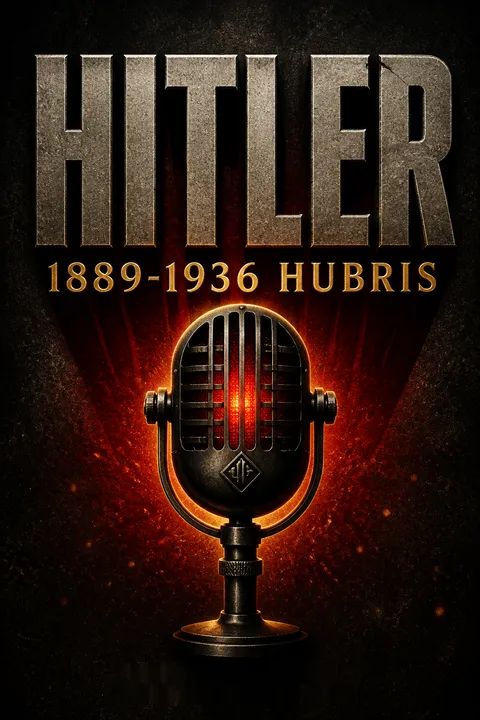


Key Takeaways
Explain Hitler through the society that empowered him, not a lone-man myth
Power was relational. Kershaw’s central question is not simply what kind of person Hitler was, but how German society made his rule possible. He combines biography with social history, tracing how political crisis, followers’ expectations, institutional weakness, and Hitler’s own choices reinforced one another. The concept of charismatic leadership describes authority created when followers believe a leader has exceptional qualities and a special mission. Hitler’s power depended on that belief as well as on his own skill and ambition.
Responsibility remains central. Hitler was indispensable to the regime’s direction, but his personality alone cannot explain its rise or crimes. Political elites underestimated him, institutions cooperated, and ordinary people supplied support. Explaining those conditions does not dilute Hitler’s responsibility; it shows why blaming only one man would leave the machinery of catastrophe unexplained.
What's striking is the refusal to choose between the individual and the system. Hitler’s agency matters precisely because it operated through institutions and people who made his authority effective. The approach also distinguishes explanation from exoneration: social conditions help account for how power was acquired, but they do not erase the choices of leaders, collaborators, or followers. That distinction is essential in political history, where structural causes can otherwise become a convenient way of making responsibility disappear.
War gave a failed artist purpose, comradeship, and an audience for his anger
A life without direction. Hitler left school at sixteen, failed to enter Vienna’s Academy of Fine Arts, and spent years drifting between fantasies of artistic greatness and small-scale work selling paintings. His account of near-starvation in Vienna exaggerated how quickly he became destitute: family support and inheritance gave him some security before poverty finally drove him to a homeless shelter. The evidence shows failure and idleness, not an inevitable path to dictatorship.
War supplied a role. In 1914, military service gave him discipline, a cause, comradeship, and a place to belong. He served as a dispatch runner, was wounded, and received the Iron Cross. The army became his home and gave him a way to avoid confronting an uncertain civilian future. Defeat and revolution then shattered the cause to which he had attached himself, leaving him furious and searching for culprits.
The contrast between private drift and wartime belonging explains an important transformation without turning childhood into destiny. Many soldiers experienced defeat, grief, and political upheaval without becoming Hitler. The war mattered because it gave this particular outsider a first durable identity and, after defeat, a grievance he could politicize. The account also warns against treating hardship as a straight road to extremism: the same historical shock can produce radically different responses.
Treat Hitler's Vienna conversion story cautiously; the evidence is contradictory
Memory became political. In Mein Kampf, Hitler portrayed Vienna as the place where he discovered the supposed Jewish threat and formed an unchanging political worldview. Kershaw tests that account against the limited evidence from acquaintances and records. Hitler encountered virulent antisemitism in a city where politicians such as Karl Lueger used anti-Jewish rhetoric to mobilize threatened lower-middle-class voters. That atmosphere helped shape his prejudices, but does not prove a single, dramatic conversion.
The record resists certainty. Hitler had Jewish customers and associates while selling paintings, and some accounts describe him speaking of Jews with respect. Other recollections suggest racial prejudice was already emerging. These witnesses are incomplete, sometimes self-serving, and often recorded years later. The strongest conclusion is not that Vienna left him untouched, but that his later account transformed a gradual, uncertain development into a heroic story of political awakening.
This is a useful lesson in reading political autobiography: a vivid origin story can reveal what a leader wants people to believe, even when it cannot establish what happened. Kershaw’s restraint is particularly valuable because the evidence is contradictory and the private record sparse. The uncertainty does not make the history unknowable. It does require separating well-supported context, such as Vienna’s antisemitic politics, from claims about a precise moment when Hitler’s hatred supposedly became complete.
His political talent emerged when the army trained him to persuade soldiers
A talent gets an audience. After returning to revolutionary Munich, Hitler stayed in the army rather than finding a civilian career. In 1919, the Reichswehr sent him to political instruction courses designed to counter Bolshevik influence among soldiers. At a camp in Lechfeld, his passionate lectures drew attention. Captain Karl Mayr recognized his speaking ability and used him as an army informant and propagandist.
The message was not new. Hitler joined the tiny German Workers’ Party in 1919 and made familiar nationalist, antisemitic, and anti-Marxist ideas compelling through timing, repetition, and theatrical delivery. The army’s backing helped him build a public platform and remain on its payroll while he entered politics. His rise was therefore neither a pure triumph of will nor simply a personal performance: institutions selected, funded, and amplified a useful speaker.
The unlikely pipeline matters: the army meant to inoculate soldiers against radicalism helped train and launch an agitator who would turn its methods against the Republic. Hitler’s ideas were not original, but his ability to translate grievance into emotionally satisfying slogans was distinctive. The episode also shows how institutions can create risks when they treat propaganda as a technical tool and overlook the political commitments of the person wielding it.
Bavaria made his movement dangerous through patrons, paramilitaries, and permissive authorities
A permissive setting. The revolution and bloody suppression of the Bavarian Soviet republic left the province intensely fearful of Bolshevism and tolerant of counter-revolutionary violence. Munich became a refuge for right-wing extremists. The Reichswehr, wealthy supporters, and figures such as Ernst Röhm supplied contacts, money, weapons, or protection that a small party could not provide for itself.
Violence created visibility. Hitler’s SA began as meeting guards, then became part of Bavaria’s wider paramilitary scene. The party disrupted opponents’ meetings, provoked street fights, and gained attention. Hitler’s failed putsch of November 1923 depended on the mistaken expectation that Bavaria’s leaders, police, and army would back a march against Berlin. Their refusal exposed the movement’s limits. Its early power came not just from crowds, but from patrons and a state establishment that helped create the stage on which it acted.
Bavaria shows how violence can become politically normalized when powerful institutions treat it as a useful answer to threats from the Left. The same officials who feared a Nazi takeover tolerated or supported the organizations that made one seem possible. Yet the putsch also demonstrates the limits of mobilization: armed crowds could not replace control of the police and army. Popular agitation opened doors, but decisions by established power-holders determined which doors stayed open.
A failed putsch and lenient trial transformed Hitler into a national leader
Defeat became theatre. The 1923 putsch collapsed after the army and police refused to join it. Fourteen putschists and four policemen died in the street fighting. At his 1924 trial, Hitler used the courtroom as a political stage, accepted responsibility, and attacked the Republic. The judges treated him with striking leniency: he received five years for high treason but was released on parole after about thirteen months.
Prison consolidated his claim. Landsberg brought visitors, gifts, and intense adulation. Hitler wrote the first volume of Mein Kampf and strengthened a worldview already forming since 1919: history as racial struggle, Jews as the central enemy, and conquest in the east as Germany’s path to living-space. His followers increasingly cast him as a saviour. The trial did not make him inevitable, but it turned a failed regional agitator into a nationally recognized figure.
The trial is a case study in how institutions can lend legitimacy to the people who seek to destroy them. Hitler’s courtroom performance mattered, but so did a judiciary willing to treat the putsch as patriotic excess rather than a grave assault on the state. Landsberg then converted defeat into martyrdom. The result was not automatic: it depended on judges, admirers, and a divided political movement that came to see Hitler as its indispensable unifier.
Keep Hitler's fixed racial mission distinct from his tactical opportunism
A hard core, flexible tactics. Hitler’s worldview held that history was a racial struggle, with Jews imagined as the enemy behind both finance and Bolshevism. He linked destroying “Jewish Bolshevism” to acquiring living-space in eastern Europe. These beliefs were extreme and enduring, but they did not amount to a detailed short-term policy plan. He could adjust public language, alliances, and campaign targets when circumstances demanded.
Propaganda served power. In the 1920s he attacked the Jews more openly in beerhalls, while addressing a Hamburg business club mainly through anti-Marxist appeals. He could support electoral participation, then denounce parliamentary government; cooperate with conservatives, then attack them as “reaction.” This was not proof that ideology meant nothing. His fixed goals supplied direction, while tactical flexibility helped him pursue power without allowing policy details to constrain him.
The distinction between ends and means helps resolve an apparent contradiction in Hitler’s conduct. He could be opportunistic about alliances and messaging while remaining deeply committed to a racial and imperial project. That combination made him adaptable without making him moderate. The danger is to mistake tactical flexibility for ideological uncertainty: people who treated his claims as disposable campaign language underestimated the direction in which his fixed beliefs pointed.
The Depression shattered democracy; conservative elites then delivered Hitler the Chancellorship
Crisis opened the door. The 1929 crash hit a Weimar Republic already weakened by political division and limited public loyalty. In the September 1930 election, the Nazis leapt from 2.6 percent of the vote to 18.3 percent and 107 Reichstag seats. They still lacked a majority. In July 1932 they reached 37.4 percent, then fell to 33.1 percent in November.
Appointment was not a popular mandate. President Hindenburg twice refused Hitler the Chancellorship before appointing him on 30 January 1933. Papen, Schleicher, and other conservative power-brokers believed they could use or contain him. Their drive to end parliamentary democracy, alongside Hitler’s ability to block alternatives, made a deal seem expedient. Hitler was not elected Chancellor by the people; he was legally appointed by elites who badly misjudged the power they were handing him.
The election figures puncture the myth of an irresistible popular march: Hitler’s party never won an outright majority in a free national election, and it lost votes before he became Chancellor. The decisive mechanism was elite miscalculation inside a collapsing constitutional system. Economic misery mattered, but so did political choices: Hindenburg and his advisers treated democratic government as expendable and assumed an extremist could be managed once inside the cabinet.
Hitler's dictatorship advanced as subordinates anticipated wishes he rarely specified
Power travelled through initiative. Kershaw calls the process “working towards the Führer”: officials and activists anticipated Hitler’s broad aims and acted without waiting for detailed orders. This helps explain why policy could radicalize even when Hitler did not personally direct each step. After his appointment, the Reichstag Fire Decree suspended civil liberties, the Enabling Act transferred legislative power to the cabinet, and political parties and trade unions were destroyed.
The state was remade from below and above. Nazi activists attacked opponents; civil servants, professional groups, and local organizations often rushed to align themselves with the regime. The result was not simply a perfectly controlled machine. Hitler’s authority set direction, while competition among subordinates and voluntary collaboration expanded the regime’s reach. The Churches and army remained significant institutions, but both were pushed into accommodation with the new order.
The concept explains how dictatorship can operate without a neat chain of command. Broad signals, ideological loyalty, career incentives, and rivalry can make subordinates act more radically than explicit orders require. That insight should not turn perpetrators into passive instruments: they chose to anticipate, implement, and intensify the regime’s aims. Nor was the process fully spontaneous. Hitler’s authority and the laws passed in his name gave these initiatives their protection and direction.
The Rhineland gamble turned success into proof of Hitler's supposed infallibility
The army became a partner. The murder of Ernst Röhm and other opponents in June 1934 removed the SA leadership’s challenge to the Reichswehr. After Hindenburg died in August, the armed forces swore personal allegiance to Hitler, helping make his dictatorship effectively unchallengeable. The army gained priority for rearmament; Hitler gained the support of Germany’s most powerful institution.
A dangerous lesson. On 7 March 1936 German troops entered the demilitarized Rhineland, in breach of the postwar settlement. Hitler’s generals feared the risks, but France and Britain did not intervene. The success strengthened his confidence and public standing. It also encouraged the belief that audacity could substitute for accurate assessment. The title’s “hubris” is not just personal arrogance: it is confidence magnified by institutions and opponents repeatedly allowing risky moves to succeed.
The army’s bargain was not passive. Its leaders backed Hitler because rearmament and domestic order served their aims, while underestimating the political price of surrendering independence. The Rhineland episode then rewarded risk-taking: no resistance could look like proof that Hitler’s instincts were infallible. But success in one crisis does not establish that the next gamble is safe. The book’s endpoint captures the moment when confidence, institutional weakness, and international hesitation begin reinforcing one another.
Analysis
Kershaw’s central achievement is to explain Hitler without making him either a supernatural monster or a mere puppet. The biography follows an unusually empty private life into public politics, then places the resulting power inside the structures that made it possible. That method reveals a double truth: Hitler’s personal agency was exceptional, but his effects depended on millions of people and on institutions that repeatedly mistook short-term advantage for political safety.
The narrative also explains why the familiar labels of opportunist and ideologue are not alternatives. Hitler adapted tactics, alliances, and public language, yet retained a small set of extreme racial and imperial goals. Flexibility helped him advance those goals; the absence of detailed intermediate plans made him more, not less, dangerous. His speeches could mobilize grievances without offering workable policy, while his followers and officials translated vague aims into action.
The most consequential transitions are not simple victories: the 1923 putsch fails, but the trial makes Hitler famous; the 1932 election surge does not give him a majority, but conservative elites appoint him; the army’s support restrains the SA, but binds the armed forces to the dictator. Contingency remains central. Different decisions by Hindenburg, Papen, Schleicher, or the judiciary could have changed the route to power. Yet contingency is not innocence: each decision emerged from a persistent willingness to sacrifice democratic institutions.
The book’s account of “working towards the Führer” is especially powerful because it connects personal authority to institutional behaviour. The resulting dictatorship is neither orderly nor simply centralized. It is a state in which competition, opportunism, ideological zeal, and the search for Hitler’s approval intensify policy. The title’s hubris names the reciprocal error: Hitler increasingly mistakes success for proof of destiny, while elites and foreign governments mistake his dependence on them for a capacity to control him. By 1936, the conditions for further catastrophe are visible, but not inevitable.
Review Summary
Hitler by Ian Kershaw receives strong praise for its meticulous research and political analysis of Hitler's rise to power. Readers appreciate Kershaw's "structural" approach, examining the societal and political forces that enabled Hitler rather than focusing on psychological speculation. The book is described as dense and detailed, sometimes dry, covering Hitler's life from 1889 to 1936. While some find the writing style challenging with long sentences and excessive detail, most consider it the definitive Hitler biography, offering crucial insights into how democracy collapsed and fascism emerged in Germany.
People Also Read

Glossary
charismatic leadership
Authority through believed exceptional missionA form of political authority that depends on followers believing a leader possesses extraordinary qualities or a historic mission. In Kershaw’s account, Hitler’s power did not come only from office or personal talents. It was also created by supporters who invested him with heroic qualities and by institutions that treated his authority as decisive.
working towards the Führer
Anticipating the leader’s aimsA principle of action in which officials and party members try to carry out what they believe Hitler wants without waiting for specific instructions. The practice translated broad ideological goals into initiatives by people below him. It helps explain why Nazi policy could radicalize through competition and anticipation as well as through direct orders.
Führer myth
The leader as national saviourThe image of Hitler as a uniquely gifted, selfless, and almost providential leader who embodied Germany’s hopes of unity and national renewal. It was built by propaganda and by followers who saw him as the answer to political division. The myth strengthened his authority within the party and helped present him as a leader above ordinary politics.
Lebensraum
Territory for German expansionLiterally “living-space,” the Nazi goal of acquiring territory, especially in eastern Europe, for German settlement and power. Hitler connected this expansion to his racial worldview and the destruction of what he called Jewish Bolshevism. The idea drew on older imperialist thinking but became part of his distinctive programme for conquest.
cumulative radicalisation
Policy intensifying through competing initiativesA process in which the regime’s policies become increasingly extreme through initiatives taken by subordinates and institutions, often without precise orders from Hitler. Officials compete to anticipate his aims, and actions that appear to advance them receive approval or protection. The term captures how radicalization could grow through the regime’s internal dynamics.
polycracy
Overlapping centres of powerA description of the Nazi regime as a system containing multiple, competing power structures rather than one orderly hierarchy. Party offices, state ministries, police bodies, and other organizations could overlap and conflict. Hitler remained the indispensable authority, but the disorder beneath him could generate rivalry, duplicated responsibilities, and increasingly radical action.
Gleichschaltung
Forcing institutions into Nazi alignmentThe Nazi term for bringing political, social, and cultural organizations into line with the regime. The process included the destruction of opposition, the replacement of leaders, and the voluntary adaptation of institutions seeking to accommodate the new rulers. It reshaped Germany rapidly after 1933, often through a combination of pressure and willing collaboration.
Volksgemeinschaft
A racially defined national communityThe Nazi ideal of a unified national community that would overcome class divisions and place the collective above individual interests. Membership was not universal: Jews and other people defined as outside the racial community were excluded. The promise of social unity helped attract support, while its discriminatory foundations enabled persecution.
völkisch
Ethnic-nationalist and racialistA German political and cultural current that defined the nation through ethnicity, mythic tradition, and often biological race. Völkisch movements commonly combined extreme nationalism, antisemitism, anti-Marxism, and visions of social renewal. Their ideas predated Hitler, but the Nazi movement repackaged them as mass politics and attached them to Hitler’s leadership.
Hitler Series
Download PDF
Download EPUB
.epub digital book format is ideal for reading ebooks on phones, tablets, and e-readers.








