

Key Takeaways
Build around the child, not the imaginary average student
Children do not arrive in matching sizes. One may read early and struggle with arithmetic, while another races ahead in math but finds words difficult. Interests, attention, development, and learning preferences vary, so a standardized grade cannot describe a whole child. Rupp's central argument is that homeschooling lets parents choose materials and approaches that fit the learner, rather than demanding that the learner fit a uniform plan.
Adapt the route, not the child. A child fascinated by the ocean could meet language arts, science, math, geography, and art through books, experiments, games, maps, and visits. The point is not to abandon learning goals, but to make them reachable through a child's actual curiosities and needs.
What's compelling is the distinction between a shared educational destination and a single prescribed route. Rupp treats difference as information for curriculum design, not as evidence that a child is defective. That is a practical corrective to the way grade labels can turn a temporary mismatch into a perceived failure. Flexibility still needs judgment: an interest-led plan can become narrow if adults never broaden it. The strongest version of her argument pairs responsiveness with deliberate exposure to unfamiliar subjects.
Let preschool learning grow out of play, talk, and daily life
Ordinary days teach plenty. For preschoolers, Rupp recommends talking, answering questions, reading picture books, singing, playing, helping with cooking or gardening, and exploring with safe household materials. Counting spoons at breakfast or noticing letters on a stop sign introduces early ideas without turning childhood into a miniature school day. Her own young children learned through experiments, play, and the abundant surprises of living together.
Development is a range, not a deadline. The book lists abilities many children develop around age four, including knowing letters, counting, following simple directions, sharing, and handling basic physical tasks. These are reference points, not a pass-fail examination. Rupp's advice is to protect time for exploration and enjoy the child's pace rather than rushing into formal academics because a checklist says to.
This approach makes the home a learning environment without requiring parents to stage a lesson for every moment. It also recognizes that attention and motivation are part of learning, not distractions from it. The useful qualification is safety and balance: free exploration does not mean that every child receives the same opportunities, or that adults should stop noticing developmental needs. A relaxed routine can include both unstructured play and attentive observation, with formal instruction introduced when it serves the child.
Use grade-level sequences as maps, never as verdicts
Order helps without dictating timing. Rupp explains why some skills commonly build on earlier ones: children learn letter sounds before blending them into words, and addition and subtraction prepare for multiplication and division. Such sequences help parents see what foundations may be missing and what kinds of support could help. The book synthesizes public-school curricula from all fifty states along with private proposals and educators' recommendations, offering a broad reference rather than one mandatory program.
Move where the learner is. Rupp describes her sons learning to read at different ages: one at five, another at six and a half, and another not comfortably until nine. A homeschooler can consult the grade-level sections above or below the child's nominal grade, reinforce a weak area, or wait when pressure is counterproductive. Standards may matter for state requirements or college preparation, but they need not dictate every assignment.
A sequence is useful because learning has dependencies, yet a grade label can conceal uneven development across subjects. Rupp's map metaphor helps separate two questions: what skill supports the next one, and when a particular child is ready to work on it. The tension is that families also face external assessments and admissions expectations. Treating standards as a planning tool, while checking local obligations separately, avoids both rigid imitation of school and careless gaps in preparation.
Turn a child's obsession into a route across the whole curriculum
A strong interest connects subjects. A marine biology fascination can lead to ocean stories and nonfiction, water experiments, collecting shells, mapping the sea, games, and an aquarium visit. Interest in ancient Egypt can connect myths, geography, building a pyramid model, hieroglyphics, museum objects, and the biography of archaeologist Howard Carter. These are not diversions from learning. They are ways to approach many kinds of knowledge through one subject the child already wants to understand.
Let connections multiply. A study of space can bring in measurement, history, art, and writing; a project about plants can involve observation, drawing, and record keeping. Rupp argues that concentrated curiosity often opens doors into other fields, including skills a child has resisted when presented in isolation. A curriculum can therefore be organized around a theme, then expanded through the questions it generates.
The value here is not merely that themed learning feels more engaging. It gives facts a network of relationships: a map belongs to a story, a measurement answers a real question, and an artwork reflects a time and place. Those links can make knowledge easier to revisit and apply. There is a practical limit, though: a theme should not be forced to contain every subject. Some skills require direct, sustained practice even when they do not naturally arise from the current project.
Make learning tangible before asking children to memorize abstractions
Give ideas something to hold. In early math, Rupp recommends manipulatives, meaning concrete objects children can move or arrange to represent mathematical ideas. Beans, blocks, measuring cups, base-ten pieces, and colored rods can make counting, place value, fractions, and operations visible. Cooking, shopping games, measuring furniture, or comparing lengths also connects number work to familiar problems instead of leaving it on a worksheet.
Treat science as a way to investigate. Children should observe, ask questions, suggest explanations, and test them. A kindergarten nature journal might hold drawings, weather records, maps, and dictated notes about an experiment. The book repeatedly favors direct exploration, from sorting objects by properties to testing what magnets attract. Facts matter, but they become more meaningful when students have first encountered the thing those facts describe.
Concrete materials can lower the barrier between an idea and a learner's understanding. They also reveal misconceptions: a child who can manipulate equal pieces may understand a fraction differently from one who has only recited a rule. Rupp's emphasis on inquiry complements this by making evidence part of science learning. Still, hands-on activity is not automatically conceptual learning. Adults need to help children name what happened, connect it to an idea, and move gradually from objects toward symbols.
Read aloud, then ask children to retell and question what they hear
Stories make room for thought. Rupp treats shared reading as a central early-learning practice, not simply a way to pass time. In one family example, children listening to a chapter book asked what unfamiliar legal words meant and how a magnifying glass worked. A story had prompted vocabulary, curiosity, and questions beyond its plot. Reading aloud also exposes children to language and ideas beyond what they can yet read by themselves.
Use narration to check understanding. Narration is the practice of asking a child to retell, in their own words, something they have heard or read. Rupp draws on educator Charlotte Mason's recommendation to read a passage, then invite the learner to recount it. Retelling encourages attention, sequence, memory, and expression. Discussion can extend the exercise: ask what happened, why a character acted, or what the child wants to know next.
Retelling is a low-pressure alternative to treating comprehension as a stack of quiz questions. It makes the learner reconstruct meaning, which gives an adult a clearer view of what was understood and what was missed. Shared reading also places conversation at the center of literacy, so the child is not merely decoding print but interpreting it with another person. The method works best when retelling remains an invitation. If every story becomes an assessment, the pleasure that sustains reading can disappear.
Teach the arts, body, language, and history alongside reading and math
A broad education has many strands. Rupp's year-by-year guide includes language arts and mathematics, but also history, geography, science, foreign language, art, music, health, and physical education. It recommends that children encounter subjects through varied forms: books, discussion, projects, experiments, field trips, performances, and physical activity. These are not decorative additions to the academic core; they build different kinds of knowledge and skill.
Make subjects speak to one another. Studying ancient Greece might include its geography, myths, architecture, music, science, and government. Learning about a historical period can involve maps, timelines, art, and biographies, while reading a story can inspire a related project or experiment. The guide's specific expectations grow with age, from recognizing shapes and seasons to analyzing primary sources, writing research papers, and studying formal sciences.
The breadth of the plan resists a common narrowing of education to what is easiest to test. Art develops ways of seeing, physical education develops bodily competence, and history and geography help place human events in context. Integration makes those areas mutually illuminating rather than competitors for time. The challenge is workload: a comprehensive list can make parents feel that every item must be completed. Prioritizing depth, continuity, and the child's actual needs is more faithful to Rupp's flexible approach than trying to check every box.
Design high school for independence, requirements, and the student's direction
Preparation includes choices and constraints. The high-school overview gives a common sequence of English, mathematics, science, history, language, arts, and health or physical education, while noting that state graduation rules and college entry expectations may specify courses. A sample plan places earth science in ninth grade, biology in tenth, chemistry in eleventh, and physics in twelfth, alongside subjects such as world history, American history, and government. These are examples, not a universal timetable.
Aim toward self-directed study. Students can build a home-designed curriculum, take correspondence or online classes, attend community college, work with mentors, or use jobs and service as part of learning. The book also emphasizes research, note taking, library use, writing, oral presentations, and effective study habits. Its larger goal is a student who knows how to find information and continue learning, not merely one who completes assignments.
The high-school discussion gives flexibility a necessary counterpart: freedom is more useful when students understand the external requirements attached to their goals. It also shifts the measure of success from coverage alone toward the capacity to plan, research, communicate, and pursue interests independently. The proposed course sequence is a starting point, not a substitute for checking current state rules or a particular college's expectations. A family can preserve student choice while making those constraints explicit early enough to act on them.
Analysis
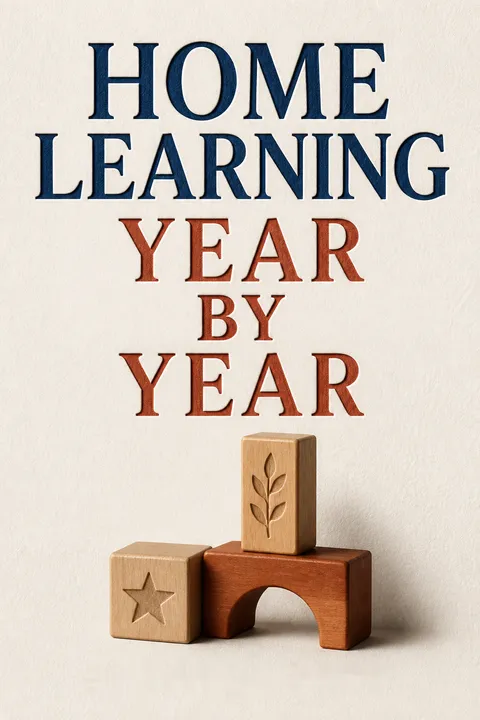
Home Learning Year by Year is both a curriculum reference and an argument against mistaking a reference for a prescription. Its large architecture moves from preschool through high school, subject by subject, giving families a sense of what skills and topics commonly appear at each stage. But the organizing idea is more important than any individual list: a useful curriculum must respond to the actual child while remaining informed about sequences, standards, and future requirements.
That balance is the book's central strength. It does not ask parents to choose between structure and freedom. It proposes using grade-level expectations to locate foundations and identify options, then adjusting pace, method, and emphasis to suit the learner. Stories about children reading at different ages make the point memorable, while examples built around marine biology, ancient Egypt, books, and everyday math show how interests can connect subjects. The result is not a claim that children learn without guidance. It is a case for guidance that watches and adapts.
The book's subject breadth also offers a corrective to an overly narrow picture of education. Reading and mathematics remain essential, but the plan includes science, history, geography, arts, music, language, health, and physical education. It further treats reading aloud, hands-on materials, field trips, discussion, and projects as serious learning methods. These are not merely alternatives to textbooks; they make knowledge usable in different forms. The main limitation is built into the book's reference format. A long progression of suggested topics and resources can overwhelm a parent or turn an invitation into a checklist. Some recommendations are also tied to the publication era, so the durable contribution lies less in particular catalogs and websites than in the principles for choosing and combining resources. Read as a flexible map, the guide is empowering. Read as a comprehensive mandate, it would contradict its own thesis. Its best lesson is to plan carefully, observe closely, and keep the child, not the grade label, at the center.
Review Summary
Home Learning Year by Year receives mostly positive reviews as a valuable resource for homeschoolers. Readers appreciate its comprehensive grade-by-grade guidelines, extensive book recommendations, and secular approach. Many find it helpful for curriculum planning and addressing educational gaps. Some criticize it for being overly ambitious or outdated in certain areas. The book is praised for its flexibility, allowing parents to tailor education to their children's needs. While some find it overwhelming, most consider it an essential reference for homeschooling families.
People Also Read


Glossary
expanding horizons
learning outward from homeA traditional sequence for social studies that begins with the child's most familiar surroundings, such as home and family, then expands to neighborhood, community, state, country, and world. Rupp presents it as one possible organizing approach, while noting that children may also be drawn to distant places and historical stories.
manipulatives
objects representing math ideasConcrete objects that learners can handle to represent mathematical concepts. Examples in the book include beans, blocks, measuring tools, base-ten pieces, pattern blocks, and Cuisenaire rods. They can make ideas such as counting, place value, measurement, fractions, and arithmetic operations visible and open to experimentation.
narration
retelling to show understandingA learning practice in which a student listens to a passage or story and then recounts it in their own words. Rupp describes it as a way to exercise listening, memory, sequencing, organization, and expression. Charlotte Mason recommended using narration across subjects after a short reading aloud.
scientific method
testing explanations with evidenceAn investigative process in which learners observe a phenomenon, propose an explanation, test it through experimentation, and assess the results. Rupp emphasizes this approach to help children understand science as an ongoing way of answering questions, rather than simply a collection of facts to memorize.
PQRST
a structured study sequenceA study technique named in the book as Preview, Question, Read, Study, Test. It gives students a sequence for approaching material: survey it, identify questions, read with those questions in mind, review the content, and test their recall. Rupp presents it alongside other study strategies for older learners.
SQ3R
a structured reading methodA study technique named in the book as Survey, Question, Read, Recite, Review. Students first survey material, frame questions, read, recall its main points aloud or in writing, and review the information. Rupp lists it as one option for helping students organize independent study.
Download PDF
Download EPUB
.epub digital book format is ideal for reading ebooks on phones, tablets, and e-readers.








