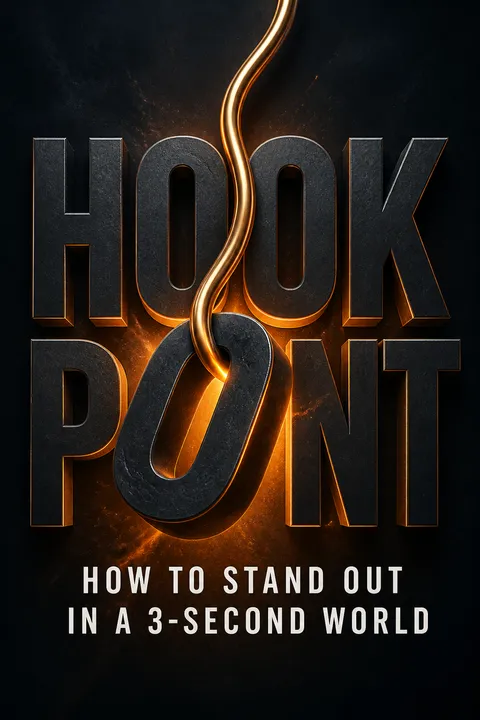


Key Takeaways
Treat the hook as a doorway, not the whole relationship
Attention is the entry fee. A Hook Point is a brief message, image, idea, product feature, personality, or format that makes someone notice and want more. Kane argues that in crowded digital feeds, creators may have only a few seconds to earn that next moment of attention. The hook does not need to explain everything or close a sale. It must open the door to the fuller story.
A sharp premise travels. Free Solo reached beyond climbing fans because its central feat, scaling a huge rock face without a rope, was instantly understandable and emotionally charged. A compelling opening can bring in an audience that would otherwise pass by, but what follows must reward its curiosity.
What's useful here is the distinction between attracting attention and converting it into a relationship. A striking premise lowers the effort required to decide whether something is worth a look, much like a clear signpost in an unfamiliar place. But attention is only borrowed, not owned. If the story that follows is thin, the hook can make disappointment arrive faster. The practical test is therefore not simply whether people stop, but whether the opening accurately signals a valuable experience.
Make your hook specific to a real audience problem
Start with their friction. Kane recommends asking what problem people already want solved, or what outcome they are seeking. Netflix's early offer addressed a familiar irritation with video rentals: returning a movie late could mean paying a fee. The company made delivery to the home and no late fees easy to understand, giving people a concrete reason to try a newcomer over Blockbuster.
Specificity creates contrast. A general claim about helping people grow online blends into a crowded market. A sharply defined promise, such as reaching a million followers in a month, gives the audience an image to react to. The strongest hooks combine something familiar with a surprising or distinctive angle, while remaining true to the actual product or story.
A well-chosen hook works like a translation layer: it turns a seller's features into the customer's felt problem. That shift is more than clever copywriting. It forces a business to name whose difficulty it understands and why its offer matters now. Yet specificity can also overpromise. A dramatic result may attract clicks while obscuring how rare, conditional, or costly that result is. The durable version makes the benefit vivid without implying that every customer will get the same outcome.
Generate many angles, then let evidence choose the winner
Ideas are hypotheses. Kane advises studying successful and weak examples, drafting far more options than seem necessary, and narrowing them through comparison and testing. His suggested exercise is to create as many as 50 to 100 possible hooks, then refine the strongest candidates. The purpose is not to copy another brand, but to learn what makes its message legible and distinctive.
Measure real response. While working on Katie Couric's digital interviews, Kane's team created dozens of hooks for an interview and tested many variations. The standout clip from an interview with Humans of New York creator Brandon Stanton drew more than 20 million views and hundreds of thousands of shares. Its subject, timing, opening, and delivery all mattered. A/B testing compares versions to learn which earns more meaningful attention.
This approach replaces confidence in a clever idea with disciplined uncertainty. Testing is especially valuable because creators are poor judges of what strangers will notice; familiarity with one's own work can make a weak opening feel obvious. Still, a test only answers the question it measures. Clicks or views can reward sensationalism, while shares, retention, and qualified inquiries may indicate different kinds of value. Before testing, define what success means, then avoid treating one metric as a complete verdict.
In video, promise a satisfying experience before explaining everything
The opening sets expectations. Kane's collaborators recommend using the first moments of a social video to show what kind of experience is coming: clear, easy to follow, and worth the viewer's time. A meme card, meaning text placed over a video, can make that promise concrete. A vague appeal to keep watching asks viewers to work without showing what they will receive.
Let the sequence breathe. A simple clip of a red plastic cup being crushed drew more than two million views because its action was immediately understandable. In instructional videos, a clear sequence helps viewers follow without catching up. In other formats, placing the funniest or most emotional moment early can help. The opening should be intriguing, but it should not overwhelm the viewer with competing text, motion, and explanation.
The opening of a video is a miniature contract. Visual clarity and pacing reassure viewers that they can follow along, while a strong image or idea gives them a reason to stay. This is a useful corrective to the belief that every clip needs louder editing or higher production value. The important distinction is between simple and empty: a clean sequence can create anticipation, but a hook that gives away everything may leave no reason to continue. The right balance depends on the promised experience.
Tell the story your audience can enter, not your brand can admire
Build around the listener. Kane describes the Process Communication Model, or PCM, as a way to notice that people respond to different styles of communication. A story may connect through evidence, values, emotion, imagination, humor, or action. The practical lesson is to avoid speaking only in the style that feels natural to the speaker. Ask who is listening and what would make the message meaningful to them.
Let customers be central. Adobe's video about students restoring photographs damaged by Hurricane Harvey put families, students, and local helpers at the heart of the story. Adobe supplied the tools but did not claim the hero's role. Similarly, Red Bull's coverage of athletes makes their achievements the event, with the brand supporting the stage around them.
Stories invite participation when an audience can recognize its own concerns in them. The PCM offers a useful reminder that one audience is not a single mind, though its personality categories should be treated as prompts for adaptation rather than rigid labels. A brand that steps back can also appear more credible because the audience sees the human stakes instead of an extended sales pitch. The risk is using a cause or customer as decoration. The story must serve the people it portrays, not merely borrow their emotion.
Earn attention with a promise your product can actually keep
Purpose gives hooks weight. Kane argues that a hook should fit the organization's real identity and be supported by a useful product or service. Nike's campaigns around athletes and social issues fit its established emphasis on sport and action. Gillette's campaign on social behavior drew criticism from people who saw a sudden shift away from the brand's familiar focus. The contrast illustrates how a message can attract attention yet feel unearned.
Delivery is the proof. Theranos attracted belief with a bold promise about simpler blood testing, but its technology did not work as advertised. Kane uses the case to show that persuasive storytelling cannot substitute for capability. Set expectations honestly, explain uncertainty, and communicate problems rather than disappearing when delivery slips. A trustworthy hook opens a conversation; consistent performance gives people a reason to stay.
This is the ethical boundary that keeps attention strategy from collapsing into manipulation. A promise is not merely a headline; it is an implicit claim about what an organization can do. When experience contradicts the claim, the damage reaches beyond one campaign because future messages lose credibility. At the same time, authenticity is not just stating a purpose. Audiences can reasonably ask whether the organization's operations match its stated values. The strongest communication makes that alignment visible through choices and results.
Listen for pain points before pitching your solution
Questions beat assumptions. Kane recounts entering an uncertain meeting with Amblin Entertainment's CEO. Instead of delivering a prepared pitch, he asked about the company's aims and obstacles. He learned that the team feared its new website would draw little traffic because the Amblin name was less recognized than Marvel. Kane then connected that concern to a strategy he had used to drive millions of visitors to Katie Couric's content.
Adapt in the room. His work with Taylor Swift followed the same pattern. Conversations with her label and family revealed separate concerns about cost, site performance, and her desire to update the website herself. The pitch changed for each person. Active listening means hearing the problem beneath the first answer, then shaping the story around what that person actually needs.
Listening is a source of information and a signal of respect. In negotiation, the person who asks careful questions can discover constraints that a polished presentation would miss. It also reduces the temptation to solve the wrong problem with impressive language. The method requires restraint: asking questions only to steer people toward a predetermined sale is disguised pitching. Genuine inquiry leaves room for the answer to change the offer, including the possibility that the best recommendation is no deal.
Borrow existing trust and traffic instead of building alone
Find where attention already gathers. YouTube grew through video embeds that Myspace users placed on their profiles, sending viewers to YouTube rather than requiring the startup to build an audience from nothing. Kane also describes partnering with film bloggers, whose readers already cared about movies, and offering events and access that benefited both the bloggers and the studio.
Use relationships to scale. Kane calls well-connected intermediaries Super Connectors: people who can introduce a business to relevant clients, partners, or audiences. Referrals and existing communities can shorten the path to trust, but the exchange must provide value to the connector and their audience. Online reach can also create offline opportunities, while in-person relationships and expertise can feed digital growth.
Distribution is often treated as a final marketing step, but these examples show it can shape the business model from the start. A product that fits an existing community's habits can grow faster than one demanding new behavior. Relationships do not remove the need for a strong offer; they amplify it. There is also a dependency risk: a company that relies on one platform, celebrity, or connector may lose access when that partner's incentives change. A resilient strategy diversifies channels while respecting the trust already lent to it.
Keep the brand steady while hooks change with the market
Hooks wear out. Kane calls the fading power of familiar messages hook fatigue. Competitors may imitate a successful idea, or audiences may simply grow used to it. Toms' one-for-one giving model initially distinguished its shoes, but similar promises spread across other brands. Netflix moved from its early rental convenience to streaming and original programming as the market changed.
Keep the deeper identity. A hook can change without changing the reason a brand exists. Brand strategist Nate Morley traces Chatbooks from a practical offer to print inexpensive photo books toward a broader purpose of helping families preserve meaningful memories. This wider identity gave the business more room to evolve. The challenge is to refresh the invitation without confusing customers about what the brand stands for.
The distinction between a stable identity and changing tactics is a useful model of adaptation. It resembles a language with a consistent grammar but new sentences: audiences can recognize the source while still encountering something fresh. Yet not every brand needs constant novelty. Small organizations may benefit from repeating a clear promise long enough for people to remember it. The key is to watch for declining relevance, not chase every trend. Innovation works best when it expresses a recognizable purpose rather than replacing one with another.
Analysis
Hook Point is best understood as a practical system for turning attention into a sequence: earn notice, make a relevant promise, deliver an experience, build trust, and use that trust to create further opportunities. Its strongest insight is not that people have suddenly become incapable of sustained attention. It is that communication now competes in environments where the audience can leave instantly, so clarity and relevance must arrive early.
The book combines copywriting, brand strategy, social video craft, sales conversations, and distribution under one vocabulary. That makes it broad and useful, but also creates a danger: a memorable hook can make unlike things seem comparable. A film trailer, a job interview, a celebrity partnership, and a social post all have different goals and ethical stakes. The underlying discipline transfers, but the right measure of success does not. A click may matter for one campaign; a qualified lead, a lasting customer relationship, or accurate public understanding may matter more elsewhere.
The examples demonstrate both sides of persuasion. A useful message can help an unfamiliar business be noticed, as Netflix's convenience promise did. But Bernays's cigarette campaign and Theranos show why effectiveness alone cannot be the standard. Attention can promote harmful behavior or lend credibility to claims that are not true. The book's insistence on authenticity and value is therefore not a decorative moral note. It is the condition that makes attention worth having.
The most transferable practice is iterative humility: listen to the audience, create alternatives, test them against a meaningful outcome, and revise when the evidence changes. That process avoids treating creativity as a lightning strike, while preserving room for judgment. Data can reveal what attracts people, but it cannot decide by itself what deserves to attract them. The lasting skill is not producing the loudest hook. It is making the right promise easy to notice, then giving people a sound reason to believe it.
Review Summary
Hook Point receives mixed reviews, with ratings ranging from 1 to 5 stars. Some readers praise its valuable insights on creating attention-grabbing content in a fast-paced digital world. However, many criticize the book for being repetitive, overly self-promotional, and lacking depth. Positive reviews highlight practical tips and real-world examples, while negative reviews argue that the content could have been condensed into a much shorter format. Several readers express disappointment with the author's frequent promotion of his services and website throughout the book.
People Also Read






Glossary
Hook Point
Attention-grabbing entry pointA brief message, image, idea, format, personality, or product feature designed to capture attention quickly and invite an audience into a fuller story. It may be used in advertising, content, presentations, or personal conversations. The hook is not necessarily the brand's tagline or unique selling proposition, though one of those can serve as the hook when it attracts attention.
hook fatigue
Declining hook effectivenessThe loss of a hook's ability to attract attention as audiences become familiar with it or competitors imitate it. A once distinctive promise can become ordinary through repetition, reducing its power to differentiate a brand. Kane recommends monitoring whether a hook still works and developing new approaches without abandoning the brand's underlying identity.
Process Communication Model (PCM)
Audience communication stylesA behavioral communication model presented in the book as a way to adapt messages to different personality patterns. It proposes that people may respond to communication emphasizing logic, values, feelings, imagination, humor, or action. The practical application is to avoid communicating only in one's preferred style and to consider which forms of language may help a particular audience connect.
Impact Arcs
Four-part persuasive messageCraig Clemens's named copywriting structure for making a message resonate. It begins by asking a question the audience is likely to answer yes to, establishes shared experience with their problem, explains a discovery or solution, and ends with a requested action. The sequence can be expanded or compressed for an advertisement, email, video, or presentation.
Super Connectors
Access through trusted relationshipsKane's term for people who have meaningful relationships with the clients, partners, customers, or audiences another person hopes to reach. A Super Connector can create introductions and lend trust that would be difficult to establish through a cold approach. The strategy depends on offering value to the connector and respecting the relationship they extend.
branded utility
Brand-linked audience valueA useful or meaningful role a brand's content or product plays in a customer's life. Rather than placing the company at the center of every message, branded utility shows how the brand helps, informs, entertains, or enables an experience. The concept links storytelling to genuine consumer benefit, so attention is supported by substance.
meme card
Text overlay that frames videoA text caption placed over a social video, often near the top or bottom of the image. In Kane's account, it can function as the video's opening hook by clarifying the subject and setting expectations for the experience. Strong meme cards provide a specific reason to watch, rather than relying on vague instructions or empty suspense.
eustress
Beneficial, manageable stressA form of psychological stress that is challenging but can feel energizing and constructive rather than overwhelming. The book uses the term to describe a work environment where people feel stretched and engaged while remaining able to function. It distinguishes healthy challenge from conditions that push people into persistent anxiety or fight-or-flight responses.
FAQ
What's Hook Point: How to Stand Out in a 3-Second World about?
- Focus on Attention: Brendan Kane's Hook Point explores strategies to capture attention in a world overwhelmed by messages, emphasizing the need for compelling Hook Points.
- Strategies for Success: The book provides real-world examples and strategies to help individuals and brands stand out both online and offline.
- Framework for Engagement: Kane introduces a framework for developing effective Hook Points, aiming to increase engagement, brand loyalty, and business growth.
Why should I read Hook Point: How to Stand Out in a 3-Second World?
- Essential for Marketers: It's a must-read for those in marketing, branding, or content creation, offering insights into effective communication in a crowded digital landscape.
- Real-World Examples: The book is filled with relatable examples from successful brands and individuals, making the strategies easy to understand and implement.
- Stay Relevant: Kane’s insights help adapt strategies to meet the evolving needs of audiences in a rapidly changing digital world.
What are the key takeaways of Hook Point: How to Stand Out in a 3-Second World?
- Importance of Hook Points: A strong Hook Point is essential for capturing attention quickly, defined as a concise, compelling message that resonates with the audience.
- Three-Second Rule: You have only three seconds to grab someone's attention, a critical concept for creating effective content in today’s fast-paced environment.
- Continuous Testing: The book advocates for continuous testing and iteration of Hook Points to ensure messaging remains effective and relevant over time.
What is a Hook Point according to Brendan Kane?
- Definition of Hook Point: A Hook Point is a concise and compelling message designed to capture attention in three seconds or less.
- Purpose of Hook Points: It generates interest and encourages further engagement with your content or brand, serving as the entry point for deeper storytelling.
- Examples of Hook Points: Kane provides examples like “Zero to a Million Followers in 30 Days,” illustrating the power of specificity and intrigue.
How can I create effective Hook Points as suggested in Hook Point?
- Understand Your Audience: Identify your audience's pain points and desires to tailor Hook Points that are compelling and relevant.
- Keep It Simple: Effective Hook Points should be concise and easy to understand, ensuring clarity and impact within three seconds.
- Test and Iterate: Continuously test different Hook Points to see which resonate best, using A/B testing to refine messaging over time.
What are some examples of successful Hook Points from Hook Point?
- Netflix's Hook Point: “No late fees” addressed a common pain point for movie renters, helping Netflix capture market share from Blockbuster.
- TOMS Shoes: “One for One” communicated TOMS' mission effectively, resonating with socially conscious consumers and aiding rapid brand growth.
- Elon Musk's Cybertruck: The unconventional design served as a Hook Point, generating significant buzz and pre-orders through its polarizing nature.
What is the significance of the three-second rule in Hook Point?
- Attention Span: The rule highlights the decreasing attention span of audiences, underscoring the need to capture attention quickly.
- Content Strategy: It informs content creation strategies, encouraging strong visuals and compelling narratives to hook viewers immediately.
- Algorithm Impact: Social media platforms use the three-second view as a metric for engagement, promoting content that captures attention quickly.
What are the best quotes from Hook Point: How to Stand Out in a 3-Second World and what do they mean?
- “If you can’t capture people’s attention in that first three seconds, you can’t get them to pay attention to the rest of your story.”: Emphasizes the critical importance of initial engagement in communication.
- “Hook Points are the essence of my success; without it I’m just another guy trying to get your attention.”: Reflects Kane's belief in Hook Points as essential tools for standing out.
- “A good Hook Point can change the world.”: Suggests that impactful communication can lead to significant changes in perception and behavior.
How does Hook Point address storytelling in marketing?
- Mastering Storytelling: Kane emphasizes storytelling as a means to connect with audiences, enhancing the impact of Hook Points.
- Structure of Stories: The book outlines how to structure stories to resonate with different audiences, ensuring relatability and engagement.
- Emotional Connection: Successful storytelling should evoke emotions, creating a connection with the audience and fostering loyalty.
What role does authenticity play in creating Hook Points according to Hook Point?
- Building Trust: Authenticity is crucial for establishing trust with your audience, making Hook Points more likely to resonate.
- Avoiding Clickbait: Kane warns against misleading tactics, advocating for Hook Points that provide real value and insight.
- Long-Term Engagement: Authenticity fosters long-term relationships, encouraging audiences to engage, share, and support your brand.
How does Hook Point suggest I scale my business?
- Leverage Existing Traffic: Go where the traffic already exists, such as partnering with influencers or using social media platforms.
- Combine Online and Offline Efforts: Integrate online and offline marketing strategies to maximize reach and engagement.
- Utilize Super Connectors: Build relationships with Super Connectors who have extensive networks and can introduce you to potential clients or partners.
What is "hook fatigue" as described in Hook Point?
- Definition of Hook Fatigue: Occurs when a Hook Point becomes less impactful over time due to overexposure or imitation.
- Need for Innovation: Brands must continuously innovate and refresh messaging to maintain audience interest and engagement.
- Monitoring Competitors: Keeping an eye on competitors and industry trends helps identify when Hook Points need revision.
About the Author

Download PDF
Download EPUB
.epub digital book format is ideal for reading ebooks on phones, tablets, and e-readers.








