

Key Takeaways
Stop waiting for life before the loss; learn to live alongside it.
Two truths coexist. In 2013, neurosurgeon W. Lee Warren’s nineteen-year-old son, Mitch, died violently. The family faced grief with no clear explanation, and Warren’s sense of faith and future collapsed. On the day of Mitch’s memorial, his first granddaughter was born. Her arrival did not repair the loss, but it revealed that sorrow and new love could occupy the same life.
Warren calls the devastating event a The Massive Thing, or TMT. His central task is not to return to the life that existed before, an impossible wish, but to make room for what remains and what can still grow. The shift from “but” to “and” means remembering the loss without letting it cancel every other source of love or possibility.
The book’s strongest move is refusing the familiar bargain that healing requires replacing grief with gratitude. Research on bereavement likewise describes continuing bonds: people may preserve a relationship with someone who died while rebuilding daily life. That model makes room for memory without demanding that the mourner “move on.” The birth of a grandchild is especially vivid because it is not presented as compensation. Still, the author’s Christian interpretation of ongoing connection will not fit every reader. The broader insight does: a changed life can hold both attachment to the dead and investment in the living.
Treat trauma as an injury with a body, a story, and a timeline.
Pain reaches the body. Warren describes the first days after Mitch’s death as a blur, with only fragments of memory. His grief came with racing heart, stomach distress, cracked teeth, gray hair, and shingles followed by persistent nerve pain. He had also experienced war trauma and divorce, histories that shaped how the new loss affected him. He uses the medical distinction between a primary injury, the initial blow, and secondary injury, later damage that can compound it.
His practical question changes from what is wrong with a suffering person to what happened to them, and what else has shaped their response. This trauma-informed view treats distress as understandable rather than a character flaw. The author’s bodily symptoms are his experience, not proof that grief alone caused each one; new or severe symptoms still warrant medical assessment.
This perspective aligns with trauma-informed care, which asks clinicians to consider a person’s history, safety, and triggers instead of treating symptoms as isolated defects. It also counters shame: difficulty functioning after catastrophe is not evidence of weak character. The primary and secondary injury analogy clarifies how later stressors can intensify suffering, but it should remain an analogy, not a literal equivalence between spinal trauma and bereavement. The body’s reactions deserve attention without assuming every pain is psychological. That distinction protects the book’s compassionate insight from becoming a reason to overlook medical or psychiatric care.
Let hope arrive as grace, then practice acting toward it.
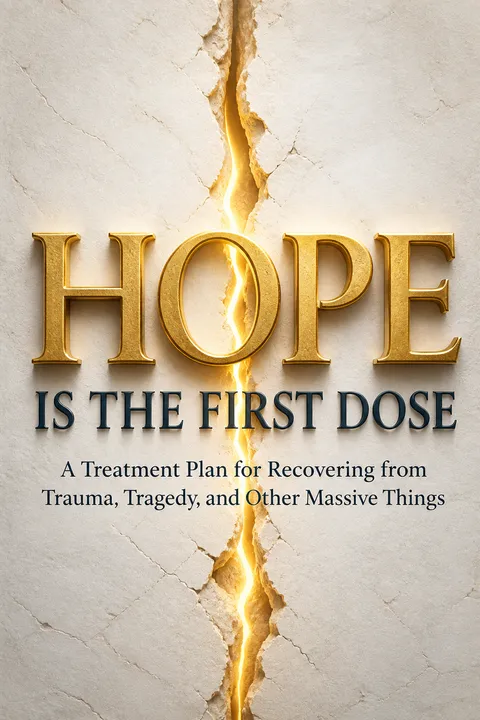
Hope is an opening. After Mitch died, Warren could not simply will himself into feeling hopeful. Friends brought food, handled practical tasks, sat quietly, and stayed close. His granddaughter’s birth offered a small glimpse of life beyond the darkness, not a cure for it. He describes hope as the first dose in a treatment plan: it does not prevent trauma or erase its effects, but it helps make a next step imaginable.
The book’s Christian framework sees hope as something received through God, often through other people, as well as something a person can actively cultivate. This distinction matters: choosing a hopeful action is not the same as choosing to feel cheerful. The aim is not a plastic smile or a promise that everything will turn out well, but a reason to keep participating in life while the pain remains.
Hope is most useful here as a form of agency under uncertainty, not a prediction that events will improve. In psychological research, hope is often associated with having valued aims and some sense of pathways toward them. That account complements the author’s spiritual one while making the idea accessible beyond Christian belief. The distinction between action and mood is essential: telling a grieving person to “choose hope” can sound like blame if it means suppressing distress. Warren’s account is more humane when hope is understood as a small opening, supported by relationships and grace, rather than an emotional demand.
Unhook hope from outcomes without pretending outcomes do not matter.
Circumstances are not enough. Warren sketches four patterns he noticed among patients facing grave illness. Crashers deteriorated emotionally after crisis; Dippers fell, then gradually recovered; Untouchables remained comparatively steady; Climbers began in difficulty but found greater hope. These are illustrative patterns drawn from his observations, not results from a formal study.
Warren’s Gap Theory names the space between hopelessness and hope, where faith can persist despite circumstances that offer little reassurance. Lucky Chuck, a rancher with likely terminal brain cancer, declined aggressive treatment but remained hopeful, drawing on his wife’s counsel and his religious belief. His choice is not offered as the right medical decision for everyone. The point is that a person’s sense of meaning and hope need not depend entirely on a favorable diagnosis or outcome.
This model usefully separates emotional well-being from the idea that life must first become safe, fair, or pain-free. It also identifies why a single crisis can reorganize a person’s entire self-understanding. Yet the four categories simplify what is often a fluctuating process: someone may be steady in one domain and overwhelmed in another, or move between patterns over time. The author acknowledges that his curves are conceptual. Their value is as prompts for noticing direction, not labels for judging sufferers. Hope can shape coping, but it cannot guarantee health, survival, or emotional recovery.
Let others witness your grief without requiring them to fix it.
Presence beats explanation. In the hours after Mitch’s death, Warren and his family were surrounded by people who cooked, arranged travel, sat with them, and took care of work they could not manage. One friend offered to stay and help when needed, without demanding conversation. Those ordinary acts mattered more than explanations about why the tragedy happened.
A pastor also warned Warren that grief could become the only thing he trusted or attended to. The warning was not that grief should be rushed or hidden. It was that pain can consume a life if it crowds out every other source of connection. Warren’s in-laws, who had lost two children, modeled another possibility: they mourned, leaned on faith and family, and eventually served other people from within their experience.
The scene illustrates a basic principle of social support: practical help and steady presence can be more regulating than advice, especially when a person is in acute shock. It also gives the bereaved permission not to perform a polished response for visitors. The caution about grief becoming all-consuming needs careful handling. Persistent grief is not a moral failure, and choosing to remember a loved one is not the same as worshipping pain. Support should widen a person’s options, not pressure them to adopt a timetable, theology, or definition of recovery that does not fit.
Biopsy catastrophic thoughts before letting them dictate your next move.
A thought needs evidence. Warren’s bad-thought biopsy is a deliberate pause to examine a painful belief before reacting to it. After Mitch’s death, he repeatedly thought that failing to protect his son made him a failed father. He asked whether that conclusion was factually true, then recognized that he had not controlled where his adult son was that night. The thought expressed guilt, but guilt did not make its accusation accurate.
The method also allows for thoughts that are true. Warren cannot honestly deny that his son died or that the loss will remain painful. Instead, he resists adding unsupported conclusions, such as that nothing else matters or that he is incapable of loving his family. The purpose is not to erase grief, but to distinguish the event from the story fear builds around it.
This method resembles cognitive behavioral approaches that identify automatic thoughts, test their evidence, and consider more balanced interpretations. Its strongest feature is that it does not require forced positivity: a true and painful fact can be acknowledged without accepting every despairing conclusion attached to it. The biopsy metaphor also encourages a pause between emotion and action, a useful skill when distress narrows attention. Still, severe trauma can produce intrusive thoughts that are not easily changed by reasoning alone. Therapy, medication, or other professional support may be necessary, and using the technique should not become another standard a person can supposedly fail.
Exercise hope through remembered survival and one next action.
Remember, then move. Reading Lamentations, a biblical poem of devastation, Warren notices a writer who describes suffering plainly and then deliberately recalls God’s faithfulness. He finds a similar pattern in Psalms: memory brings earlier help to mind, while movement means praying, reflecting, or taking some next step. Warren calls these the working parts of hope.
After the funeral, he and Lisa had stayed inside, overwhelmed. A church service prompted Lisa to suggest a walk. They retraced a familiar route, saw reminders of Mitch everywhere, and still returned home. The walk did not make the grief disappear. It was movement through a world that remained present, even when it hurt. The practice is to remember what has helped before, then take one manageable action without waiting for a better mood.
This pairing connects reflective practice with behavioral activation, an approach in which meaningful activity can precede improved mood rather than wait for it. Recalling prior endurance can also counter the feeling that the present crisis is the only chapter that exists. The author’s religious memory is a source of strength for him, but readers can draw on other anchors, such as trusted people, past coping skills, or personal commitments. A walk is not a prescription for every trauma. The useful scale is modest: one chosen action, not a demand to resume normal life immediately.
Rebuild through supported practice, not by waiting to feel ready.
Recovery takes repeated work. Warren organizes his approach through three surgical metaphors: prehab prepares a person for change, self-brain surgery examines and revises harmful thinking, and rehab builds strength through repeated action and support. He illustrates the final stage with Marcus Green, an older man whose spinal injury left him nearly paralyzed. After surgery, pain and complications made him want to stop therapy. His clinicians and family helped him continue until he regained meaningful movement.
Warren also returns to Kiawah Island, where his family had vacationed with Mitch and his mother-in-law before both died. The familiar beach did not restore the past. New memories and his changed understanding made it possible to enjoy the place again. He stresses that recovery may leave scars, and his advice does not replace a doctor or therapist, especially after serious trauma.
The framework’s power lies in combining reflection with practice and social support. Rehabilitation research broadly supports gradual, structured activity after injury, while behavior-change science emphasizes that routines and other people can help sustain effort when motivation fluctuates. The beach story adds a useful account of memory: returning to a place cannot reproduce the past, but it can permit new associations. The surgical language risks implying that a person can repair trauma alone through discipline. Warren’s own disclaimer matters: self-guided work can complement professional care, not substitute for it, and recovery pace varies widely.
Analysis
Hope Is the First Dose is a memoir-driven Christian guide to surviving devastating loss, built around a practical sequence rather than a detached theory. Warren’s son Mitch dies, and Warren’s medical authority does not protect him from disorientation, bodily distress, anger, or doubt. His credibility comes partly from this reversal: the doctor who has helped patients face catastrophe must become a patient himself. Stories of grieving parents, a terminally ill rancher, and recovering patients give the ideas emotional texture and keep the book’s central claim tied to lived consequences.
Its most useful contribution is the insistence that recovery need not mean restoration. Warren rejects the fantasy of returning to an untouched past and instead argues for a life that contains loss without being reduced to it. His metaphors translate this into memorable practices: examine thoughts, recall prior sources of strength, act before feelings improve, and let other people help. The surgical vocabulary gives readers a sequence they can remember, though its neatness risks making a nonlinear process seem more controllable than it is.
The book’s evidence is chiefly autobiographical and observational. Warren’s patient categories and brain-science explanations can illuminate experience, but they should not be mistaken for validated clinical classifications or proof that thought alone changes brain chemistry in a simple, predictable way. Nor should a person who remains depressed or traumatized infer that they have failed to choose hope. Grief can require psychotherapy, medication, community care, or time beyond any self-help framework.
The Christian theology is central, not decorative. Warren interprets endurance as trust in a God present within suffering, while acknowledging anger and unanswered questions. Readers outside that faith tradition may not share the metaphysical conclusion, but can still use the book’s distinction between pain and the total story of a life. Its most credible promise is modest: not that tragedy becomes good, but that grief need not consume every remaining possibility.
Review Summary
Glossary
The Massive Thing (TMT)
Life-altering traumaWarren’s term for a devastating event or experience that overwhelms a person’s sense of control and changes how they understand their life. Examples in the book include a child’s death, a serious diagnosis, abuse, or a major personal loss. TMT names the scale of the impact, not a formal clinical diagnosis.
Self-brain surgery
Intentional thought changeWarren’s metaphor for examining and changing one’s thinking after trauma, with the aim of reducing harmful interpretations and making room for hope and action. It is not literal surgery or a substitute for professional treatment. The phrase describes a self-directed process supported by faith, practice, and other people.
Bad-thought biopsy
Testing a painful thoughtA technique in which a person pauses over a distressing thought and checks whether it is true, false, or only partly supported. The goal is to separate a painful fact from added conclusions driven by guilt, fear, or despair, then choose a response that fits the evidence rather than reacting automatically.
Warren's Gap Theory
Faith amid uncertaintyWarren’s description of faith as existing between hopelessness and hope, especially when circumstances provide no guarantee of a good outcome. The theory encourages separating trust and meaning from immediate results. Warren presents it as a personal framework and an interpretive model, not a tested scientific law.
Happification
Active movement toward hopeWarren’s coined word for deliberately shifting attention away from consuming anxiety or hopelessness long enough to recognize possible sources of happiness and endurance. He links this process to memory and movement: recalling what remains trustworthy or sustaining, then taking an action that supports life despite unresolved pain.
Crashers, Dippers, Untouchables, and Climbers
Four observed response patternsWarren’s illustrative labels for how people he encountered responded emotionally to serious adversity. Crashers declined and stayed low, Dippers fell and later recovered, Untouchables remained relatively steady, and Climbers moved from a low baseline toward greater hope. He presents these as patterns he noticed, not formal diagnoses or empirically validated categories.
Warren's Law of Suffering
Grief is not comparativeWarren’s principle that grief is a human condition, not a contest in which one person’s pain invalidates another’s. Suffering can feel total to the person experiencing it, even while other people face serious losses too. Comparison does not reduce either person’s distress and can make compassion harder.
Prehab
Preparation for recovery workThe preparatory phase in Warren’s treatment-plan metaphor. It includes acknowledging the injury, learning about one’s reactions, drawing on supportive relationships, and strengthening readiness for difficult mental work. The term adapts the medical idea of preparing a patient before surgery to the process of responding to trauma.
Download PDF
Download EPUB
.epub digital book format is ideal for reading ebooks on phones, tablets, and e-readers.








