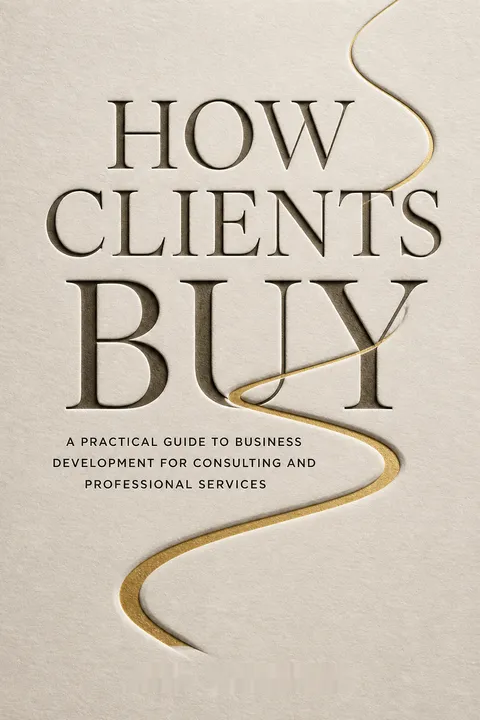


Key Takeaways
Stop pitching expertise; make it easier for clients to buy it
Start with the buyer. Consulting is not a product sale with a clever pitch attached. It is a decision journey in which clients must first know you, understand your work, see its relevance, believe you can deliver, trust your intentions, secure support, and find the right moment to act. The authors call these conditions the Seven Elements of How Clients Buy. They are better treated as the buyer's needs than as a seller's checklist.
A patient introduction. Mac Shields met technology CEO Peter Tyre through a mutual friend. They spent months talking about Tyre's business before he asked Mac to help assess new markets. Mac's curiosity and useful advice made the eventual project feel like a natural next step, not a pressured close.
The shift in viewpoint is more than a softer sales style. It changes the unit of analysis from a seller's conversion rate to a buyer's uncertainty. That aligns with service design, where the experience is improved by studying the user's actual obstacles rather than optimizing the provider's preferred process. It also sets a useful ethical boundary: helping someone decide is different from engineering a decision that serves the seller. The model is not a guarantee that patience produces revenue, however. It is a way to make commercial effort more useful even when a prospect never becomes a client.
Treat expertise as a credence good, where trust precedes proof
Clients cannot inspect the service. A credence good is a service whose buyer may struggle to judge what was needed, how much work was done, or whether the solution was sound. A client hiring a lawyer or cybersecurity specialist faces information asymmetry: the expert knows far more about the problem and its remedy. Even a successful outcome may not reveal whether the work was necessary or fairly priced.
Borrow trust carefully. The book groups three routes to confidence as relationships, referrals, and reputation. A recommendation from a trusted colleague, a record of good work, and a genuine relationship help reduce the buyer's risk. Unlike a phone's battery life, professional judgment cannot always be tested against a neutral scorecard before purchase.
Credence goods create a classic principal-agent problem: the buyer delegates a decision to someone whose incentives may not perfectly match their own. That makes reputation and referral more than marketing decoration. They are imperfect safeguards against hidden quality and hidden effort. Yet social proof can also preserve weak judgments: a prestigious name or familiar recommender is not proof of good work. The practical implication is to combine relational signals with transparent scope, clear reasoning, and evidence that a client can examine. Trust matters most when the buyer has the least ability to verify it.
Cultivate a small professional community instead of processing endless leads
A relationship is not a lead. The traditional sales funnel treats prospects as a steady supply to qualify, pitch, and either close or discard. That model fits mass markets better than expert services, where a niche may contain only dozens of likely buyers. The book gives the example of a specialist serving just thirty-seven large reinsurance companies. A relationship that is not ready today may become important years later, as a contact changes roles or a need emerges.
Narrowcast with care. The authors suggest identifying roughly two hundred people who could meaningfully shape a practice, though the right number varies. They recommend useful introductions, thoughtful follow-up, and sharing relevant ideas, rather than counting every email or conference badge as progress.
This is a social-capital model of growth. A relationship can carry information, access, and credibility across organizational boundaries, often in ways that are difficult to attribute to one marketing activity. That explains why a referral chain can outperform a large volume of anonymous contacts. It also cautions against treating people as future transactions: a network built only for extraction will eventually become visible as such. The approach benefits from some measurement, but measures should track meaningful interactions and follow-through, not merely activity counts. Otherwise, the relationship model can become another funnel wearing friendlier language.
Own a narrow category so referrals know when to name you
Make yourself easy to recall. Potential clients cannot recommend an expert if they cannot explain what that person does. The book advises defining a specialty by a clear market, customer, or problem, then explaining it in plain language. One accounting firm that had served two mining clients decided to focus on mining companies. It began building industry-specific case studies, convening mining executives, and presenting itself as a specialist rather than a firm for every kind of business.
Focus sharpens memory. The authors connect this to familiar mental categories such as first, best, or biggest. Their elevator-pitch guidance is to say what you do, whom you serve, how you help, and what distinguishes you. A niche can change as expertise and markets change; focus is not a life sentence.
Specialization reduces the cognitive work required to remember and recommend a service provider. It also gives a firm a better chance to accumulate relevant experience, which strengthens its actual capability as well as its market position. The constraint is that a niche must be credible and large enough to support the business. A polished category claim without distinctive results is just positioning language. The strongest specialization is therefore a feedback loop: focused work produces deeper knowledge, deeper knowledge produces better outcomes, and those outcomes make the focus believable.
Start with the client's agenda, then show why your work matters
Relevance belongs to the buyer. A service earns interest when it connects to a priority the client already has, or reveals a problem with meaningful consequences. The authors recommend asking how a department or business will be judged over the next few years, then listening for the goals and constraints behind the answer. A turnaround specialist is immediately relevant to a manufacturer facing a cash crisis, but a security consultant may need to help a company understand a vulnerability it has not yet recognized.
Make the impact concrete. A useful proposal should connect expertise to outcomes such as higher revenue, lower costs, or reduced risk. The value must matter at the scale of that particular organization. Research the client, ask questions, and bring information that helps them think, rather than simply reciting credentials.
This is a form of problem framing. In many professional engagements, the buyer does not arrive with a fully specified problem, so the expert helps define what is worth solving. That can create substantial value, but it also creates ethical responsibility: a provider can make an issue seem more urgent or more expensive than it is. A disciplined approach distinguishes evidence from hypothesis and invites the client to correct the diagnosis. Listening is not passive politeness here. It is a method for testing whether the proposed work is relevant before either party commits resources.
Prove capability with relevant outcomes, not impressive claims
Show evidence the buyer can use. When a client considers a consequential service, they ask whether the provider has solved a similar problem before. Relevant experience usually persuades more than a famous but unrelated project. The book contrasts a general merchandising firm with a team that had repeatedly served coffee-shop chains; the latter had more directly applicable proof for a coffee retailer.
Build a portable case. A concise presentation, called The Deck in the book, should explain capabilities, show relevant case studies and results, establish credibility, and include contact details. Bios, references, publications, and client examples help a decision-maker explain the choice to colleagues. The point is not to pile on credentials. It is to make a defensible case that this team can deliver this outcome for this client.
Evidence reduces perceived risk, especially when the buyer must defend the choice internally. In organizational psychology, this resembles accountability: people often need not only a good decision but a decision they can explain to others. Specific comparable outcomes make that explanation easier. Still, past performance is evidence, not destiny. A case study can conceal differences in team, context, or client contribution. Strong proof therefore says what changed, what the provider actually did, and what conditions made the result possible, rather than implying that a logo guarantees a repeatable outcome.
Earn trust by demonstrating competence and putting the client's interests first
Trust has two jobs. Clients need confidence that a provider can do the work, and confidence that the provider will act honestly and protect their interests. The book draws on a model of trust involving competence, honesty, and benevolence. A strong track record supports competence; transparent communication and sound judgment show the other qualities. Trust grows through repeated interactions, not a single polished meeting.
Let choices reveal character. A McKinsey partner described declining work when the firm judged another provider a better fit, while offering the client useful guidance on what to consider. The decision surprised the buyer and strengthened the relationship. Small acts count too: report bad news promptly, own mistakes, protect confidences, and avoid expanding a project merely because the client cannot judge what is necessary.
The distinction between competence and benevolence is important because expertise alone can make a provider more dangerous, not less. A technically capable adviser can still exploit the client's information gap. Trustworthy behavior therefore requires visible alignment of incentives, candid limits, and willingness to say no when the proposed work is wrong. The book's emphasis on intentions is compelling, but intentions are hard for buyers to observe directly. They become credible through consistent conduct, clear agreements, and decisions that carry a real cost to the provider when the client's interest comes first.
Build buying ability by shaping returns and internal support
A willing contact may not control the decision. In a large organization, buying usually requires budget, authority, and colleagues who will support the project. The authors' practical formula is a compelling return combined with a stakeholder at the right organizational level. Return on investment can mean revenue or savings, but buyers also weigh career risk, internal politics, and the cost of doing nothing.
Do not screen too soon. A small services firm spent a year building a relationship with an IBM executive after initial outreach and introductions failed to produce work. Eventually, a senior contact engaged, a proposal followed, and the firm won a project. The lesson is not to pursue every prospect forever. It is to learn who else must be involved and what would make the opportunity supportable inside the organization.
Organizational buying is a coalition problem, not simply a conversation with one person who has a budget. A promising internal champion must translate the provider's value into language colleagues can endorse, while managing the personal risk of being wrong. That makes internal advocacy part of the service provider's work. The ROI frame is useful, but not every valuable outcome is immediately monetized. Risk reduction, capability, and strategic options may matter even when their returns are uncertain. A credible business case should expose those assumptions rather than manufacture precision.
Stay useful through delays because timing often decides the deal
Readiness is not interest. A client can understand the work, trust the provider, and still be unable to act because of a reorganization, budget cycle, new leader, or competing priority. The book recounts a consultant who met a former classmate interested in a project but waited months while the client's organization changed. A competitor met the new leader during that interval and won the work.
Keep the relationship warm. When timing is wrong, remain helpful with relevant articles, introductions, or brief check-ins. The authors warn against inventing a crisis to force urgency. A real risk should be described with evidence specific to the client, not inflated into a sales scare. The need for outside expertise often appears suddenly, so staying known and useful improves the chance of being considered when circumstances shift.
Timing introduces contingency into business development. A provider can do everything well and still miss an opportunity because the organization is not ready, or because a new decision-maker resets the process. This makes persistence rational, but only when it respects the prospect's attention and autonomy. Regular contact should offer a reason to engage, not merely remind someone that the seller exists. The distinction between surfacing a genuine risk and manufacturing a burning platform is crucial: fear may create action, but it can also destroy the trust required for a durable advisory relationship.
Make business development routine, and tailor it to your service's buying rhythm
Treat growth as part of the job. Great work is essential, but it does not reliably introduce itself to future clients. The authors urge professionals to take personal responsibility, make time for relationship-building, develop a style that feels authentic, and persist through rejection. One consulting firm leader attributed long-term growth to working on business development every day, even while delivering current projects.
Match effort to the service. The book distinguishes evergreen work, bought repeatedly; acute work, triggered by a crisis; and optimizing work, which is discretionary. Evergreen providers need familiarity and trust, acute specialists need to be remembered for a specific problem, and optimizing firms must uncover interest and stay present until priorities change. Even global expertise is often hired through local, personal connections.
The service categories offer a useful way to allocate scarce effort. A tax provider and a crisis-response specialist should not use identical outreach calendars because their buyers encounter need differently. The framework also prevents the familiar mistake of copying another rainmaker's personality or tactics. One qualification matters: daily effort need not mean daily networking. It can include excellent delivery, writing, research, or thoughtful follow-up. The durable principle is continuity. A practice built only during slow periods leaves no time for the relationships that may matter when current work ends.
Analysis
The book's central contribution is a change in perspective: business development for experts is not primarily a sequence of seller actions, but a set of uncertainties the buyer must resolve. This matters because professional services are difficult to evaluate before purchase and sometimes even afterward. Buyers are not merely choosing among features. They are delegating diagnosis, judgment, and execution to someone who knows more than they do, while carrying organizational and career risk.
The seven-part model is strongest when used diagnostically. A stalled opportunity may not need a sharper pitch. The buyer may not understand the specialty, see relevance, trust the provider, have a coalition, or have a reason to act now. This reframing connects ethical conduct with commercial effectiveness: clear evidence, careful listening, and honest restraint reduce buyer risk while making the provider easier to choose. The book's stories make that logic tangible, particularly the long relationship that led to work only after the client recognized a specific need.
Its most important tension is that relationship-centered selling can sound universal while operating unevenly. Networks distribute opportunity, but they can also reproduce exclusion by favoring people already connected to influential circles. A modern practice can widen access through useful writing, public expertise, and online communities, while still treating direct relationships as more than a substitute for mass advertising. Likewise, a strong reputation is a helpful proxy for quality, but proxies can mislead. Buyers benefit when references and case studies are paired with transparent scope, relevant evidence, and explicit discussion of uncertainty.
The framework is not a predictive law. The authors draw on practitioner interviews and accumulated experience, not a controlled study establishing that every buyer follows the same path. Its value lies elsewhere: it offers a practical map of conditions that commonly block a purchase, and a principled alternative to coercive closing. The most useful application is to ask what the buyer still needs in order to make a sound decision, then provide that support without pretending that readiness, trust, or timing can be forced.
Review Summary
How Clients Buy receives mostly positive reviews, with readers praising its practical insights into selling professional services. Many find it helpful for understanding client perspectives and developing business relationships. Some criticize it for lacking groundbreaking ideas or being too theoretical. Readers appreciate the book's structure, anecdotes, and focus on relationship-building in consulting. It's particularly recommended for those new to business development in professional services, though experienced professionals may find it less valuable.
Glossary
Credence goods
Hard-to-evaluate expert servicesServices whose buyers may be unable to judge what work was necessary, how much was actually performed, or whether the result was high quality. Consulting, legal, medical, and cybersecurity services can fit this category because the provider often understands the problem and solution better than the client. Buyers therefore rely heavily on trust, reputation, referrals, and other signals.
The Three R's
Routes to professional trustThe book's shorthand for relationships, referrals, and reputation, the social routes through which clients gain confidence in an expert. A relationship gives the buyer direct experience of a person, a referral transfers confidence from someone trusted, and a reputation reflects accumulated judgments by clients or peers. These routes matter because service quality is hard to inspect in advance.
Seven Elements of How Clients Buy
Seven buyer decision conditionsA framework for diagnosing what a prospective client needs before hiring an expert: awareness of the provider, understanding of the work, interest in its relevance, respect for capability, trust in the provider's intentions, organizational and financial ability to act, and readiness in timing and priorities. The conditions may unfold in different orders, and a weakness in any one can stall a decision.
Evergreen, acute, and optimizing service firms
Three service buying rhythmsThe book's categories for how professional services are typically purchased. Evergreen services recur, such as routine accounting. Acute services respond to urgent events, such as a crisis or bankruptcy. Optimizing services improve performance but are often discretionary, such as a strategy or technology project. Each type places different emphasis on familiarity, specialization, proof, interest, and timing.
The Deck
A concise proof presentationA short presentation sent after an introductory conversation to help a prospective client understand and share a provider's case internally. The book recommends including a clear capability statement, relevant case studies with outcomes, credibility signals such as client references or logos, and contact information. Its purpose is to make the provider's value understandable to people who were not in the original meeting.
Firefly ideas
Short-lived business fashionsA term used for management ideas that flare into popularity and then fade quickly, such as fashionable technology or management concepts. The book argues that accelerated communication shortens the useful life of some ideas, making it risky for a service firm to build its identity around a passing trend. Providers need enduring expertise and may need to refresh how they explain it.
Burning platform
Urgency to force changeA metaphor for a situation so dangerous or costly that an organization feels compelled to act. The book recognizes that real crises can create readiness, but warns consultants not to manufacture urgency by exaggerating threats. A trusted adviser should describe risks grounded in the specific client's circumstances rather than using fear as a shortcut to a sale.
Download PDF
Download EPUB
.epub digital book format is ideal for reading ebooks on phones, tablets, and e-readers.








