

Key Takeaways
Treat prosperity as a system of incentives, specialization, and exchange
Start with scarcity. Economics asks how people make the best of limited resources, not merely how they make money. The book opens with a measure of progress almost everyone understands: a prehistoric person needed about 58 hours of work to obtain an hour of artificial light; today, less than a second of work pays for it. Better technology and more productive workers made light radically cheaper. Specialization lets people concentrate on what they do well, while markets let them trade for what others produce.
Watch what rewards change. When Australia offered a payment for babies born after a particular date, births set a daily record as some families delayed scheduled deliveries. The lesson is not that people are selfish, but that rules and rewards shape decisions, often in surprising ways.
The light example makes abstract growth tangible: prosperity often appears as time and effort no longer required. It also suggests a useful test for economic progress: ask what ordinary capability has become cheaper, safer, or more accessible. Incentive analysis is powerful precisely because it does not require assuming perfect rationality. But an incentive's effects depend on context. A payment may alter timing without changing the number of children, and efficiency alone says nothing about whether gains are fairly shared.
Agriculture built civilization, but geography and power chose its winners
Surplus changed society. Farming was five or six times as productive as foraging, allowing settled communities to store food, build cities, and support craftspeople. The Indus Valley civilization developed trade, planned streets, and even homes with flush toilets, while its relative equality left fewer grand monuments than in Egypt or Rome. Yet early farming also narrowed diets, concentrated people in disease-prone settlements, and coincided with average heights falling by about 10 centimetres.
Technology distributes power. The plough made cultivation more productive but demanded greater physical strength, helping entrench male-dominated work and gender norms. Geography mattered too: Eurasia's east-west reach and domesticated plants and animals let farming practices spread across similar climates. These advantages helped explain why Eurasian powers later expanded overseas, rather than the reverse.
Agriculture is a reminder that innovation rarely arrives as an unambiguous improvement. It expands what a society can produce, while changing who controls the surplus and who performs the work. The geographic account usefully resists explanations based only on culture or national character. Still, geography is a starting advantage, not a destiny: institutions and political choices shape whether it becomes broad prosperity, extraction, or both. The plough example likewise shows how a tool can encode social assumptions long after its original practical purpose fades.
Trade spreads ideas and wealth, but institutions decide who pays
Exchange creates gains. Comparative advantage means that people or countries can benefit by specializing in what they produce at relatively lower cost, even when one side is more productive at everything. Trade also carries ideas: the printing press multiplied book production, while imported crops such as maize helped support population growth in China. After the Black Death killed a large share of Europe, worker scarcity roughly doubled real wages and weakened landowners' power.
Prosperity had victims. Ocean trade also moved more than 12 million enslaved people across the Atlantic. Profits from slavery enriched merchants and helped finance some European development, while families were separated and millions endured forced labor. Trade is not automatically fair: who owns the ships, sets the rules, and bears the costs determines whether exchange broadens opportunity or entrenches coercion.
This account avoids the comforting fiction that expanding commerce is the same thing as moral progress. Trade can increase total output while distributing gains brutally, a distinction familiar in modern debates about globalization and labor standards. The Black Death example also shows how shocks redistribute bargaining power, not just wealth. Comparative advantage explains why exchange can benefit both parties in principle, but it cannot establish that either party consented freely or that the gains reach those who bear the costs.
Productivity revolutions take decades to turn inventions into higher living standards
Inventions need redesign. The Industrial Revolution combined productive agriculture, growing cities, commercial networks, and new machinery. Adam Smith illustrated specialization with a pin factory: dividing production among workers could multiply output dramatically compared with one person making pins alone. Yet a powerful invention is not the same as an immediate productivity boom. Steam engines took many decades to transform factories and transport; electric motors and personal computers also produced their largest gains only after workplaces were reorganized around them.
Institutions make risk possible. British capital markets, insurance, stable currency, and relatively independent courts helped entrepreneurs finance experiments and absorb losses. Meanwhile, coal-powered growth created pollution whose costs were not reflected in the price of factory output. Progress depends on more than clever machines: it requires organizations that use them well and rules that account for the damage they cause.
The lag between invention and productivity is a useful antidote to both technological hype and pessimism. A tool often matters only after complementary systems, skills, and work routines change. This is visible in the difference between installing computers and redesigning how an organization communicates. The coal example adds an important complication: measured output can rise while environmental costs are shifted onto others. Productivity is therefore a powerful measure of capacity, but a weak stand-alone measure of social welfare.
Markets coordinate millions, but competition and public rules keep them honest
Prices coordinate choices. A market failure occurs when prices and private decisions do not produce a socially beneficial outcome. Pollution is one example: a factory may profit while imposing health and environmental costs on others. Monopoly is another. John D. Rockefeller's Standard Oil controlled about 90 per cent of US oil refining by 1880, using its power to squeeze rivals and influence prices. Employers can also hold monopsony power, meaning a dominant buyer can push down what it pays workers or suppliers.
Shared resources need rules. The tragedy of the commons describes how individuals can overuse a shared resource when each receives the benefit of extra use but spreads the damage among everyone. Cod stocks off Newfoundland collapsed to about 1 per cent of their historic level. Yet Elinor Ostrom found communities could manage shared fisheries, forests, and water when locals helped set rules and enforce them.
The central distinction is not market versus government, but which institutional arrangement handles a problem best. Prices can coordinate dispersed knowledge with remarkable speed, while concentrated power and unpriced harm can make those same signals misleading. Ostrom's cases also complicate the assumption that common resources require either privatization or distant state control. Local governance can work, although it depends on trust, monitoring, and workable sanctions. No single ownership form guarantees good stewardship.
Treat protectionism as a costly tool, not a free shield
Barriers have side effects. In 1930, the United States raised tariffs on more than 20,000 imports. Other countries retaliated, trade shrank, and US firms faced higher prices for inputs such as car parts and wool rags. The Great Depression deepened as households spent less, companies invested less, and unemployment rose. John Maynard Keynes argued that public spending could restart demand; Friedrich Hayek warned that intervention could preserve bad investments. Their disagreement remains a live question about how forcefully governments should counter recessions.
Cooperation followed catastrophe. After World War II, the Bretton Woods system established the International Monetary Fund and World Bank, while trade agreements began reducing tariffs. Standardized shipping containers later made loading and unloading far cheaper. The broader lesson is that openness depends on institutions and infrastructure, not just goodwill between trading partners.
The tariff episode demonstrates a political asymmetry: concentrated industries can press for protection, while the higher costs are dispersed across consumers and businesses. That does not mean every barrier is irrational or every trade agreement benign. Strategic resilience, worker displacement, and bargaining power matter alongside aggregate gains. The Keynes-Hayek contrast is best read as a dispute over timing and institutional risk, not a choice between compassion and discipline. Economic downturns have costs that markets alone may not quickly repair.
Change incentives and ownership, and economic life can change almost overnight
Small rules can unlock effort. In 1978, villagers in Xiaogang secretly divided collective farmland into family plots and allowed farmers to keep some of what they produced. The next harvest exceeded the previous five years combined. China's leaders allowed similar experiments to spread, and the reforms helped launch decades of rapid growth. The episode shows how ownership and rewards can change work decisions without changing people's character.
Markets need capable states. India's 1991 reforms dismantled much of the licensing system that dictated what firms could produce, helping private business and growth expand. East Asian development also relied on education, infrastructure, and government support for export industries. Such support can help firms learn and compete, but it can also become permanent protection for businesses that never become productive. Neither laissez-faire nor state direction guarantees success.
Xiaogang is compelling because a locally devised experiment revealed information that central planners lacked: farmers responded strongly when effort and reward were connected. It also cautions against treating formal law as the whole story, since practice can change before legislation catches up. The wider comparison points to a productive tension: markets can discover opportunities, while governments can build infrastructure and capabilities that private firms underprovide. The hard problem is designing support that remains accountable and temporary when its purpose is learning.
Growth raises averages, but education, bargaining power, and policy shape who gains
Growth is not distribution. After World War II, many advanced economies combined rapid growth with strong unions, expanding education, and progressive taxes. The Beatles faced a 95 per cent top tax rate, while factory wages rose and inequality fell. Thomas Piketty's shorthand, r > g, means that when returns on wealth exceed the economy's growth rate, owners of capital tend to pull further ahead. Social mobility also varies: rare elite surnames remain unusually common among high-status occupations across generations.
Opportunity takes structure. Education can help workers keep pace with technological change, while unions give individual employees more bargaining power. Parenthood, unequal care responsibilities, discrimination, and inflexible careers contribute to the gender pay gap. These patterns show why national growth figures cannot tell whether people can move upward, earn fairly, or participate fully in the economy.
The section's strongest contribution is to separate economic growth from the question of who commands its rewards. Education and unions are not merely redistributive afterthoughts: they influence workers' capacity to benefit from change in the first place. But no single inequality formula captures every mechanism. Returns to capital, education, family inheritance, discrimination, and labor-market institutions interact, and policies can produce trade-offs. A useful assessment therefore tracks mobility and security as well as average income.
Use economic models as maps, then check them against human behavior
People are not calculators. Behavioral economics studies systematic departures from the fully rational decision-maker. Daniel Kahneman's System One is fast and intuitive; System Two is slower and more effortful. A person may fear a plane more than a car despite the different risks, or underestimate the cost of a home renovation. Recognizing these patterns helps identify when a decision deserves closer attention.
Test claims with evidence. Randomized trials, which compare randomly assigned groups, helped researchers establish that early-childhood programs and free malaria bed nets could improve outcomes. Large datasets can reveal patterns in mobility and opportunity, but statistics also have blind spots: national accounts often omit unpaid care and understate the value people get from free digital services. Economic reasoning is strongest when models are tested against real behavior and measures are checked against what matters.
The combination of models and empirical checks is one of economics' most useful intellectual habits. Random assignment can distinguish cause from correlation, while behavioral research explains why a formally sensible choice may fail in practice. Yet data do not interpret themselves. Randomized trials may reveal whether a program works in one setting without establishing that it will transfer elsewhere, and measured output is not the same as lived welfare. Good analysis pairs causal discipline with humility about scope and measurement.
Price the damage we impose on others before climate and technology compound it
Unpriced harm grows. Climate pollution is an externality: a cost imposed on others that is missing from the emitter's private calculation. The Stern Review argued that reducing emissions would cost less than allowing severe climate damage to accumulate, especially when future lives are not discounted as though they matter less. During COVID, vaccines also illustrated an externality in the other direction: vaccination protected recipients and reduced risks to others, supporting free public provision.
Prepare for uncertain extremes. Artificial intelligence may raise productivity, but it can also displace workers or create risks that markets do not price well. The Tinbergen Rule says one policy tool cannot reliably achieve several independent goals at once. That makes careful policy design essential: use suitable tools for pollution, competition, employment, and catastrophic risks, while remembering that economics ultimately concerns human wellbeing, not income alone.
Externality analysis turns climate policy from a contest between growth and the environment into a question about which costs are being hidden and who bears them. The same logic applies to data systems and emerging technologies: private benefits can coexist with public risks. Still, assigning a price to harm is not a complete moral answer, especially where losses are irreversible or unequally distributed. Economic tools can clarify trade-offs, but decisions about acceptable risk and obligations to future generations remain political and ethical.
Analysis
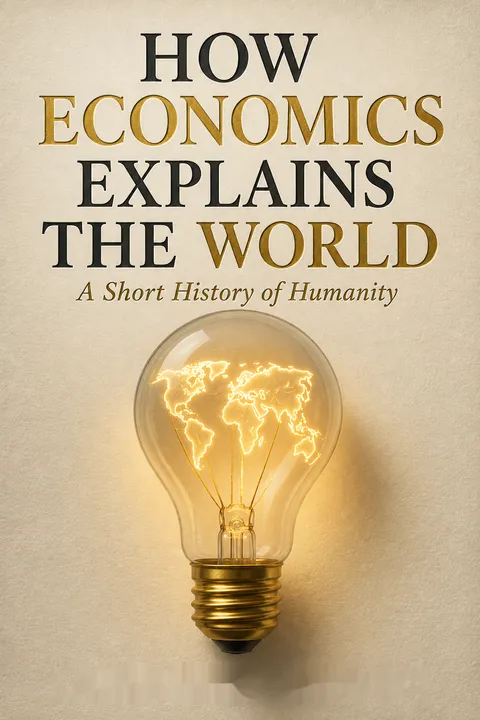
The book's strongest organizing idea is that prosperity is neither a cultural miracle nor the automatic reward for invention. It emerges from interacting systems: technology raises productive capacity, specialization coordinates effort, markets transmit information, and institutions shape incentives and divide the gains. The history of light makes the argument concrete. A modern bulb represents not one breakthrough but generations of innovation, higher worker productivity, and systems that make specialized production available to ordinary households.
The chronological sweep also corrects two tempting simplifications. First, markets are not synonymous with fairness. The same commercial networks that carried useful crops and knowledge also enabled slavery and colonial extraction. Second, government is not simply the enemy or servant of markets. Public institutions can stabilize demand, protect competition, finance research, and provide social insurance, but they can also suppress information, protect insiders, and make catastrophic mistakes. China's farming reforms and Mao-era policies show how sharply incentives and governance can alter outcomes.
A critical distinction running through the material is between aggregate efficiency and human welfare. GDP can rise while pollution, insecurity, unpaid care, or unequal bargaining power remain invisible. The book recognizes this by emphasizing health, capabilities, mobility, and the distribution of gains, but these measures can conflict. For example, a policy that expands total output may harm a particular industry or community. Economic analysis can reveal those trade-offs and estimate their consequences; it cannot decide whose losses are acceptable without ethical and political judgment.
The book is most persuasive when it treats economic models as disciplined questions rather than universal laws. Comparative advantage explains why trade can create gains, not why its gains will be fairly shared. Incentives predict responses, not every motive. Historical evidence suggests mechanisms, but rarely supplies a perfect counterfactual. The practical inheritance is therefore a set of habits: notice scarcity, ask who faces which incentives, identify costs shifted to others, and test elegant explanations against lived outcomes. Economics explains much of the world by making these hidden structures visible, while leaving room for values to determine what prosperity should mean.
Review Summary
How Economics Explains the World receives mostly positive reviews, praised for its accessibility, concise explanations, and broad historical scope. Readers appreciate Leigh's ability to simplify complex concepts and connect economic principles to major historical events. Some criticize the brevity, feeling it oversimplifies certain topics. The book is recommended as an engaging primer on economics for general readers, though some find it less suitable for those already well-versed in the subject.
Glossary
Comparative advantage
Relative production efficiencyComparative advantage describes a person's or country's ability to produce something at a lower opportunity cost than another activity. Specializing according to these relative costs can make both sides better off through trade, even when one side is more efficient at producing every good. It explains why difference, rather than superiority in every category, can create mutual gains.
General-purpose technologies
Technologies with broad usesGeneral-purpose technologies are innovations that can transform many industries and activities, rather than serving only one narrow purpose. Their effects may be delayed because firms and institutions must adapt around them. Steam power, electric motors, and computers each required changes in production and work organization before their largest productivity gains appeared.
Market failure
Markets produce harmful outcomesA market failure occurs when individual market decisions and prices do not produce an efficient or socially desirable outcome. Pollution is a classic example: a producer may profit while imposing costs on people who are not part of the transaction. Monopoly power and the overuse of shared resources are other cases where public policy or collective rules may improve outcomes.
Tragedy of the commons
Shared resources become overusedThe tragedy of the commons describes the risk that individuals will overuse a shared resource because they receive much of the personal benefit while spreading the resulting damage across the group. A shared pasture can be ruined by too many animals. The outcome is not inevitable: communities can create and enforce local rules to protect common resources.
Tinbergen Rule
One tool, one targetThe Tinbergen Rule states that policymakers need at least as many independent policy instruments as they have independent objectives. A central bank that primarily controls interest rates cannot reliably target inflation, housing prices, employment, and household debt all at once. The rule highlights why complex problems often require coordinated policies rather than a single lever.
System One
Fast intuitive thinkingSystem One is the fast, automatic, and intuitive mode of thought described in Daniel Kahneman's account of decision-making. It helps people make quick judgments without sustained effort, but it is vulnerable to predictable biases, such as overreacting to vivid risks or relying too heavily on an initial price. It is useful for routine choices, but can mislead on consequential ones.
System Two
Slow deliberate thinkingSystem Two is the slower, more effortful mode of thought used for complex calculations and careful comparisons. It can correct some intuitive errors, but requires attention and mental effort, so people do not use it for every decision. Economic reasoning can help identify high-stakes choices where deliberate analysis is worth the cost.
r > g
Capital returns exceed growthThe expression r > g compares the rate of return on capital, represented by r, with the rate of economic growth, represented by g. When returns on wealth exceed overall growth for extended periods, people who already own substantial assets can increase their share of total wealth. The relationship is a framework for understanding one mechanism behind rising inequality, not a complete account of its causes.
FAQ
What's "How Economics Explains the World: A Short History of Humanity" about?
- Overview of Economics: The book by Andrew Leigh explores how economic principles have shaped human history and the development of societies.
- Chronological Journey: It takes readers through key historical periods, from prehistoric times to the modern era, highlighting the role of economics in each.
- Capitalism and Market Systems: The narrative focuses on the evolution of capitalism and market systems, explaining their impact on global development.
- Interdisciplinary Approach: It blends microeconomics and macroeconomics, offering insights into both individual decision-making and broader societal trends.
Why should I read "How Economics Explains the World: A Short History of Humanity"?
- Comprehensive History: The book provides a thorough historical account of how economics has influenced world events and societal changes.
- Accessible Economics: It makes complex economic concepts accessible to a general audience, without requiring prior knowledge of the subject.
- Engaging Narrative: Leigh uses engaging storytelling to connect economic theories with real-world historical events and figures.
- Broader Understanding: Reading this book can enhance your understanding of current economic issues by providing historical context.
What are the key takeaways of "How Economics Explains the World: A Short History of Humanity"?
- Economic Forces Shape History: Economic principles have been central to shaping human history, from the agricultural revolution to modern capitalism.
- Role of Innovation: Technological and policy innovations have driven economic growth and societal change throughout history.
- Market Systems and Failures: While markets have facilitated growth, they are not perfect and can lead to issues like inequality and environmental challenges.
- Interconnectedness of Economics: The book highlights the interconnectedness of global economies and the importance of trade and specialization.
How does Andrew Leigh explain the evolution of capitalism in the book?
- Historical Context: Leigh traces the development of capitalism from early trade systems to the industrial revolution and beyond.
- Key Innovations: He discusses technological advancements, such as the steam engine and assembly line, that fueled capitalist growth.
- Economic Theories: The book examines the contributions of economists like Adam Smith and their impact on capitalist thought.
- Modern Capitalism: Leigh explores contemporary issues in capitalism, including globalization and market failures.
What role does innovation play in "How Economics Explains the World: A Short History of Humanity"?
- Driver of Growth: Innovation is presented as a key driver of economic growth and societal advancement throughout history.
- Technological Breakthroughs: The book highlights significant technological innovations, such as the printing press and the internet, and their economic impacts.
- Policy Innovations: Leigh also discusses policy innovations, like the welfare state and trade agreements, that have shaped economic systems.
- Future Challenges: The book considers the role of innovation in addressing future economic challenges, such as climate change and inequality.
How does the book address the concept of market failure?
- Definition and Examples: Market failure is explained as situations where markets do not allocate resources efficiently, leading to issues like pollution and monopolies.
- Historical Instances: Leigh provides historical examples of market failures, such as the Great Depression and environmental degradation.
- Role of Government: The book discusses the role of government intervention in correcting market failures and promoting social welfare.
- Contemporary Relevance: It highlights current market failures, such as climate change, and the need for innovative solutions.
What insights does the book offer on the relationship between trade and economic development?
- Historical Trade Systems: Leigh explores the evolution of trade systems from ancient times to the modern global economy.
- Comparative Advantage: The book explains the concept of comparative advantage and its role in promoting international trade.
- Economic Growth: Trade is shown as a key factor in economic growth, allowing countries to specialize and benefit from global markets.
- Challenges and Opportunities: The book discusses the challenges of trade, such as protectionism, and the opportunities it presents for economic development.
How does Andrew Leigh incorporate behavioral economics into the narrative?
- Behavioral Insights: The book includes insights from behavioral economics, highlighting how human behavior affects economic decision-making.
- Systematic Biases: Leigh discusses systematic biases, such as the anchoring effect and planning fallacy, that influence economic choices.
- Decision-Making Models: The narrative contrasts traditional economic models with behavioral models that account for irrational behavior.
- Practical Applications: The book explores practical applications of behavioral economics in areas like policy design and consumer behavior.
What are the best quotes from "How Economics Explains the World: A Short History of Humanity" and what do they mean?
- "The history of light illuminates some key themes of this book." This quote underscores the book's focus on how technological advancements, like lighting, have transformed economies and societies.
- "Economics can be defined as a social science that studies how people maximise their wellbeing in the face of scarcity." This quote encapsulates the essence of economics as a discipline concerned with resource allocation and human welfare.
- "Learning to think like an economist can change your life for the better." Leigh emphasizes the practical benefits of understanding economic principles in everyday decision-making.
- "The secret of our discipline is that the most powerful insights come from a handful of big ideas that anyone can comprehend." This quote highlights the accessibility of key economic concepts and their relevance to understanding the world.
How does the book explore the impact of economic policies on inequality?
- Historical Context: Leigh examines historical policies, such as the Corn Laws and welfare state, and their effects on inequality.
- Role of Education: The book discusses the impact of education policies on reducing inequality and promoting social mobility.
- Taxation and Redistribution: It explores the role of progressive taxation and social welfare programs in addressing economic disparities.
- Contemporary Issues: Leigh considers current policy challenges, such as globalization and technological change, and their implications for inequality.
What does "How Economics Explains the World: A Short History of Humanity" say about the future of economics?
- Technological Advancements: The book discusses the potential impact of emerging technologies, like artificial intelligence, on future economic systems.
- Global Challenges: Leigh highlights global challenges, such as climate change and inequality, that will shape the future of economics.
- Role of Innovation: The narrative emphasizes the importance of continued innovation in addressing economic and societal issues.
- Interdisciplinary Approach: The book advocates for an interdisciplinary approach to economics, integrating insights from other fields to tackle complex problems.
How does Andrew Leigh address the concept of economic wellbeing in the book?
- Beyond Income: Leigh emphasizes that economic wellbeing encompasses more than just income, including factors like health, education, and quality of life.
- Happiness and Satisfaction: The book explores the relationship between economic growth and happiness, challenging the notion that more money always leads to greater satisfaction.
- Role of Policy: It discusses the role of economic policy in enhancing wellbeing, through measures like social welfare and environmental protection.
- Future Considerations: Leigh considers future challenges to economic wellbeing, such as technological disruption and environmental sustainability.
Download PDF
Download EPUB
.epub digital book format is ideal for reading ebooks on phones, tablets, and e-readers.








