

Key Takeaways
Teach for the learner humans already are, not a blank slate.
Learning has deep roots. Joshua Eyler’s argument begins with a teacher who changed his life. In college, Chris Fee made medieval literature vivid, treated students’ ideas as worth developing, and had the class stage a medieval play. Eyler learned more through that experience than through conventional coverage of the subject, and became a teacher himself.
The book explains why such teaching works through five durable features of human learning: curiosity, social connection, emotion, authentic activity, and learning from error. These capacities appear early in life and remain relevant in adulthood. Teaching improves when it works with them instead of assuming students are passive containers for information.
The book’s unifying move is to treat effective teaching as a design problem grounded in human development, not as a bag of classroom tricks. That framing encourages instructors to ask why a practice works and what learner need it serves. The continuity between childhood and adult learning is illuminating, though it should not be taken to mean that adults and children learn identically. Experience, expertise, culture, and access to support change how shared capacities show up.
Build courses around questions students genuinely need to answer.
Curiosity needs a gap. Psychologist George Loewenstein describes curiosity as an information gap: the distance between what someone knows and what they want to know. Questions make that gap visible and give learning direction. In one study, children aged four to six explored a toy less when an adult immediately demonstrated how it worked than when the demonstration left room to investigate. Curiosity can be crowded out by premature explanation.
It can also erode in school. In observations cited by Eyler, kindergarten classrooms averaged 2.36 visible episodes of curiosity per two-hour period, compared with 0.48 in fifth grade. Course design can counter that drift by organizing material around essential questions or one overarching question, then using readings, activities, and assessments to help students pursue answers.
A well-formed question does more than create interest. It gives learners a reason to notice evidence, tolerate uncertainty, and connect separate facts. That is why inquiry can make a syllabus feel like a coherent investigation rather than a storage unit for topics. The caution is that an unanswered question can become a source of frustration if students lack background knowledge or feel unsafe admitting confusion. Productive curiosity requires both a genuine puzzle and enough support to enter it.
Let learners assemble explanations before handing them the formula.
Understanding is built, not delivered. Constructivism is the view that learners develop understanding by actively building and revising knowledge, rather than simply receiving finished explanations. Eyler illustrates this with chemistry instructor John Hutchinson, whose students use observations and simple demonstrations to reason toward ideas such as chemical equilibrium. The instructor still guides the work, and students later have to apply what they learned in assignments and exams.
The principle travels beyond science. In Eyler’s literature course, students compared two ancient flood narratives and tested possible explanations for their similarities. They had to use evidence to decide which explanation made the most sense, rather than being told the scholarly conclusion first. In both cases, the teacher supplies structure and feedback while students do meaningful intellectual work.
The distinction between active construction and unassisted discovery matters. Learners benefit from making a claim, encountering its limits, and revising it, but they do not benefit automatically from being left alone with a difficult task. Effective guidance keeps the challenge within reach and makes reasoning visible. This is also a useful corrective to teaching that equates explanation with understanding: a student may repeat a formula accurately without knowing when or why it applies.
Make classmates necessary to solve the intellectual problem.
Learning is social work. Social pedagogies are teaching approaches that use interaction and shared knowledge-building as central parts of learning. Students need more than a group label on an assignment: the task should require their contributions to combine. Otherwise, a project can be divided into separate pieces and completed without real collaboration.
Eric Mazur’s Peer Instruction gives a concrete model. Students first consider a conceptual question on their own, then discuss their reasoning with classmates, and reconsider their answers. In physics courses, research found substantially larger gains on concept tests with this approach than with traditional teaching. A supportive social classroom also depends on belonging, clear expectations, and teachers who model respectful disagreement. Research described by Eyler found that an intervention helping Black first-year students interpret early academic difficulty as a common transition experience was associated with stronger later academic outcomes.
Peer discussion is valuable not simply because students talk, but because explaining an idea exposes gaps that private confidence can conceal. It also gives learners access to reasoning styles beyond the instructor’s. The design challenge is to ensure that participation is genuinely shared and that social status does not silence some students. A classroom can be highly interactive yet inequitable. Clear roles, thoughtful group composition, and low-stakes opportunities to speak help make collaboration a learning structure rather than a performance.
Treat trust and emotional safety as conditions for demanding thought.
Feelings shape thinking. Emotion and cognition are intertwined: emotion influences attention, memory, motivation, and decision-making. Positive responses such as interest, enjoyment, and humor can strengthen engagement, while overwhelming anxiety or fear can make intellectual work harder. Eyler’s former teacher, Tom Scheivert, combined high standards with personal, specific feedback. A brief note recognizing a student’s effort made the student feel seen and more willing to tackle difficult work.
Pedagogical caring means treating students as developing people while helping them build the knowledge and skills of a course. It does not require lowering standards or becoming a student’s friend. It means being prepared, giving useful feedback, learning students’ names, and responding with empathy. When material may provoke distress, thoughtful content warnings can help some students prepare, though they cannot prevent every difficult reaction.
Care is not a soft alternative to rigor. Trust can make demanding work more possible because students are less likely to interpret correction as rejection or challenge as proof they do not belong. That relationship also has boundaries: instructors are educators, not clinicians, and cannot resolve every personal difficulty. A strong approach combines humane attention with transparent expectations and clear access to professional support when a student needs help beyond the course.
Teach inside the discipline's real problems, not beside them.
Context makes knowledge usable. Cognitive authenticity describes how closely a learning task resembles the thinking, tools, and interactions used in the real work of a field. Situated cognition is the idea that knowledge develops in context, so students need practice using disciplinary ideas in meaningful settings, not only memorizing definitions away from those settings.
Forensic anthropologist Donna Boyd showed students actual human remains from a murder investigation. By examining clues in the bones, students reasoned about the person’s age and injuries, then developed and tested explanations for the death. The activity gave them a version of the interpretive work forensic specialists do. Authentic learning can also include undergraduate research, performances, fieldwork, and service-learning. It need not occupy a whole semester: a carefully designed class activity can place students inside a real disciplinary question.
Authentic tasks help students learn not only what a concept means, but when and how to use it. They also show that disciplines are ways of asking questions and weighing evidence, not just collections of facts. Realism alone, however, is not enough. A task that imitates professional work without adequate preparation can overwhelm novices or reduce complex practice to a theatrical exercise. Useful authenticity pairs meaningful context with scaffolding, feedback, and reflection.
Replace uninterrupted lectures with active work that demands thinking.
Listening has limits. Eyler distinguishes short explanations from prolonged lectures that leave students mostly listening and taking notes. Lectures can efficiently transmit information, but they offer fewer chances to test understanding, practice disciplinary reasoning, or learn through interaction. In a large analysis of 225 studies in undergraduate science, technology, engineering, and mathematics courses, active learning improved exam performance by just under half a standard deviation. Lecture-based courses had failure rates 55 percent higher than courses using active learning.
The argument is not that every lecture is useless. Short explanations can provide context or clarify a difficult idea. The practical change is to make room for students to apply, discuss, or question material during class instead of asking them to remain passive for most of the session.
The strongest case against uninterrupted lecturing is not that students have a single, fixed attention span. It is that learning requires more than exposure: learners need opportunities to retrieve, apply, and receive feedback on ideas. The cited comparison is especially strong evidence for undergraduate STEM teaching, but it should not be treated as a guarantee that any activity beats any lecture in every field. The relevant choice is which approach best serves the learning goal, and whether students are doing enough intellectual work.
Turn errors into evidence, then give students room to revise.
Mistakes reveal the gap. Failure in learning ranges from a wrong calculation to a mistaken understanding that blocks new knowledge. Eyler describes brain processes that detect errors and help people recognize them, attend to them, and adjust. A correction alone may not replace a deeply rooted misconception; students need opportunities to see where their current explanation fails and to build a better one.
Productive failure is a teaching approach in which students first attempt a challenging problem, often using incomplete or imperfect prior knowledge, and then receive instruction that helps them interpret the attempt. Desirable difficulties are manageable challenges that make learning effortful in ways that support later understanding. Both require support: tasks must be challenging but reachable. Frequent, low-stakes practice and feedback make it safer to take risks than a course built around a few high-value grades.
The valuable message is not that failure is automatically good. It is that a well-designed error can reveal what a learner understands, while feedback and another attempt turn that information into learning. Without follow-up, failure can deepen confusion or discourage participation. Grading systems matter because students reasonably protect themselves when one mistake carries a large penalty. Separating some feedback from evaluation can create more room for experimentation without pretending that institutions can simply remove grades.
Audit barriers beyond the syllabus before blaming ability.
Learning has material conditions. Food, housing, sleep, safety, stress, and social expectations can all shape a student’s ability to concentrate and persist. Research discussed by Eyler documents food and housing insecurity among college students; a student worried about basic needs has less room for academic work. Stress can also burden the cognitive processes used to plan, remember, and solve problems.
Stereotype threat is the risk that a negative stereotype about a group will affect a person’s performance in a setting where that stereotype feels relevant. In an experiment discussed in the book, equally skilled women performed worse on a mathematics test when told it measured gender differences; when told it did not, the difference disappeared. Growth mindset and perseverance can help, but they cannot substitute for addressing unequal conditions or creating inclusive classrooms.
This is a crucial safeguard against turning learning science into a morality tale about effort. A student’s performance reflects not just preparation and motivation, but also resources, belonging, and the conditions under which a task is taken. Individual instructors cannot fix housing insecurity or structural discrimination alone, but they can avoid interpreting every struggle as a lack of talent. The distinction matters: support is not an excuse from learning, it can be what makes learning possible.
Analysis
Eyler’s central contribution is to connect classroom practice to a broader account of how people learn. Curiosity supplies a reason to inquire, social interaction gives learners models and collaborators, emotion shapes attention and memory, authentic activity makes knowledge usable, and failure exposes the limits of current understanding. These are not five independent tricks. They form a mutually reinforcing design logic: questions invite investigation, supportive relationships make risk tolerable, and meaningful tasks give errors consequences that students can interpret.
The narrative structure strengthens the argument. Eyler repeatedly moves from research to observed teaching, then to a practical implication. The result is not a universal recipe but a case for examining why a teaching method might work. His account of Chris Fee’s class anchors the book in a lived transformation, while examples from chemistry, forensic anthropology, literature, and engineering demonstrate that active learning need not belong to one discipline.
The strongest caution concerns causal certainty. Evolutionary explanations offer a useful long view, but evidence that a capacity has deep roots does not by itself establish which teaching method is best. Findings about attention, brain regions, and learning should inform practice without becoming simplistic prescriptions. The book itself recognizes this danger, and its best examples pair scientific claims with classroom observation and assessment.
A second tension is between shared human capacities and unequal learning conditions. Curiosity and sociality may be widespread, but access to safety, time, food, belonging, and prior preparation is not. The book’s practical force depends on holding both truths together. Effective teaching is not merely making students more resilient; it is designing environments where asking, collaborating, attempting, and revising are genuinely possible. The educator’s job is therefore both cognitive and relational: build worthwhile intellectual work, then make it safe enough for students to do that work honestly.
Review Summary
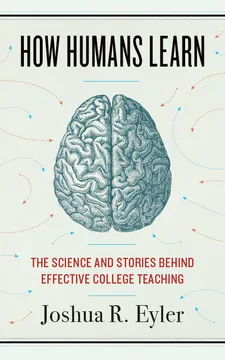
Reviews of How Humans Learn are largely positive, averaging 4.03 out of 5. Readers appreciate Eyler's synthesis of research from neuroscience, child development, and sociology, organized around five principles: curiosity, sociality, emotion, authenticity, and failure. The book is praised for its practical, non-dogmatic approach and its focus on higher education, a less common target audience. Some readers note the content isn't entirely new, and a few critique the reliance on evolutionary psychology. Overall, it's widely recommended for educators seeking evidence-based, student-centered teaching strategies.
Glossary
information gap
distance between knowing and wantingA way of describing curiosity as the distance between a person’s current knowledge and the information they want to acquire. An information gap can create motivation to investigate, ask questions, or seek an explanation. In teaching, questions that reveal a meaningful gap can make new material more compelling than simply presenting facts.
constructivism
active building of understandingA theory of learning that views learners as active participants in creating and revising knowledge. Students connect new information to what they already know, test interpretations, and develop concepts through interaction with problems and other people. Constructivist teaching can include direct instruction, but it gives learners meaningful agency in the process of understanding.
Question Formulation Technique
structured student question-makingA process developed by Dan Rothstein and Luz Santana to help learners generate, improve, and prioritize their own questions. Students work from a chosen focus, produce questions, revise them, and reflect on which are most useful. The technique gives explicit practice in inquiry, rather than assuming students already know how to frame productive questions.
social pedagogies
learning through purposeful interactionTeaching approaches that make social interaction central to learning. Students use discussion, collaboration, or communication with an audience to build and represent knowledge. In Eyler’s expanded use of the term, these approaches draw on human sociality by making learners’ interactions with instructors and peers part of the intellectual work, rather than an optional add-on.
social classroom
classroom built for belongingA learning environment organized to support belonging, community, and productive intellectual relationships. Eyler emphasizes three features: students feel that they belong, classroom management helps build community, and the instructor models effective intellectual engagement. Such an environment provides a foundation for discussion and collaborative learning.
zone of proximal development
learning possible with guidanceLev Vygotsky’s term for the distance between what a learner can do independently and what the learner can accomplish with guidance from an adult or a more capable peer. The zone varies by person and subject. Teaching can support development by offering appropriately matched help, then allowing the learner to take on more of the work.
pedagogical caring
care that supports learningAn educational relationship in which an instructor recognizes students as developing people and actively supports their learning. It includes attention, respect, useful guidance, and feedback, while maintaining professional boundaries and academic expectations. The purpose is not simply to make students feel comfortable, but to help them become more capable and self-directed.
cognitive authenticity
realistic disciplinary thinkingThe degree to which a learning task resembles the reasoning, tools, complexity, and interactions involved in meaningful work outside the classroom. A task can be authentic even when it takes place in a simulation, provided that learners engage in the relevant thinking. Realistic context helps students understand when and how knowledge can be used.
situated cognition
knowledge shaped by contextThe view that learning and thinking are closely connected to the contexts in which they occur. Students develop usable understanding by applying disciplinary concepts in meaningful situations, rather than encountering ideas only as detached definitions or examples. Teaching can support this by involving students in the kinds of questions and practices used in a field.
Peer Instruction
concept learning through peer debateA teaching method developed by Eric Mazur in which students consider a conceptual question, discuss their reasoning with peers, and reconsider their responses. The instructor uses the process to reveal understanding and misconceptions. The approach emphasizes explanation and conceptual reasoning, rather than relying only on lecture or memorized procedures.
productive failure
attempt first, then receive instructionA learning approach in which students try to solve a problem before receiving instruction on the targeted concept. Their attempts may be incomplete or incorrect, but working with prior knowledge can prepare them to learn from subsequent explanation. For failure to be productive, the problem needs useful entry points and the instructor must help students examine their reasoning.
desirable difficulties
effortful practice that strengthens learningChallenges that make learning harder in the short term but support comprehension, recall, or later application. Examples discussed in the book include spacing practice, generating answers, and interleaving different kinds of problems. These difficulties are desirable only when learners have enough background knowledge and support to respond; otherwise, they can obstruct learning.
error climate
classroom norms around mistakesThe ways students and instructors perceive, evaluate, and respond to errors within a classroom. A constructive error climate treats mistakes as useful material for learning, offers support after errors, and limits humiliation or punitive reactions. It also encourages students to take appropriate risks and analyze what went wrong.
growth mindset
belief that abilities can developA belief that abilities and qualities can grow through effort, experience, and learning, rather than being fixed permanently. In teaching, this perspective can help students interpret setbacks as information about what they need to practice or understand. It does not mean effort alone guarantees success or that structural barriers can be ignored.
stereotype threat
stereotypes that burden performanceThe risk that awareness of a negative stereotype about a group will interfere with a person’s performance when the stereotype feels relevant to the task. Research discussed in the book found that cues suggesting a mathematics test measured gender differences affected women’s performance, while removing that cue eliminated the observed gap in the study.
Download PDF
Download EPUB
.epub digital book format is ideal for reading ebooks on phones, tablets, and e-readers.








