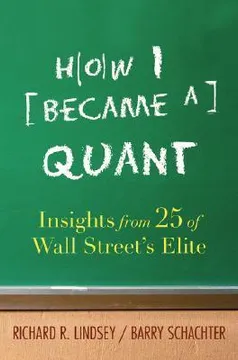


Key Takeaways
Wall Street quants are made by useful detours, not a single academic pipeline.
A quant, broadly defined, applies mathematics or computation to financial problems such as pricing derivatives, measuring risk, or analyzing investments. The contributors rarely followed a straight route into the work. David Leinweber moved from mathematics through computer science and artificial intelligence before finance clients found him useful. Gregg Berman combined physics with years of selling toys at flea markets, then left an academic path for a hedge fund. Peter Muller nearly rejected an interview because he smelled cigarette smoke in BARRA's bathroom.
Accidents still need preparation. A delayed career decision, an unexpected contact, or a new technology opened doors, but the contributors had useful skills ready when opportunity arrived. Their paths suggest that career direction can emerge through experiments with real work, not just through early declarations about who one intends to become.
What's striking is how often a seemingly irrelevant skill becomes valuable once a new context appears. This resembles the idea of career capital: transferable abilities accumulate before their eventual use is obvious. The stories also resist a tidy meritocratic myth. Luck, timing, and personal introductions matter, but preparation makes those events actionable. A practical implication is to seek low-cost experiments, such as projects, internships, or conversations with practitioners, rather than treating a career choice as an irreversible identity decision.
Start with the financial question, then learn the mathematics it demands.
Questions choose tools. Thomas Wilson says his contribution came less from mastering a particular technique than from identifying consequential questions. He studied whether market risk could be estimated for nonlinear portfolios, whether a credit model captured portfolio behavior, and whether common risk-adjusted performance measures were biased. Each problem required him to learn methods he had not previously used.
The reverse approach can mislead. Bjorn Flesaker considered importing advanced mathematical techniques into finance, but recognized that some were solutions looking for a problem. Evan Schulman likewise found that a computer model could optimize a bank's investments only after someone identified the real objective and constraints. The useful sequence is to understand the decision, define what evidence could change it, and select mathematics suited to that job.
This is close to problem-driven science: the question determines what counts as relevant evidence and which tools are worth the cost. It also guards against a common form of intellectual overfitting, where an elegant method is applied simply because it is available. Yet question-first work is not automatically objective. The person framing the question decides which outcomes matter and which constraints are visible. That makes problem definition a source of power, not merely a preliminary technical step.
Treat a spectacular backtest as a suspect, not a discovery.
Noise can impersonate insight. David Leinweber set a computer to search thousands of national statistics for the best predictor of U.S. stock returns. Over a decade of historical data, Bangladesh butter production correlated with the S&P 500 at 75 percent. Adding cheese raised the result to 95 percent, and sheep population brought it to 99 percent. The relationship was a joke with a serious warning: searching enough variables will produce impressive patterns by chance, especially when tested on the same data used to find them.
Demand a harder test. A pattern that survives in data not used to build the model is more credible, though still not guaranteed to persist. Clifford Asness describes applying value and momentum ideas across different markets as a test beyond the original U.S. stock results. A plausible mechanism, careful testing, and realistic trading costs matter more than a dazzling historical fit.
The butter example is a memorable instance of multiple testing: the more relationships examined, the more likely some will look meaningful by accident. Modern machine learning faces the same trap, often intensified by repeated tuning against a supposedly separate test set. Replication across markets can strengthen a claim, but those markets may share hidden exposures or data quirks. Strong evidence therefore combines out-of-sample performance with an explanation of why the signal might survive competition and the costs of acting on it.
Models let investors trade uncertainty instead of merely enduring it.
Risk became transferable. A derivative is a contract whose value depends on a future price, rate, or other quantity. Options existed long before modern quantitative finance, but models offered a more systematic way to estimate their value and use them to reshape exposure. The Chicago Board Options Exchange opened in 1973 with 911 contracts across 16 stocks. At roughly the same time, Black and Scholes published an option-pricing model, while advances in computing made difficult calculations more practical.
Volatility created demand. Shifting interest rates, inflation, oil shocks, and the end of fixed exchange rates made future asset values harder to predict. Investors wanted ways to transfer unwanted exposures to others. Derivatives became tools for redistributing risk, not simply novel bets. They can help one party reduce a risk, but they do not make that risk disappear from society.
The key change is conceptual: an asset can be understood as a bundle of exposures that different parties may value differently. This is a form of risk sharing, familiar in insurance as well as finance, and it can make investment or business activity possible when uncertainty would otherwise be prohibitive. The caveat is distributional. Transferring risk can improve a portfolio while concentrating exposure elsewhere, sometimes in places with less capacity to absorb losses. Better pricing does not, by itself, ensure safer outcomes.
Optimize the whole portfolio for return, risk, and the cost of execution.
Portfolio context matters. Modern portfolio theory treats risk as a property of the combined holdings, not simply a score attached to each security. Correlations matter: two individually volatile investments may diversify each other, while apparently different assets may move together. Ron Kahn and Richard Grinold describe active investing as balancing expected excess return against risk and cost. The information ratio compares active return with active risk, while the Fundamental Law of Active Management links consistency to both investment skill and the number of independent chances to apply it.
Separate real signals from proxies. Bruce Jacobs and Ken Levy's method of disentangling estimates the return associated with one characteristic while controlling for correlated characteristics, such as industry or yield. Trading costs also belong in the calculation: a forecast that looks attractive before fees and market impact may not be worth implementing.
This framework connects investment management to operations research: a portfolio is a constrained allocation problem, and the best choice depends on interactions among components. The emphasis on breadth explains why many modest decisions can be more reliable than a few dramatic predictions, provided the decisions are genuinely independent and the edge is real. In practice, independence is difficult to establish, and costs change with scale. A portfolio model is therefore most useful as a disciplined comparison tool, not as an oracle that certifies an optimum.
Make models face market behavior, imperfect data, and independent scrutiny.
A market is not a formula. Mortgage-backed securities contain borrower options to refinance or default, so their cash flows depend on behavior as well as interest rates. Andrew Davidson found that prepayment history mattered, and that borrowers' different exercise thresholds could cause prepayments to rise and then fall even when rates did not change. An option-adjusted spread, or OAS, compares a security's price with model-based values across interest-rate scenarios. Mortgage prices did not always match the theory that a correctly modeled security should have no residual spread.
Implementation needs checking too. Peter Jäckel's model-validation work showed why code deserves scrutiny: an implementation error can distort trading, risk reports, or payments. Independent checks, transparent assumptions, and comparison with observed prices help reveal what a model misses. A model may still be useful without perfectly describing the market, but its limitations should be visible to the people relying on it.
Mortgage models illustrate the difference between structural uncertainty and mere computational error. More powerful computing can improve calculation while leaving borrower behavior, changing incentives, or missing data unresolved. That distinction matters across fields: a model can be precisely solved and still answer the wrong question. Independent validation adds value because its purpose is not to certify sophistication, but to challenge assumptions, test code, and expose consequences that the model's creators may overlook.
Turn quantitative insight into a trading process people can actually execute.
Execution changes the result. Evan Schulman observed that a manager's forecast could be right yet fail to cover transaction costs. His work on program trading and electronic systems treated order size, timing, and market impact as part of the investment decision. Andrew Sterge focused on market microstructure, the way bids, offers, and incoming orders shape short-term prices. His team built trading systems around those frictions rather than relying only on closing prices.
Models need people and machinery. A strategy must be coded, connected to reliable data, made understandable to traders, and monitored in live markets. Sterge emphasizes that researchers cannot hand a formula to a desk and assume the job is finished. A model's performance depends on the systems and people that turn its signals into orders, and the resulting trading experience can reveal weaknesses that a historical test did not show.
This is the distinction between prediction and control. A forecast is only one input to a system that must act under latency, capacity limits, and human oversight. Engineering research often makes the same point: performance depends on the interface between a tool and the environment where it is used. The caution is that close integration can also create groupthink, especially when a team becomes financially invested in its own model. Independent monitoring remains valuable even when implementation is collaborative.
Assume risk estimates fail when liquidity disappears.
Risk is not just volatility. Value at Risk, or VaR, estimates a loss threshold over a specified period and confidence level. Julian Shaw argues that historical simulation can be valuable because a trader can inspect the actual past market days that produce a risk estimate. But a number based on historical observations cannot ensure that tomorrow resembles those observations. Allan Malz describes how risk can be understated when portfolios contain hidden short-volatility exposures, smoothed valuations, or incentives to increase bets after losses.
Crowded exits are dangerous. Bruce Jacobs and Ken Levy warned that strategies designed to reduce individual investors' risk, such as automatic portfolio insurance, can intensify selling when many participants use them together. Long-Term Capital Management and other leveraged strategies also showed how positions that appear low-risk in normal conditions can become difficult to unwind during stress. Liquidity, leverage, and the behavior of other investors belong in the risk discussion.
Risk measures are conditional statements, not guarantees. Their apparent precision can obscure that the underlying distribution, liquidity, and participant behavior may all change together during a crisis. This resembles systemic risk in ecology: individually sensible responses can destabilize the shared environment when many actors respond alike. Scenario analysis and transparent position-level explanations help, but no metric can eliminate uncertainty. Risk governance must also ask who can exit, who is forced to sell, and how losses travel across institutions.
Give quantitative work a business owner, not just a mathematical author.
Models have to change decisions. Stephen Kealhofer and colleagues built a database of corporate defaults after discovering that existing records often removed failed firms. Their model, later commercialized through KMV, estimated expected default frequency, or EDF, for companies. But adoption required more than a statistical result: banks needed to understand how default probabilities could improve portfolio management and credit decisions.
Translate analysis into practice. Thomas Wilson stresses that models matter when they inform strategic choices, while Leslie Rahl's work in trading and risk management shows the value of combining quantitative tools with judgment and market knowledge. A model that no one understands, trusts, or uses may be technically impressive and operationally irrelevant. The relevant test is whether it improves a decision while making its assumptions and accountability clearer.
The adoption story is organizational as much as technical. A model redistributes authority: it can make judgments comparable, reveal inconsistent practices, and challenge experienced decision-makers. That creates resistance as well as value. Research on technology adoption repeatedly finds that tools work better when users can inspect their outputs and connect them to existing tasks. Yet acceptance should not be confused with truth. A business owner should be accountable both for using a model and for recognizing when its evidence no longer fits the decision.
Analysis
This collection is less a textbook than a field report from a profession being invented. Its contributors arrive from physics, mathematics, engineering, business, and economics, then discover that financial work rewards neither abstract brilliance alone nor commercial instinct alone. The recurring craft is translation: from uncertainty into a model, from a model into a decision, and from a decision into a process that can survive trading costs, scrutiny, and institutional resistance.
The book's strongest contribution is its portrait of quantitative finance as empirical and operational. The butter-and-sheep correlations expose the seduction of data mining. Mortgage prepayments show that behavior can defeat elegant assumptions. Trading stories reveal that implementation details and liquidity can dominate a model's theoretical promise. Together, these examples make a more persuasive case for quantitative work than any claim that mathematics has made markets fully predictable.
There is also a productive tension between rigor and judgment. Some contributors celebrate systematic rules and broad diversification; others emphasize market intuition, context, and the limits of formal models. These positions are not contradictory so much as complementary. Rules can prevent inconsistent decision-making, while judgment can identify when the data or assumptions have changed. The danger lies in treating either one as sufficient.
The anthology's limits deserve notice. Its successful contributors are survivors, so the collection cannot tell readers how often similar training or strategies failed. Its 2007 setting also predates major later changes in markets and computing. And while it explains how risk can be priced and shifted, it spends less time asking who ultimately bears that risk when models are wrong. The durable lesson is not that quants can master uncertainty, but that disciplined measurement, honest testing, and sound implementation can make decisions more explicit and less arbitrary.
Glossary
Quant
Mathematical finance specialistA quant is a person who applies mathematical, statistical, or computational methods to financial problems. The work can include pricing derivatives, measuring risk, analyzing investments, or developing trading systems. The contributors use the term broadly: being quantitative is an approach to work, not necessarily one fixed job title or academic background.
Fundamental Law of Active Management
Skill multiplied by opportunitiesA framework associated with Richard Grinold that relates an active manager's consistency to two ingredients: skill in making investment decisions and breadth, or the number of independent decisions available. Its practical implication is that a modest edge can become valuable when applied across many genuinely independent opportunities. Correlated bets do not provide the same breadth.
Information ratio
Active return per active riskThe information ratio compares a portfolio's return above its benchmark with the risk of that active return. In the book's account, it measures the consistency of an active manager's performance relative to the benchmark. A higher ratio indicates more active return for each unit of active risk, though it depends on sound estimates and meaningful comparisons.
Disentangling
Separating overlapping return signalsJacobs and Levy use disentangling for the simultaneous analysis of multiple characteristics that may predict stock returns. Instead of measuring one feature in isolation, the method controls for correlated features, such as industry, yield, or company size. This helps distinguish a characteristic's independent association with returns from effects it merely appears to represent.
Option-adjusted spread (OAS)
Model-based spread for optional bondsAn option-adjusted spread compares a security's market price with values produced by modeling possible interest-rate paths and the security's embedded options. It is used for instruments such as mortgage-backed securities, whose cash flows can change when borrowers refinance or default. The result depends on assumptions about rates, borrower behavior, and prepayments.
Value at Risk (VaR)
Estimated loss thresholdVaR estimates a portfolio loss threshold over a specified time horizon and confidence level, using a model or historical observations. It became widely used for measuring market risk and informing regulation. The contributors emphasize that VaR depends on its data and assumptions, may understate extreme events, and should not be mistaken for a maximum possible loss.
Expected default frequency (EDF)
Estimated likelihood of corporate defaultEDF is the term Kealhofer and colleagues used for a model-based estimate of a company's probability of default over a specified horizon. Their work combined a structural view of a firm's assets and liabilities with empirical default data. The estimate was designed to support credit analysis and portfolio management, rather than merely rank firms by perceived credit quality.
Download PDF
Download EPUB
.epub digital book format is ideal for reading ebooks on phones, tablets, and e-readers.








