

Key Takeaways
Treat hard cases as lawmaking, not as rule application in disguise.
Rules have limits. In routine disputes, statutes, precedents, and established procedures often point to a workable answer. But vague constitutional language, conflicting precedents, and unforeseen facts leave many appellate cases without a decisive legal instruction. Posner calls this discretionary space the open area. Judges must still decide, so their experience, values, and judgments help determine what the law becomes. They are occasional legislators, constrained by legal materials and judicial norms, but not merely their passive transmitters.
The stakes are uneven. Most cases are routine, and legal rules do real work. The important distinction is that the cases that shape doctrine and affect society are especially likely to be the ones where rules run out. The Sherman Antitrust Act, for instance, is so general that courts have built much of its practical meaning through decisions.
The useful distinction is not between law and lawlessness, but between cases where rules settle the result and cases where judges must choose among plausible options. That distinction makes judicial discretion easier to discuss without treating every decision as political theater. It also raises a democratic question: if judges help make law, how should their choices be checked? Posner’s answer begins with professional norms and institutional limits, but the open area remains large enough that legal accountability cannot rest on the comforting fiction that judges only apply rules.
Judge incentives shape decisions even when salaries cannot buy obedience.
Judges are workers. Posner unifies theories of judicial behavior by treating judges as participants in an unusual labor market. They seek familiar rewards, including income, leisure, status, power, and self-respect. Many also want to do work they and their peers consider good. Federal judges receive strong job security, fixed salaries, and few promotion opportunities, so ordinary workplace incentives have limited force. The President and Senate want judges who are competent and independent, while also hoping to appoint people whose views align with their own.
The job pays in other ways. Authority, public respect, interesting work, and freedom from clients can make judging attractive despite lower pay than private practice. Posner also describes the market as monopsonistic: the federal government is effectively the sole employer of federal judges. Raising salaries might therefore change who seeks the job without necessarily improving judicial performance.
This account connects judicial behavior to a broader problem in organizational design: independence protects an agent from improper control, but it also makes performance harder to monitor. The judiciary cannot simply copy a company’s bonus system without risking political pressure on decisions. Posner’s emphasis on reputation and professional pride helps explain why judges still work hard despite weak material incentives. Yet those motives are difficult to measure, and a desire to be seen as a good judge can reward polished reasoning as much as sound judgment.
Political judging is usually ideological, personal, and unconscious, not partisan.
Party is a rough proxy. Studies find that a judge’s decisions in politically charged cases often correlate with the party of the President who appointed the judge. But appointment party does not explain every vote, and many cases have little political content. Judges may be influenced by ideology, professional experience, personal background, or temperament without consciously asking what a party or President would prefer.
Prior beliefs shape evidence. Posner uses Bayesian decision theory to explain how a judge’s prior expectations affect the interpretation of new information. A judge deciding whether a witness is credible brings experience-based expectations to the testimony; another judge may interpret the same evidence differently. These priors can be unconscious and still influence outcomes. That does not make every difference prejudice, but it does mean that neutrality cannot require thinking without preconceptions.
The distinction between partisan loyalty and ideological influence is essential. It allows the evidence of patterned voting to be taken seriously without assuming judges are party operatives. The Bayesian analogy also clarifies why sincerity is not proof of neutrality: people can reason carefully from starting assumptions they do not notice. Still, a correlation between appointment party and voting does not identify the cause. Selection effects, professional networks, and historical moment may all contribute, so the findings should inform institutional analysis, not become a label for each judge.
Test judicial intuition against opposing arguments before turning it into doctrine.
Experience thinks quickly. Judges hear arguments, draw on years of legal and professional experience, and often form an initial view before drafting an opinion. Posner treats intuition not as a random hunch but as compressed reasoning that draws on knowledge accumulated through practice. In difficult cases, however, intuition can also reflect emotion, stereotypes, or mistaken assumptions.
Opinions can check a first impression. Writing requires a judge to give reasons that can be examined by colleagues, lawyers, and the public. But the vote often comes first, so research for the opinion may become a search for support rather than a genuine test of the initial view. The adversarial process and dissent can expose overlooked arguments, though the check is imperfect. A narrow opinion can also preserve room to reconsider an issue when more facts arrive.
Expert intuition is valuable when a decision is complex and time is limited, but expertise does not immunize a person from confirmation bias. The strongest safeguard is not simply more analysis. It is structured exposure to credible opposition, with enough independence that disagreement is not punished as disloyalty. Posner’s account of opinion writing is especially useful here: reasons matter even when they did not generate the decision, because public reasons constrain future cases. The limitation is that a persuasive explanation can make a weak conclusion look more inevitable than it was.
Precedent narrows discretion, but interpretation decides how much it narrows.
Analogy does not decide. In Adams v. New Jersey Steamboat Co., a court treated a locked steamboat cabin like an inn room, where the operator could protect a guest’s belongings. An earlier railroad case involved open sleeping berths, where the railroad had less ability to guard passengers from theft. The useful question was not which setting looked most similar, but whether the policy behind the earlier rule applied to the new facts.
Rules need interpretation. Judges can distinguish a precedent, limit its reach, or choose among competing precedents. They can also decide whether a rule’s purpose fits a new situation. These choices may preserve the law’s continuity, or use continuity as cover for changing it. Posner argues that precedent constrains judges, but does not mechanically determine outcomes in difficult cases.
The steamboat example shows how comparison can uncover a relevant feature, such as who can prevent a loss, without supplying the final legal judgment. In that sense, analogy is a tool for generating questions, not an algorithm for answering them. This is consistent with how reasoning works in science and engineering: a comparison suggests a model, then testing reveals where the model fails. The caution is that policy can also be selected to justify a preferred result. A judge must explain why a feature matters, not merely point to a convenient resemblance.
Use practical consequences, while keeping the judge inside the judicial role.
Pragmatism is bounded. Posner’s constrained pragmatist considers how a decision affects the parties, future cases, legal predictability, and the functioning of institutions. That is not permission to decide however one wishes. Judicial norms rule out some considerations, such as a judge’s preference for one presidential candidate over another. Precedent and statutory language also matter, even when they do not settle the case.
Aim for a defensible range. Posner’s idea of a tolerable window is that a judge may not be able to calculate the single best policy, but can sometimes tell that one option is clearly worse. In Yi v. Sterling Collision Centers, the court traced a confusing requirement for “clear and affirmative evidence” back to a simpler principle: statutory exemptions should not be read so broadly that they defeat the law’s purpose. The practical question clarified the inherited formula.
Pragmatism is strongest when it disciplines attention: it asks what a rule is trying to accomplish and what a decision will do beyond the immediate dispute. That resembles decision analysis in public policy, where a precise optimum may be unavailable but dominated choices can still be rejected. Posner is right that this is not an anything-goes method. Its weakness is that reasonable people can value consequences differently, and judges may lack reliable evidence about them. Practical reasoning needs explicit assumptions, not just confident appeals to common sense.
Change the institution before expecting judges to become different people.
Different systems create different judges. Private arbitrators may split the difference to remain acceptable to future clients. Career judiciaries use promotion and detailed codes to encourage conformity. Elected judges face voter pressure and campaign fundraising, which can bias decisions in politically salient cases. U.S. federal judges have life tenure and few external rewards or penalties, leaving reputation, professional norms, and workload as important constraints.
Colleagues matter too. Appeals courts decide cases in panels, where maintaining working relationships can shape decisions. Posner calls the reluctance to issue dissenting opinions dissent aversion. A judge with an intense preference may persuade colleagues who care less about the outcome to avoid conflict or a dissent. This can moderate a panel, but it can also substitute collegial convenience for stronger reasoning. Institutional reforms therefore involve trade-offs, not simple fixes.
The comparison across judicial systems makes independence look less like a universal setting and more like a design choice. Career promotion can secure compliance while narrowing innovation; elections increase accountability while exposing courts to campaign pressures. Neither arrangement removes judgment from judging. The same is true of proposed performance rankings: measures can reward speed or citation counts while displacing work that is harder to count. Institutional reform is most promising when its target is specific, such as improving information or reducing conflicts, rather than promising to eliminate discretion.
The Supreme Court legislates most when constitutional text offers least guidance.
The Court rarely corrects errors. In the figures Posner reports, the Supreme Court reviewed about 2.4 percent of federal appeals decided on the merits in 1960, but about 0.27 percent in 2004. The Court therefore cannot supervise lower courts case by case. It tends to use the few cases it hears to announce rules with broad future effects, especially in constitutional disputes.
Politics enters through both judgment and appointments. The Constitution is old, difficult to amend, and often open-ended. In 2005, replacing Justice O’Connor with Justice Alito changed the Court’s balance and helped produce a rightward shift in close decisions. Precedent and public opinion still constrain the Justices, and political backlash can prompt legislative responses, as after Kelo. But these checks do not turn constitutional decisions into mechanical applications of law.
The sharp decline in review rates helps explain why the Court behaves differently from an ordinary appellate court: it is shaping the rules for a vast body of litigation it cannot inspect directly. That makes broad rulings powerful but risky. The appointment example also shows that constitutional doctrine can change without any amendment to the text. Posner’s account is persuasive about the Court’s political character, though the term can obscure the different mechanisms involved, including ideology, precedent, public reaction, and strategic restraint.
No constitutional theory can erase the politics it claims to discipline.
Theories do not apply themselves. Originalism asks judges to interpret constitutional language through its historical meaning; Stephen Breyer’s active liberty approach asks them to consider democratic participation and practical consequences. Posner argues that each leaves room for judges to choose which history, purpose, or consequence matters. A theory can organize a judge’s reasoning, but it cannot resolve every conflict among legal materials or prevent personal views from influencing interpretation.
Brown exposes the problem. The Supreme Court’s decision to end public school segregation became accepted as right, but Posner argues that its result was not compelled by a literal reading of the Equal Protection Clause or by the precedent then in force. The decision rested on a political and moral judgment about segregation’s purpose and effects. That judgment may have been sound, but calling it inevitable legal interpretation hides what the Court had to decide.
Comprehensive theories can still be valuable as public commitments. They give critics a standard against which to test a judge’s consistency, even if they do not dictate results. The danger comes when a flexible theory is presented as a neutral machine, since that makes discretionary choices harder to scrutinize. Brown also warns against treating legal indeterminacy as proof that any outcome is equally defensible. Historical context, institutional consequences, and the injuries a rule sustains can support a judgment without converting it into a deduction.
Foreign judgments can teach, but they cannot vote in American law.
Comparison is not authority. Posner distinguishes learning from foreign legal experience from treating foreign decisions as persuasive authority in U.S. constitutional cases. Other countries can serve as laboratories, but their courts operate under different histories, appointment systems, and amendment rules. A foreign ruling on abortion or capital punishment cannot be understood simply by counting how many courts reached the same result.
Context changes meaning. Posner points to Israeli Chief Justice Aharon Barak, who claimed broad powers for Israel’s Supreme Court, including review of government action without the usual U.S. standing limits. Israel’s institutional setting differed substantially from America’s. Barak’s reasoning may have suited his country’s circumstances, but importing it as a model would obscure the political choices embedded in it. Judicial cosmopolitanism can look like consensus while hiding these differences.
Comparative law is most useful when it asks how institutions work, not when it treats a foreign holding as a vote in a global poll. A policy that succeeds under one country’s electoral system, constitutional amendment process, or political crisis may fail elsewhere. The comparison can still reveal options that domestic debate overlooks. The necessary discipline is to translate the institutional context before borrowing a conclusion. Otherwise, citation becomes decoration: it lends prestige to a choice without explaining why the foreign experience should govern at home.
Train advocates to explain the stakes, not merely recite cases.
Judges need usable information. Federal appellate judges are generalists facing heavy workloads; law professors can specialize and choose their subjects. Posner argues that academic writing has grown more distant from judicial work, while law schools often teach opinions as though their stated legal reasoning fully explains how judges decide. Many opinions also rely heavily on law clerks, a fact that standard teaching tends to hide.
Better advocacy starts with purpose. Lawyers should explain what a legal rule is meant to achieve, how the facts bear on that purpose, and what consequences follow from each proposed outcome. Posner urges more attention to legislative facts, such as the background information relevant to policy, rather than only precedent citations. He also calls for critical studies of judicial decisions that compare opinions with records, briefs, and court practice, rather than relying on rankings alone.
This is the book’s most practical lesson for lawyers and teachers. A judge with little time does not need a longer pile of citations as much as a clear account of what is at stake and why a rule fits the facts. The recommendation also links legal education to empirical literacy: lawyers should be able to assess data and communicate uncertainty. Yet advocacy should not become unbounded policy lobbying. Legal texts and precedent remain part of the case, and effective argument shows how consequences can be considered without pretending those materials are irrelevant.
Analysis
Posner’s central contribution is a shift in the question. Instead of asking whether judges obey law or impose politics, he asks what happens when legal materials do not determine an acceptable outcome, and what personal and institutional forces shape the choice. This makes the book both realist and institutional: legal uncertainty creates discretion, while career structures, professional norms, selection, and psychology channel it. The argument is most powerful when it resists two caricatures at once. Judges are neither impartial calculators nor unconstrained politicians. Routine cases can be rule-governed, while consequential appellate cases often require judgment that cannot be reduced to rules.
The labor-market model also clarifies why independence is double-edged. Strong insulation from removal and salary pressure protects adjudication from direct political retaliation, but weakens the tools available to correct poor performance. Reputation and professional identity fill some of the gap, though they are difficult to assess and can reward institutional conformity. This tension makes Posner’s discussion of reform more credible than calls for either perfect independence or strict supervision.
A limitation is that the book’s economic vocabulary can make motivations sound more measurable than they are. A judge’s desire for status, leisure, or self-respect cannot by itself explain a particular vote. Posner’s Bayesian account helps describe how predispositions filter evidence, but correlations between background, appointment, and outcomes do not establish which mental mechanism caused a decision. The theory is strongest as a map of influences, not as a case-by-case prediction engine.
The normative question remains unsettled: if pragmatism is inevitable, what makes one exercise of discretion better than another? Posner points to consequences, legal stability, role boundaries, and social consensus, but these can conflict. That is not a defect unique to his account. It is the institutional problem the book exposes. The most productive response is not to demand a fictitious return to mechanical judging, but to make the assumptions, evidence, and trade-offs in hard cases more visible and contestable.
Review Summary
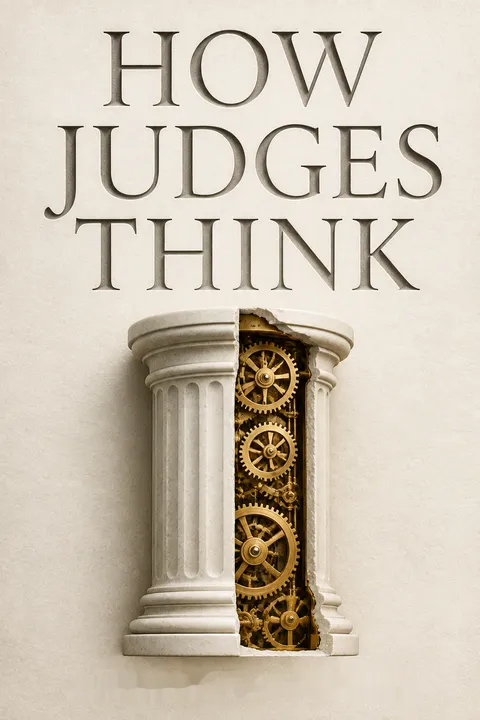
How Judges Think explores judicial decision-making, balancing political, personal, and legal factors. Posner critiques various judicial approaches, advocating for pragmatism. Readers found the book insightful but occasionally rambling and dense. It offers a nuanced view of the judicial process, challenging simplistic notions of judges as neutral arbiters. While some praised Posner's writing and analysis, others felt it was self-indulgent. The book is recommended for those interested in law and judicial philosophy, though its complexity may deter casual readers.
Glossary
Open area
space for judicial choiceThe set of cases in which statutes, constitutional text, precedent, and established legal methods do not produce an acceptable or determinate answer. Judges must still decide these cases, so policy judgments, ideology, experience, and personal characteristics can influence the result. Posner argues that this discretionary space is especially important in appellate and constitutional cases.
Occasional legislator
judge who makes lawPosner’s term for an appellate judge who must sometimes create or revise legal rules while resolving disputes. The judge is not a legislator in the ordinary institutional sense: cases, standing rules, precedent, professional norms, and limited investigative powers constrain the work. The term highlights that judging can include lawmaking when existing legal materials fail to settle a case.
Legalism
rule-based judgingThe view that judicial decisions should be determined by preexisting legal rules and authoritative texts, such as statutes, constitutional provisions, and precedent, applied through accepted legal methods. Posner treats legalism as influential in routine cases but incomplete as a description of difficult cases, where rules may be vague, inconsistent, or silent.
Constrained pragmatist
consequence-minded, role-bound judgePosner’s description of a judge who considers the practical effects of decisions while remaining bound by judicial norms, legal materials, and institutional responsibilities. Such a judge may assess policy consequences, but cannot treat every consideration as permissible. The approach rejects both mechanical rule application and unrestricted, case-by-case policymaking.
Bayesian decision theory
belief updated by evidenceA framework for describing how prior expectations combine with new evidence to shape a person’s judgment. Posner applies it to judges: experience, ideology, and background can create prior beliefs that influence how testimony or legal arguments are assessed. The process need not be conscious or numerically calculated to affect a decision.
Judicial utility function
judges’ valued rewardsAn economic model of the goods that influence a judge’s choices. Posner includes salary, leisure, power, prestige, reputation, self-respect, and satisfaction in the work. The concept helps explain why judges may work hard despite weak external incentives, and why different career structures can affect both the people who seek judging and their behavior once appointed.
Dissent aversion
reluctance to dissentA tendency among judges to avoid publishing a dissenting opinion because dissent takes time, may strain collegial relationships, and can draw attention to a majority ruling. In a small appellate panel, a judge with a strong preference may use the prospect of dissent to influence colleagues who care less about the outcome.
Tolerable windows
acceptable range of outcomesPosner’s idea that a judge may be unable to identify the single optimal policy but can sometimes recognize a range in which outcomes are acceptable, and options outside it are clearly worse. The method allows practical judgment under uncertainty without claiming that courts can calculate a perfect social result.
Monopsony
single dominant buyerA market condition in which one employer or buyer has unusually strong control over the terms offered to workers or sellers. Posner applies the term to federal judging because the federal government is effectively the only employer of federal judges. The lack of competing employers helps explain why judicial salaries can remain below private-sector legal incomes.
Judicial cosmopolitanism
foreign rulings as authorityThe practice of treating foreign judicial decisions as persuasive authority in domestic constitutional cases, on the theory that courts may share a broader legal outlook. Posner distinguishes this from studying foreign experience for information. He argues that foreign decisions arise from different histories and institutions and therefore should not automatically guide American constitutional interpretation.
About the Author
Other books by Richard A. Posner

Download PDF
Download EPUB
.epub digital book format is ideal for reading ebooks on phones, tablets, and e-readers.








