

Key Takeaways
Turn ambitious objectives into numbers a real campaign can actually reach
Start with the business. A brief once demanded that a famous brand add 13 percentage points of penetration and recover market share lost over a decade, yet offered no new positioning, audience, channel, or budget. The ambition had no credible route to reality. The book’s remedy is to connect business goals, customer behavior, and communication: define the sales or profit outcome, identify what people must do differently, then decide how many people must be reached and what message or feeling could help. Check the arithmetic before creative work begins, and make budgets part of the plan.
Measure the right steps. John Lewis’s Christmas advertising is presented as a model because its business, marketing, and communication objectives were linked to specific indicators. The point is not to make every forecast exact. It is to discover early when the requested result exceeds what the strategy and resources can plausibly deliver.
A useful plan is a causal argument, not a wish list. Each link should be open to challenge: if awareness rises, why should purchasing change, and by how much? Making those assumptions visible gives teams a chance to revise the strategy before sunk costs and internal politics make revision painful. Precision has limits, especially in markets affected by competitors or economic shocks, so forecasts should be treated as scenarios rather than promises. Still, even rough arithmetic can expose a brief that is asking communication to perform a miracle.
Grow by reaching more category buyers, not by chasing perfect loyalty
Count buyers, not devotion. The authors argue that brands usually grow chiefly by increasing penetration, meaning the proportion of category buyers who buy the brand. Conventional loyalty measures, such as purchase frequency or retention, rarely shift much through advertising. Most people buy several brands in a category, so a brand’s customers are not a captive tribe. They are also other brands’ customers.
O2 shows the distinction. In 2004, O2 advertised improved service and rewards to existing customers and reported an 80:1 return. Yet the campaign ran in mass media, and its main commercial effect was attracting new customers. The company itself described the existing-customer message as a more effective way to win new ones. Warmth toward a brand can matter, especially if it supports a higher price, but it should not be confused with exclusive purchasing.
This reframing corrects a common measurement error: a stable customer relationship and repeat purchasing are not the same thing. A buyer may feel positive toward a brand while buying a competitor next time because of availability, habit, or price. The broader growth lens also reduces the temptation to treat customers as property. The claim is strongest for established, frequently purchased categories, the terrain emphasized in the book. Subscription services, contractual products, and categories with meaningful switching costs may require a more prominent retention strategy.
Treat product, price, and availability as strategy, not someone else's department
Communication is only one lever. The book uses the four Ps, product, price, place, and promotion, to remind planners that an ad cannot rescue an inconvenient product, an unsuitable price, or poor distribution. Availability affects both the chance of purchase and the chance that a brand comes to mind. Felix cat food, for example, used advertising to lift demand, which helped retailers give it more shelf space. Its market share eventually grew fivefold, and stronger brand demand also allowed price increases.
Beware easy sales spikes. Promotions may lift immediate sales by 30 to 70 percent, but the cited IRI analysis found 84 percent unprofitable even in the short term. Stockpiling, sales shifted between stores, and discounts on purchases that would have happened anyway can erase the apparent gain. Repeated deals can also teach shoppers to wait for a lower price.
The practical insight is organizational as much as strategic: marketing results depend on decisions made across departments, so planners need enough commercial fluency to question them. A campaign that increases demand can improve distribution and price tolerance, creating a reinforcing loop. Promotions can still be appropriate for trial or genuinely incremental consumption, but their economics should include margin, cannibalization, and post-promotion sales. Counting units sold during a discount period is not the same as counting profit created.
Build memory and feeling, not elaborate arguments for people who aren't listening
Most choices are low-attention. The authors use Daniel Kahneman’s distinction between fast, automatic thought and slower, deliberate reasoning to explain why shoppers rarely work through the tidy decision trees marketers put on slides. Many choices are guided by habit, feeling, and association; conscious reasoning often arrives afterward to justify them. Most people also spend little time thinking about brands, because brands are useful shortcuts, not hobbies.
A shaver ad illustrates the point. Philips advertised a moisturizing electric shaver with a sensual, dreamlike film and no conventional product explanation. Tracking measures for communication were weak, yet the campaign doubled market share in six months. The book argues that emotional brand advertising can shape preference before a person is actively shopping, while product facts are more useful when someone is close to deciding.
The distinction helps match a communication task to the audience’s attention. A person browsing casually may respond to a memorable association; a person comparing specifications may need clear facts. Treating every ad as a miniature sales presentation ignores cognitive effort and context. The argument should not be taken to mean that information never matters. In unfamiliar, regulated, or high-risk purchases, clear evidence can reduce uncertainty. The stronger lesson is that facts work best when delivered at a moment and in a format where people can use them.
Make the brand unmistakable through creative assets, not forced uniqueness
Distinctive beats different. The book separates functional differentiation from distinctive expression. A brand need not claim a benefit competitors cannot claim if it can make familiar category ideas recognizably its own. Walkers built a long-running campaign around the broadly shared idea that its crisps are irresistible, while presenting it in a distinctive way. Comparethemarket.com entered a crowded field of similar price claims with a memorable meerkat character, and achieved its 12-month objectives in nine weeks.
Execution carries meaning. Casting, timing, music, and small visual details can shape how an ad feels and whether people remember the brand. The authors cite evidence that prominent music can increase campaign effectiveness by 20 to 30 percent. A round tea bag also helped Tetley stand out, despite offering no obvious functional advantage. Sometimes the detail is the difference people actually notice.
Distinctive assets solve a retrieval problem: when a person sees an ad, can they quickly connect it to the right brand? That is different from proving the brand is objectively superior. A memorable character, sound, or color can give a brand a reliable signature, while the creative idea supplies interest. This is not a license for arbitrary weirdness. The execution still needs a credible link to the brand or category, and a genuine product advantage should be stated plainly rather than hidden behind style.
Use evidence to challenge your hunch, then measure sales rather than proxies
Numbers need a backstory. A precise result is only as trustworthy as the questions, sample, and conditions that produced it. Long questionnaires can turn quick, intuitive reactions into deliberate answers that do not resemble real shopping. Focus groups can reveal emotion and hesitation, but only if researchers interpret more than the literal words. The authors also warn that correlations do not establish cause: people who recognize an ad may already know and buy the brand, rather than buying because they recognized the ad.
Prefer a real comparison. A controlled exposure test compares similar groups, with advertising shown to one group and withheld from another. For broader effects, sales and profit data, econometrics, and long-term market trends offer stronger evidence than clicks or awareness alone. The Wall’s ice cream campaign produced 2.7 million extra sales; comparing media impressions and sales contributions clarified what each channel actually delivered.
The book’s best research principle is methodological humility: ask how a number was made before letting it settle a decision. That stance is especially valuable when many metrics are available, because the easiest measure can quietly become the goal. Controlled tests improve causal reasoning, while qualitative work can explain why a result occurred. Neither method is infallible. Tests may miss social spillover, and econometric models depend on assumptions. Multiple kinds of evidence, interpreted against actual business outcomes, make a sturdier case than one impressive chart.
Meet the people who buy your brand, especially those your office overlooks
The agency is not the market. Planners can mistake their own lives for typical ones, then build strategies around the media, ages, and habits familiar to colleagues. The authors describe visiting women in their sixties outside London and realizing how little direct contact the agency had with people unlike itself. They argue that brand buyers within a category often resemble one another more than segmentation studies suggest, and may buy several competing brands.
Age is a commercial fact. In the UK figures cited, people over 45 outnumber 16-to-24-year-olds by about four to one and account for more than half of consumer spending. Grandparents are also active buyers and caregivers, not simply frail retirees. The advice is practical: examine representative demographic data, get outside the office, and distinguish life-stage differences from lasting generational change.
Direct contact is not just an empathy exercise. It can expose mistaken assumptions before those assumptions become a media plan or a product brief. Demographic averages should still be handled carefully: older people are not one uniform segment, and age alone does not explain an individual’s needs or resources. The useful combination is representative data plus observation and conversation. Data shows how common a behavior is; listening helps explain what it means in someone’s actual life.
Buy broad reach before polishing targeting or counting digital engagement
Scale creates the chance to grow. The authors argue that brands generally need to reach many category buyers, not only a narrow target or a small group of supposed influencers. Social sharing can amplify a campaign, but it rarely replaces paid exposure. In the book’s example, even a vast base of Facebook fans represented a tiny share of a major brand’s users, and very few fans actively posted about it.
Do not call every untargeted exposure waste. A television campaign may reach people who are not shopping today but could buy later, or influence the people around current buyers. One client’s direct mail cost 92 pence per target customer reached, compared with 3 pence for television, even though half the television audience was outside the defined target. The point is to compare total effect and cost, not assume precision is automatically efficient.
Broad reach and precise targeting solve different problems. Reach helps build familiarity across a market; targeting can make an immediate offer more relevant to someone ready to act. Confusing the two encourages brands to optimize the easiest short-term response and neglect future buyers. The book’s case for mass communication is strongest when a brand needs broad growth and media costs support it. Narrow targeting remains sensible when the objective is specific, the audience is reachable, and the added cost is justified by incremental results.
Keep winning campaigns recognizable long enough for memory to compound
Familiarity is an asset. Felix’s black-and-white cat appeared consistently across advertising and packaging from 1989 onward. The campaign evolved, but the recognizable character remained. Felix grew from a small brand facing possible removal from supermarket shelves to a major competitor that overtook Whiskas in its core market. The book contrasts this with Whiskas’s frequent creative changes, arguing that continuity helped Felix build associations efficiently over time.
Novelty has a cost. A campaign may need refreshing, but replacing its recognizable cues can make it harder for people to identify the brand. The authors point to Tropicana’s US packaging redesign, which changed familiar design elements and was quickly reversed after sales fell. They also describe wear-in: the process by which an initially unfamiliar campaign becomes more effective as people encounter and learn it.
Consistency lets each exposure build on the last instead of asking the audience to start over. This resembles cumulative learning: repeated, stable cues make retrieval easier and can lower the effort needed to recognize a brand. Yet continuity should not become nostalgia for work that no longer performs or fits the market. The useful distinction is between preserving core memory cues and repeating every execution unchanged. Refreshing the expression while retaining what people recognize can protect accumulated value without freezing a brand in time.
Maximize profit, not ROI, and treat learning as part of the budget
Efficiency can hide a smaller prize. A campaign spending £10 million to produce £1 million in net profit has a 10 percent return on investment. A campaign spending £100,000 to produce £50,000 has a 50 percent return, but contributes far less profit. ROI is a ratio of return to spending; profit measures the amount created. Chasing the higher ratio alone can therefore shrink a brand’s total gains.
Learn from failure, not just success. Pepsi’s Refresh Project replaced major television spending with a social campaign that earned substantial online attention but did not sustain sales. Pepsi and Diet Pepsi each lost around 5 percent market share in a year, and the company returned to television advertising. The authors’ larger argument is that marketing needs evidence and financial discipline, but also creative judgment, room to test, and an honest record of what worked.
Metrics do not merely describe choices; they shape them. When teams are rewarded for a ratio, they may rationally cut investment even when additional spending could generate more total value. A profit-centered view corrects that distortion, while disciplined testing limits the risk of simply spending more on hope. The balance matters: experiments should be small enough to learn from without endangering the business, but large enough to produce interpretable evidence. A culture that hides failure loses the information needed to make the next decision better.
Analysis
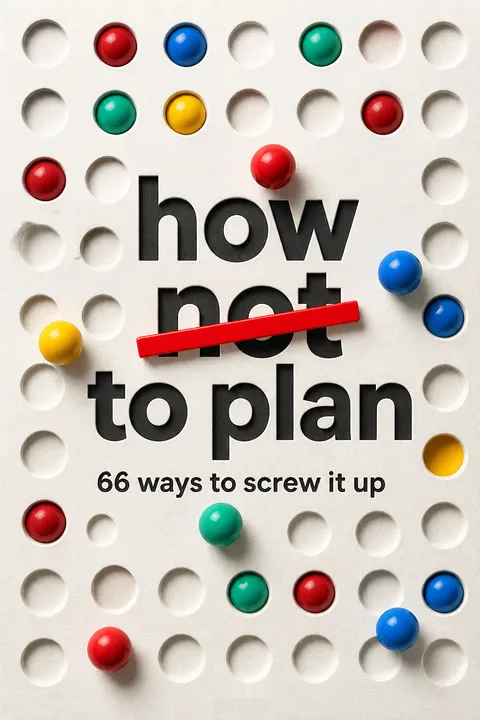
How Not to Plan is a collection of 66 practical objections to marketing habits that look sensible inside organizations but often fail against real buying behavior. Its organizing argument is that effective planning requires two kinds of discipline at once. Commercial discipline makes objectives, budgets, distribution, reach, and evaluation answerable to business results. Creative discipline recognizes that people are distracted, emotionally guided, and rarely eager to hear a brand’s carefully arranged argument. The book rejects both wishful marketing and overconfident measurement.
Its strongest contribution is the repeated separation of concepts that business language tends to blur: loyalty from repeat purchasing, differentiation from distinctiveness, efficiency from effectiveness, correlation from causation, and an audience’s stated preference from its behavior. These distinctions matter because they expose how a metric or phrase can quietly steer strategy toward the wrong task. The examples make the argument memorable: O2’s apparent loyalty campaign gained customers, Felix built value through continuity, and a high-profile digital initiative generated attention without protecting sales.
The book is also a defense of commercial creativity. Emotion, humor, casting, music, and recognizable assets are not decorative extras. They can help advertising be noticed, remembered, and associated with the brand. At the same time, the authors insist that creative freedom needs a commercial frame: clear objectives, adequate reach, and post-campaign learning.
The evidence is drawn heavily from advertising effectiveness cases and established packaged-goods markets. That gives the recommendations empirical texture, but also sets boundaries. Subscription businesses, novel categories, and products with high switching costs may behave differently from everyday brands. Some figures about media and platform behavior are specific to the period covered by the 2018 edition and should not be treated as current measurements. The durable value is the method: test assumptions, distinguish the outcome from its proxy, and let evidence inform rather than replace judgment. The result is not a formula for planning. It is a sharper set of questions for avoiding expensive self-deception.
Review Summary
How Not to Plan receives overwhelmingly positive reviews, with readers praising its practical insights, data-backed advice, and myth-busting approach to marketing and advertising. Many consider it essential reading for marketers, planners, and advertising professionals. Reviewers appreciate the book's clear explanations, real-world examples, and challenging of conventional wisdom. Some criticize its focus on traditional advertising and occasional repetitiveness. Overall, readers find it an invaluable resource that improves their understanding of effective marketing strategies and brand communication.
People Also Read









Glossary
System 1 and System 2
Fast and deliberate thoughtA distinction popularized by psychologist Daniel Kahneman. System 1 refers to fast, automatic, associative processing that operates with little conscious effort. System 2 refers to slower, deliberate reasoning that requires attention. The book uses this distinction to explain why many brand choices depend more on feelings, habits, and associations than on conscious comparison of product claims.
mental availability
Ease of coming to mindThe ease with which a brand comes to mind when someone encounters a buying situation or category. Mental availability is built through exposure and memorable associations, including distinctive brand cues. The book treats it as a major contributor to brand choice: a familiar brand is more likely to be considered, especially when people make quick, low-attention decisions.
Share of Voice (SOV)
Brand's share of paid exposureA measure of a brand’s advertising presence relative to competitors, generally based on paid media exposure or spend. The book compares SOV with Share of Market, the brand’s share of category sales. Its cited research finds that brands with a greater SOV than their market share are more likely to grow, while inadequate advertising presence can contribute to decline.
penetration
Share of category buyersThe proportion of people who buy a brand within a defined category and period. In the book’s account of established markets, increasing the number of people who buy a brand is usually a more responsive route to growth than trying to make existing customers buy more often. Penetration is therefore distinguished from purchase frequency and other conventional loyalty measures.
Mephisto Waltz
Rivals mirror each other's strategyA pattern in which two leading brands become so focused on one another that they copy each other’s decisions and increasingly resemble each other. As they cut investment or compete narrowly on efficiency, smaller rivals can attract neglected buyers. The book presents this imitation as a possible decline spiral when market leaders overlook threats beyond their closest competitor.
Rosser Reeves fallacy
Mistaking correlation for ad effectAn evaluation error in which people who recognize an advertisement are compared with people who do not, and their different brand attitudes or buying intentions are credited to the ad. The comparison can be misleading because people already familiar with or favorable toward a brand may be more likely to notice its advertising. Recognition alone does not establish causation.
Long Data
Historical trends over timeA term the book uses for long runs of comparable information about a brand, category, or market. Long Data helps reveal slow changes and cumulative effects that can disappear in short-term dashboards or highly granular data. The authors argue that retaining several years of consistent data is essential for understanding brand growth, decline, and the consequences of sustained investment.
wear-in
Effectiveness gained through familiarityThe increase in a campaign’s impact as audiences become familiar with its creative idea, characters, or brand cues. The book contrasts wear-in with the commonly feared wear-out, arguing that established campaigns may strengthen over repeated exposure rather than quickly becoming ineffective. A campaign that initially tests below a familiar predecessor may improve as its associations become established.
Download PDF
Download EPUB
.epub digital book format is ideal for reading ebooks on phones, tablets, and e-readers.








