

Key Takeaways
Treat decline as a five-stage process, not a sudden business surprise.
Decline often starts invisibly. Collins studied eleven once-successful companies and compared their histories with stronger companies in similar industries. He found a recurring progression: success encourages overconfidence; overconfidence fuels expansion beyond the organization’s strengths; warning signs get explained away; visible trouble prompts desperate fixes; and repeated failures drain the resources and resolve needed to continue. The pattern is a diagnostic model, not a law. Companies can skip stages, overlap them, or fall for other reasons, but the sequence helps leaders look for trouble before it becomes obvious.
Early action matters. The book’s central claim is that decline is often self-inflicted and more reversible when detected early. A company can appear healthy while its underlying discipline, judgment, or adaptability is already weakening.
The strength of a staged model is practical: it gives leaders a shared vocabulary for discussing a problem that otherwise feels like scattered bad news. It also counters hindsight bias by directing attention to early signals, not just the dramatic collapse. The danger is treating the sequence as fate. A model can help organize evidence, but managers should test it against their own industry, incentives, and operating realities. The useful question is not, “Which stage are we in?” but, “What evidence would change our minds about the health of this business?”
Keep asking why success works, especially when your record looks invincible.
Success can distort self-knowledge. Collins distinguishes knowing which practices worked from understanding why they worked, and when they might stop working. A&P preserved old store practices as if their past success guaranteed their future relevance. Motorola, once a leading mobile-phone maker, dismissed the shift from analog to digital technology even as customers and carriers moved on. In both cases, a record of achievement made it easier to confuse a past advantage with a permanent one.
Stay a learner. Collins advises leaders to treat luck and timing as possible contributors to success, not embarrassing footnotes. That stance encourages preparation: if success depended partly on favorable conditions, the organization has reason to build strength before those conditions change. The safer error, he argues, is to underestimate one’s own mastery rather than assume it is unlimited.
This is an argument for intellectual humility as an operating practice, not a personality trait. It resembles good scientific reasoning: explain what happened, identify assumptions, and ask what observations would disprove the explanation. That habit matters because organizations often turn successful routines into identity, making revision feel like betrayal. Yet excessive self-doubt can also paralyze decision-making. Humility is most useful when paired with evidence and clear responsibility, so that questioning the formula leads to learning rather than endless second-guessing.
Renew the business that works before chasing the exciting business that might.
Do not abandon the engine. Collins uses “flywheel” for the core business activity whose repeated improvement builds momentum. Circuit City pursued side ventures such as used-car retailer CarMax and the Divx video format, while failing to renew its electronics stores with comparable intensity. Best Buy, by contrast, repeatedly redesigned its stores around changing customer needs. The lesson is not to avoid experimentation: CarMax itself became a promising business. The failure was letting new projects distract from improving the established business that still mattered.
Adapt the method, retain the insight. A&P made the opposite error, preserving familiar practices instead of asking what customers valued. Strong organizations distinguish enduring reasons for success from the specific routines that once delivered it. They keep testing new ideas while tending the core.
The distinction between a business’s underlying value and its current delivery method is useful well beyond retail. It resembles the difference between a function and its implementation in engineering: the function can remain essential while the mechanism changes. This also avoids a false choice between tradition and disruption. Still, a core business can become structurally obsolete, so persistence should not become sentimental attachment. Leaders need explicit tests for whether the core remains viable, rather than relying on either nostalgia or the glamour of novelty.
Grow only as fast as your people can execute with excellence.
Capacity sets the pace. Collins calls this constraint Packard’s Law: a company cannot sustain revenue growth faster than it can find enough capable people to carry it out. When growth outruns staffing and management capacity, performance frays, and bureaucracy often grows to compensate. Rubbermaid illustrates the risk. It pursued a new product at a furious pace and expanded into new categories, but struggled with costs, production, and fulfilling orders. Its energy and inventiveness did not prevent its decline; the organization could not execute everything well.
Size is not the goal. Merck’s drive to be a top-tier growth company raised expectations around blockbuster products, including Vioxx. The drug’s safety questions became a major challenge, and Merck withdrew it after new evidence indicated increased cardiovascular risk in a study. Collins’s point is not that growth or innovation is inherently wrong, but that ambition should not outrun capability, purpose, or sound judgment.
This principle connects strategy to organizational capacity, a constraint that financial projections can obscure. Headcount is not the only issue: expertise, coordination, trust, and decision speed also limit how much complexity a company can absorb. Growth targets can make those limits invisible because each unit appears manageable in isolation. The Merck example also calls for care: a product’s risks and an organization’s decline are not interchangeable explanations. The broader lesson is about how growth pressure shapes decisions, not a claim that ambition alone explains a complex medical or corporate outcome.
Build responsibility and succession into the institution, not one leader’s reputation.
Make ownership unmistakable. Collins describes strong contributors as people who accept clear responsibility rather than hide behind job titles or process. At Bank of America, lending decisions became tangled in committees and signatures, making it harder to identify who owned the outcome. When accountability is diffused, bureaucracy can protect weak performance while frustrating capable employees.
Prepare the next generation. Leadership transitions can magnify existing weaknesses. Ames began as a successful discount retailer, but its acquisition of Zayre more than doubled its scale and changed its business model. Its decline contrasted with Wal-Mart, which grew more gradually and developed successors who understood its operating principles. Collins argues that institutions should identify critical roles, develop candidates, and avoid making the organization dependent on a celebrated leader. A good succession plan protects continuity without freezing strategy.
Clear accountability is a form of organizational design: it determines whether information reaches decision-makers and whether errors produce learning. Committees are not automatically harmful, especially when decisions require multiple kinds of expertise. They become dangerous when they blur who has authority and who must answer for results. Succession planning has a similar tension. Promoting insiders can preserve cultural knowledge, but an insider is not necessarily the best choice. The stronger criterion is fit with the organization’s real work, paired with the ability to question inherited assumptions.
Make irreversible bets only when evidence can carry their downside.
Match proof to the stakes. Motorola’s Iridium project began as a small experiment in satellite phone service. By the time it required a huge launch investment, ordinary cellular networks had spread, while Iridium phones remained expensive and awkward to use. The venture launched anyway and went bankrupt the following year. Texas Instruments took a more gradual route into digital signal processing, investing modestly, learning from customers, and expanding after evidence accumulated.
Price the bad outcome. The “waterline principle” compares a risky decision to a hole in a ship: damage above the waterline can be repaired, while damage below it may sink the vessel. Before a hard-to-reverse decision, assess the upside, the worst plausible downside, and whether the organization could survive it. Collins uses the Challenger launch decision to show how ambiguous evidence can be interpreted too optimistically when the cost of waiting seems inconvenient.
This is a version of decision theory that puts irreversibility at the center. Small experiments preserve the option to learn; large commitments can remove that option before the uncertainty is resolved. Safety engineering uses a similar logic: the burden of proof should rise with the severity of potential harm. But avoiding every large bet would also prevent meaningful innovation. The practical distinction is between a bold goal supported by accumulated evidence and a wager whose downside threatens the organization’s ability to recover.
Reward the people who surface bad news before the market does.
Warning signs need a hearing. Collins found that companies in decline often discounted negative information, highlighted reassuring news, and blamed outside forces. In some cases, leaders responded to worsening performance with repeated reorganizations rather than addressing the competitive problem. IBM’s decline included an instance in which a leader dismissed troubling data about the company’s market position. Its eventual turnaround under Lou Gerstner began with a more direct examination of customer feedback, costs, and competitive losses.
Make disagreement useful. Effective teams, in Collins’s account, argue with evidence, challenge assumptions, and then commit to a decision. A company should monitor deteriorating margins, liquidity, debt, customer engagement, and the proportion of key roles filled by capable people. These measures do not diagnose a company by themselves, but persistent deterioration deserves investigation rather than a reassuring slogan.
Bad-news reporting depends on incentives, not merely courage. If people expect punishment for raising problems, leaders receive a distorted picture and may mistake silence for agreement. A culture of challenge therefore requires visible protection for dissent and a disciplined process for testing claims. Metrics help, but they can also be gamed or lag behind customer behavior. The best warning system combines financial indicators, frontline observations, and independent scrutiny, then asks whether apparently conflicting signals share a plausible explanation.
Rebuild with disciplined decisions, not savior leaders and dramatic resets.
A turnaround is accumulated work. In Stage 4 of the decline model, companies seek quick rescue through a charismatic executive, a sweeping reorganization, a dramatic acquisition, or an untested strategy. Collins contrasts HP’s high-profile transformation under Carly Fiorina with IBM’s more incremental recovery under Gerstner. Gerstner focused first on people, customers, costs, and the company’s ability to integrate technology for clients, instead of promising an instant reinvention.
Recovery can preserve identity. Xerox was also near collapse when Anne Mulcahy became CEO. She cut costs and closed businesses that could not be sustained, while continuing investment in research and preserving useful parts of the company’s culture. Nordstrom’s recovery similarly began with a return to customer service and improvements to basic inventory systems. These cases suggest that recovery requires both honest diagnosis and consistent execution, not change for its own sake.
The appeal of a savior is understandable: a leader can concentrate authority and signal that the organization recognizes the crisis. But charisma is not a substitute for a credible operating plan, and dramatic change can destroy capabilities the company still needs. Gerstner’s case also complicates a simple rule against external leaders: an outsider can help when willing to diagnose before prescribing. The more transferable test is whether a turnaround creates evidence of progress through coherent decisions, rather than demanding belief in a future that has not yet been earned.
Guard cash and a distinctive purpose before choices vanish.
Survival requires liquidity. Collins recalls a lesson from his mentor Bill Lazier: earnings can look healthy while a company runs out of cash. As decline deepens, failed initiatives and restructuring consume resources, leaving leaders with fewer choices. Zenith shows how this can happen. Its computer division became a major source of revenue and profit, but debt and dwindling cash made it difficult to keep investing in that business while carrying the struggling television operation. Zenith ultimately sold the computer division and later shrank dramatically.
Fight for something specific. Persistence is not the same as protecting an institution at any cost. Collins asks leaders to consider what would be lost if their organization disappeared. If the answer is compelling, recovery may be worth the pain. If the organization has no distinctive contribution and no viable path, selling or closing it may be wiser than confusing survival with success.
Cash is a strategic asset because it preserves choice. In a crisis, liquidity buys time to learn, negotiate, and change direction; without it, even good ideas can arrive too late to matter. Purpose adds a different kind of discipline by distinguishing a meaningful recovery from mere institutional self-preservation. Yet leaders should not use a noble mission to excuse bad decisions or indefinite losses. A credible case for continuing requires both social value and a plausible way to fund the work.
Analysis
The book’s most valuable move is to shift the question from why successful companies become complacent to how energetic, ambitious companies can damage themselves. Its cases show that innovation, expansion, and confident leadership are not safeguards against decline. Under pressure, the same drive that built a company can become overreach, especially when leaders confuse momentum with proof that their assumptions remain valid.
The five-stage model is strongest as a vocabulary for noticing interacting risks: overconfidence weakens learning, expansion strains capacity, strained results invite denial, and visible trouble tempts leaders into costly gestures. It also makes decline feel less like a mysterious event and more like a chain of choices. That framing is useful for boards and executives because it invites diagnosis before the crisis becomes obvious.
The research design adds rigor by comparing eleven fallen firms with companies in similar industries and by reading contemporary records rather than relying primarily on retrospective accounts. Collins is explicit that the findings are correlations, not proof of causation. That qualification matters. The sample is historically specific, the companies were selected for dramatic rise and decline, and successful comparison firms may have benefited from factors the model cannot isolate. The five stages should therefore be treated as a map, not a forecast. A contemporary application should also account for how power, ownership, regulation, and technology shape a firm’s options. A startup, a public corporation, and a financial institution do not face the same failure dynamics. Nor is every failed strategy evidence of hubris; uncertainty sometimes defeats well-reasoned decisions. The strongest practical synthesis is to preserve room for experimentation while limiting irreversible downside, keep accountability close to decisions, and ensure that leaders hear disconfirming evidence. Recovery then becomes less a heroic event than a renewal of organizational capacity, judgment, and purpose.
Review Summary
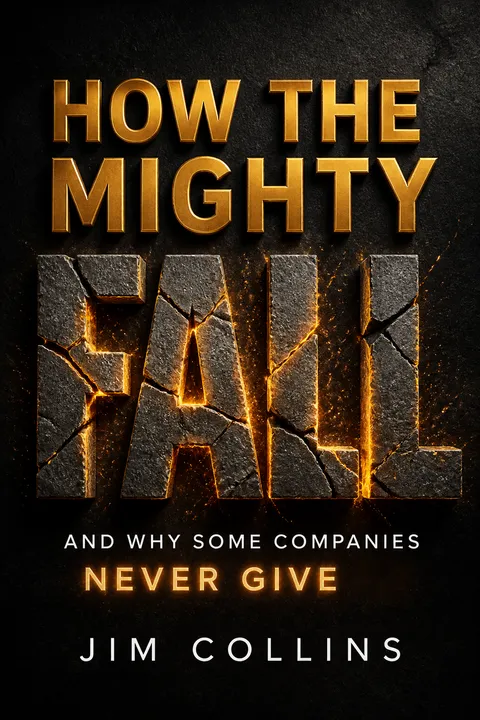
How the Mighty Fall examines why successful companies decline, identifying five stages of decline. Readers found it insightful for both business and personal applications, praising Collins' research and accessible writing. Some criticized the lack of rigorous data analysis, while others appreciated the practical lessons and cautionary tales. The book's concise format and focus on failure rather than success were seen as strengths. Many readers considered it valuable for leaders, entrepreneurs, and anyone interested in organizational or personal performance.
People Also Read






Glossary
Five Stages of Decline
A model of organizational declineCollins’s framework describes a recurring path from overconfidence after success, through undisciplined expansion and denial of warning signs, into desperate rescue attempts and eventual surrender or collapse. The stages can overlap, vary in speed, or be absent in some failures. The framework is intended as a diagnostic aid, not a deterministic law.
Packard’s Law
Growth limited by talentA principle named for HP cofounder David Packard: a company cannot consistently grow revenue faster than it can obtain enough capable people to execute that growth well. When expansion outruns the supply of qualified people, execution suffers, responsibility weakens, and bureaucracy may grow to compensate.
Waterline principle
Scale risk to survivabilityA decision-making analogy associated with W. L. Gore founder Bill Gore. A mistake above a ship’s waterline can be repaired, while damage below it can sink the vessel. Applied to organizations, it advises leaders to examine the worst plausible consequences of a risky decision and avoid bets that could destroy the organization’s ability to recover.
Flywheel
Momentum from repeated effortCollins’s metaphor for progress built through many consistent actions rather than one dramatic breakthrough. Each successful push adds momentum to the next. In this book, a primary flywheel refers to the central business activity that underlies an organization’s success and requires continued improvement, even while the organization experiments elsewhere.
Arrogant neglect
Taking the core for grantedA form of overconfidence in which leaders divert attention from a successful core business, assuming it will keep performing while they pursue newer or more exciting opportunities. The danger is not experimentation itself, but allowing the established business to lose its momentum because it no longer receives sustained attention and improvement.
FAQ
What's "How The Mighty Fall" about?
- Focus on decline: "How The Mighty Fall" by Jim Collins explores why once-great companies decline and how they can potentially recover.
- Five stages of decline: The book outlines a framework of five stages that companies typically go through as they fall from greatness.
- Research-based insights: Collins uses extensive research and case studies to illustrate how decline can happen even to seemingly invincible companies.
- Hope for recovery: The book also offers insights into how companies can detect early signs of decline and reverse their downward trajectory.
Why should I read "How The Mighty Fall"?
- Understanding failure: It provides a deep understanding of the factors leading to corporate failure, which is crucial for business leaders and managers.
- Preventive strategies: The book offers strategies to prevent decline, making it a valuable resource for sustaining business success.
- Real-world examples: Through case studies, readers can learn from the mistakes and successes of other companies.
- Hope and recovery: It emphasizes that decline is not inevitable and that recovery is possible with the right actions.
What are the key takeaways of "How The Mighty Fall"?
- Five stages of decline: The stages include Hubris Born of Success, Undisciplined Pursuit of More, Denial of Risk and Peril, Grasping for Salvation, and Capitulation to Irrelevance or Death.
- Self-inflicted decline: Most declines are self-inflicted and can be reversed if detected early.
- Leadership's role: The wrong leadership can accelerate decline, while disciplined leadership can prevent or reverse it.
- Importance of core values: Maintaining core values and disciplined practices is crucial for long-term success.
What are the five stages of decline according to Jim Collins?
- Stage 1 - Hubris Born of Success: Companies become arrogant and lose sight of the factors that made them successful.
- Stage 2 - Undisciplined Pursuit of More: Companies overreach, pursuing growth without discipline or strategic alignment.
- Stage 3 - Denial of Risk and Peril: Warning signs are ignored, and leaders downplay negative data.
- Stage 4 - Grasping for Salvation: Companies make desperate moves for quick fixes, often seeking a savior leader or strategy.
- Stage 5 - Capitulation to Irrelevance or Death: Companies give up the fight, leading to irrelevance or closure.
How can companies detect early signs of decline?
- Monitor key metrics: Keep an eye on financial ratios, customer loyalty, and employee engagement for early warning signs.
- Encourage open dialogue: Foster a culture where employees feel safe to share bad news and confront brutal facts.
- Avoid complacency: Continuously question and validate the factors driving success to prevent arrogance.
- Focus on core values: Ensure that the company’s core values and purpose remain central to its operations.
What role does leadership play in preventing decline?
- Level 5 leadership: Leaders should be ambitious for the company, not themselves, and have the resolve to do what it takes for success.
- Succession planning: Effective succession planning is crucial to maintain continuity and prevent decline.
- Disciplined decision-making: Leaders should make decisions based on empirical evidence and strategic alignment.
- Avoiding savior complex: Leaders should focus on building a strong team and culture rather than relying on a single charismatic figure.
What is the "Hedgehog Concept" in "How The Mighty Fall"?
- Core focus: The Hedgehog Concept involves focusing on what a company can be the best at, what drives its economic engine, and what it is deeply passionate about.
- Strategic alignment: It helps companies align their strategies with their core strengths and market opportunities.
- Avoiding distractions: By adhering to the Hedgehog Concept, companies can avoid the pitfalls of undisciplined growth.
- Long-term success: It is a key factor in sustaining long-term success and avoiding decline.
How does "How The Mighty Fall" suggest companies can recover from decline?
- Return to basics: Companies should return to sound management practices and strategic thinking.
- Focus on core strengths: Rebuild momentum by focusing on core competencies and values.
- Disciplined execution: Implement a series of well-executed decisions to build cumulative momentum.
- Leadership and culture: Cultivate disciplined leadership and a strong, value-driven culture.
What are some real-world examples discussed in "How The Mighty Fall"?
- Motorola: The book discusses Motorola's fall due to arrogance and undisciplined growth.
- HP: HP's struggles with leadership changes and strategic missteps are analyzed.
- Fannie Mae: The book examines Fannie Mae's decline during the financial crisis.
- IBM: IBM's recovery under Lou Gerstner is highlighted as a successful turnaround story.
What are the best quotes from "How The Mighty Fall" and what do they mean?
- "The signature of mediocrity is not an unwillingness to change. The signature of mediocrity is chronic inconsistency." This highlights the danger of erratic changes without a coherent strategy.
- "Great companies can stumble, badly, and recover." This emphasizes that decline is not irreversible and recovery is possible with the right actions.
- "We are not imprisoned by our circumstances, our setbacks, our history, our mistakes, or even staggering defeats along the way. We are freed by our choices." This underscores the power of choice in determining a company's fate.
How does "How The Mighty Fall" relate to Jim Collins' other works?
- Continuation of themes: The book builds on concepts from "Good to Great" and "Built to Last," focusing on the decline aspect.
- Research-based approach: Like his other works, Collins uses rigorous research and case studies to support his findings.
- Frameworks for success: It complements the frameworks for achieving greatness by providing insights into avoiding and reversing decline.
- Holistic view: Together, Collins' books offer a comprehensive view of building, sustaining, and recovering greatness.
What is the significance of the "Flywheel" concept in "How The Mighty Fall"?
- Momentum building: The Flywheel concept emphasizes the importance of building momentum through consistent, disciplined actions.
- Avoiding doom loop: It contrasts with the doom loop of erratic, reactive changes that lead to decline.
- Cumulative effect: Success is achieved through the cumulative effect of small, well-executed decisions.
- Sustained progress: The Flywheel is a metaphor for sustained progress and long-term success.
About the Author
Other books by Jim Collins



Download PDF
Download EPUB
.epub digital book format is ideal for reading ebooks on phones, tablets, and e-readers.








