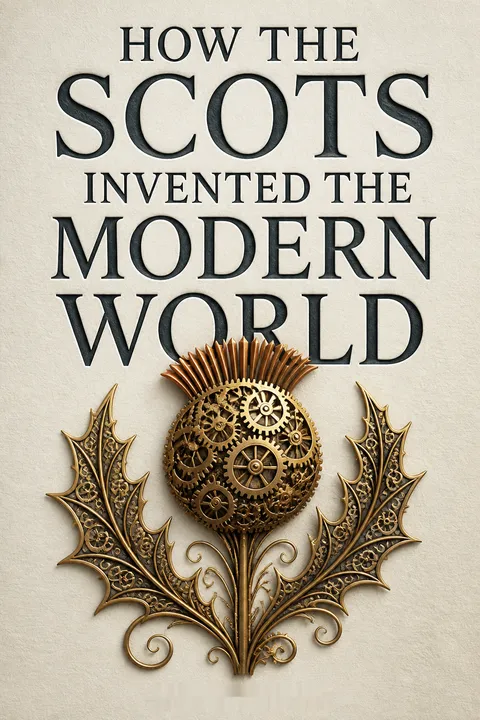


Key Takeaways
See modernity as Scotland's export: literacy, social science, markets, and liberty.
A small country, outsized influence. Around 1700, Scotland was poor, sparsely populated, and recently battered by famine and religious conflict. By the end of the eighteenth century, it had become a center of philosophy, science, commerce, and political debate. Herman's argument is not that Scots invented every modern institution or machine alone. It is that they helped connect ideas about progress, education, human behavior, and liberty into a coherent way of understanding society.
A story of transmission. Scots carried those ideas through universities, trade, migration, government, and engineering. Adam Smith shaped economic thought; Scottish-trained figures helped form American political institutions; engineers and doctors transformed transport and public health. The book's sweeping claim is that modern life often follows a Scottish blueprint, even when its origins are forgotten.
What's distinctive is the book's focus on connections rather than a roster of celebrated Scots. Literacy feeds intellectual exchange; universities train practical experts; commercial growth spreads their influence. That is a useful model of how ideas gain force through institutions and networks, not just through famous individuals. The title's claim is deliberately provocative, though. Modernity was a shared European and Atlantic construction, and the book is strongest when it shows Scottish contributions without treating them as sole authorship.
Build freedom on institutions, but remember institutions can persecute.
A violent contradiction. In 1697, theology student Thomas Aikenhead was hanged in Edinburgh for blasphemy. His case revealed a society where religious authorities could press the state to punish dissent, and where remorse did not secure mercy. Yet the Presbyterian Kirk had also created local structures that gave ordinary people a role in choosing ministers and managing community affairs.
An unintended educational legacy. The same religious commitment that demanded people read Scripture helped drive Scotland's 1696 law requiring a school in every parish. Estimates in the book put male literacy at about 55 percent by 1720 and possibly 75 percent by 1750, higher than in England. Wider reading created an audience for secular books and new ideas, even as the church continued to police belief.
The Scottish case shows how institutions can produce both civic capacity and coercion. Local participation and widespread literacy made more people able to debate authority, but neither automatically protected conscience. This distinction matters: education can enlarge people's powers without guaranteeing that those powers are used tolerantly. The book's strongest insight is not that repression somehow caused enlightenment, but that institutions built for one purpose can create skills and habits that escape their founders' control.
Judge political bargains across generations, not by their first losses.
A failed gamble. Scotland's Darien Company tried to establish a trading colony in Panama. The expeditions were devastated by disease, Spanish resistance, and inadequate supplies. More than 2,000 people died, and the financial losses helped ruin investors and weaken Scotland's already fragile economy. The disaster sharpened the case that Scotland could not compete for overseas trade on equal terms with England.
Union's delayed return. The 1707 Act of Union abolished Scotland's Parliament and moved political power to London, while opening English and imperial markets to Scottish merchants. Early years brought taxes, industrial disruption, and the Jacobite rising of 1715. But Glasgow entered the Atlantic trade, and by 1755 Scottish exports had more than doubled. Herman presents union as a bargain whose benefits arrived unevenly and over time, not as an uncomplicated victory.
This is a vivid example of path dependence: a political settlement can redirect investment and opportunity long after its negotiators have disappeared. But judging a bargain by its aggregate growth risks overlooking who bore the costs. Union benefited some merchants and landowners far more quickly than poor households, and political representation remained sharply unequal. The long view is essential, but it should include distribution, not merely the size of the eventual economic gain.
Study societies as changing systems, not fixed national characters.
Kames's historical lens. Lord Kames organized societies into four broad stages: hunting and gathering, pastoral life, agriculture, and commercial society. His claim was that how people make a living shapes their laws, relationships, government, and habits. Farming, for example, requires more cooperation and creates more complicated disputes over land and property than a small hunting group does.
Progress as a process. Kames and historians such as William Robertson used this model to explain how societies change rather than treating them as permanently primitive or advanced. The Scottish school helped establish history and the study of society as systematic fields of inquiry. Its account emphasized social conditions and human experience over racial explanations. But its four stages also placed commercial Europe at the top of a single ladder, a ranking that can mistake one historical path for a universal standard.
The enduring move is to ask how institutions fit the material conditions people face. That question helps explain why laws, work, and social expectations change together. It also anticipates modern social science's interest in incentives and historical context. The caution is built into the framework: once a model sorts societies into stages, description can quietly become a verdict. Kames's account is most useful as a prompt to investigate change, not as a scorecard for ranking cultures.
Treat morality as social learning, not pure reason or pure self-interest.
Three answers to human nature. Francis Hutcheson argued that people possess a natural moral sense and can take pleasure in helping others. David Hume countered that passions, habits, and social conventions shape conduct more than reason does. Adam Smith tried to hold both truths together: people care about their own interests, but they also imagine how their actions appear to other people.
The inner observer. Smith called this imagined evaluator the impartial spectator. By mentally taking another person's perspective, people learn to judge their own motives as well as their actions. Morality, in this account, grows through social feedback and self-reflection. It is neither simply obedience to religious rules nor a calculation of personal advantage. Society teaches people to restrain some impulses, while conscience helps them assess whether the crowd itself is behaving well.
Smith's account links moral judgment to perspective-taking, a powerful way to explain how people learn to regulate behavior without constant supervision. It also avoids treating self-interest and care for others as mutually exclusive. Yet social approval can reward conformity as readily as kindness. The imagined observer therefore needs standards beyond popularity. Smith's approach is most persuasive when social feedback is understood as material for judgment, not as proof that the majority is right.
Let markets coordinate work, then fund education against their blind spots.
Specialization multiplies output. In The Wealth of Nations, Smith argued that dividing production into specialized tasks raises productivity. Commercial society links people through exchange: individuals pursue their own aims, yet depend on many strangers as suppliers, customers, and workers. This network can produce enough goods to improve the lives of people far from the top of the economic hierarchy.
Markets need public foundations. Smith did not advocate a state with no responsibilities. He assigned government roles in defense, justice, property rights, and public works such as roads and bridges. He also warned that repetitive work could narrow workers' minds. Public education, including Scotland's parish schools, could counter that damage and prepare citizens to participate in public life. Markets can organize production, but they do not automatically produce informed citizens or fair outcomes.
The book's Smith is more nuanced than the familiar slogan-maker: markets are powerful coordinating systems, but their functioning depends on law, infrastructure, and a capable public. His concern about workers' mental narrowing also puts human development inside the economic argument rather than outside it. A limitation is that productivity and abundance do not by themselves settle questions of bargaining power or who receives the surplus. The institutional supports need scrutiny as well as celebration.
Preserve the past without disguising who paid for modernization.
The Highlands were not a costume. Culloden in 1746 ended the Jacobite military challenge, and government reprisals weakened clan authority. Decades later, Scottish landlords and chieftains cleared many Highland tenants from their land to make room for more profitable sheep farming. Families were evicted, sometimes from burning homes, and many emigrated. The Clearances were not simply an English assault on an intact Scottish society; Scottish landowners played a central role.
Memory has its own history. Sir Walter Scott's novels brought Scotland's past and its regional voices to mass audiences, while the 1822 royal visit turned Highland dress into a national spectacle. Some supposedly ancient clan tartans were standardized or popularized later. This revival gave Scotland a vivid shared identity, but its romantic imagery could obscure poverty, eviction, and the variety of Scottish experience.
Scott's historical fiction shows how cultural memory can help a society absorb change without pretending the past was flawless. Stories, landscapes, and clothing can give people a sense of continuity. But a public tradition is curated: a noble image of the Highlander can crowd out the tenant who lost a home, and a single national costume can flatten regional differences. The task is not to reject inherited symbols, but to keep the human consequences visible alongside their emotional power.
Trace American liberty to both Scottish classrooms and frontier dissent.
Ideas crossed the Atlantic. Scottish migration included Lowlanders, Highlanders, and Ulster Scots. John Witherspoon brought Scottish university methods to Princeton, teaching students including James Madison. The book links Hutcheson's language of natural rights and happiness to American political thought, and David Hume's analysis of large republics to Madison's defense of the Constitution's divided powers. Thomas Reid's philosophy of common sense also helped make self-evident truths and ordinary judgment central to American arguments.
Not just a classroom inheritance. Ulster Scots carried a more populist Presbyterian tradition into the colonies. Their ministers helped drive the Great Awakening, and many settlers supported independence. Scots and people of Scottish descent were prominent among the Declaration's signers and in the revolutionary forces. The American republic, in Herman's account, drew on both Enlightenment theory and religiously charged resistance to distant authority.
The strongest account here is plural: political ideas reached America through education, migration, religious networks, and local conflicts. That helps explain why the revolution could combine constitutional design with moral and religious urgency. The argument should not be mistaken for a claim that Scots alone made the United States. The book's more defensible point is that Scottish thinkers supplied influential tools for reasoning about rights, representation, and how a large republic might remain governable.
Build progress with engineers and doctors, while interrogating empire's price.
Practical knowledge changed daily life. James Watt improved the Newcomen steam engine with a separate condenser, helping make continuous mechanical power useful across industry. Thomas Telford built roads, bridges, and canals that connected remote regions. Scottish doctors advanced clinical teaching and public health; James Lind's experiment showed that citrus could treat scurvy, though officials took decades to adopt the remedy.
The same tools served power. Scottish expertise also helped extend the British Empire. Herman describes administrators who pursued education, roads, and legal reforms in India, but also Scottish merchants who profited from the illegal opium trade in China. Steam-powered gunboats helped force China open to British commerce. The history therefore links engineering and reform to military force and extraction. Technological capability can improve lives, but its purpose depends on who directs it and who bears its costs.
Infrastructure is an often invisible form of power: roads, ports, and medical knowledge make some kinds of movement and exchange possible while making others easier to control. The Scottish examples show that practical problem-solving can produce public benefits and imperial advantage at once. This tension resists a simple verdict on progress. A useful test is to ask who gains access, who sets the rules, and whether those affected can refuse the arrangement.
Use devolution to improve government, not to romanticize a lost Scotland.
Reform, not permanent upheaval. Scottish thinkers such as Dugald Stewart taught that political institutions should adapt as society changes. In 1832, parliamentary reform expanded Scotland's electorate from about 4,500 to more than 65,000, though voting remained restricted. The episode reflects a recurring Scottish argument: change can preserve a political system by making it more responsive.
The national story remains contested. In 1950, students stole the Stone of Scone from Westminster Abbey, turning a medieval royal symbol into a modern protest for Scottish self-government. The book ends as Scotland regains a Parliament in 1999, while warning that autonomy cannot solve every economic problem. Herman also challenges accounts that reduce Scotland's history to English oppression, arguing that Scots helped govern the empire and shaped Britain. His closing standard is balance: greater self-rule matters, but nostalgia and grievance are not substitutes for clear-eyed history.
This ending treats political identity as a practical question as well as an emotional one. Devolution can bring decisions closer to the people affected, but symbolic sovereignty does not guarantee competent policy or material renewal. The book is right to resist a simple story of Scotland as only victim or only victor. Its own emphasis on union's benefits, however, also invites scrutiny of the people and places that paid for growth. Historical balance requires both accounts.
Analysis
Herman's central achievement is to make Scotland legible as a system of transmission. Parish schooling expands literacy; universities train thinkers and practitioners; commercial connections move people and capital; migration carries institutions abroad. The story's force comes from showing these elements reinforcing one another across centuries. The book is less a catalogue of Scottish inventors than an argument about how a small society became unusually effective at turning knowledge into institutions, and institutions into influence.
Its method also creates a problem. The narrative often treats social change as progress because it increases commerce, literacy, state capacity, or individual choice. Those measures matter, but they do not tell the whole moral story. Highland tenants displaced for sheep farming, Chinese communities exposed to a forced opium trade, and industrial workers whose lives were narrowed by repetitive labor all appear within the same history of modernization. They complicate any easy equation between growth and human betterment. The author recognizes many of these costs, but the national success story can make them feel like the price of an otherwise desirable outcome.
The book is most convincing when it preserves tensions rather than resolving them: liberty needs authority, markets rely on law, progress can destroy communities, and a shared national memory can both sustain people and conceal their losses. Its account of Scotland's role should likewise be read as a strong interpretive thesis, not a literal claim that modernity had one national inventor. The intellectual traffic ran through England, Europe, the Atlantic colonies, and the empire. Scotland's significance lies in how its institutions and thinkers synthesized and circulated ideas within those wider networks. That more precise claim is both more historically credible and more interesting: influence does not require sole authorship, but it does require explaining the pathways by which ideas become durable.
Review Summary
How the Scots Invented the Modern World receives mixed reviews. Many praise its engaging writing and detailed exploration of Scottish contributions to philosophy, science, and politics. Readers appreciate learning about influential Scots and their impact on global history. However, some criticize the book for overstating Scottish influence and neglecting other nations' contributions. Critics also note a lack of women's perspectives and question the author's selective focus on positive aspects of Scottish history. Despite these concerns, many find the book informative and enjoyable, particularly those with Scottish heritage.
People Also Read


Glossary
Scottish Enlightenment
Scottish intellectual movementAn eighteenth-century movement centered in Scottish universities and cities, especially Edinburgh and Glasgow. Its thinkers studied human nature, history, law, commerce, and the sciences as connected subjects. Herman emphasizes its effort to explain social change systematically and to link education and intellectual inquiry with the improvement of society.
Four-stage theory
Model of social developmentA theory associated in the book with Lord Kames and other Scottish thinkers. It divides social development into hunting and gathering, pastoral life, agriculture, and commercial society. Each way of earning a living, the theory argues, shapes social relationships, law, government, and habits. It treats societies as historically changing, though its hierarchy of stages can imply a single standard of progress.
Commercial society
Society organized by exchangeThe Scottish thinkers' term for a society in which trade, manufacturing, and the exchange of goods become central to economic and social life. In Herman's account, commerce increases specialization and interdependence, encourages new laws and institutions, and can expand individual opportunity. It also raises concerns about inequality and the narrowing effects of specialized work.
Impartial spectator
Imagined moral evaluatorAdam Smith's term for the imagined observer whose perspective a person uses to assess their own conduct. By considering how an action looks from another person's position, people develop judgments about motives and behavior. The concept explains conscience as partly formed through social interaction, while leaving room for individuals to judge themselves against the crowd.
Common sense philosophy
Knowledge grounded in experienceA philosophical tradition associated with Thomas Reid and other Scottish thinkers. It holds that ordinary human faculties can provide reliable knowledge of the external world and support basic judgments about truth and right and wrong. The book presents it as a response to radical skepticism and as an intellectually democratic claim about people's capacity to judge.
Civil society
Modern organized social lifeIn Adam Ferguson's usage, civil society describes the organized social world shaped by human cooperation, institutions, and historical change. The book connects the term to the emergence of modern society, while emphasizing Ferguson's warning that commercial development can weaken civic courage and shared responsibility.
Division of labor
Specialization of productive tasksAdam Smith's term for dividing production into specialized tasks rather than having one person perform every step. Specialization can raise output and create networks of exchange among workers, merchants, and consumers. Smith also warned that repetitive work could narrow workers' abilities, making education and public institutions important counterweights.
Liberal imperialism
Empire justified as reformA form of British imperial policy described in the book through Scottish administrators and thinkers. It justified foreign rule in terms of practical improvement, including education, roads, legal reform, and public order, rather than religious conversion alone. Its humanitarian aims coexisted with unequal political power and, in some cases, commercial coercion and military force.
FAQ
What's How the Scots Invented the Modern World about?
- Scottish Influence on Modernity: The book explores how Scotland, despite its economic struggles in the 18th century, played a pivotal role in shaping modern ideals such as technology, capitalism, and democracy.
- Cultural and Historical Context: It delves into historical events and figures like John Knox and Adam Smith, highlighting their contributions to a distinctly Scottish mentality that influenced the broader world.
- Legacy of the Scots: The author argues that many contemporary institutions and ideas have Scottish roots, emphasizing the need to recognize and appreciate this legacy.
Why should I read How the Scots Invented the Modern World?
- Unique Perspective: The book offers a fresh viewpoint on the contributions of Scots to global progress, challenging the common narrative that overlooks their influence.
- Engaging Historical Narrative: Arthur Herman combines storytelling with historical analysis, making it accessible and engaging for readers interested in history, culture, and social development.
- Relevance to Modern Issues: The themes resonate with contemporary discussions about national identity, cultural heritage, and the impact of small nations on global history.
What are the key takeaways of How the Scots Invented the Modern World?
- Scottish Enlightenment: The book highlights the significance of the Scottish Enlightenment, showcasing figures like Adam Smith and David Hume, who laid the groundwork for modern economics and philosophy.
- Cultural Identity: It emphasizes the importance of cultural identity and how the Scots maintained their heritage while contributing to a broader British and global context.
- Interconnectedness of Ideas: The author illustrates how various ideas, from religion to economics, are interconnected and how the Scots synthesized these to create a modern worldview.
What are the best quotes from How the Scots Invented the Modern World and what do they mean?
- “If you want a monument to the Scots, look around you.”: This quote encapsulates the idea that the contributions of Scots are embedded in the very fabric of modern society, often unnoticed.
- “The moral law is summarily comprehended in the Ten Commandments.”: This reflects the traditional view of morality in Scotland, which Hutcheson challenged by proposing an innate moral sense that guides human behavior.
- “Liberty is the perfection of civil society.”: This quote highlights the Enlightenment belief in the value of individual freedom and its role in societal progress.
Who are the key figures discussed in How the Scots Invented the Modern World?
- John Knox: A pivotal figure in the Scottish Reformation, Knox's efforts to establish Presbyterianism laid the foundation for Scotland's religious and cultural identity.
- Adam Smith: Often regarded as the father of modern economics, Smith's works, particularly The Wealth of Nations, are highlighted for their profound impact on economic thought and practice.
- David Hume: A philosopher whose ideas on human nature and society contributed significantly to the Enlightenment, Hume's skepticism and empirical approach are discussed in relation to Scottish thought.
How did the Scottish Enlightenment influence modern thought?
- Foundation of Modern Economics: The Scottish Enlightenment introduced key economic concepts, particularly through Adam Smith's work, laying the groundwork for modern capitalism.
- Philosophical Contributions: Thinkers like David Hume advanced ideas about human nature, morality, and knowledge, shaping modern philosophy and social sciences.
- Cultural and Political Ideals: The Enlightenment fostered a belief in progress, reason, and individual rights, influencing democratic movements worldwide.
How did the Act of Union impact Scotland according to How the Scots Invented the Modern World?
- Political Changes: The Act of Union in 1707 dissolved the Scottish Parliament and integrated Scotland into a single British Parliament, altering the political landscape significantly.
- Economic Opportunities: It opened up new economic opportunities for Scots, allowing them access to English markets and trade routes, which contributed to Scotland's economic growth.
- Cultural Identity: The Union prompted a re-evaluation of Scottish identity, as Scots navigated their place within a larger British context while striving to maintain their unique cultural heritage.
What role did Sir Walter Scott play in the Highland revival?
- Cultural Preservation: Scott's works romanticized Highland culture and traditions, helping to preserve them during a time of significant change.
- Literary Influence: He is credited with creating the historical novel genre, which allowed readers to engage with Scotland's past in a compelling way.
- Political Impact: Scott's writings contributed to the rise of Scottish nationalism, instilling a sense of belonging and cultural identity among Scots.
How did the Scottish diaspora shape the modern world?
- Global Influence: The Scottish diaspora spread Scottish ideas, culture, and practices across the globe, particularly in North America, Canada, and Australia.
- Contributions to Industry: Many Scots became leaders in various industries, including shipbuilding, textiles, and engineering, shaping the industrial landscape of their adopted countries.
- Cultural Exchange: The diaspora facilitated cultural exchange, blending Scottish traditions with local customs, enriching both Scottish culture and the cultures of the countries where Scots settled.
What is Adam Smith's concept of the "invisible hand" in How the Scots Invented the Modern World?
- Market Self-Regulation: The "invisible hand" refers to the self-regulating nature of the marketplace, where individuals pursuing their own self-interest inadvertently contribute to the overall good of society.
- Consumer Benefits: Smith argues that when producers focus on their own profit, they create goods and services that meet consumer needs, leading to a more efficient allocation of resources.
- Moral Implications: While self-interest drives economic activity, Smith also emphasizes that a moral framework is necessary for a functioning society.
How does How the Scots Invented the Modern World address the theme of cultural identity?
- Cultural Revival: The book discusses the Highland revival as a significant movement in shaping Scottish cultural identity.
- Interplay of Tradition and Modernity: It explores how Scots navigated the tension between preserving traditional values and embracing modernity.
- Nationalism and Memory: The theme of memory is central to the discussion of cultural identity, emphasizing the role of a nation's past in shaping its present and future.
Download PDF
Download EPUB
.epub digital book format is ideal for reading ebooks on phones, tablets, and e-readers.








