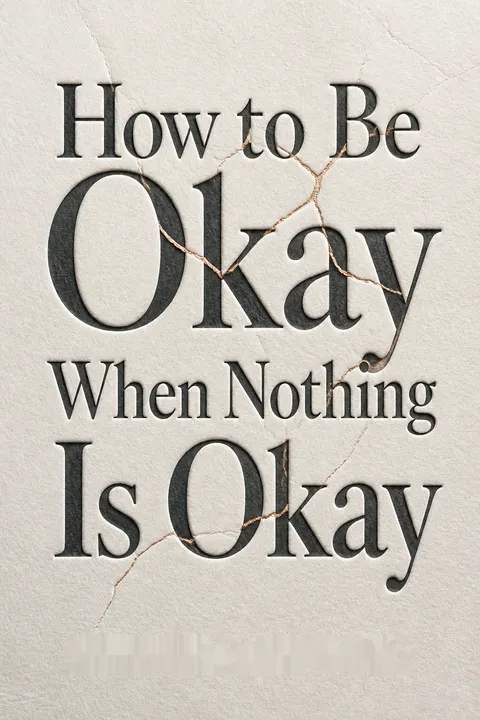


Key Takeaways
When nothing feels okay, aim first for staying here, not fixing everything
Survival is real work. Lawson writes from experience with depression, anxiety, ADHD, chronic illness, and suicidal thoughts. Her coping ideas are not a cure or a replacement for professional care. They are small ways to reconnect with the present and get through a hard stretch. Sometimes that means using a practical tool; sometimes the achievement is simply making it through the day. The book returns to the idea that a person’s worth does not depend on productivity, talent, or feeling happy on schedule.
Keep support within reach. Lawson treats these reminders as tools to revisit when needed, not a program that permanently fixes a complicated life. She describes relying on therapy, medication, and help from people close to her. The message is compassionate but grounded: hardship can persist, and support still matters.
The distinction between coping and curing is important. It avoids the familiar self-help promise that the right attitude can dissolve serious illness, while still treating small actions as meaningful. This resembles a useful principle in crisis support: reduce the task to what can be done safely in the immediate moment, then connect with human help. The book’s reassurance is strongest when understood as companionship, not clinical instruction. Readers facing immediate danger need qualified, local support, not a list of lifestyle adjustments. That boundary does not diminish the practical value of the book; it clarifies what kind of help it offers.
Stop comparing your full life with everyone else's edited highlights
Compare complete timelines. Lawson describes watching other people announce finished projects, new jobs, and major life changes while her own progress seems slow. The comparison is misleading: she sees their public milestones but experiences her own delays, doubts, and unfinished work in full. Her first book was described as an overnight success, though completing it had taken twelve years. The public label concealed the actual process.
Measure by your own values. When self-doubt turns achievement into a test of personal worth, Lawson points toward qualities she admires in ordinary life, especially kindness. Her mother, a retired cafeteria worker who cares for goats and enjoys books and crafts, is a personal example of someone she values simply for being herself. A life need not look impressive from the outside to matter.
This is a sharp account of a context problem: people compare their private, continuous experience with other people’s selective public evidence. The useful correction is not to stop noticing others, but to ask what information is missing from the comparison. The book also challenges achievement as the default measure of worth, replacing it with relationships and character. That move can be liberating, though it should not be used to dismiss legitimate ambition. A person can want recognition or progress without making either the price of self-respect.
Treat coping tools as seasonal equipment, not moral tests
Fit the tool to the day. Lawson resists the idea that one solution should work for everyone or forever. She hates hot yoga, for instance, but enjoys skipping to the quiet relaxation at the end of a class. The useful part is not completing the prescribed routine; it is noticing what genuinely helps. A friend’s advice to rotate coping strategies also helped Lawson see that replacing a tool is not failure. Needs change with health, energy, and circumstance.
Allow imperfect practice. For creative work, Lawson draws on the Taste-Talent Gap, the distance between the quality a beginner can recognize and the quality they can currently produce. Closing that gap requires making work, even when it falls short. Her doodling during a writing slump became meaningful in its own right. A detour can be useful without needing to justify itself as the original plan.
Flexible coping is a practical alternative to turning self-care into another performance standard. In design, a tool is judged by whether it serves the user in context, not by whether the user obeys it consistently. The same logic applies here: a strategy can be useful in one season and frustrating in another. The Taste-Talent Gap also offers a productive account of early practice, because dissatisfaction may reflect discernment rather than lack of potential. The nuance is that a detour can nourish someone, but persistent avoidance can also disguise itself as exploration. Honest reflection helps distinguish the two.
Interrupt panic through the body before debating the mind
Check basic signals first. Lawson notes that bodily states can resemble or intensify anxiety. She suggests trying water, food, and relaxing tense muscles before concluding that every wave of dread has a deeper meaning. These steps do not stop every panic attack; she estimates that they help her head off only a portion. Sensory grounding is another option: notice what can be seen, heard, felt, smelled, or tasted to bring attention back to the present.
Find a breathing pattern that fits. A stranger helped Lawson during a panic attack by guiding her into slower belly breathing, where the abdomen rises on the inhale and falls on the exhale. Other people may prefer a different rhythm or technique. If a method worsens panic, it is not a personal failure. The point is to experiment gently, and to seek professional support when needed.
This advice works partly because panic is not only a stream of thoughts; it is also a bodily event that can feed on its own sensations. Attending to hydration, food, muscle tension, breath, or the senses can interrupt that feedback loop. The practical strength lies in offering several entry points rather than declaring one breathing exercise universally effective. These measures are supportive, not diagnostic. Severe, new, or recurring symptoms can have causes that require medical assessment, and a self-help technique should not be treated as proof that the danger is imaginary.
Schedule joy and useful action when the news makes you feel helpless
Contain the news cycle. When world events leave Lawson overwhelmed, she gives herself a set period to check the news, then follows it with a set period to choose one useful response. That response might be a donation, a letter, or learning how to support an organization. The sequence turns passive exposure into bounded attention and a concrete act, without pretending that one short action solves a large problem.
Make joy easier to remember. Depression can make familiar pleasures hard to recall, so Lawson keeps a growing list of small comforts and chooses from it when she feels stuck. She also describes Rose, Rose, Thorn, Bud, a nightly check-in naming two good moments, one difficulty, and one thing to anticipate. The practice makes room for hardship and pleasure in the same account of a day.
The combination of limited exposure, chosen action, and ordinary pleasure offers a helpful response to helplessness. It avoids two extremes: consuming distressing information without a next step, and withdrawing so completely that concern becomes numbness. A joy list also solves a memory problem, not just a motivation problem: low mood can make previously rewarding activities difficult to retrieve. Still, happiness should not become another obligation. The practice is most humane when it offers options, rather than implying that a person who cannot feel pleasure has failed to try hard enough.
Make asking for help easier before your crisis arrives
Prepare before the emergency. Lawson recommends finding a crisis line or peer support service while feeling relatively safe, saving its contact information, and checking whether its approach suits the caller. She notes that people can contact such services for advice about someone they love, too. If one conversation does not feel helpful, trying another person may be reasonable.
Give words to the first reach. When speaking feels impossible, a short prepared message can say that things are difficult and ask whether someone trusted is available to talk. Lawson describes both receiving and providing support during serious mental health crises, including times when professional care was needed. She also thanks caregivers, whose efforts can be exhausting and largely unseen. Asking for help is not a burden imposed on others; it can give them a way to care.
Advance planning lowers the number of decisions required at the moment when distress may make decision-making harder. The idea resembles preparation in other safety practices: choose a contact and a first step before urgency narrows attention. The book also makes support reciprocal, recognizing caregivers as people with limits rather than endlessly available resources. A useful extension is to agree in advance on what kinds of help are welcome, from listening to helping locate care. Because crisis services differ in their policies and fit, checking those details beforehand is a meaningful part of the plan.
Build around your brain instead of punishing it for lagging
Reduce friction, not dignity. Lawson describes ADHD-related difficulty with focus, memory, task switching, and beginning work. Her adaptations include asking to meet by video rather than spending energy on travel, using another person’s quiet presence to stay on task, and giving family a gesture that means her brain needs time to process. Body-doubling is the practice of working alongside someone whose presence helps sustain attention, even when that person is not doing the task for you.
Make reminders visible. A scrunchie on her wrist can cue a forgotten task, while a timer can limit phone scrolling. For overwhelming projects, flying blind means attending only to the next small stretch of work rather than planning every step in advance. Lawson presents these as personal strategies, alongside medical care and consultation with doctors, not as universal treatment.
The underlying shift is from moral judgment to environmental design. If a person repeatedly forgets, loses focus, or stalls during transitions, adding visible cues or changing the setting may work better than demanding more discipline. This approach also makes accommodations legible: a video meeting is still a meeting, and a reminder system is a tool, not a character flaw. The caution is that an anecdote cannot establish which strategy suits a particular person. The book is most useful here as a source of experiments to discuss with clinicians and collaborators, not as a diagnostic checklist.
Begin with playful experiments, not the masterpiece in your head
Make the first step smaller. Lawson’s early drawing attempts produced comic failures, but low-pressure pattern drawing gave her a way to practice without needing to depict something perfectly. During a writing block, she sometimes walks and dictates ideas into her phone, replacing the intimidating blank page with rough spoken material. The principle is to start in a form that makes exploration easier, then shape the work later.
Keep the amateur's permission. Lawson recalls making mistakes while opening a bookstore despite loving books. Her husband reminded her that amateur comes from a word associated with love: a person can be a novice because they care enough to try. She also argues that another person’s success is evidence of an audience, not proof that one’s own contribution is unnecessary. A distinctive voice often emerges through practice, risk, and imperfect attempts.
Play lowers the perceived cost of beginning, which matters because a blank page can make every possible choice feel consequential. Dictation, pattern exercises, and small creative challenges turn a finished work into a sequence of trials. This resembles prototyping: an early draft is information, not a verdict on the maker. The amateur framing also helps separate competence from permission to participate. It should not romanticize lack of preparation, especially where others may be affected, but it does make room for learning without waiting until confidence is complete.
Find collaborators who make imperfect work safer to share
Choose people for fit and honesty. Lawson built friendships with writers and artists rather than approaching every relationship as career networking. She recommends communities shaped around shared interests, mutual encouragement, and clear expectations. A useful creative group is not merely pleasant; it helps people keep working and feel less alone.
Ask for specific feedback. Lawson’s beta readers are people who read drafts and identify what engaged, confused, or bored them. She advises choosing readers who understand the genre, bring different experiences, and can be candid without expecting every suggestion to be adopted. Setting expectations prevents feedback from drifting into irrelevant details. Reading pages aloud can reveal awkward rhythm or unclear passages. The broader lesson applies beyond writing: seek both kindness and useful truth, and do not mistake one person’s reaction for a universal verdict.
The strongest form of creative community combines psychological safety with standards. Praise alone can soothe but cannot reliably improve a draft; criticism without trust can make a person retreat. Specific requests help collaborators offer feedback that is both usable and bounded. Diverse readers can also notice assumptions that a creator cannot see from inside their own experience. At the same time, a group is not automatically wise because it is supportive. Members need room to disagree, and the creator remains responsible for deciding which feedback fits the work.
Make progress visible, and let recovery belong to the work
Show yourself the evidence. To finish a book, Lawson uses cards to map chapters, record what each section needs, and mark progress. Seeing completed portions helps counter the feeling that nothing is moving. She sometimes counts a small gain even after deleting material, because exploration and revision can contribute to a finished project. The same method can make household or personal-care tasks feel less invisible.
Respect the fallow stretch. Lawson compares creative work with nature, where growth does not happen continuously. Rest can mean enjoying other people’s art, visiting a museum, or reading to refill attention rather than forcing output. She also recommends tiny celebrations for ordinary accomplishments. Completion matters, but progress is easier to sustain when recovery and small rewards are treated as part of the process rather than evidence of laziness.
Visible tracking counters a common cognitive distortion: unfinished work is easy to perceive as no work at all. A map of sections or a simple record of steps makes change easier to notice, which can help maintain effort. The book wisely pairs measurement with rest, since tracking can otherwise become another instrument of self-punishment. Progress indicators are aids, not objective measures of human value. A sustainable practice should allow for illness, interruptions, and changing priorities, while still helping a person recognize the movement that has occurred.
Analysis
This book is best understood as a field guide assembled from lived experience, not a linear program or a claim to clinical expertise. Its structure mirrors the instability it addresses: a reader can enter through panic, discouragement, creative paralysis, social fear, or the need for a small pleasure. That modular form is not merely convenient. It respects the reality that distress often reduces the capacity to process elaborate systems, and that useful support must sometimes be brief enough to reach someone on a difficult day.
Lawson’s central move is to replace self-condemnation with observation. A stalled task may reflect fear, sensory overload, exhaustion, or a mismatch between a person and a routine. Once the actual obstacle is named, the response can change: reduce the task, alter the setting, seek help, or try another tool. The book repeatedly treats adaptation as competence rather than cheating. This is especially persuasive in its account of neurodivergence, where practical accommodations challenge the assumption that everyone should function through identical routines.
Humor is part of the method. The absurd anecdotes make vulnerability less formal and help readers recognize themselves without being turned into a problem to solve. That warmth also carries a risk: funny framing can make serious mental illness seem more manageable than it is. Lawson addresses this by naming treatment, medication, crisis planning, and caregiving, but readers should still distinguish companionship from professional care.
The book’s strongest overall contribution is its refusal to make wellness a prerequisite for deserving care. It allows a person to be struggling and creative, imperfect and valuable, in need of help and capable of offering it. Its advice is intentionally personal rather than universal. The reader is not asked to adopt every technique, but to notice what helps, discard what does not, and keep a workable set of supports close at hand.
Review Summary
Most readers who enjoy Jenny Lawson's previous work find How to Be Okay When Nothing Is Okay a warm, humorous, and validating read, particularly for those dealing with anxiety, depression, or ADHD. Fans appreciate her trademark dark humor, personal anecdotes, and doodles woven into practical self-help strategies. However, some longtime followers feel the book leans too heavily into self-help territory, missing the deeper memoir-style storytelling they loved before. Overall, it resonates strongly with neurodivergent readers seeking comfort and community, while others may prefer her earlier, more narrative-driven works.
Glossary
Taste-Talent Gap
Distance between taste and skillThe gap between a creator’s ability to recognize quality and their current ability to produce work at that level. Lawson presents it as a normal stage of creative learning: strong taste can make early work feel disappointing, but continued practice gives skill time to catch up.
Spoon theory
有限 daily energy metaphorA metaphor for the limited energy available to someone managing chronic illness or other constraints. Each activity costs a spoon, and a person begins the day with only so many. If planned tasks exceed that supply, something may have to be postponed. The concept helps explain why ordinary activities can carry very different costs for different people.
Rose, Rose, Thorn, Bud
Four-part daily check-inA reflection exercise that identifies two positive moments from the day, one difficulty, and one thing to anticipate. Lawson uses it to make positive experiences easier to notice without pretending that problems are absent. It can also give family or friends a simple structure for sharing how a day went.
Body-doubling
Working beside another personA strategy for focusing on a task while another person works nearby. The other person does not need to assist directly. Their presence can provide company, structure, or a gentle prompt to return attention to the work. Lawson uses the method for writing and studying.
flying blind
Focus on the next stepLawson’s name for starting a task without mentally planning every stage that follows. Instead, attention is limited to the immediate action or short stretch of time. The approach can reduce paralysis when a complete task list feels overwhelming, while allowing momentum to develop before more planning is needed.
The Telescope Method
Narrow attention to one partA technique for reducing overwhelm by focusing on one small portion of a large project or problem. Lawson compares it to using a telescope to examine one area of the night sky rather than trying to take in the whole horizon. A writer might edit one page, or a person might address one room instead of an entire house.
Ma
Meaningful space or pauseA Japanese concept Lawson describes as the value of emptiness, silence, or a pause. In creative work, it can mean leaving space on a page or allowing a moment between actions. In life, it supports stillness and room to breathe rather than filling every interval with activity.
driveway moments
A compelling story delays departureA term for radio stories so engaging that listeners remain parked in their driveways to hear the ending. Lawson uses the phrase to discuss transitions: what looks like idling after a drive may be a needed period for someone to shift attention before starting the next activity.
Weird Walks
Walks seeking unusual detailsA walking practice in which a person goes outside and looks for something strange, surprising, or intriguing. Lawson uses the search to redirect attention from anxious thoughts toward details in the immediate environment. Sharing a found detail with someone else can also make the practice easier to continue.
Download PDF
Download EPUB
.epub digital book format is ideal for reading ebooks on phones, tablets, and e-readers.








