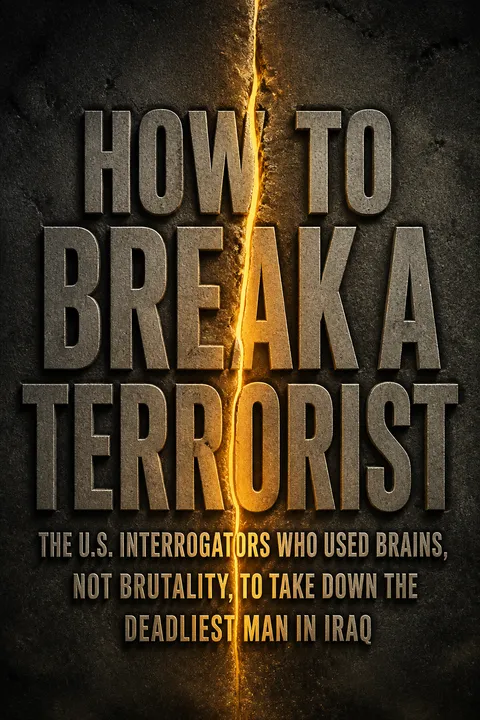


Key Takeaways
Replace coercion with rapport, and the prisoner may start reasoning with you
A different kind of interrogation. After the Abu Ghraib scandal, Alexander’s team arrives in Iraq to try an alternative to fear and control. Their tools are respect, rapport, hope, and carefully chosen deception, within a strict prohibition on abuse. The aim is not simply to make a detainee comfortable. It is to understand what matters to him, then give him a reason to reconsider silence.
Human contact can shift the exchange. Abu Ali begins by saying he would kill his American interrogators. Yet patient questioning reveals his anger, his losses, and the family he wants to protect. He eventually provides locations used by suicide bombers. The change comes through conversation, not physical force. The book’s central claim is practical: skilled questioning can produce intelligence without brutality.
The approach treats interrogation as a relationship shaped by unequal power, rather than as a contest of endurance. That distinction matters: coercion can produce compliance while leaving the source’s beliefs and reliability untouched. Rapport can invite voluntary detail, but it is not proof that the speaker is truthful. The strongest version of this method pairs humane treatment with verification, clear limits, and accountability. Otherwise, a polished performance of respect can become merely a more sophisticated form of manipulation.
Ask what joining protects before deciding what the prisoner believes
One organization, different motives. Alexander’s detainees include committed Al Qaida loyalists, but many Sunni men describe joining for protection or money. After Saddam’s fall, the army was disbanded, many Sunnis lost government work, and Shia militias such as the Badr Corps and Mahdi Army threatened Sunni neighborhoods. Some detainees say Al Qaida offered the weapons, money, or security that other groups could not.
Context changes the questions. Abu Ali and Zaydan describe joining to defend their families from militia violence, not because they embraced every Al Qaida goal. Abu Gamal, an electronics-shop owner, became a bomb maker as his business faltered and his expenses rose. Treating all three as identical ideological fanatics would hide the different pressures that made each useful to the organization.
This account resists a common analytical error: treating membership as a complete explanation of motive. Political violence can recruit through ideology, fear, livelihood, and social ties at once. Understanding those routes can help distinguish committed leaders from people drawn into a network under pressure. The caution is that the book’s sample consists of captured suspects, not a representative survey of Iraqi Sunnis. Their accounts reveal plausible mechanisms, but cannot establish how common each motive was across the population.
Find the pressure point that matters to this person, not your script
Approaches are starting points. In the interrogators’ vocabulary, an approach is a tactic meant to encourage a detainee to share information. The team learns standard approaches, including appeals to family, but a technique that works with one person may fail with another. Abu Ali seems unmoved by threats of punishment and by talk of his own fate. When the interrogators focus on the future of his eleven-year-old son, he finally gives them two farmhouse locations.
Listen for the real motive. Abu Gamal initially hides his second marriage and insists he was only a driver. Conversation reveals his failing shop, financial strain, and desire to support his family. His own explanation of why he went to the farmhouse changes the interrogation. The work is less about delivering a clever line than noticing what produces a genuine response.
The method resembles good diagnosis: test a hypothesis, watch the response, and revise rather than repeating a standard intervention. Family, pride, fear, and money are not universal buttons, however. They are clues to investigate, not assumptions to impose. The interrogator’s advantage comes from sustained attention to detail, while the detainee faces serious consequences and has reason to conceal or perform. Reading emotion carefully is valuable, but emotional intensity alone cannot distinguish honesty from strategy.
Use empathy to uncover motive, but do not confuse leverage with redemption
A role can build access. Alexander calls the interrogator’s adaptable persona a doppelgänger: a temporary role shaped to connect with a particular detainee. With Abu Gamal, he presents himself as a family-minded man who understands financial strain. He also brings a forged divorce petition, which Abu Gamal believes will help him leave his second wife. In return, Abu Gamal admits wiring suicide vests and roadside bombs, and identifies a location where he worked.
The confession does not settle the moral question. Abu Gamal says he earned about fifty dollars per job and had built hundreds of bombs. He shows concern for his own family, but little remorse for the people killed. Alexander ultimately destroys a letter Abu Gamal wrote to his first wife rather than deliver it. The scene forces a distinction between understanding a person’s motive and excusing what he helped do.
Empathy here is both humane attention and an instrument of influence. That dual purpose is the method’s strength and its ethical risk: a source may feel understood while being maneuvered through a false promise. The episode also resists an easy redemption story. Personal tenderness does not cancel responsibility for mass harm, yet denying a letter adds a separate moral decision to the interrogator’s role. The scene asks where information gathering ends and unofficial punishment begins.
Offer credible hope, not certainty built on a lie
Hope can loosen silence. Zaydan, a cheerful imam and Al Qaida recruiter, initially refuses to identify his boss. During an interrogation, a real suicide car bombing strikes near the compound where his family lives. Bobby pretends to call a Marine commander and claims he is checking on the family. The call is fabricated, but the bombing and Zaydan’s fear are real. Once Bobby tells him the family is safe, Zaydan gives information about a farmhouse used for meetings.
The gain carries a cost. The scene shows how quickly concern for loved ones can change a detainee’s willingness to speak. It also shows that a truthful outcome is not guaranteed merely because a tactic works: the interrogators have created a false account of how they learned the family was safe. The book presents the maneuver as effective, but its success does not erase the risk of damaging trust.
Hope can restore a sense of agency to someone who believes every option has closed. But manufactured certainty is different from a truthful offer of help. In this scene, the real danger makes the lie unusually potent, and that same potency creates an ethical hazard: the detainee cannot make an informed judgment about what is happening. A useful standard is to separate honest possibilities from invented assurances. The book’s example demonstrates effectiveness, not a general license to deceive about a loved one’s safety.
Treat intelligence as a hypothesis until independent evidence confirms it
A convincing story can still be true. Yusif and his brothers are detained after a blue BMW is filmed near a firefight where insurgents load bodies and weapons into a car. Yusif says his own BMW has not moved. Under intense pressure, he continues to deny involvement, and Alexander pushes him to choose which brother he would save by telling the truth.
Check before concluding. Yusif’s brother confirms that a neighbor owns an identical blue BMW. Surveillance footage also shows that the camera briefly lost sight of the car, and a raid finds the neighbor, weapons, and the matching vehicle. Yusif was telling the truth. Alexander apologizes directly. The mistaken detention makes the cost of premature certainty concrete: an innocent journalist was frightened and psychologically pressured because investigators treated an apparent match as proof.
This episode is a compact lesson in updating beliefs. A photograph supports a claim, but it does not settle ownership, continuity of surveillance, or who was driving. Cross-checking with a second source changes the interpretation of the same evidence. The interrogator’s confidence is not a substitute for a reliable chain of evidence. The account also shows why apology matters, though repair cannot undo the fear inflicted. In high-stakes investigations, humility about what is not yet known is operational discipline.
Connect every human source to analysts, maps, and field verification
Information has to travel. The interrogation team works alongside analysts who set priorities and map locations, and Special Forces teams who act on leads. Abu Ali identifies two farmhouses; Zaydan confirms one. Analysts compare the locations with existing information, surveillance watches the sites, and soldiers eventually raid a house where suicide bombers are present. Later, Abu Gamal identifies another apartment used for bomb making, giving the strike team a target to investigate.
The loop is powerful and dangerous. A detainee’s words can quickly shape a raid, so the details matter: which house, what it is used for, when the source saw it, and whether anyone else can confirm it. The book shows intelligence moving from booth to map to operation, but also the risk when information is incomplete. A location can be useful without proving who is inside or what will happen during entry.
The book’s strongest operational insight is that interrogation is not a standalone performance. It is one stage in an intelligence cycle linking sources, analysts, surveillance, and field teams. Each stage can correct the previous one, but speed and organizational pressure can also compress those checks. A good system therefore records uncertainty as carefully as a target coordinate. The more immediate the consequences of a lead, the more important it becomes to distinguish what a source observed from what the team inferred.
Make disagreement about methods serve the mission, not the pecking order
The unit is divided. Some interrogators favor dominance and control; others try rapport, cultural knowledge, and individualized approaches. Alexander observes that an effective interrogation can blend techniques, as Steve and Tom do when rapid questions expose inconsistencies in an imam’s story. But rank and institutional politics interfere. Alexander’s recommendations about who should question certain detainees are overruled, and colleagues resist his methods.
A breakthrough creates new friction. After Alexander builds rapport with Abu Haydar and persuades him to name Abu Ayyub al-Masri, the lead to Zarqawi’s deputy, Lenny reasserts control and tells the detainee Alexander had no authority to make a deal. The resulting distrust threatens the operation. The conflict is not just old methods versus new ones; it is a team failing to preserve a promising source relationship across shifts.
Specialized teams need room to challenge a dominant routine, especially when evidence shows that it is failing. They also need shared records, handoffs, and clear authority, so one person’s success does not become another person’s threat. The memoir makes the organizational costs vivid: internal status contests consume attention that should go to the source and the mission. Yet innovation alone is not enough. A successful unit must test new practices openly and prevent any single interrogator from becoming an unreviewable source of promises.
A difficult source may open through shared interests, not pressure
The key conversation starts elsewhere. Abu Haydar has resisted repeated questioning and seems to control the exchanges. With only hours before his transfer, Alexander introduces himself as a student of Islam and Iraqi history. They discuss the Crusades, Salah al-Din, and martial arts. The conversation gives Abu Haydar room to show expertise and lets the interrogator demonstrate respect rather than begin with demands.
A lead emerges through trust and a gamble. Alexander then claims he can negotiate with Washington and asks Abu Haydar to name a person they both know. Abu Haydar identifies Abu Ayyub al-Masri, then points to Sheikh Abu Abd al-Rahman, Zarqawi’s spiritual adviser, as a route to Zarqawi. Surveillance follows the sheikh’s car changes. A first opportunity is lost, but a later track leads to the June 7 strike that kills Zarqawi.
The breakthrough illustrates the value of curiosity that is specific enough to feel genuine. Shared interests let a guarded source speak from knowledge and identity, not only fear. But the conversation also depends on claims about authority and a secret arrangement that Alexander cannot transparently substantiate. The successful outcome cannot by itself validate every part of the bargain. In intelligence work, a productive relationship can reveal a path, while independent surveillance and operational confirmation remain essential.
Killing Zarqawi disrupted networks, but did not resolve Iraq’s war
A major target is not the whole conflict. On June 7, surveillance tracks Zarqawi’s spiritual adviser to a farmhouse. Special Forces launch, and an airstrike kills Zarqawi and others at the site. The strike follows months of interrogations, analysis, and surveillance, not a single interrogation-room revelation. Afterward, intelligence from the operation helps dismantle additional cells, and suicide bombings fall for a time.
The violence continues. Alexander says Zarqawi’s death does not end the bombings or the sectarian conflict. His successor takes over, and the organization persists. The author also carries guilt after seeing that children died in the strike. The ending complicates the mission’s apparent success: removing a leader can save lives and disrupt a network, while political grievances and the danger to civilians remain.
The distinction between tactical achievement and political resolution is central to the book’s ending. A network can lose a leader and suffer operational damage without losing the conditions that made recruitment possible. The memoir also refuses a clean victory narrative by foregrounding civilian death and the interrogator’s own responsibility. That honesty strengthens the account, though the scale and duration of the strike’s effects remain difficult to isolate from other events. Leadership removal is an instrument, not a settlement.
Analysis
This is a military memoir organized as an intelligence chase, but its deeper subject is how knowledge is produced under pressure. The plot advances through successive acts of interpretation: a detainee’s biography suggests a motive, an interrogator tests it, an analyst connects the detail to a map, and a field team determines whether the lead survives contact with reality. The book’s suspense depends on this chain, while its ethical force comes from showing how quickly a plausible interpretation can become a consequential mistake.
Its argument for rapport is strongest when it is treated as a disciplined method of inquiry rather than a softer substitute for force. Listening closely helps Alexander distinguish committed ideologues from people drawn into Al Qaida through fear, income, or family obligations. Yet the same skill is repeatedly used to manipulate: fabricated calls, false assurances, forged paperwork, and a fictional account of authority. The narrative invites readers to judge these tactics by both their results and the unequal conditions under which they are used. A successful ruse does not establish that the same practice is reliable or defensible in another case.
The book also exposes an organizational problem. Intelligence depends on diverse roles and accurate handoffs, but status conflict can interrupt cooperation. Interrogators argue over control, leaders micromanage assignments, and an internal dispute risks damaging a source relationship. The team’s eventual success is therefore not simply a triumph of individual cleverness. It depends on analysts, interpreters, surveillance, and soldiers, even as the memoir gives the senior interrogator the narrative center.
Finally, the ending resists the neat logic of a single decisive enemy. Zarqawi’s death disrupts networks, but the wider conflict continues, and children die in the strike. The account’s most durable lesson is not that rapport guarantees good intelligence or that one leader’s removal ends violence. It is that intelligence work must combine curiosity with verification, tactical initiative with institutional checks, and operational success with an honest accounting of human costs.
Glossary
’gator
Military interrogator shorthandA casual term used by the interrogators for an interrogator. The book’s “’gators” question detainees, coordinate with analysts, and pass information to operational teams. The shorthand also reflects the unit’s distinctive workplace culture, where military members and civilian contractors work side by side.
approach
Tactic for eliciting informationIn the interrogators’ vocabulary, an approach is a planned way to encourage a detainee to talk. Examples include appealing to family, explaining the consequences of silence, or building rapport. The book presents formal approaches as starting points that interrogators adapt to a particular person, rather than scripts guaranteed to produce a confession.
doppelgänger
Interrogator’s adapted personaAlexander’s term for the role an interrogator adopts to connect with a particular detainee. The persona may draw on shared interests, family experience, or cultural knowledge, whether genuine or performed. It is meant to help create rapport and encourage disclosure, but it also highlights the deliberate acting and manipulation involved in the work.
Love of Family
Appeal to family bondsAn interrogation approach that draws on a detainee’s concern for relatives, such as a spouse or child. The interrogator connects cooperation to the family’s safety or future. In the book, it helps move Abu Ali from indifference toward sharing locations, but the tactic depends on discovering that family genuinely matters to him.
Prisoner’s Dilemma
Pressure through possible betrayalThe book’s label for telling two detainees that the first to cooperate may receive a better outcome while the other faces harsher consequences. It is used to create pressure between associates who may be withholding information. The name refers to the interrogators’ tactic in these sessions, not to a guarantee that either detainee will speak.
Fear Down
Explain consequences, then offer helpAn approach that makes a detainee confront a real possible consequence, such as a legal penalty, and then presents cooperation as a way to seek help or improve the situation. Alexander describes it as a variation on direct questioning. Its responsible use depends on stating actual consequences rather than inventing threats or promising outcomes the interrogator cannot control.
Boss Introduction
Use authority to increase leverageA tactic in which an interrogator introduces a superior as someone with influence, hoping the detainee will take the opportunity to cooperate more seriously. Alexander connects it to the familiar practice of bringing in a manager when a negotiation stalls. In the book, the tactic is adapted to a hierarchical social setting and relies on the detainee believing the superior can help.
We Know All
Present evidence of prior knowledgeAn approach that tells a detainee the interrogators already know key facts, encouraging him to stop repeating a cover story and add information. It may use details supplied by other detainees or collected during operations. The approach can prompt useful corrections, but its effectiveness depends on not overstating what the team actually knows.
Download PDF
Download EPUB
.epub digital book format is ideal for reading ebooks on phones, tablets, and e-readers.








