

Key Takeaways
Chase change by treating identity as editable, not fixed
Your beliefs are working maps. A schema is a mental pattern used to interpret the world and guide behavior. It can change: assimilation fits new information into an existing belief, while accommodation revises the belief when new evidence no longer fits. If someone believes they are incapable of learning, for instance, a difficult first attempt can be treated as proof, or as a reason to update that belief through further practice.
Make the invisible visible. The book suggests writing down current beliefs about work, relationships, health, abilities, and the wider world. This reveals the gap between what someone hopes to do and what they currently think possible. Cognitive bias can hide evidence that challenges those views, so the exercise is not about forced optimism. It is about noticing the assumptions shaping decisions.
The map metaphor is useful because it makes identity open to revision without pretending it is imaginary. In cognitive science, prior expectations influence what people notice and remember, so examining beliefs can expose a self-reinforcing loop. Still, not every limit is a mistaken belief. Money, health, discrimination, and caregiving responsibilities can constrain real options. A sound self-audit asks both, 'What assumption might be outdated?' and 'What external condition needs to change?' That distinction keeps agency from turning into self-blame.
Find purpose by tracking what makes you useful and fulfilled
Purpose can start small. The book defines it as a meaningful aim that gives life direction, and argues it need not be a single, grand calling. It can grow from noticing moments of connection and contribution: teaching someone, helping a neighbor, caring for a garden, or making another person laugh. The useful clue is not prestige, but a feeling of engagement that makes someone want to contribute again.
Use it as a compass. After an early heartbreak, the author found that studying neuroscience gave her a reason to move toward something while grief remained. She describes purpose as helping her recover, not erasing sadness. Research cited in the book links a sense of purpose with better emotional recovery after negative events, while a 2022 study examined benefits from acts of kindness.
This account makes purpose less intimidating by grounding it in repeated, observable moments rather than a dramatic revelation. It also fits a broader view of motivation: people often find meaning through participation and contribution, not just private introspection. The important safeguard is that usefulness should not become compulsory self-sacrifice. A role that benefits others but chronically depletes the person doing it is not automatically a sustainable purpose. Fulfillment and contribution belong in the same picture.
Audit behavior without turning mistakes into verdicts on character
Critique actions, not worth. Negative self-talk turns a specific failure into a sweeping identity claim. Self-awareness instead names what happened, considers its effects, and identifies a possible adjustment. After hurting someone, for example, a person can examine the words or choices involved without deciding they are irredeemably bad.
Notice the pattern. The author recounts a listener who repeatedly questioned his wife's past relationships, seeking reassurance and starting arguments. He eventually recognized this as retroactive jealousy, a persistent sense of threat about a partner's earlier romantic history. He saw that his reactions had made his wife reluctant to discuss the subject, rather than proving she had something to hide. Owning the behavior created space for an honest conversation and a chance to change the pattern.
This distinction resembles a useful principle in clinical practice: accountability works best when it is specific enough to guide repair. Shame tends to globalize, while behavioral reflection can point toward an apology, a changed habit, or a clearer boundary. The listener's story also shows why outside perspectives can disrupt a familiar explanation. Its lesson is not that every conflict can be repaired by admitting fault. It is that defensiveness can block information that relationships need in order to improve.
Prove ability through deliberate practice, not talent stories
Treat early struggle as information. The book contrasts a fixed mindset, which sees ability as largely unchangeable, with a growth mindset, which treats skills as developable through effort and learning. The author once assumed academic neuroscience belonged to naturally gifted people. Studying it showed her that sustained work, rather than an imagined inborn quality, was central to her progress.
Practise with intention. Repetition alone is not enough: practice should include attention to improvement and a way to track results. The book rejects the popular ten-thousand-hour rule as an oversimplification, while emphasizing focused practice. It also describes a study in which children who pretended to be a hardworking character such as Batman persisted longer at a repetitive task. The exercise is to choose a measurable skill, practise consistently, and record progress.
The strongest point is not that effort guarantees mastery, but that a poor first attempt cannot reliably predict a person's eventual skill. Deliberate practice gives people evidence that can replace vague assumptions about talent. The Batman example also suggests that a small shift in perspective can reduce the pressure of self-judgment. A necessary nuance is that practice happens within real conditions: coaching, time, health, money, and opportunity all affect progress. Mindset can widen effort, but it cannot make every playing field equal.
Name discomfort, then take one small action toward it
Patterns can be retrained. Repeated experiences strengthen neural connections through processes including long-term potentiation, a lasting increase in the effectiveness of connections between neurons. The book uses this idea to explain why familiar reactions can become automatic, and why a new behavior may feel effortful at first. Rather than attempting a total overhaul, choose one specific action and repeat it until it becomes more familiar.
Separate pain from added suffering. Pain follows loss or rejection; the author uses suffering for avoidable spirals, such as assuming what another person thinks and reacting to that imagined outcome. Her mother's story of a man who becomes furious about a friend's presumed refusal before asking to borrow a guitar illustrates the trap. Naming the trigger, then checking what is known and what can be done, can interrupt the spiral.
Naming a feeling can create a pause between an emotional reaction and the next behavior. That pause is valuable because it makes room for interpretation rather than automatic response. The book's distinction between pain and suffering is memorable, but should be used gently: distress is not always voluntary, and anxiety or trauma cannot simply be switched off by deciding to think differently. The practical invitation is narrower and more humane: notice when an avoidable story is amplifying distress, while allowing genuine pain to be felt.
Protect relationships with boundaries that govern your own actions
A boundary is self-protection. It defines what treatment someone will accept and what they will do if it continues. Asking a colleague to speak calmly, then ending a conversation when they yell, is a boundary. Telling a partner whom they may see or what they may wear is an attempt to control the partner, not a boundary. A limit without a consistent consequence is only a request.
Look for mutual connection. Relationships involve giving and receiving value, though not necessarily in equal amounts at every moment. The book cites John Gottman's observations of couples' small attempts to connect, called bids. Couples who remained married six years later had responded positively to 86 percent of these bids in the initial observation; those who divorced had done so 33 percent of the time. Small gestures matter because they accumulate into a sense of being attended to.
This framing usefully separates self-governance from coercion, a distinction that can be blurred when people use the language of boundaries to justify demands. It also treats connection as something built in ordinary exchanges, not only grand declarations. Gottman's figures are striking, though they describe patterns in a particular study, not a guarantee that any couple can predict its future from a single interaction. In practice, boundaries and responsiveness both require context, especially where safety, power, or persistent disrespect is involved.
Design goals around the life you can actually sustain
Fit matters more than perfection. Adherence is the ability to keep following a plan. Self-efficacy is a person's belief that they can carry out the actions needed for a goal. The book argues that both shape whether a plan survives daily life. A person who often spends afternoons with friends may struggle to maintain an afternoon workout, even if the program is excellent. Moving exercise to the morning can make the same goal more workable without requiring a less social life.
Adjust the route. When a goal repeatedly falls apart, examine what made the previous plan hard to follow and change that part. Reduce the intensity, add variety, find a class or mentor, or begin with a smaller behavior. The aim is not to shrink every ambition. It is to build a route that someone can repeat long enough to make progress and strengthen confidence in their own follow-through.
This is a practical corrective to plans that look impressive on paper but ignore a person's actual routines and sources of satisfaction. Behavior-change research often distinguishes intention from execution, and adherence is where that difference becomes visible. A plan that fits imperfectly but persists can outperform a theoretically optimal plan that repeatedly collapses. The caution is that flexibility should not become an excuse to avoid meaningful effort. The useful question is whether an adjustment makes the desired behavior more sustainable, not merely more comfortable.
Spend attention deliberately; easy rewards can crowd out meaningful work
Attention is a finite resource. The book warns that rapid, low-effort digital rewards can make sustained tasks feel less appealing. Its advice is practical: put the phone out of reach during focused work, reserve specific periods for messages, and use time blocks rather than repeatedly switching tasks. The author suggests working for 45 minutes and then taking a 15-minute break, while noting that task-switching can cost focus.
Make effort easier to begin. A small reward after a task can help someone complete dull work, and announcing a goal too early may provide some of the satisfaction before any work is done. The book's alternative is to tell only people who can genuinely help, or wait until a meaningful first step is complete. It is less about secrecy than ensuring that celebration does not substitute for action.
The attention metaphor captures a genuine design problem: digital services compete for repeated engagement, while demanding work often offers delayed feedback. Environmental changes, such as moving a phone, can reduce reliance on moment-to-moment restraint. The neuroscience explanation needs care, however. Dopamine is not a simple motivation tank that ordinary phone use drains below empty; it participates in learning, motivation, and reward prediction in more complex ways. The behavioral recommendation remains useful without the depletion story: reduce cues that interrupt the task someone has chosen.
Turn regret into a next-step signal, not a permanent sentence
Potential needs a decision. The book argues that regret often grows less from choosing one path over another than from repeatedly taking no path at all. Waiting indefinitely for certainty can leave skills, interests, and relationships unexplored. Starting something does not guarantee it will become a career or lifelong passion, but it creates experience that can inform the next choice.
Do not let past investment dictate the future. The sunk-cost fallacy is the tendency to keep investing in a course of action because of time or money already spent, even when that investment cannot be recovered. The author advises asking what staying now actually gains. She also points to people who began new careers later in life, including Julia Child, whose first cookbook appeared at 49, as reminders that a late start is not automatically a wasted one.
This takeaway separates regret about a choice from grief about an outcome, which can prevent hindsight from pretending the future was obvious. Regret is most useful when it identifies a value that was neglected, then informs a specific next decision. The sunk-cost lens is similarly powerful because it redirects attention from past expense to future consequences. Still, persistence is not always irrational: obligations, transition costs, and limited alternatives matter. The point is not to abandon commitments lightly, but to stop treating past investment as proof that staying is best.
Earn a new reputation through repeated, visible actions
Reputation is accumulated evidence. People learn what to expect from a pattern of behavior, and a single exception rarely changes that expectation. The author describes once viewing herself as someone who could not run because childhood asthma made exercise difficult. She joined colleagues training for a 10K, started slowly, and finished the event. Over time, repeated running changed both her ability and how others understood her.
Build self-trust the same way. A reputation is not only public. Keeping small promises creates evidence that someone can rely on themselves, making larger commitments feel more credible. The book treats identity as something that can be revised through action, rather than something people must defend as fixed. Change may look unusual to friends at first; consistent behavior gives them new evidence.
The running story makes identity change concrete: action comes first, then the label catches up. This resembles learning through mastery experiences, where successful attempts build confidence more persuasively than abstract encouragement. Reputation also has a social dimension, since other people use past behavior to decide how much trust to extend. Its limits matter: one person's perception may lag behind genuine change, and reputations can be unfairly shaped by bias. Repeated action is powerful, but it does not guarantee that every audience will interpret it accurately.
Build happiness into the process, not the milestone you chase
Good events do not guarantee lasting joy. Hedonic adaptation describes the tendency for people to adjust to changes in circumstances, so an exciting gain may stop feeling exceptional over time. The book cites research on lottery winners who, months after winning, were not happier than comparison participants. It does not argue against ambition; it warns against treating money, status, or one achievement as a permanent source of contentment.
Make the journey rewarding. The author's sister once approached athletic competition as a test of winning, then began valuing training, teammates, and personal improvement. Variety and appreciation can keep worthwhile activities engaging. For hard choices, the book offers the deathbed test: imagine looking back from the end of life and ask whether today's fear or delay will still seem important. That perspective can clarify priorities while life continues to change.
The shift from outcome fixation to process enjoyment is a strong account of durable motivation: daily rewards are more available than a distant finish line. The contrast between a treat that quickly loses novelty and a varied activity that keeps offering challenge is especially memorable. Yet happiness does not settle at one universal baseline after every event; adaptation differs across people and circumstances, and some losses have lasting effects. The deeper point is not that external conditions never matter, but that milestones alone cannot carry the entire burden of a satisfying life.
Analysis
The book's central move is to turn mindset from a slogan into a set of observable practices. Identity becomes a revisable map; self-awareness becomes behavior-specific reflection; discipline becomes environmental design and repeated action; relationships become both connection and boundary-setting. The 30-day structure reinforces its practical premise: readers should test ideas in ordinary life rather than wait for a sudden transformation. The author's career shifts, heartbreaks, and return to study give this approach a credible narrative arc. Change is presented not as a single epiphany, but as a succession of small decisions that create evidence for a different self-image.
The book is most persuasive when it pairs a concept with an action: record a skill, name a trigger, move a workout to a workable time, or decide what to do when a boundary is crossed. These are useful because they replace vague aspiration with feedback. Its relationship material also complicates the individualistic tone of some self-help: agency is exercised among other people, where reciprocity, autonomy, and respect matter.
The neuroscience gives the advice a memorable explanatory language, but sometimes makes complex systems sound too linear. Long-term potentiation is real, yet behavior change is not simply one neural pathway growing while another fades. Dopamine is not a finite fuel tank depleted by ordinary phone use, and findings about happiness adaptation are more varied than a single baseline model suggests. These simplifications do not invalidate the practical exercises, but they should not be mistaken for complete scientific accounts.
A further limit is the risk of over-crediting personal effort. Mindset can change how someone responds to a constraint, but it cannot erase structural barriers, illness, or unequal access to time and opportunity. The most balanced reading preserves the book's call to act while refusing to treat every setback as an individual failure. Its lasting contribution is an invitation to test assumptions, choose a workable next step, and keep revising the plan as life changes.
Review Summary
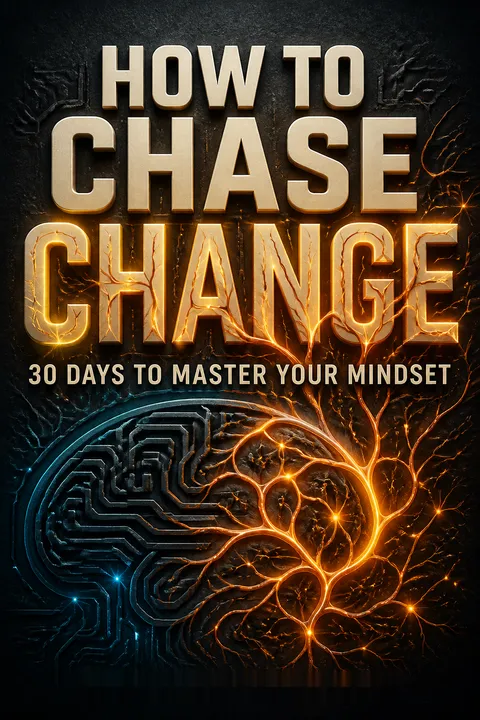
How to Chase Change receives an overall positive reception, averaging 4.01 out of 5 across 267 reviews. Readers frequently praise its practical, actionable advice and neuroscience-backed insights. The audiobook format is widely enjoyed for being engaging and easy to digest. Many appreciate its structure of 30 strategies paired with 30 micro-tasks, though several listeners wish they had a physical copy to better complete the exercises. Common critiques are minor, including the lack of an accompanying PDF and its brevity.
Glossary
schema
Mental pattern for interpretationA schema is an organized pattern of thought and behavior used to interpret incoming information and make sense of the world. The book describes schemas involving objects, the self, roles, and events. They help the brain process experience efficiently, but they can be revised when new information is assimilated into an existing view or requires accommodation.
accommodation
Revising a belief structureAccommodation is a form of cognitive adaptation in which a person modifies an existing schema because new information does not fit it. For example, someone who holds a broad negative belief about a group may revise that belief after meaningful experiences contradict it. The concept is associated in the book with Jean Piaget's account of learning and cognitive development.
cognitive bias
Skewed interpretation of evidenceCognitive bias is a systematic tendency to interpret information selectively rather than weigh all available evidence evenly. The book illustrates it with people who notice encounters that confirm a belief, such as assuming everyone in a city is rude, while overlooking counterexamples. Bias can shape judgments, relationships, and decisions without the person consciously choosing a distorted view.
long-term potentiation
Persistent strengthening of synapsesLong-term potentiation, or LTP, is a lasting increase in the effectiveness of connections between neurons after particular patterns of activity. The book uses it to explain how learning and repeated experiences can strengthen neural pathways. It is a broad biological process, not a simple guarantee that any repeated behavior will change in a predictable way.
fixed mindset
Ability viewed as unchangeableA fixed mindset is the belief that traits such as intelligence or personality are largely set. In the book's account of Carol Dweck's research, this belief can make people avoid challenges, fear mistakes, and interpret criticism as a threat to their ability. The contrasting growth mindset treats skills and capacities as developable through effort, learning, and practice.
growth mindset
Ability viewed as developableA growth mindset is the belief that abilities can improve through learning, effort, and practice. The book links this view with greater willingness to attempt challenges, learn from mistakes, and see other people's achievements as useful examples rather than threats. It does not mean effort guarantees success, but it frames setbacks as information about what may need further work.
loss aversion
Losses feel especially costlyLoss aversion is the tendency for people to experience the prospect of losing something as more compelling than an equivalent possible gain. The book applies this idea to avoidance of risk and discomfort, and suggests that consequences can sometimes motivate follow-through more strongly than rewards. The strength of loss aversion varies with context and should not be treated as a fixed formula.
self-efficacy
Belief in one's capabilitySelf-efficacy is a person's belief that they can carry out the actions needed to achieve a particular result. In the book, it influences which goals a person chooses, how much effort they invest, and how persistently they respond to obstacles. It is task-related: someone may feel capable in one area and uncertain in another.
adherence
Ability to stick with a planAdherence is the ability to continue following a plan or behavior over time. The book emphasizes that a technically sound plan can fail if it does not fit a person's preferences, routines, or confidence. Enjoyment, manageable difficulty, support, and self-efficacy can all affect whether someone maintains a goal long enough to benefit from it.
Name it to tame it
Labeling an emotion or triggerName it to tame it is a technique for identifying and putting words to an emotion or the event that triggered it. The book describes this as a way to interrupt an escalating reaction and make room for reflection and problem-solving. It is not a promise that naming an emotion removes it, but a method for noticing what is happening before responding.
self-directed neuroplasticity
Intentional brain adaptationSelf-directed neuroplasticity refers to intentionally using thoughts, attention, and behavior to encourage changes in how the brain functions and organizes itself. The book applies the idea to learning, habits, and beliefs about personal capability. It distinguishes intentional change from adaptations that occur in response to experiences outside a person's control.
hedonic adaptation
Adjustment to changed circumstancesHedonic adaptation is the tendency for emotional responses to shift as people adjust to positive or negative changes in their circumstances. The book uses it to explain why a major achievement or acquisition may bring a temporary lift without creating lasting happiness. Adaptation differs among people and events, so the concept does not mean all outcomes eventually feel the same.
deathbed test
Future perspective for decisionsThe deathbed test is a decision-making exercise that asks a person to imagine looking back on life near its end. The person considers whether today's reason for avoiding an action is likely to matter in that broader perspective. The book uses the exercise to clarify values and prompt action, particularly when fear of judgment or failure is driving delay.
Download PDF
Download EPUB
.epub digital book format is ideal for reading ebooks on phones, tablets, and e-readers.








