

Key Takeaways
Treat creation as ordinary work, not a gift reserved for geniuses
The myth dissolves. A letter long attributed to Mozart described masterpieces arriving fully formed in his imagination. It was a forgery. His real letters and working papers show a composer using instruments, sketches, revision, and craft. The romantic story survives because effortless genius is more glamorous than labor, but it also gives everyone else an excuse to believe they cannot create.
Edmond’s work mattered. In 1841, twelve-year-old Edmond Albius worked out how to pollinate vanilla by hand, enabling its cultivation far beyond Mexico. The method transformed an industry, yet Edmond’s story is remarkable partly because someone preserved his name. Creation is a human capacity, Ashton argues, though people differ in skill, opportunity, and results.
The book’s opening move is powerful because it changes the reader’s question from “Am I gifted?” to “What work can I do next?” That shift is consistent with how expertise develops in fields such as music and engineering: practice builds fluency, while repeated attempts expose problems invisible to a beginner. The egalitarian claim deserves one qualification. A universal capacity does not mean equal access to tools, time, education, or recognition. Edmond’s brilliance depended on knowledge around him, and his enslavement constrained his life. Making creation ordinary should widen opportunity, not erase the conditions that shape it.
Advance by solving the next problem, then testing the solution
Progress comes in steps. Psychologist Karl Duncker studied people solving practical problems and found that they worked through intermediate possibilities, testing and revising rather than leaping to a complete answer. In the candle problem, for instance, people eventually notice that an empty tack box can serve as a candle platform. The solution emerges from working through the objects’ uses, not from a magical flash.
The Wrights built their way upward. They treated flight as a balance problem, studied birds, tested wing control, and built successive kites and gliders. When existing aerodynamic measurements failed, they constructed a wind tunnel and gathered their own data. Their first powered flight was not a single stroke of genius. It was the result of many tested adjustments, each one revealing the next problem.
This process resembles experimental science: a useful hypothesis is not a finished answer but a tool for generating the next test. It also explains why prototypes are valuable even when they fail. They make hidden constraints visible. The book’s emphasis on iteration is a strong corrective to idea worship, although sheer repetition is not automatically progress. A process improves when each attempt produces information, and when creators can recognize when a promising line of work needs a different approach.
Question familiar assumptions, because expertise can hide what is present
Attention filters reality. Inattentional blindness is the failure to notice something visible because attention is directed elsewhere. In one experiment, many people walking while using a phone failed to notice a clown riding a unicycle. Experts face a related risk: training teaches them where to look, but also what to dismiss.
Robin Warren looked again. Doctors assumed the stomach was too acidic for bacteria. Warren noticed curved bacteria in stomach samples, kept investigating, and eventually worked with Barry Marshall to show that H. pylori was associated with ulcers. Other researchers had seen the organism before but interpreted it through the prevailing belief that it could not be there. A beginner’s mind, the book’s term for looking without automatic assumptions, helps experts notice exceptions to what they know.
Expertise is a compression system: it helps people identify familiar patterns quickly, saving time and attention. The same efficiency can turn a sound expectation into a blind spot. This tension appears in medicine, aviation, and safety engineering, where checklists and second opinions can catch errors that experience alone misses. A novice’s fresh eyes are useful, but novices also lack the knowledge to distinguish a genuine anomaly from noise. The strongest approach pairs deep expertise with deliberate opportunities to question its assumptions.
Use rejection to improve evidence, not to prove yourself right
No has several meanings. Judah Folkman’s theory that tumors depend on new blood vessels was dismissed for years. He kept testing it, and a laboratory contaminant that his team investigated rather than discarded helped advance the work. His persistence paid off because it was tied to evidence and experiment, not just faith in a favored idea.
Warnings can be lifesaving. Inventor Franz Reichelt ignored expert criticism and repeated failures of his parachute suit, then died testing it from the Eiffel Tower. Ignaz Semmelweis, by contrast, had strong evidence that hand-washing reduced deaths in a maternity clinic, but failed to establish the cause clearly enough to persuade his peers. Rejection may reveal bias, flaws, or missing proof. It is a signal to investigate, not an automatic verdict either way.
The distinction between persistence and stubbornness is central to responsible invention. In scientific practice, criticism is useful when it points toward a test that could change minds; it becomes mere status defense when no evidence would count against the critic’s position. The opposite danger is treating opposition as proof of insight. Reichelt’s story makes that error vivid. Good judgment therefore requires both confidence to continue and humility to revise. Rejection can refine a project, but only if the creator takes its content seriously.
Protect focused hours and begin before inspiration or approval arrives
Time is the raw material. Many creators in the book decline invitations because even a small interruption can consume attention beyond the minutes it occupies. Woody Allen writes regularly rather than waiting for a perfect mood. He drafts on paper, cuts and rearranges pages, and has offered to shelve work he dislikes, even when others praise it.
Make room for choice. Psychologist Teresa Amabile’s experiments found that people expecting evaluation often produced less creative work and felt more anxious. Rewards can also impede open-ended discovery, although they may help with tasks that have clear answers. The practical lesson is not that all praise or pay is harmful. It is that creative work needs protected time, some autonomy, and permission to make imperfect early versions before judgment takes over.
The research discussed here points to a useful design principle: evaluation should arrive at the right stage. Early exploration benefits from room to generate and test possibilities; later review can impose standards and remove weak choices. That is not an argument against feedback or accountability. It is an argument for separating them from the moment when a fragile idea is first being formed. The book’s insistence on solitude also has limits. Many projects need collaborators, but collaboration works best when it does not fragment every person’s concentration.
Credit the network, not just the visible name on the discovery
Creation has many hands. Edmond Albius’s pollination method built on botanical knowledge and plantation experience, while its economic success depended on people who spread and cultivated it. His owner, Ferréol Bellier-Beaumont, publicly defended Edmond’s claim to the discovery, a rare intervention in a world where creators’ names were often lost.
Recognition follows status. Rosalind Franklin’s X-ray work was crucial to understanding DNA’s structure, yet colleagues used her data without her knowledge and failed to acknowledge her contribution adequately. Sociologist Harriet Zuckerman documented a related pattern: already famous scientists tend to receive disproportionate credit for collaborative work. The Matthew effect names this cumulative advantage, in which recognition attracts further recognition. Individual achievement is real, but it is built on earlier work and uneven systems of visibility.
Attribution is more than a courtesy. It affects who gets funding, authority, jobs, and the chance to pursue the next question. The Matthew effect helps explain why credit can become self-reinforcing even in institutions that formally reward merit. Yet the opposite simplification also matters: describing every discovery as collective can obscure who made a decisive contribution, especially when less powerful collaborators are already easy to overlook. Fair attribution requires both acknowledging the network and naming specific intellectual labor within it.
Judge inventions by their full consequences, including costs far away
Every tool has a chain. A can of Coca-Cola links mining, shipping, chemistry, agriculture, manufacturing, and local water. Ashton estimates that the full production chain for a twelve-ounce can uses more than thirty gallons of water. Its impacts include resource use, pollution, and effects on communities far from the person who buys it.
Consequences keep moving. The Luddites attacked automated looms because they feared for their jobs. They could not foresee that mechanization would help create new industries and increase demand for educated workers, contributing to wider literacy. Amish communities offer a different lesson: they assess technologies partly by how they shape community life. A tool can solve one problem and create another, so invention requires attention to consequences and continued adaptation.
This account resists two easy stories: that technology automatically improves life, and that its harms prove innovation should stop. A systems perspective asks who benefits, who bears the costs, and where those costs appear along the chain. That approach is especially useful for technologies whose effects are geographically or temporally distant from their users. Prediction will remain imperfect, however. Responsible innovation cannot mean forecasting every outcome before acting. It means monitoring impacts, listening to affected communities, and treating harmful side effects as real problems to address.
Build teams that test ideas quickly and let truth challenge rank
Make action easier than argument. During World War II, engineer Kelly Johnson led a small, isolated team called the Skunk Works to build America’s first jet fighter. Given 180 days, the team delivered its aircraft 37 days early. Its structure reduced administrative layers, kept technical workers close to the work, and used experiments to settle disputes. Johnson’s response to a young engineer’s criticism of an aircraft design was to give him a chance to demonstrate it.
Conversation needs the right conditions. Jim Henson and Frank Oz developed Bert and Ernie by trying the puppets together, not by planning their personalities in a meeting. In the marshmallow challenge, kindergartners often outperform adult groups because they prototype early and repeatedly. Teams need trust and useful exchange, but lengthy discussion without testing can become a performance of work rather than work itself.
The examples suggest that creative organizations are designed around fast feedback, psychological safety, and access to the materials of the task. Small teams can reduce coordination costs, while a norm of demonstration lowers the stakes of disagreement: the idea can be tested instead of defended as a matter of status. Still, meetings are not inherently wasteful, and isolation is not always appropriate. Complex work also needs coordination, documentation, and review. The challenge is to make discussion serve action, rather than allowing process to displace the work it is meant to support.
Make one useful thing better through the perspective only you bring
Creation need not be grand. Annie Miler’s neighborhood bakery is an example of ordinary work made distinctive by its creator’s taste and care. Its food and welcoming space become part of local life. Such contributions may not resemble famous inventions, but they still add something new and useful.
The need keeps growing. Ashton contrasts Thomas Malthus’s prediction that population growth would bring mass famine with the role of invention in increasing the world’s capacity to feed and sustain people. More people can mean more creators, knowledge, and connections, though it also means greater resource pressure. Passion matters when it becomes action: baseball player George Shuba practiced hundreds of swings each night through the winter. The book’s closing challenge is to contribute, not to wait for a guarantee that the contribution will matter.
The final argument joins personal agency to collective capacity. A bakery, a scientific discovery, and a manufacturing process operate at different scales, but each can improve the conditions in which other people live and work. This is a compelling alternative to measuring creativity only by fame or market size. The claim that more people generate more solutions is plausible, but it does not make growth costless or progress automatic. Human ingenuity expands possibilities; institutions and communities still decide whose problems count and how benefits are shared.
Analysis
The book is a story-driven argument against the romantic model of creation. Its recurring pattern is not inspiration followed by effortless execution, but attention, problem formulation, trial, evaluation, and revision. The examples range from Edmond Albius’s hand-pollination method to the Wright brothers’ aircraft, Robin Warren’s recognition of H. pylori, and the Skunk Works. Their variety gives the thesis reach: creation is not confined to art, science, or business, and its visible breakthroughs are often the accumulated result of ordinary work.
The strongest contribution is practical and epistemic at once. The book asks readers to begin, tolerate imperfect attempts, inspect assumptions, and treat criticism as potentially informative. It also expands the unit of analysis beyond the celebrated individual. Inventions depend on inherited knowledge, collaborators, institutions, and material supply chains. The stories of Franklin and Edmond show that recognition is not a neutral record of who contributed, but a social process shaped by power.
Some claims are more sweeping than the evidence presented can support. The book’s skepticism toward incubation and brainstorming risks replacing one simple story with another. Deliberate iteration is indispensable, but unreported mental processing may contribute to problem solving, and group discussion can help when participants bring distinct knowledge and have structures that prevent domination. Likewise, the claim that creativity is universal should not be mistaken for equality of resources or outcomes.
These qualifications strengthen rather than weaken the central message. Ideas do not create value merely by appearing, and repeated effort does not guarantee success. Yet creators can improve their odds by making work observable, testing assumptions, learning from failures, protecting attention, and designing institutions that hear dissent. The book’s deepest reframe is that creation is less a mysterious personal trait than a human practice embedded in a social chain. The task is not to become a genius, but to contribute a next step and remain alert to who helped make it possible.
Review Summary
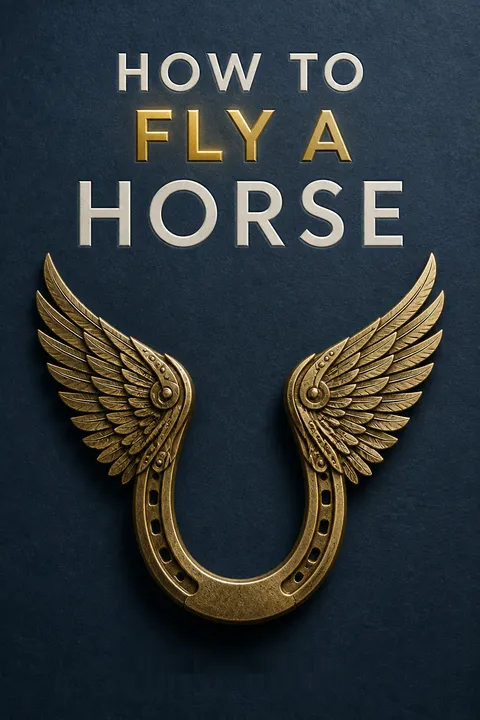
How to Fly a Horse challenges common myths about creativity, arguing that it stems from hard work rather than innate genius. Readers praised Ashton's engaging anecdotes and insights into the creative process, finding the book inspiring and thought-provoking. Many appreciated the debunking of creative myths and emphasis on persistence. Some critics found it repetitive or disagreed with certain arguments. Overall, reviewers found it an enjoyable and accessible exploration of creativity, invention, and discovery, with valuable lessons for fostering innovation in various fields.
People Also Read




Glossary
creativity myth
genius-and-flash mythThe belief that creation belongs to a rare class of geniuses, arrives through sudden inspiration, and requires little ordinary work. Ashton argues that this story misrepresents how creators actually proceed and discourages people from trying. The book counters it with histories of incremental discovery, revision, testing, failure, and collaboration.
problem-solution loop
repeated problem solvingA pattern of thinking in which a person identifies a problem, proposes a solution, evaluates it, and uses the result to identify the next problem. The process may include failed attempts and revisions. Ashton uses it to explain creative work across fields, from engineering and painting to scientific research.
inattentional blindness
missing visible informationA failure to notice something in plain sight because attention is focused elsewhere or prior expectations filter what reaches awareness. In the book, examples include people missing an unexpected clown while using a phone and researchers overlooking bacteria in stomach samples. The concept shows how perception depends on attention and assumptions.
beginner's mind
attention without assumptionA mode of attention associated with Zen teaching in which observation is not fully governed by established expectations. Ashton presents it as a practical complement to expertise, not a rejection of knowledge. It helps experienced people notice anomalies, question inherited assumptions, and reconsider familiar objects or problems.
paradigm
shared way of seeingA framework of assumptions and accepted practices that shapes what a community notices, regards as a problem, and considers a valid explanation. Drawing on Thomas Kuhn, Ashton explains that a paradigm can guide expert attention while also hiding observations that do not fit. New evidence may require revising the framework itself.
Matthew effect
recognition compounds recognitionA pattern in which people who already have status or recognition receive disproportionate credit for work, while less recognized contributors remain overlooked. Sociologist Harriet Zuckerman observed it among scientists, including Nobel laureates. Ashton uses the term to show how credit can accumulate around prominent names rather than accurately reflect each person’s contribution.
tool chains
linked tools and contributionsThe linked processes, parts, knowledge, and labor required to make an object or carry out an invention. A modern product may depend on materials, technologies, and expertise from many places and eras. Ashton uses tool chains to show that creations are inherited collective achievements and that their consequences can spread far beyond their users.
hidden curriculum
unwritten rules shaping behaviorThe informal rules and incentives people learn in schools and organizations, often through everyday practice rather than explicit instruction. These rules can contradict official messages. For example, an institution may praise originality but reward compliance, teaching members to avoid risk even while leaders publicly call for innovation.
interaction ritual chains
linked social interactionsA term associated with sociologist Randall Collins for sequences of small social exchanges shaped by context, relationships, authority, and emotion. These interactions influence how people speak and act in settings such as meetings. Ashton applies the idea to organizations, arguing that everyday interaction patterns help determine whether people can create together.
angiogenesis
growth of new blood vesselsThe formation of new blood vessels. Judah Folkman proposed that tumors stimulate blood-vessel growth to obtain the supply needed to expand, and that blocking this process might restrict tumor growth. His work faced long skepticism before the approach became influential in cancer research and treatment.
FAQ
What's How to Fly a Horse about?
- Exploration of Creativity: The book argues that creativity is an ordinary human trait, not a rare gift, and that everyone has the potential to create.
- Historical Context: Kevin Ashton uses historical examples, like Edmond Albius and the Luddites, to show how creativity often stems from hard work and perseverance.
- Challenging Myths: Ashton challenges romanticized notions of creativity, emphasizing that it is a result of ordinary acts and accessible to all.
Why should I read How to Fly a Horse?
- Empowering Perspective: The book empowers readers by showing that creativity is accessible to everyone, encouraging them to embrace their own potential.
- Practical Insights: Ashton shares relatable stories and practical advice, making the book applicable to everyday life.
- Debunking Myths: It debunks common myths about creativity, helping readers understand that failure and rejection are part of the process.
What are the key takeaways of How to Fly a Horse?
- Creativity is Work: Ashton emphasizes that creating is not magic but requires persistence and effort over time.
- Everyone Can Create: The book asserts that creativity is a fundamental human trait, not limited to a few "geniuses."
- Value of Failure: Ashton highlights the importance of failure in the creative process, encouraging readers to embrace their mistakes.
What are the best quotes from How to Fly a Horse and what do they mean?
- "Creating is ordinary, even if the outcome is not.": This quote encapsulates the book's theme that creativity is a common human experience.
- "If you want to make an apple pie from scratch, you must first invent the universe.": This humorous quote by Carl Sagan illustrates the complexity and interconnectedness of creation.
- "Innovation is a series of repetitive failures.": This quote emphasizes that persistence through failure is essential for successful creation.
How does Kevin Ashton define creativity in How to Fly a Horse?
- Ordinary Process: Ashton defines creativity as an ordinary process involving hard work, iteration, and problem-solving.
- Accessible to All: He argues that creativity is inherent in all humans, encouraging everyone to engage in creative endeavors.
- Cumulative Effort: Creativity builds on the work of others, highlighting the importance of collaboration and innovation.
What role does failure play in How to Fly a Horse?
- Essential for Growth: Ashton posits that failure is crucial in the creative process, providing valuable lessons for success.
- Normalizes Setbacks: He normalizes setbacks, encouraging readers to view failure as a stepping stone rather than an endpoint.
- Encourages Persistence: The book suggests that many successful creators faced numerous rejections before achieving their goals.
How does Kevin Ashton use historical examples in How to Fly a Horse?
- Illustrative Stories: Ashton uses figures like Edmond Albius and Rosalind Franklin to show how hard work led to significant discoveries.
- Challenging Norms: These examples demonstrate that groundbreaking ideas often come from questioning established beliefs.
- Connecting Past to Present: Ashton connects past innovations to contemporary creativity, showing the timelessness of creation.
What is the significance of the "creativity myth" discussed in How to Fly a Horse?
- Misleading Beliefs: The "creativity myth" suggests creativity is a rare gift, which Ashton argues is misleading and harmful.
- Impacts Perception: This myth affects how society views creators, often leading to the belief that only certain individuals can contribute significantly.
- Encourages Inclusivity: By debunking this myth, Ashton promotes a more inclusive understanding of creativity.
How does Kevin Ashton address the concept of credit in How to Fly a Horse?
- Shared Contributions: Ashton emphasizes that most innovations result from collective efforts, challenging the idea of the "lone genius."
- Historical Context: He shows how many creators have been overlooked, highlighting the importance of recognizing all contributors.
- Encouraging Collaboration: The book suggests that recognizing shared credit can foster a more supportive creative environment.
What is the relationship between expertise and creativity in How to Fly a Horse?
- Expertise as a Tool: Ashton argues that expertise can enhance creativity but can also limit perspective if one becomes too entrenched.
- Beginner's Mind: He encourages experts to maintain an open attitude, allowing them to see new possibilities.
- Balance of Knowledge: While expertise is valuable, questioning assumptions and remaining open to new ideas is crucial for creativity.
How does How to Fly a Horse redefine the concept of genius?
- Genius as Myth: Ashton redefines genius as a myth that creates barriers to creativity, suggesting anyone can be creative with effort.
- Focus on Process: The book shifts focus from individual brilliance to the processes and practices that lead to creation.
- Encouraging Everyone: By debunking the myth of genius, Ashton encourages everyone to engage in creative pursuits.
What does Kevin Ashton say about the relationship between passion and creativity in How to Fly a Horse?
- Passion as a Driving Force: Ashton posits that passion fuels the desire to create and innovate, leading to meaningful creations.
- Balance of Knowledge and Passion: He highlights the need to balance passion with knowledge for successful creation.
- Intrinsic Motivation: The book emphasizes creating for the sake of creation, leading to more authentic and fulfilling work.
Download PDF
Download EPUB
.epub digital book format is ideal for reading ebooks on phones, tablets, and e-readers.








