

Key Takeaways
Turn toward the problem before silence turns it into distance
Honesty can protect closeness. The book reframes confrontation as facing an issue with someone, not attacking them. Avoidance may feel polite, but unspoken hurt can quietly close people off from each other. A friend’s gentle feedback about a colleague’s self-absorption helped him change course; a waiter’s honest admission of competitiveness prevented a friendship from souring. In both cases, the conversation addressed a threat to the relationship while there was still room to repair it.
A good conversation can preserve affection, reduce alienation, help solve a problem, prompt growth, and clarify what is actually happening. It may not produce agreement or immediate change. Its first achievement may simply be replacing private assumptions with a shared view of the issue.
What's distinctive is the book's definition of relational care: not just keeping the peace, but making reality discussable. That is a useful correction to the idea that intimacy requires uninterrupted agreement. A relationship can tolerate disagreement when both people remain engaged and neither treats discomfort as proof of rejection. Still, directness is not automatically loving. Timing, power, and safety shape whether a conversation can be constructive. The practical test is not whether the talk feels pleasant, but whether it makes the problem clearer without needlessly diminishing the person.
Set boundaries by naming your limits, not by controlling another person
A boundary marks responsibility. The book defines a boundary as a personal property line: it distinguishes what belongs to you, including your choices, values, feelings, time, and energy, from what belongs to someone else. A boundary conversation is a direct discussion of a problem and what you will do about it. It can include a request for change, but it cannot guarantee that the other person will comply.
A wife could ask her husband to stop criticizing her in public. If he refuses, her boundary is not a command that makes him stop. It may be a decision to leave the conversation or decline to attend events where the behavior continues. The affected person can take initiative even when the other person denies there is a problem.
This distinction separates influence from control. People often use boundary language to disguise an attempt to dictate another person’s choices, but the book’s stronger account keeps agency on both sides: one person can make a request, and the other can refuse; the requester then chooses a response. That structure can reduce coercion and clarify responsibility. It also places a burden on the person setting the limit to follow through. A consequence that is merely announced, inconsistently enforced, or designed to punish becomes a threat rather than a boundary.
Make one behavior, its impact, and your requested change unmistakable
Specificity makes change possible. A conversation becomes hard to resolve when it begins with a global judgment such as “you never connect” or “you are irresponsible.” Those labels leave the other person guessing what to do. Instead, identify an observable action, explain its effect on you or the relationship, and ask for a particular change.
For example, rather than asking a partner to be “more connected,” request a walk together and an unhurried conversation about what is happening at work. Rather than calling a roommate careless, name the unpaid bill or unfinished chore that is causing trouble. Keep to one central issue instead of building a prosecution from every old grievance. A clear request gives both people a way to judge whether anything has changed.
Specificity improves more than politeness. It turns a vague complaint into information that can be tested, discussed, and acted on. It also limits the temptation to treat a single conflict as proof of someone’s entire character. The other person can still dispute the facts or decline the request, but the conversation has a stable object. One caution: a request can be precise and still be unfair. Concrete language clarifies what is being asked; it does not establish that the request is reasonable or that the other person owes agreement.
Pair clear truth with warmth, listening, and ownership of your part
Connection helps truth land. A good confrontation combines grace, meaning genuine care for the person and relationship, with truth about the problem. The book calls this balance being “neutralized”: not being neutral about the issue, but preventing either warmth or bluntness from dominating the conversation. Be emotionally present, allow the other person to answer, and distinguish your experience from theirs.
The authors recommend describing a specific action and its emotional effect without claiming control over your feelings. “When the joke about my clothes happened at dinner, I felt embarrassed” is clearer and less accusatory than saying the other person made you feel a certain way. If you have caused harm, apologize before demanding accountability. That humility signals that the conversation is about repair, not winning.
The combination of firmness and care avoids a false choice between being honest and being kind. Listening matters because the speaker’s account may be incomplete, while warmth helps prevent correction from becoming humiliation. Yet care should not be confused with cushioning every difficult fact until its meaning disappears. Conversely, a calm tone does not make a controlling demand acceptable. The strongest version of this approach is reciprocal: both people can describe impact, challenge interpretations, and take responsibility without one person becoming the permanent judge and the other the permanent defendant.
Ask for what you want without making refusal emotionally unsafe
Desire belongs to the asker. People cannot reliably infer unstated wishes, and expecting them to do so often breeds disappointment. First identify what you want, then state it directly as your preference or request rather than disguising it as a criticism or a demand. A person seeking more time together might say what kind of time would help, rather than accusing a partner of never caring.
The other person must remain free to say no. If the answer is no, acknowledge your disappointment without punishing, withdrawing affection, or declaring the other person selfish. If the request matters deeply, explain why and ask about the reasons for the refusal. A practical alternative may emerge. For serious needs or repeated neglect, explain the real effect on the relationship and decide what you need to do for yourself.
The book treats freedom as a condition of genuine generosity: a yes means more when no is permitted. This is especially valuable in close relationships, where requests can carry unspoken emotional pressure. But preserving freedom does not mean pretending every refusal is inconsequential. A partner’s repeated unwillingness to make time, for example, may reveal a real mismatch in priorities. The useful distinction is between respecting another person’s choice and suppressing one’s own judgment about what that choice means for the future of the relationship.
When blame or denial derails the talk, acknowledge it and return to the issue
Resistance has recognizable forms. The book describes common ways people evade feedback: attacking the person who raised it, rationalizing, minimizing, shifting blame, denying the problem, or attributing their own faults to someone else. These moves can leave the speaker defending themselves instead of discussing the original concern.
The recommended response is to hear the other person’s perspective without surrendering the point. Acknowledge that a criticism may be hard to hear, ask whether there is a valid complaint about your part, and then return to the issue. If deflection continues, name the pattern and ask how the two of you can discuss problems without losing the topic. Do not turn the exchange into a courtroom debate over who is right. The goal is to establish whether the issue can be addressed together.
The distinction between a person’s grievance and their evasiveness is important: a defensive response can contain legitimate feedback. Taking it seriously keeps the conversation from becoming self-righteous. At the same time, endlessly accommodating diversions rewards avoidance and exhausts the person trying to raise a concern. A useful discipline is to pause, assess whether the counterpoint deserves attention now, and explicitly agree on when to return to it. If the other person repeatedly refuses any process for mutual accountability, the obstacle may be less the original behavior than the inability to resolve conflict at all.
Prepare your motives, emotions, and support before entering the hard conversation
Preparation protects your purpose. Before speaking, examine whether you are seeking repair or trying to punish, shame, unload resentment, or regain power. Own your contribution to the problem and any apology you owe. Identify what you fear, such as rejection, anger, or being outmaneuvered, because fear can make a person abandon the point they intended to raise.
The book’s preparation advice is practical: talk with trusted supporters, write down the main points, and role-play likely responses. A woman who planned to end a damaging dating pattern instead gave in to her boyfriend’s charm because she had not prepared for that pressure. Support and rehearsal helped her later hold to her decision. Preparation is not a guarantee of success; it is a way to enter with clearer aims and more choices.
This advice treats communication as a skill performed under emotional load, not simply a matter of finding the perfect sentence. Rehearsal can make it easier to remember priorities when anxiety or anger narrows attention. Support also helps distinguish a realistic concern from a distorted picture of the other person. Preparation should not become a script designed to control the exchange, however. A written outline is most useful as an anchor, with enough flexibility to absorb new information and revise an initial interpretation.
Forgive what happened without granting trust the evidence has not earned
Past, present, and future differ. The book separates forgiveness, reconciliation, and trust. Forgiveness concerns how a person regards a past wrong. Reconciliation concerns renewed relationship in the present and requires participation from both people. Trust concerns future vulnerability and depends on evidence of reliability.
This distinction matters when apologies repeat but behavior does not change. Someone can accept an apology and release the desire to retaliate while still requiring counseling, a recovery plan, or limited contact before restoring trust. The authors warn against treating “I’m sorry” as proof that the risk has disappeared. A new relationship pattern needs observable action, and the person who was hurt can set conditions for renewed closeness without using the past as a weapon.
Separating these ideas makes room for compassion without confusing it with access. It also gives the person who caused harm a constructive route forward: consistent behavior can rebuild confidence more credibly than repeated declarations. The distinction is particularly useful where there are serious breaches or safety concerns. It should not be turned into a rigid formula, since trust can vary by domain and degree. Someone may be reliable with ordinary plans yet still not be safe with money, intimacy, or confidential information.
Match consequences to the problem, and let changed behavior rebuild trust
Requests need a next step. When a behavior is persistent, damaging, or dangerous, a conversation may need clear limits and consequences. State what you will do rather than issuing orders. For instance, a parent may stop providing money if an adult child refuses to follow an agreed job-search plan; a friend may leave if someone drives after drinking. For addiction, abuse, or repeated betrayal, outside support or professional help may be needed.
The book distinguishes discomfort from injury and urges readers to consider timing, severity, and safety. It also says to vary the intensity of the response: a minor annoyance does not call for the same force as violence or deception. Patience makes sense when a person takes responsibility and works a real plan. Repeated apology without a change of direction calls for firmer limits.
This is where relational advice meets risk management. Consequences make a boundary credible, while proportionality keeps it from becoming retaliation. The focus on observable follow-through is particularly strong because verbal remorse can be sincere yet insufficient to protect anyone. A crucial limitation is that direct confrontation may be unsafe in abusive or volatile situations. The book recognizes danger and recommends support or protective action; in such cases, the priority is not achieving mutual understanding but reducing exposure to harm.
Adapt the conversation to the relationship, but keep accountability in every setting
Context changes the approach. In dating, raise important patterns early: a person’s response to feedback offers evidence about how future conflicts may go. In marriage, connect the issue to the health of the partnership, not just the immediate task. With children, pair love and truth with age-appropriate choices and real consequences, so correction can become self-correction. With adult children, shift from managing their lives to clear conditions for any help you provide.
At work, clarify formal policies and authority, describe effects on the task and team, and use established reporting channels when needed. With parents, speak as an adult who can honor them without obeying every demand. Across all these settings, the aim is not identical wording. It is clear truth, respect for choice, and responsibility for what happens next.
The book’s broad reach comes from a portable method rather than a one-size-fits-all script. A child depends on a parent for structure, while a worker may face formal power and retaliation; the same conversational tone cannot safely serve both situations. The shared principles need to be filtered through role, dependence, and risk. The especially useful question is not merely “What should be said?” but “Who has authority here, what options does each person realistically have, and what support or safeguards are needed?”
Analysis
The book’s central achievement is to make confrontation less mysterious by converting it from a personality trait into a repeatable practice. Its method moves from self-examination to a focused account of behavior and impact, then to a request, listening, and proportionate follow-through. That sequence matters because many failed conversations do not fail for lack of courage alone. They fail through vague accusations, mixed motives, accumulated grievances, emotional flooding, or a refusal to distinguish a request from a command.
Its most humane insight is that directness and relationship are not competing goods. Care without truth can leave harmful patterns untouched; truth without care can make feedback feel like attack. The book’s examples show how small, specific interventions can prevent resentment from becoming a private story about another person’s character. Its repeated emphasis on naming one’s own contribution also counters the common fantasy that the person raising a concern is automatically the clear-eyed party.
The framework is strongest when it treats boundaries as decisions about one’s own participation, rather than instruments for controlling others. That preserves agency and makes consequences meaningful. It is also strongest when it recognizes that a conversation may not produce agreement, and that persistent denial or retaliation can require outside help or distance. This avoids promising that better phrasing can solve every relationship.
There are limits to the approach. Its hopeful premise that confrontation can be an act of care depends on sufficient safety and some capacity for mutual engagement. In relationships marked by coercion or violence, the demand to remain warm, listen, or keep trying can be misapplied. The book acknowledges danger, but readers should treat safety and power as prior questions, not afterthoughts. Likewise, advice rooted in Christian theology will resonate most with readers who share its moral vocabulary, while the practical distinctions between impact, responsibility, trust, and choice can still be used more broadly. The enduring lesson is not to confront everything. It is to stop confusing silence with peace, and to speak with enough clarity to discover what kind of relationship is actually possible.
Review Summary
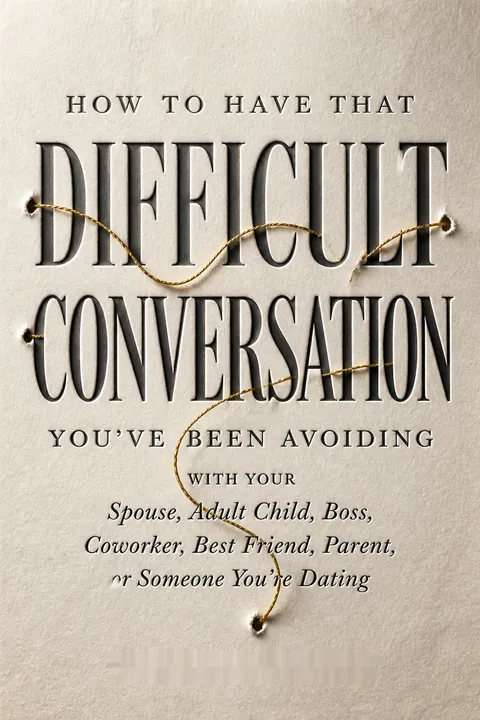
How to Have That Difficult Conversation You've Been Avoiding receives mixed reviews. Many readers find it practical and empowering, offering valuable scripts and techniques for handling tough conversations. The book's Christian perspective is appreciated by some but off-putting to others. Readers praise its advice on setting boundaries and confronting issues, though some find it overly simplistic or idealistic. Critics note the heavy use of Bible references and gender stereotyping. Despite these drawbacks, many readers consider it a helpful guide for improving communication and relationships.
Glossary
boundary conversation
Direct problem-solving talkA boundary conversation is a focused discussion in which someone raises a problem affecting a relationship, explains its impact, and asks for a change or states what they will do. It is meant to bring an issue into the relationship directly, not to control the other person. The other person remains free to respond or refuse.
boundary
Personal responsibility lineA boundary is a limit that distinguishes a person’s own choices, values, feelings, time, and resources from those of other people. It can protect against harm and clarify what someone will or will not participate in. In the book’s approach, a boundary may include a request, but its enforceable part concerns the boundary-setter’s own actions.
being neutralized
Grace joined with truthBeing neutralized means combining care for the person and relationship with a clear statement of reality about a problem. It does not mean being neutral about the issue or withholding an opinion. The balance aims to make truth easier to hear without softening it into vagueness, and to keep care from becoming avoidance.
confrontation sandwich
Support before and afterA confrontation sandwich is a preparation and recovery practice: contact supportive people before a difficult conversation, have the conversation, then reconnect with those supporters afterward. The support can help someone clarify goals, manage fear, rehearse, and feel less alone. Afterward, it offers a chance to process the outcome and regain perspective.
containment
Help bearing strong feelingsContainment is listening to another person’s difficult emotions without immediately dismissing, correcting, or reacting to them. The listener helps the person feel heard and tolerate the emotion, while not necessarily agreeing with the person’s interpretation. It has limits: listening should not require enduring emotional or physical injury.
spousal equity
Shared marital impactSpousal equity refers to the practical and emotional stake spouses have in each other’s behavior because their lives are closely intertwined. A spouse can describe how a pattern affects the individual, the partner, and the marriage. The concept supports speaking from lived impact, not claiming superior authority or a right to control.
FAQ
What's Boundaries Face to Face about?
- Focus on Confrontation: The book emphasizes the importance of having difficult conversations to set boundaries and resolve conflicts in relationships.
- Practical Guidance: It offers practical steps and methods for effectively confronting issues, applicable in both personal and professional settings.
- Integration of Insights: The authors combine biblical principles with psychological research to support their arguments about the necessity of confrontation for healthy relationships.
Why should I read Boundaries Face to Face?
- Improve Communication: If you struggle with communication, this book provides tools to enhance understanding and connection in your relationships.
- Learn to Confront: It teaches you how to confront others in a loving and constructive manner, essential for personal growth and relationship health.
- Overcome Fear: The book helps readers understand and overcome the fears associated with confrontation, empowering them to engage in necessary discussions without anxiety.
What are the key takeaways of Boundaries Face to Face?
- Confrontation is Essential: Confrontation is not adversarial; it is a necessary part of love and relationship maintenance.
- Balance Grace and Truth: Effective conversations require a balance of grace (kindness) and truth (honesty) to foster understanding and connection.
- Preparation is Key: Preparing for difficult conversations can significantly improve the outcome, ensuring that both parties feel heard and respected.
What are the best quotes from Boundaries Face to Face and what do they mean?
- “Love does not blind...”: True love involves recognizing and addressing issues in a relationship rather than ignoring them.
- “When you confront a defensive person...”: Highlights the challenge of maintaining composure during confrontations and the importance of responding maturely.
- “It is for freedom that Christ...”: Underscores the idea that personal growth and healthy boundaries lead to true freedom in relationships.
How do I prepare for a difficult conversation according to Boundaries Face to Face?
- Clarify Your Intentions: Understand what you want to achieve from the conversation and be clear about your goals.
- Practice Empathy: Consider the other person’s feelings and perspective to approach the conversation with compassion.
- Anticipate Reactions: Be prepared for various responses, including defensiveness, and plan how you will handle them.
What is the When You Do “A,” I Feel “B” formula in Boundaries Face to Face?
- Expressing Impact: This formula helps you articulate how someone’s actions affect you emotionally, making it easier for them to understand your perspective.
- Avoids Blame: By focusing on your feelings rather than blaming the other person, you create a safer space for dialogue.
- Encourages Responsibility: It encourages the other person to take responsibility for their actions and consider their impact on you.
What does Boundaries Face to Face say about the difference between forgiving and trusting?
- Forgiveness is Unilateral: Forgiveness is something you can offer regardless of the other person’s actions; it’s about letting go of past hurts.
- Trust Requires Change: Trust is built over time and requires the other person to demonstrate changed behavior before it can be restored.
- Separate Conversations: Discussions about forgiveness and trust should be distinct, focusing on past actions versus future expectations.
How can I effectively stop a behavior in someone else according to Boundaries Face to Face?
- Be Direct and Specific: Clearly articulate the behavior you want to address and its impact on you or the relationship.
- Request Change: Make a specific request for how you would like the person to change their behavior moving forward.
- Set Boundaries: If the behavior continues, establish limits on what you will tolerate and communicate the consequences of not changing.
What are some common defensive reactions people have during confrontations as discussed in Boundaries Face to Face?
- Blame Shifting: Individuals may deflect responsibility by blaming others or external circumstances for their behavior.
- Rationalization: They might create excuses that minimize the seriousness of their actions, making it difficult to address the issue.
- Counterattack: Some may respond with anger or defensiveness, attacking the person confronting them instead of addressing the problem.
How does Boundaries Face to Face suggest handling defensiveness in conversations?
- Empathize First: Acknowledge the other person’s feelings and perspective before returning to the main issue at hand.
- Stay Focused: Keep the conversation centered on the specific behavior or issue you want to address, avoiding distractions.
- Clarify Your Intent: Reiterate that your goal is to improve the relationship and not to attack or criticize them personally.
What strategies can I use to ensure a successful boundary conversation as per Boundaries Face to Face?
- Be Direct and Specific: Clearly articulate the issue at hand and avoid vague language. Specificity helps the other person understand exactly what needs to be addressed.
- Use “I” Statements: Frame your concerns using “I” statements to express how the behavior affects you personally. This approach reduces defensiveness and fosters empathy.
- Follow Up: After the conversation, check in with the person to see how they are feeling about the discussion. This reinforces the importance of the conversation and shows that you care about their perspective.
How can I apply the principles from Boundaries Face to Face in my workplace?
- Encourage Open Communication: Foster an environment where team members feel safe to express their concerns and feedback. This can lead to improved morale and productivity.
- Model Healthy Confrontation: Demonstrate effective confrontation skills by addressing issues directly and respectfully. Your behavior can set a positive example for others.
- Establish Team Norms: Work with your team to create guidelines for how to handle conflicts and feedback. This structure can help everyone feel more comfortable engaging in difficult conversations.
Download PDF
Download EPUB
.epub digital book format is ideal for reading ebooks on phones, tablets, and e-readers.








