

Key Takeaways
Treat every probing question as an invitation the other person can refuse.
A painful first lesson. At a lunch-course table, Elke Wiss wanted to make space for people without children to share their stories. When another woman said she had no children, Wiss abruptly asked whether that was her choice. It was not, and the question landed as an intrusion. Wiss came to see that a sincere motive does not guarantee a considerate question. Asking permission first could have made the same curiosity easier to receive: the other person would know what was coming and could decline.
Make room for refusal. A question is not merely a request for information. It invites someone to think, explain, or disclose something, and the invitation works only if the other person has a real choice. A gentle opening can preserve both depth and agency.
The lunch-table story captures a useful distinction between intention and impact. Curiosity can be generous, but it does not create an automatic right to another person's private history. Permission makes the exchange more collaborative and gives the respondent control over disclosure. It is not a magic shield, however: a person may agree out of politeness, or discover only afterward that a subject hurts. Respectful questioning therefore depends on noticing the response and being willing to stop, not merely securing an initial yes.
Ask before advising, and give the other person room to finish their own thinking.
The self-talk reflex. When someone describes a problem, listeners often interrupt with fixes, personal stories, or judgments. A friend who says she quit her job may be met with a lecture about financial risk before anyone asks what led to the decision. Such responses can feel helpful to the speaker, but they shift attention to the listener's experience and preferences.
Why the reflex wins. Wiss cites research suggesting people spend about 60 percent of conversation talking about themselves, rising to 80 percent on social media. In a study of 195 people, self-disclosure activated brain regions associated with reward. That helps explain why talking can feel more gratifying than asking. But the person sharing a dilemma may need questions that help clarify their own priorities, not ready-made answers borrowed from someone else's life.
Advice can be valuable when requested, especially where safety, expertise, or urgent action is involved. The point is not to ban solutions, but to avoid confusing a listener's impulse to help with the speaker's actual need. Asking what kind of response would be useful can prevent both neglect and overreach. The reward of self-disclosure also suggests that good listening is not simply a matter of kindness. It asks people to resist a gratifying conversational habit long enough to discover what the other person is really saying.
Hold opinions lightly enough to inspect the assumptions holding them up.
Practice not-knowing. The Socratic attitude is a deliberate readiness to question what seems obvious, remain curious, and admit when knowledge is incomplete. Wiss calls the capacity to examine another person's perspective without immediately retreating into one's own an agile perspective. The aim is not to have no views, but to avoid treating a view as untouchable proof of identity.
Separate judgment from condemnation. In one discussion, a mother was sure her love for her children would never change. Questions about an extreme case led her to reconsider whether her love was truly unconditional. The exercise did not establish a universal answer. It exposed the assumptions beneath her confident claim. Wiss also argues that judgments are unavoidable; the practical task is to notice them, distinguish observation from interpretation, and stay willing to revise them.
This approach treats uncertainty as an intellectual tool rather than a personal defect. That matters in conversations where beliefs are tied to identity, because direct contradiction often invites defense instead of reflection. Yet questioning should not imply that every belief is equally doubtful or that evidence has no authority. The discipline is to examine both the belief and the reasons supporting it. A person can reach a firm conclusion after inquiry, while still understanding what would count as a reason to change their mind.
Listen to the actual words, not the story your mind fills in.
Three listening positions. Wiss distinguishes listening to decide what you think, listening to understand what the speaker means, and listening from a wider view of how the exchange is going. The second keeps attention on the other person's experience; the third notices patterns, body language, and whether the conversation is connecting. Surface listening means attending closely to the words and structure of what is said, rather than filling gaps with assumptions.
A small but revealing example. An accountant heard a colleague complain about a delayed flight and assumed the lost time was the problem. When he asked what had been irritating, the colleague explained that sitting cramped in the seat was the real issue. The listener's guess made sense, but it was wrong. A follow-up question uncovered a different experience and made the conversation more accurate.
Listening is often treated as passive receptivity, but this method makes it an active check on inference. The distinction between what was observed and what was imagined is useful well beyond conversation, including analysis of interviews, reports, and group decisions. Still, body language and word choice are clues, not reliable translations of another person's inner state. They can guide a question, but should not be treated as evidence by themselves. Asking what a pause or phrase means is safer than announcing what it must mean.
Slow down, ask consent, and treat discomfort as information rather than failure.
Create the conditions. A probing conversation needs attention, time, and a willingness to tolerate pauses. Wiss describes an exercise in which pairs listened for a full minute before asking one question. Participants found that the question they eventually asked was more useful than their first impulse. In another exercise, a twenty-second pause before each answer helped a room of business leaders relax and think more carefully.
Stay alert to strain. Wiss uses empathic neutrality for a temporary stance in which the questioner notices emotion without immediately mirroring it, comforting, or trying to fix it. This can help someone continue examining an idea. But neutrality is not indifference: when irritation appears, check whether the other person wants to continue. Frustration may signal that a thought is being tested, or simply that the exchange has become unwelcome.
Silence can improve thought by interrupting the race to respond, and consent can turn difficult questioning into a shared task. The book's distinction between empathy and neutrality is most useful when understood as a temporary conversational mode, not a general rule against emotional care. In grief or crisis, companionship may matter more than analysis. A sound questioner reads the situation rather than applying one style everywhere. Discomfort can mark productive effort, but it can also be a boundary, and those possibilities must not be confused.
Reconstruct the event first, then question the belief attached to it.
Move from scene to meaning. Wiss's practical method uses downward questions to establish concrete facts, then upward questions to explore the values or assumptions behind a judgment. In a training exercise, a mother called her daughter lazy after seeing her on the couch with a phone and television on. Questions established what had happened and when the mother formed that judgment. Only then did the group examine what the scene proved about laziness.
Find the hinge. The critical point is the moment in an event when a feeling or judgment takes shape. Once located, the speaker can explain the thought attached to it. In the example, the mother had not asked what her daughter was doing; she had inferred idleness from appearances. The sequence matters: clarify the scene before debating the label, or the conversation may drift into abstractions detached from evidence.
The movement between observable events and abstract principles resembles careful case analysis: first establish what happened, then ask what rule or value people are applying. This makes disagreement more diagnostic. Two people can use the same word, such as fairness or responsibility, while judging different facts or applying different standards. The method also limits a common error, namely treating a vivid impression as a complete record. Its strength depends on honest description, since even the account of a scene can be selective.
Ask one clean question, then let its answer shape the next.
Choose the right tool. A closed question can clarify a fact or prompt a sharp judgment; an open question can invite a wider account. Neither form is automatically superior. Wiss recommends replacing accusatory versions of why with questions about reasons or how a decision developed, especially when the wording might sound like blame. An echo question repeats the speaker's own words to invite elaboration without introducing a new interpretation.
Avoid conversational clutter. A question that bundles several requests, hides a criticism, or contains a vague term is harder to answer. If someone says a meeting was awful, asking what made it awful is clearer than asking a string of unrelated questions. Ask, pause, and listen. If the answer does not address the question, repeat it calmly rather than adding more prompts or pretending the response was clear.
The emphasis on one question at a time is a practical response to limited attention: a respondent should not have to choose which part of a verbal bundle to answer. Echoing can also communicate that the listener has heard the speaker's framing rather than replacing it with their own. But exact repetition is not always necessary, and can sound mechanical if used without warmth. The larger principle is fidelity: preserve the speaker's meaning, make the request intelligible, and adapt the next question to the answer actually given.
Build a shared inquiry before asking the other person to hear your view.
Think together, not against. A Socratic dialogue is a structured inquiry into a meaningful question, grounded in a participant's real experience. Instead of beginning with abstract definitions, the group tests what ideas such as honesty or friendship mean in a concrete case. Wiss recounts a discussion about whether to lie to a friend. Participants began with opposing yes-or-no answers, but examining the case changed how everyone understood the question.
Keep the exchange reciprocal. The aim is to keep searching for a more considered view, not force agreement or win a vote. Once the other person's reasoning is understood, offer a bridge to share a different perspective, asking whether they want to hear it. The same discipline applies inward: invite questions about one's own assumptions and accept that a careful conversation can end in uncertainty rather than a tidy verdict.
A concrete case gives abstract moral language traction, while continued inquiry makes room for distinctions that slogans erase. The approach is especially valuable when disagreement is real but neither side has yet explained its standards. Consensus should remain a direction for examination, not a demand for sameness; people may reason carefully and still disagree because their priorities differ. The bridge to one's own view also matters: listening should not become self-erasure. Mutual understanding creates a better basis for disagreement, not a guarantee that disagreement disappears.
Analysis
Wiss's central claim is that better conversation depends less on clever prompts than on the discipline surrounding them. The book begins with a failure: a question intended to include someone instead exposes her to an unwanted personal disclosure. That episode gives the method its ethical center. Curiosity is valuable, but the questioner is responsible for how curiosity is offered, for listening to the answer, and for recognizing when the other person wants to stop.
The book's practical sequence is unusually coherent. First, it diagnoses why people default to self-display, advice, premature certainty, and speed. Next, it trains an attitude of wonder and not-knowing. It then establishes conditions for dialogue, including listening, precise language, permission, and patience. Finally, it offers techniques for moving between concrete events and abstract beliefs, and for keeping questions and answers aligned. This ordering matters: a technique detached from intention can become interrogation, while a good intention without technique can still produce a clumsy or harmful question.
The most useful intellectual distinction is between what happened and what a person concludes it means. The lazy-daughter example shows how an ordinary label can rest on an untested inference. By reconstructing the scene before examining the judgment, the conversation becomes more rigorous without requiring specialist knowledge. That practice also makes room for changed minds without treating revision as humiliation.
The book's strongest caution is implicit in its opening story and explicit in its advice to seek consent: Socratic questioning is not appropriate for every relationship or moment. A listener may need empathy, action, or privacy rather than analysis. The method works best when both parties knowingly choose inquiry and the questioner remains responsive to signals of strain. Its promise is not that every conversation reaches truth or agreement, but that people can make their reasoning more visible, test assumptions together, and disagree with greater precision.
Review Summary
How to Know Everything received mixed reviews, with an average rating of 3.60/5. Readers appreciated the practical tips for asking better questions and fostering deeper conversations. Many found the book insightful and applicable to daily life. However, some criticized the writing style as too casual or repetitive. Several reviewers noted that the content could have been condensed. While some praised the book's potential to improve communication skills, others felt it lacked depth or originality. Overall, opinions varied widely on its effectiveness and readability.
People Also Read

Glossary
Socratic attitude
Curious, self-questioning stanceA conversational disposition shaped by wonder, curiosity, and awareness that one's knowledge may be incomplete. It involves noticing one's own assumptions, resisting the impulse to win or advise, and asking questions that help another person examine their reasoning. It is the foundation for the book's practical questioning techniques.
agile perspective
Flexible examination of viewpointsWiss's term for the ability to explore another person's point of view without immediately collapsing back into one's own. It includes holding judgments provisionally, considering alternative interpretations, and examining one's beliefs as well as another person's. The goal is not permanent neutrality, but greater flexibility in how a person thinks.
empathic neutrality
Attentive emotional distanceA temporary stance used in Socratic discussion: the listener registers another person's emotions without immediately sharing, soothing, judging, or fixing them. This distance can help the speaker continue examining their own reasoning. It does not mean lacking care, and it should be adjusted when the context calls for emotional support or the other person wants to stop.
surface listening
Attention to words and formA listening technique that focuses on the speaker's actual words, sentence structure, repeated terms, contradictions, and gaps, rather than filling in the story with one's own assumptions. It helps the listener formulate precise follow-up questions. Interpretations remain provisional and can be checked directly with the speaker.
upward and downward questions
From facts to principlesA questioning structure that moves between concrete events and abstract ideas. Downward questions clarify what happened, who was involved, and what was said or done. Upward questions examine the values, beliefs, and assumptions behind a person's interpretation. Starting with the concrete often keeps discussion focused before it moves toward general principles.
critical point
Moment a judgment takes shapeThe specific moment in an event when a person begins to feel or think something central to their account, such as anger or a judgment about another person. Identifying it helps connect concrete details to the interpretation that followed. Questions can then examine why that moment carried the meaning it did.
echo question
Repeat words to invite detailA follow-up question that reuses the speaker's own wording to ask for clarification or elaboration without introducing a new interpretation. If someone says an event was an ordeal, an echo question asks what made it an ordeal. Used sparingly and sincerely, it keeps attention on the speaker's account.
elenchus
Scrutiny that exposes contradictionsA Socratic process of testing a person's claims through questions until inconsistencies, unsupported assumptions, or gaps in reasoning become visible. It can unsettle someone because a confident belief may prove less secure than expected. Its purpose in inquiry is to clear space for better thinking, not to shame or defeat the other person.
aporia
Recognized uncertainty after inquiryA state of perplexity in which a person or group sees that no available answer is fully satisfactory. In Socratic inquiry, aporia can follow the examination of assumptions and expose the limits of what participants know. It is not necessarily a dead end; recognizing uncertainty can make more careful questions possible.
maieutics
Drawing understanding out through dialogueA term derived from the Greek word for midwifery, used for Socrates's idea that questioning helps another person bring understanding to the surface. Rather than simply transferring answers, the questioner assists a partner in examining and developing their own thought. Wiss connects the metaphor to Socrates's mother, who was a midwife.
FAQ
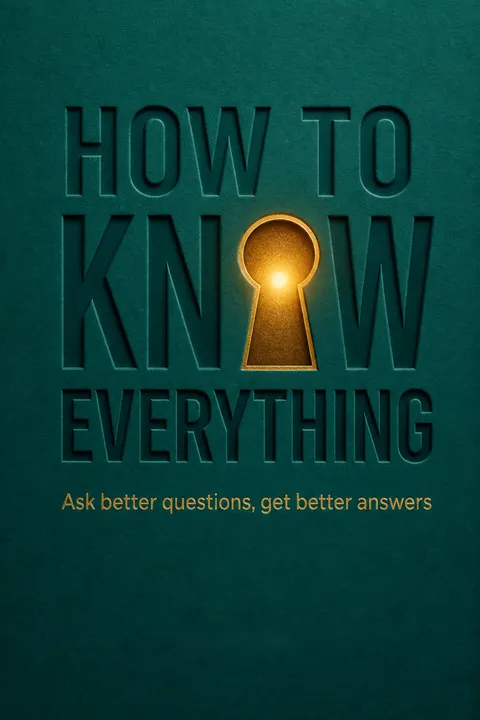
What's "How to Know Everything" about?
- Practical Philosophy Focus: The book by Elke Wiss explores practical philosophy, emphasizing the art of asking questions to gain deeper understanding and wisdom.
- Socratic Method: It draws on the Socratic method, encouraging readers to adopt a questioning attitude to explore concepts and beliefs critically.
- Improving Conversations: The book aims to help readers have more meaningful conversations by asking better questions and understanding others more deeply.
- Modern Application: It applies ancient philosophical techniques to modern life, from personal relationships to professional settings.
Why should I read "How to Know Everything"?
- Enhance Communication Skills: The book provides tools to improve your questioning and listening skills, leading to more effective communication.
- Personal Growth: It encourages self-reflection and critical thinking, helping you understand your own beliefs and assumptions.
- Conflict Resolution: By learning to ask better questions, you can navigate disagreements and conflicts more constructively.
- Broaden Perspectives: The book helps you explore different viewpoints, fostering empathy and understanding in diverse interactions.
What are the key takeaways of "How to Know Everything"?
- Socratic Attitude: Embrace a mindset of curiosity and not-knowing to ask meaningful questions.
- Listening Skills: Develop the ability to listen purely and attentively, focusing on the other person's story.
- Questioning Techniques: Learn to use upward and downward questioning to explore both abstract concepts and concrete examples.
- Empathic Neutrality: Practice maintaining a neutral stance to ask critical questions without being swayed by emotions.
How does Elke Wiss define a "good question"?
- Invitation to Think: A good question invites the other person to think, explain, and explore their ideas.
- Open and Curious: It is born of an open, curious attitude and remains focused on the other person's story.
- Leads to Insight: A good question leads to clarification, new insights, or a new perspective for the recipient.
- Non-Judgmental: It is not intended to give advice, impose a point of view, or leave the other person feeling judged.
What is the Socratic attitude according to "How to Know Everything"?
- Embrace Wonder: Approach situations with a sense of wonder, questioning what seems self-evident.
- Curiosity and Courage: Cultivate genuine curiosity and the courage to ask difficult questions.
- Judgment Awareness: Be aware of your judgments and learn to step back from them to explore other perspectives.
- Not-Knowing Acceptance: Accept and even embrace not-knowing as a starting point for deeper inquiry.
How can I apply the Socratic method in everyday life?
- Ask Permission: Before diving into deep questions, ask if the other person is open to exploring the topic.
- Slow Down: Take your time to think and ask questions, allowing for a more thoughtful conversation.
- Focus on Listening: Listen attentively to the other person's words and body language to understand their perspective.
- Use Upward and Downward Questions: Start with concrete examples and move to abstract concepts to explore ideas thoroughly.
What are some common pitfalls in asking questions?
- Leading Questions: Avoid questions that suggest a particular answer or impose your own views.
- Cocktail Questions: Steer clear of asking multiple questions at once, which can confuse the conversation.
- Vague Questions: Ensure your questions are clear and specific to avoid ambiguity.
- Empathy Overload: Be cautious of letting empathy cloud your ability to ask critical questions.
How does "How to Know Everything" suggest handling difficult conversations?
- Empathic Neutrality: Maintain a neutral stance to ask questions that challenge without causing defensiveness.
- Confrontation with Care: Use questions to confront inconsistencies or unclear statements gently and constructively.
- Explore Opposing Views: Encourage the other person to consider alternative perspectives to broaden the discussion.
- Tolerate Frustration: Accept that frustration is part of the process and can lead to deeper understanding.
What are the best quotes from "How to Know Everything" and what do they mean?
- "Philosophy begins in wonder." This quote emphasizes the importance of approaching life with curiosity and openness to new ideas.
- "I know that I know nothing." A reminder to embrace not-knowing as a path to true knowledge and understanding.
- "A question is an invitation." Highlights the role of questions in inviting others to think and explore their beliefs.
- "Take the time it takes, so it takes less time." Encourages slowing down to achieve more meaningful and efficient conversations.
How does "How to Know Everything" address the fear of asking questions?
- Acknowledge Fear: Recognize that fear of discomfort or conflict can prevent us from asking important questions.
- Build Courage: Develop the courage to ask questions that may challenge or unsettle, knowing they can lead to growth.
- Create Safe Spaces: Establish conditions where both parties feel comfortable exploring difficult topics.
- Practice Empathy: Understand the other person's perspective to ask questions that are considerate and constructive.
How can I improve my listening skills as suggested in "How to Know Everything"?
- Focus on the Other Person: Listen with the intention of understanding their perspective, not just waiting for your turn to speak.
- Surface Listening: Pay attention to the language and structure of what is being said, not just the content.
- Observe Body Language: Notice non-verbal cues to gain deeper insight into the other person's feelings and thoughts.
- Practice Active Mindfulness: Stay present in the conversation, avoiding distractions and assumptions.
What is the role of empathy in asking questions according to "How to Know Everything"?
- Empathic Neutrality: Temporarily set aside empathy to maintain objectivity and ask critical questions.
- Non-Empathetic Compassion: Focus on understanding and helping without becoming emotionally entangled.
- Balance Empathy and Inquiry: Use empathy to connect, but ensure it doesn't hinder your ability to ask meaningful questions.
- Shelve Empathy When Necessary: Recognize when empathy might cloud judgment and choose to ask questions that challenge.
Download PDF
Download EPUB
.epub digital book format is ideal for reading ebooks on phones, tablets, and e-readers.








