Key Takeaways
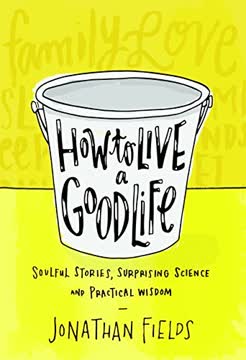
1. The Good Life Rests on Three Buckets: Vitality, Connection, Contribution.
The fuller your buckets, the better your life. When all simultaneously bubble over, life soars.
Holistic framework. Imagine your life as three interconnected buckets: Vitality (mind and body), Connection (relationships), and Contribution (how you bring your gifts to the world). A truly good life isn't about excelling in just one area; it's about nurturing all three simultaneously. When one bucket runs dry, it inevitably drains the others, creating pain and limiting your overall well-being.
Three Laws of the Buckets. These buckets are not static; they constantly leak, requiring continuous refilling. Your emptiest bucket will always drag the others down, emphasizing the need for balance. Crucially, the buckets never lie—self-delusion about their fullness won't change your reality. Regularly assessing and intentionally filling each bucket is key to sustained happiness and fulfillment.
2. Shift from Autopilot to Intentional Living.
Awakening one morning, she thought, Welcome to my autopilot life.
Break the cycle. Many of us live on autopilot, reacting to external demands and other people's agendas from the moment we wake up. This pervasive busyness leads to fractured attention, a sense of being overwhelmed, and a disconnect from what truly matters. It's a "Reactive Life Syndrome" where survival replaces purpose, leaving us feeling "comfortably numb" and unfulfilled.
Cultivate awareness. The antidote is to move from a reactive state to an aware and intentional one, driven by awareness, intention, and action. Mindfulness is the master key, allowing you to hit pause, slow down, and reconnect with the present moment. This practice improves memory, cognitive function, mood, and stress management, enabling you to deliberately choose actions that align with your desired life, rather than mindlessly reacting.
3. Optimize Your Vitality: Move, Rest, and Connect with Nature.
Exercise is powerful medicine.
Move your body. Vitality is an optimal state of body and mind. Regular movement and exercise are crucial, not just for physical health (reduced disease risk, enhanced brain function, elevated mood) but for mental well-being. Reframe exercise as "play" by finding activities that engage your mind, offer novelty, and foster community, making it something you crave rather than dread. Incorporate gentle movement throughout your day to counteract the damaging effects of prolonged inactivity.
Prioritize sleep and nature. Sleep is a fundamental vitality filler, impacting everything from health and energy to memory and resilience. Aim for 7-8 hours, establish consistent sleep and wake times, and create a calming bedtime ritual. Additionally, "forest bathing" (shinrin-yoku) or even small exposures to nature significantly reduce stress, improve mood, boost immune response, and enhance overall happiness, proving nature is a powerful, accessible elixir for mind and body.
4. Cultivate Inner Well-being: Gratitude and Authentic Self-Expression.
Before you can choose joy, you have to choose you.
Embrace authenticity. Many people stifle their true selves, hiding behind facades to meet societal expectations, which ultimately drains their energy and joy. Unapologetic self-expression, like Elizabeth Gilbert dancing in old sweats, radiates confidence and lightness. Choosing to be authentically "you"—with all your quirks and goofball tendencies—frees up immense energy previously spent on maintaining an illusion, allowing deeper joy to emerge.
Practice gratitude. Our brains have a "negativity bias," making us latch onto what goes wrong. Gratitude is a powerful counter-force, rewiring our brains for positivity. Exercises like Martin Seligman's "Three Blessings" (writing down three good things and why they happened) or a "gratitude visit" (thanking someone in person you never properly thanked) can significantly boost mood and shift your perspective, helping you see and appreciate the good in your life.
5. Befriend Uncertainty: Embrace the Unknown with Mindfulness and Action.
Every breakthrough is preceded by great uncertainty.
Uncertainty as opportunity. Life's greatest moments and breakthroughs reside in the space of uncertainty, between desire and attainment. While acting in the face of the unknown can trigger fear, anxiety, and self-doubt, it's also where possibility finds its wings. Avoiding uncertainty means replicating, not creating, and ultimately leads to a life in "the gray twilight that knows neither victory nor defeat."
Tools for navigating the unknown. You can train yourself to find grace in this space.
- Mindfulness helps you recognize and let go of paralyzing doubts and doomsday scenarios.
- Movement resets your brain, diminishing anxiety and fostering an optimistic state.
- Story allows you to reframe potential failures into opportunities for learning and growth, envisioning success as vividly as you might have spun tales of defeat.
6. Forge Deep Connections: Understand Your Social Needs and Build Intimacy.
Belonging begins with safety.
Know your social set point. Understanding whether you're an introvert, extrovert, or ambivert is crucial for filling your Connection Bucket. Introversion isn't antisocial; it's about how you recharge. Knowing your orientation helps you choose social settings and interactions that leave you feeling energized and connected, rather than drained. This self-awareness allows you to honor your natural wiring instead of trying to fit a mold.
Cultivate deep bonds. Humans are hardwired to belong, and isolation can be devastating. Finding "your people" involves seeking out relationships built on safety, shared values, beliefs, and "Sparks" (deep interests). Tools like Arthur Aron's 36 questions, which progressively deepen self-disclosure and vulnerability, can rapidly foster intimacy and "friend love" among strangers, transforming casual acquaintances into profound, life-affirming friendships.
7. Practice Compassion and Protect Your Energy.
Compassion, Weng showed, is not just an orientation or a stable trait. It’s not something we either have or don’t have; it is a skill we can learn.
Build compassion. Compassion—empathy meeting altruism—is vital for human connection and can be cultivated. Practices like loving-kindness meditation (metta) have been scientifically proven to increase empathy and altruism in as little as two weeks. This practice helps you feel others' suffering and act to alleviate it, fostering a "giver's glow" that benefits both you and the recipient.
Vanquish energy vampires. Some relationships can leave you utterly drained, acting as "energy vampires" due to profound neediness or negativity. While compassion is a starting point, it's essential to set boundaries or, if possible, step away from these draining dynamics. Crucially, cultivate "energy beacons"—relationships that lift you up and leave you feeling revitalized—to hedge against unavoidable energy drains and keep your Connection and Vitality Buckets full.
8. Define Your Contribution: Discover Your Sparks, Strengths, and Values.
What if it isn’t so much about having to find that ever-elusive solitary passion or purpose, but rather finding a way to spark your interest in something that increasingly pulls you from ahead, the deeper you wade into it?
Ignite your sparks. Instead of chasing a singular, elusive "passion," focus on what "sparks" your interest. These can be:
- Curiosity sparks: Burning questions or problems you're compelled to solve.
- Fascination sparks: Topics or ideas that intrinsically draw you in.
- Immersion sparks: Activities you get lost in, where the process itself is the reward.
- Mastery sparks: A desire to become highly proficient or excellent at something.
- Service sparks: A compulsion to help a particular person, group, or cause.
Embracing these diverse sparks fills your Contribution Bucket with joy and meaning.
Align with values and strengths. To make decisions that truly matter, you need ruthless self-knowledge. Identify your core values and translate them into actionable sentences that guide your choices. Simultaneously, discover your "signature strengths" (using tools like the VIA Survey) and your "killer app" (your unique blend of skill, talent, and expertise). Building your life and work around these intrinsic elements ensures you contribute in a way that feels authentic, satisfying, and deeply aligned with who you are.
9. Act on Your Ideas: Get Out of Your Head and WOOP Your Goals.
You cannot think your way to an outcome. You’ve got to act your way to it.
Ideas are worthless without action. Many brilliant ideas remain trapped in our heads, endlessly debated by internal "warring factions" of fear and self-doubt. This mental spinning, driven by the fear of judgment or failure, prevents us from ever testing our ideas in the real world. As Brené Brown notes, this stifles potential contributions and leaves the world missing out on valuable songs and stories.
WOOP your goals. To translate dreams into reality, use the scientifically validated WOOP method:
- Wish: Identify a desired, attainable goal.
- Outcome: Vividly describe the positive feelings and results of achieving it.
- Obstacle: Acknowledge the internal obstacles (fear, lack of willpower) that might arise.
- Plan: Create "If X happens, I will do Y" strategies to overcome these obstacles.
This proactive approach, which embraces potential challenges, is far more effective than wishful thinking alone.
10. Master the Art of the Loving No to Create Space for What Matters.
The only way to add a new piece, one you desperately want because it’ll make the whole thing so much better, is to get rid of a different one first.
Life's finite capacity. Your life is like a jigsaw puzzle with a fixed number of pieces. You can't add new "yes" opportunities—especially those that truly fill your soul—without removing existing "no" obligations. Without the ability to say no, your life becomes a "death by a thousand asks," filled with commitments that deplete your energy and distract from your core values and contributions.
Saying no with grace. Learning to deliver a "loving no" is crucial. This involves:
- Gratitude: Thanking the person for the invitation or request.
- Directness: Stating your refusal clearly and concisely.
- Reason: Offering a single, understandable, and incontrovertible reason (without over-explaining).
- Alternative: Suggesting another solution or person if appropriate.
- Good wishes: Expressing hope for their success.
This approach sets healthy boundaries, preserves your energy, and creates space for the "hell yes" opportunities that genuinely matter.
11. Find Meaning in Your Current Work: Love the Job You're With.
When we are no longer able to change the situation, we are challenged to change ourselves.
Beyond leaving. While leaving a soul-sucking job is an option, it's not always feasible or desirable due to responsibilities and the pain of disruption. Instead of suffering in silence, Viktor Frankl's wisdom suggests that when you can't change your circumstances, you can change your perspective. This means actively seeking ways to find meaning and fulfillment in your current role, even if it seems menial or unrewarding.
Job crafting and purpose. You can transform your work experience by connecting to a bigger purpose. Adam Grant's research showed that call-center employees became happier and more effective after meeting the scholarship students their work funded. Similarly, hospital maintenance staff found deep reward by expanding their roles to genuinely care for patients. By proactively identifying and integrating small changes, building relationships, and focusing on the beneficiaries of your work, you can "love the job you're with" and turn it into a source of contribution and grace.
12. Choose Presence Over Hyper-Connectivity: Look Up and Slow Down.
We spend so much time looking into our own palms, we’ve forgotten what it means to look into one another’s eyes.
The cost of hyper-connectivity. Our constant engagement with smartphones and digital devices has inadvertently become a dehumanizing force. Sherry Turkle's research highlights how this "hyperconnection matrix" leads to shallow conversations, a loss of empathy, and a disconnect from deeper emotions and understanding. We often offend others by checking our phones, yet many can't stop, indicating a compulsive, addictive behavior that prioritizes digital hits over real-world presence.
Reclaim your presence. The solution isn't abstinence, but intentional choice and moderation.
- No walk-n-check: Keep your phone in your pocket while walking or waiting.
- Phone-free meals: Leave your phone in another room with notifications off during meals and conversations.
- Call someone: Use your phone's original function to have a real, voice-to-voice conversation.
- Take the slow lane: Intentionally slow down your pace, as Derek Sivers discovered, often yields similar results with far less stress and more enjoyment.
By choosing presence, you reclaim control over your attention, deepen your connections, and experience life more fully.
Last updated:
Review Summary
How to Live a Good Life by Jonathan Fields receives mixed reviews (3.81/5). Readers appreciate the practical "bucket" framework covering vitality, connection, and contribution, with actionable 30-day challenges and inspiring ideas. Many praise Fields' podcast-quality communication and useful psychological research summaries. However, critics note the book lacks originality, feels targeted toward privileged audiences, comes across as overly optimistic without acknowledging real struggles, and includes questionable content like auras. Some find the daily format exhausting and suggestions impractical for busy parents or those facing financial constraints.