

Key Takeaways
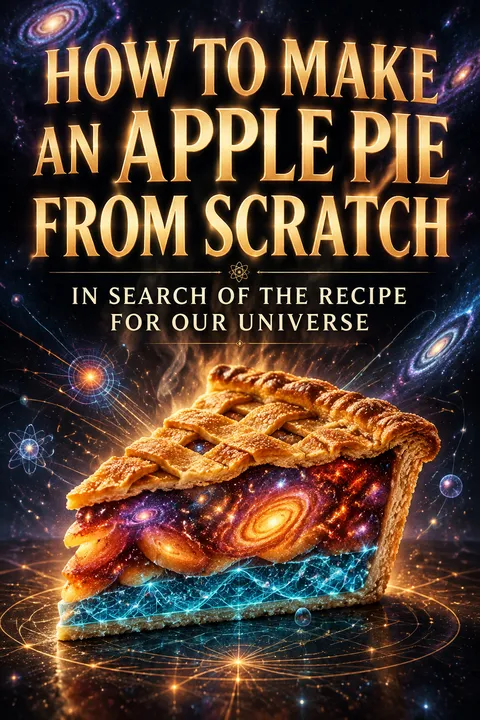
To make an apple pie from scratch, trace every ingredient to cosmic origins.
Start with the familiar. The book turns Carl Sagan’s apple-pie thought experiment into a guide to the universe. A pie looks like apples, flour, and butter, but each ingredient is made of atoms, and those atoms have histories that reach into stars and the Big Bang. The author begins with a homemade attempt to heat a supermarket pie into separate substances, leaving a black carbon-rich residue and a little liquid, probably mostly water. Even one pie contains roughly four trillion trillion atoms.
Follow the chain backward. The point is not that a kitchen experiment can reveal the whole cosmos. It is that ordinary matter connects chemistry, particle physics, astronomy, and cosmology. Each deeper explanation answers one question while exposing another: what are elements made of, where did those ingredients come from, and what made the universe that produced them?
What's striking is how an everyday object becomes a map of scientific explanation. The pie links scales that human perception usually keeps separate: taste and texture, chemical compounds, atoms, stars, and cosmic history. This is a powerful way to make abstract science memorable because the starting point is tangible and the destination is unexpectedly vast. The metaphor also has a limit: knowing the ingredients does not fully explain why a pie tastes like a pie. Large-scale properties emerge from interactions among components, not from a list of components alone.
Trust precise measurements when common sense insists on phlogiston.
Weigh the evidence. Eighteenth-century chemists believed burning released an invisible substance called phlogiston. Antoine Lavoisier challenged the theory by weighing materials and showing that metals gain mass when burned because they combine with oxygen in the air. His careful accounting also helped establish a modern chemical element as a substance that cannot be broken into simpler substances by chemical means.
Infer what cannot be seen. John Dalton used fixed combining ratios in chemical compounds to argue that matter consists of atoms with distinct masses. Much later, Einstein explained Brownian motion, the irregular jiggling of visible particles in liquid, as the cumulative impact of invisible molecules. Jean Perrin’s measurements confirmed the prediction. Across these episodes, strong explanations did not rely on intuition alone: they connected hidden entities to measurable consequences.
The progression illustrates a central strength of science: a theory earns credibility by making the world more measurable, not merely more imaginable. Lavoisier’s mass balance turned combustion from a story about an invisible substance into an accounting problem; Brownian motion made an invisible molecular world inferable from visible movement. This resembles a general strategy in the sciences: infer a hidden cause from a pattern of effects. The caution is that measurement is never theory-free. Instruments and assumptions shape what counts as evidence, so independent methods matter as much as precision.
Keep splitting the atom, because each answer can become a new question.
Indivisible did not mean final. In 1897, J. J. Thomson showed that cathode rays were negatively charged particles far smaller than atoms, later called electrons. Ernest Rutherford’s gold-foil experiments then revealed that an atom’s mass and positive charge are concentrated in a tiny nucleus. James Chadwick identified the neutron, completing the basic nuclear picture: protons and neutrons in the nucleus, with electrons outside it.
The pattern repeated. Particle accelerators and scattering experiments eventually showed that protons and neutrons are made of quarks. A proton contains two up quarks and one down quark; a neutron contains one up and two down. These discoveries did not come from looking directly at tiny objects. Physicists fired particles at targets and inferred internal structure from how the projectiles scattered, much as Rutherford had done with gold.
The repeated use of scattering is more than a historical curiosity. It shows how experimental methods can scale: a technique that exposed the atomic nucleus became a way to probe the proton itself. The history also warns against treating scientific categories as permanent. Atom once meant indivisible; later, it named a complex system. Yet endless decomposition is not guaranteed. At some point, available experiments may stop resolving finer structure, and the absence of smaller parts would remain a conclusion limited by current evidence.
Stars cook carbon and oxygen; stellar deaths scatter the heavier elements.
Stellar furnaces build matter. Stars fuse hydrogen into helium. To make carbon, they need three helium nuclei to combine through a fleeting intermediate state of beryllium. Fred Hoyle predicted that carbon must have a particular excited energy state for this process to occur efficiently; experiments found the state near the predicted value. Carbon can then capture helium to form oxygen. In massive stars, further burning creates elements up to iron.
Explosions spread the recipe. Sun-like stars shed outer layers rich in elements such as carbon. Massive stars collapse and explode as supernovae, dispersing oxygen and other products. Observations of a neutron-star collision also revealed the creation of heavy elements including gold. Astronomers reconstruct these histories through spectroscopy, which identifies elements from the distinctive patterns in starlight. Neutrino measurements have also confirmed hydrogen-to-helium fusion in the Sun.
The account makes stellar evolution do double duty: it explains both why stars shine and how the periodic table acquires its variety. Spectroscopy is especially consequential because it turns distant light into chemical evidence, making the sky a laboratory without requiring a sample to be brought home. Still, the cosmic production story is not a single tidy furnace. Different stars and explosions contribute different elements, and some origins remain uncertain. The result is best understood as a distributed supply chain, not one universal recipe.
The Big Bang made hydrogen and helium, not the whole periodic table.
The early universe made light elements. As the universe expanded and cooled, nuclear reactions began after its first few minutes. They produced mostly hydrogen and helium, with a small amount of lithium. The process stopped before it could build the heavier elements: the universe cooled too quickly, and gaps in stable nuclear masses blocked an easy route upward. Stars later supplied most of the elements beyond helium.
Evidence came from two directions. The Big Bang predicts that about a quarter of ordinary matter by mass should be helium, close to what astronomers observe. In 1965, Arno Penzias and Robert Wilson detected a faint microwave glow from every direction in the sky. It is cooled remnant light released when the young universe became transparent, about 380,000 years after the beginning. Together, the helium abundance and this cosmic microwave background support a hot, expanding universe.
The division of labor between the Big Bang and stars is a useful corrective to the tempting idea that one dramatic event made everything. The early universe established the simplest ingredients; stellar generations transformed and redistributed them. The evidence is also unusually strong because it joins independent kinds of observation, elemental abundance and ancient radiation. This is a general advantage of converging evidence: when different measurements support the same history for different reasons, confidence grows without requiring any single observation to carry the entire case.
Treat particles as field ripples, with the Higgs setting their mass.
A particle is not necessarily a tiny bead. In quantum field theory, each kind of particle corresponds to a field that fills space. A photon is a discrete excitation of the electromagnetic field; electrons and quarks are excitations of their own fields. Particle-like behavior is real, but the field is the deeper description. This framework also allows particles and antiparticles to appear or annihilate when energy is converted into matter.
The Higgs field changes the ingredients. Its nonzero value gives mass to fundamental particles such as electrons and quarks, and to the W and Z bosons. The Higgs boson, found at the Large Hadron Collider in 2012, is an excitation of that field. A crucial qualification: most of a proton’s mass comes not from the Higgs, but from energy in the strong force binding its quarks. The discovery completed a successful theory while exposing new puzzles.
Replacing solid particles with fields changes the reader’s mental picture without making particle physics less empirical. Detectors still record localized events; field theory explains how those events fit into a broader account of interactions and creation. The distinction resembles the difference between a wave on water and the water itself, though no analogy fully captures a quantum field. The Higgs story also usefully resists oversimplification: it gives mass to fundamental constituents, but it does not account for most of the mass of ordinary objects.
A one-in-ten-billion matter surplus may explain why anything exists.
Matter barely survived. Early in cosmic history, matter and antimatter were created together and then annihilated. If their numbers had matched perfectly, almost nothing would remain except radiation. Instead, roughly one matter particle survived for every ten billion matter-antimatter pairs, leaving the material universe we see.
The cause remains unresolved. Andrei Sakharov identified three requirements for producing such an imbalance: a process that makes more matter than antimatter, a difference between matter and antimatter behavior, and conditions out of equilibrium. Known physics has some ingredients, including measured charge-parity violation and sphalerons, field configurations that can convert matter into antimatter and vice versa. But the observed asymmetry is insufficient to explain the universe. One proposed account involves an uneven Higgs-field transition; another invokes heavy neutrinos. Neither has been established.
This is an unusually stark example of a tiny quantitative difference carrying enormous consequences. A slight imbalance in the first moments of cosmic history separates a universe with stars and observers from one without them. The proposed explanations are valuable partly because they turn a sweeping question into testable conditions. But satisfying a checklist of necessary conditions does not prove that a mechanism actually operated. The distinction between a plausible route and a confirmed history is essential, especially when the decisive events are difficult or impossible to reproduce.
Take the LHC's silence seriously: the Standard Model is not the whole universe.
Success has boundaries. The Standard Model describes known particles and three forces with remarkable accuracy, but it does not explain dark matter, dark energy, gravity, or why matter defeated antimatter. It also leaves basic questions unanswered, including why there are three generations of matter particles and why the Higgs field has its measured strength.
Null results constrain ideas. The LHC discovered the Higgs boson, but its searches found no confirmed supersymmetric particles or other predicted new particles. A much-discussed bump near 750 GeV disappeared when more data arrived, a reminder that statistical fluctuations can imitate discoveries. Meanwhile, LHCb reported unusual patterns in certain beauty-quark decays, but these remained hints rather than proof. A failed prediction is useful: it narrows the theories that can still fit the evidence.
What's striking is that the collider’s lack of new discoveries is itself a scientific result. It removes some comfortable expectations and forces theories to answer to nature rather than to aesthetic preference. This is especially important in a field where elegant proposals can be difficult to test. At the same time, one experiment’s silence rarely settles a broad question: new particles may be too heavy, too rare, or otherwise hard to detect. The right response is neither triumphalism nor despair, but tighter constraints and more discriminating tests.
The universe's first instant may be hidden, but its clues remain testable.
The deepest recipe needs new physics. Quantum field theory describes particles and forces; general relativity describes gravity and spacetime. Near the Big Bang, both are expected to matter, but no confirmed theory unites them. Reaching the relevant Planck-scale energies directly would require a collider beyond realistic human engineering, and concentrating still more energy could create a black hole that hides the very region under study.
Indirect windows remain. Gravitational-wave observatories can reveal events that light cannot, while future measurements of the cosmic microwave background may preserve traces of inflation and the earliest cosmic conditions. These clues may illuminate the universe’s history without delivering a final explanation. The book ends with an open question, not a recipe: scientific knowledge has reached from kitchen chemistry to cosmic origins, yet some origins may remain inaccessible.
The ending distinguishes a limit on present methods from proof that a question is meaningless. That distinction is central to responsible scientific optimism: indirect traces can test claims even when direct reproduction is impossible. Still, not every theory produces observable consequences, and a mathematically rich account is not automatically a description of nature. The story therefore closes on a productive tension. Instruments expand the field of evidence, while the structure of the universe may set boundaries that no instrument can cross.
Analysis
The book’s deepest argument is not simply that ordinary matter has cosmic ancestry. It is that knowledge of the universe is built through linked acts of inference. Chemists weigh reactions; physicists infer hidden structure from scattering; astronomers read elemental fingerprints in light; cosmologists test histories against radiation and abundance. Each scale supplies tools for the next. The apple pie is an unusually effective organizing device because it makes this chain concrete without pretending the chain is complete.
The narrative also complicates a simple story of inevitable progress. Scientific ideas advance through mistakes, rival models, technical limits, and lucky observations. Phlogiston fell to mass measurements; atoms gained support from molecular motion; the proton’s supposed internal electrons gave way to the neutron; the particle zoo yielded to quarks. Yet a successful theory can remain incomplete. The Standard Model’s precision does not make dark matter, gravity, or the matter-antimatter imbalance disappear.
A subtle tension runs through the book between reductionism and emergence. Breaking matter into smaller constituents has repeatedly revealed explanatory structure, but the properties that make a pie, a star, or a living organism recognizable arise from organization and interaction, not from ingredients alone. The cosmic recipe is therefore more than a list of particles. It requires forces, fields, physical laws, and a history in which conditions change.
The final uncertainty is not a failure of the narrative. It is the point. The closer physics approaches the origin of spacetime, the harder it becomes to devise decisive tests. That makes intellectual restraint as important as ambition. The book celebrates curiosity while showing why evidence, not elegance or confidence, must decide which cosmic recipes are real.
Review Summary
Readers widely praise How to Make an Apple Pie from Scratch as an accessible, engaging, and often humorous journey through particle physics and the history of science. Many highlight Cliff's exceptional ability to explain complex concepts in layman's terms, his fluid storytelling, and his knack for weaving personal scientific history into a compelling narrative. While most find the first half stronger, some note the latter sections grow challenging. A few readers caution that particle physics still resists full popularization, though the majority rate it among their favorite science reads.
Glossary
Standard Model
the theory of known particlesThe Standard Model is the leading theory describing the known fundamental particles and three forces: electromagnetic, weak, and strong. It explains a wide range of particle interactions and has passed extensive experimental tests. It does not include gravity, and it does not explain dark matter, dark energy, or the observed excess of matter over antimatter.
Brownian motion
jiggling caused by moleculesBrownian motion is the irregular movement of small visible particles suspended in a liquid or gas. The motion results from countless collisions with surrounding molecules. Einstein showed how its measurable pattern could reveal the properties and number of otherwise invisible molecules, and experiments by Jean Perrin supported this account.
isotopes
same element, different massIsotopes are forms of the same chemical element that have the same number of protons but different numbers of neutrons. Because their nuclear charges match, they share the element’s chemical identity while having different masses. The discovery of isotopes explained why some elements have measured atomic masses that are not whole-number multiples of hydrogen’s.
quantum tunneling
a particle crossing an energy barrierQuantum tunneling is the possibility that a particle can be detected on the other side of an energy barrier even when classical physics says it lacks enough energy to cross. In the book, tunneling explains how nuclear reactions can occur at stellar temperatures lower than classical calculations would allow, and how radioactive alpha particles escape nuclei.
triple-alpha process
stellar production of carbonThe triple-alpha process makes carbon inside stars by combining three helium nuclei. Two helium nuclei briefly form unstable beryllium-8, which may capture another helium nucleus before falling apart. A special excited state of carbon-12 makes the overall reaction efficient enough to occur in stars. Fred Hoyle predicted that state, and laboratory measurements found it.
stellar nucleosynthesis
element production inside starsStellar nucleosynthesis is the production of atomic nuclei through reactions inside stars and during stellar deaths. Hydrogen fusion produces helium; later reactions can build carbon, oxygen, and heavier elements. Different stellar environments make different elements, while winds, supernovae, and neutron-star collisions distribute many of these products into space.
quark-gluon plasma
hot matter of free quarks and gluonsA quark-gluon plasma is an extremely hot, dense state of matter in which quarks and gluons are no longer confined within individual protons and other hadrons. It existed in the very early universe and can be recreated briefly by colliding heavy atomic nuclei. Experiments infer its properties from the particles produced as it cools.
quantum field
a field whose excitations are particlesA quantum field is an entity that exists throughout space and can produce particle-like excitations in discrete amounts. In this account, photons are excitations of the electromagnetic field, while electrons and quarks correspond to their own fields. Quantum field theory describes how these fields interact and how particles can be created or annihilated.
Higgs field
field that gives mass to particlesThe Higgs field is a quantum field with a nonzero value throughout space. Its interactions give mass to fundamental particles such as electrons and quarks, and to the W and Z bosons. The Higgs boson is an excitation of this field. Most of the mass of protons and neutrons, however, comes from energy associated with the strong force.
Sakharov conditions
requirements for matter excessThe Sakharov conditions are three requirements for generating more matter than antimatter in the early universe: a process that changes the balance between them, a violation of the symmetry relating matter to antimatter, and a period out of thermal equilibrium. Meeting these conditions makes an explanation possible, but does not by itself identify the mechanism that occurred.
electroweak baryogenesis
matter production during a Higgs transitionElectroweak baryogenesis is a proposed explanation in which the early universe’s transition to a nonzero Higgs field produces a temporary imbalance between quarks and antiquarks. Sphalerons could then convert that imbalance into a surplus of ordinary matter. The Standard Model alone appears unable to make the transition sufficiently uneven or generate enough asymmetry, so additional fields may be needed.
hierarchy problem
why the Higgs mass stays smallThe hierarchy problem is the puzzle of why the Higgs field has a relatively low, life-permitting value despite the enormous contributions that quantum fluctuations are expected to make. Proposed solutions include supersymmetry and extra spatial dimensions. The absence of predicted new particles at the Large Hadron Collider has made some versions of these explanations less persuasive.
About the Author
Other books by Harry Cliff

Download PDF
Download EPUB
.epub digital book format is ideal for reading ebooks on phones, tablets, and e-readers.








