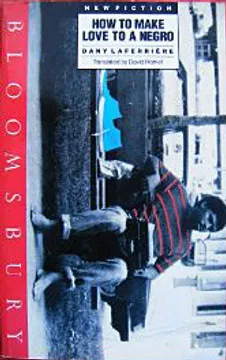


Plot Summary
The Room Above
The narrator1 shares a cramped, overheated Montreal room with Bouba,2 a devout, jazz-obsessed friend2 who spends much of his time sleeping, reading, and arguing about ideas. The narrator1 watches Bouba2 treat their battered couch as a private kingdom while he tries to make sense of their lives through books, music, and sex.
Their ceiling shakes with the noisy lovemaking of the couple upstairs. Bouba2 imagines Beelzebub living above them, turning each crash and cry into a comic apocalypse. The room's filth, heat, and thin ceiling establish the pressure surrounding both men: they are poor, isolated, and alert to a world that assigns them roles before it sees them as individuals.
The apartment is both shelter and stage. Its leaking ceiling makes private life impossible, while Bouba's comic theology and the narrator's watchful voice turn material hardship into a contest over who gets to interpret it.
Peonies in the Slum
Miz Literature,3 a well-educated McGill student from a wealthy background, begins visiting the narrator1 with food, flowers, and practical help. She cleans his dishes and tries to make the shabby room comfortable, while he wonders why she accepts work and surroundings she would never tolerate in her own class.
He sees her fascination with his appetite and his stories as evidence of how readily she believes racial myths. Their attraction becomes physical, and she offers him tenderness as well as sexual intimacy.
During one encounter, a piece of the ceiling falls, making the apartment's upstairs racket suddenly dangerous. The narrator's1 pleasure is inseparable from his suspicion: he wants closeness, but cannot stop measuring what race and privilege make it mean.
Care unsettles the narrator because it cannot be reduced to either romance or charity. He welcomes Miz Literature's attention, yet reads her innocence through the racial fantasies that shape their encounter.
The Couch Philosopher
When Bouba2 wakes from one of his long sleeps, he argues that desire comes from imagination rather than from a woman's physical beauty. His theory becomes a test of his own habits when Miz Literature3 brings her striking friend Valery4 to meet him. Bouba2 leaves the room instead of approaching her, confirming his fear of beauty's power over him.
Meanwhile, the narrator1 acquires a Remington typewriter once associated with writer Chester Himes and tries to turn his disordered notes into a novel about the life he shares with Bouba.2 The machine gives him a tool and a borrowed lineage, but not an easy path forward. He can describe ambition more readily than he can fill the page.
Bouba's abstractions protect him from the demands of action, while the narrator's typewriter converts borrowed literary authority into a risk of his own. Both men use ideas to approach what they fear doing.
Montreal's Cruising Circuit
On a hot day, the narrator1 follows a woman through the post-office line and is publicly accused of harassing white women. A union man challenges the accusation by invoking the history of colonization, but the exchange leaves the narrator1 exposed as both person and racial symbol.
In a cafe, an older Ivorian immigrant recalls a time when Black men seemed to have more romantic power, while a Senegalese newcomer describes how years in Canada have worn him down. Later, the narrator1 tells a prospective lover that people in his country eat cats. Her alarm ends the visit, and he hurries to leave. Each encounter offers him a chance at connection, then reveals how quickly desire becomes a performance shaped by race.
The public scenes make the narrator's private theories tangible. Others project danger, sexual potency, or exotic authenticity onto Black men; his own exaggerations can exploit those projections while leaving him no less trapped by them.
Rice Becomes the Rupture
Miz Sophisticated Lady,5 a disciplined student who watches her calories, spends time with the narrator1 and Bouba.2 The narrator1 treats her diet as evidence of the cultural distance between her world and his attachment to rice, then sleeps with her while Bouba2 is away. In the night, she wakes frightened by sounds in the room and discovers Bouba2 eating a head of lettuce in the dark.
The narrator1 tries to explain Bouba's2 rejection of animal foods through the history of Black oppression, but his account does not bridge their difference. When he compares the struggle for food with her concern about diet, she leaves in anger. The encounter confirms that sex can cross a boundary without undoing the history on either side.
The argument over rice makes an ordinary meal carry incompatible histories. The narrator turns food into a claim about deprivation and identity, while Miz Sophisticated Lady hears a judgment that denies her own concerns.
The Window's Edge
Bouba2 receives Miz Suicide6 regularly, offering tea and philosophical reflections while she speaks about ending her life. The narrator1 doubts that Bouba's2 performance of wisdom can help her, though Bouba2 believes their meetings keep her connected to the living. Later, Miz Mystic,7 a visitor recently returned from Tibet, suddenly tries to climb through the apartment window.
Bouba2 catches her around the waist, Miz Suicide6 grabs her foot, and the narrator1 joins them in hauling her back inside. Miz Mystic7 sleeps on the couch afterward. The narrator1 recognizes that their room has become a refuge for people in distress, even as its own occupants struggle with hunger, isolation, and stalled ambitions.
The apartment's theatrical philosophy briefly gives way to immediate responsibility. Whatever Bouba's motives, the visitors' danger forces the men to act physically, making care more consequential than their arguments about it.
The Book Gets Written
The narrator's1 writing stalls despite the Remington and his growing collection of encounters. Miz Literature3 encourages him, and he imagines stealing books with her, but neither intimacy nor literary bravado can finish the work for him. He finally isolates himself with wine, beer, food, and the typewriter, pushing through days of heat and exhaustion.
In a dream, his completed novel is praised by critics, discussed on television, and sought by readers; he even imagines a call from the actress Carole Laure, whose attention he has long fantasized about. These triumphs are fantasies, not events in the waking story. At dawn, the finished manuscript sits beside the typewriter, and the narrator1 regards it as his chance to escape obscurity.
The ending grants the narrator a completed book, not proof of success. His imagined acclaim exposes the hunger behind his ambition: writing promises recognition, but the manuscript's value remains something he must risk without guarantee.
Analysis
The novel builds its plot from encounters rather than from a single external quest. The narrator's1 pursuit of sex, recognition, and a finished book repeatedly collides with the racial meanings other people attach to him, while his own provocative performances sometimes reinforce the myths he resents. Bouba's2 couch philosophy offers an alternative to action, but the attempted rescue of Miz Mystic7 shows that ideas matter most when they lead to care. Food, music, and the cramped apartment make large historical divisions concrete: who can eat freely, who is treated as exotic, and who has room to be complicated. The ending does not certify the narrator's1 success. It gives him a manuscript and leaves recognition uncertain.
Review Summary
Reviews of How to Make Love to a Negro Without Getting Tired are largely positive, with readers praising its sharp, intelligent satire on racial and sexual stereotypes. Many find it hilarious, thought-provoking, and surprisingly relevant despite being published in 1985. The book's provocative title and explicit content divide some readers, while others appreciate its layered critique of race, class, and colonialism. A recurring concern is its portrayal of women as one-dimensional types, though many acknowledge this objectification is intentional, serving the satirical framework.
People Also Read

Characters
The narrator
The restless writerAn unnamed Haitian immigrant in Montreal, the narrator is observant, sexually ambitious, sharply funny, and acutely conscious of how others racialize him. He wants literary recognition and material security, yet distrusts easy moral explanations of his own desires. His stories about women and race can be brash or self-serving, but he also notices how stereotypes distort everyone involved. The novel follows his effort to turn a precarious life into writing.
Bouba
The couch philosopherThe narrator's1 roommate1, Bouba spends his days sleeping, reading the Koran and Freud, listening to jazz, and building elaborate theories about desire. His apparent idleness conceals an appetite for control through thought. He can be evasive and theatrical, but he also offers attention to troubled visitors. His contrast with the narrator1 gives their shared poverty two distinct responses: withdrawal into contemplation and restless pursuit.
Miz Literature
The generous McGill scholarA literary student from a privileged Montreal family, Miz Literature is curious, earnest, and willing to enter the narrator's1 cramped world. She brings food and flowers, helps with domestic work, and takes his writing seriously. Her attentiveness offers genuine intimacy, though the narrator1 also sees her through assumptions about white innocence and privilege. She connects his private life to the educated world in which he hopes to be recognized.
Valery Miller
The beauty Bouba avoidsMiz Literature's3 beautiful friend, Valery is introduced as someone whose looks have become a barrier between her and the kind of recognition she wants. Her visit tests Bouba's2 theories about beauty and exposes the distance between his philosophical confidence and his behavior.
Miz Sophisticated Lady
The disciplined class outsiderA student with polished manners and strict dietary habits, she is sexually adventurous but not detached from her own values. Her encounter with the narrator1 brings class and cultural difference into the bedroom, where neither attraction nor shared time makes those differences disappear.
Miz Suicide
The searching tea guestA troubled regular who visits Bouba2 for tea and counsel, Miz Suicide is drawn to ideas that make despair feel speakable. Her presence tests whether philosophical attention can become practical care.
Miz Mystic
The visitor in crisisRecently returned from Tibet, Miz Mystic arrives with an aura of spiritual detachment. Her sudden crisis exposes how fragile that composed image is and brings the apartment's residents into urgent physical action.
Miz Cat
The wary book loverA Montreal woman with a home full of books and cats, Miz Cat becomes the narrator's1 prospective date. His blunt claim about cat-eating frightens her and ends the visit.
Plot Devices
The Remington 22
A borrowed literary inheritanceThe narrator's1 typewriter, linked by its seller to Chester Himes, gives his writing ambition a physical instrument and a symbolic ancestry. Its blank page repeatedly exposes the gap between wanting to be a writer and making a book. It finally becomes the tool with which he completes his manuscript.
The shared apartment
A stage for private lifeThe hot, cluttered room shelters the narrator1 and Bouba2, but its thin ceiling and open doorways let other people's noise and crises enter. The couch becomes Bouba's2 center of thought and hospitality, while the room's scarcity keeps class difference visible in every visit.
Jazz and literary allusions
A counter-language for survivalRecords, books, and arguments give the roommates ways to interpret a society that often reduces them to racial types. Bouba2 turns music and philosophy into performance; the narrator1 borrows literary models as he searches for a voice of his own. Their references offer pleasure and identity, but cannot erase economic hardship.
Download PDF
Download EPUB
.epub digital book format is ideal for reading ebooks on phones, tablets, and e-readers.








