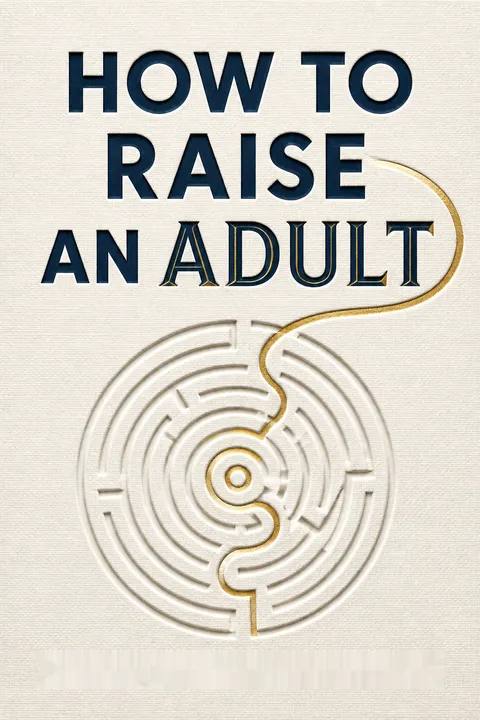


Key Takeaways
Raise adults by preparing children for life, not insulating them from it
Help must have a destination. Julie Lythcott-Haims, a former Stanford freshman dean and a parent herself, argues that love can turn into overinvolvement when fear drives parents to prevent every problem and engineer every outcome. She describes the goal as raising adults, not extending childhood dependence indefinitely. The crucial capacity is self-efficacy: a realistic belief that one can act, solve problems, and manage situations through one’s own effort.
A culture took shape. The book traces modern overparenting to changing fears and expectations: child-abduction coverage, achievement-focused education, praise intended to protect self-esteem, and scheduled play. Each shift had understandable motives. Together, they helped make constant supervision and adult management seem normal, even when children needed opportunities to practice independence.
The argument is strongest when it treats independence as something built through practice, not a personality trait some children simply possess. That idea aligns with developmental scaffolding: support is useful when it helps a learner do more, then recedes as skill grows. The challenge is that family circumstances vary sharply. A child’s age, disability, neighborhood, and available support all affect what independence can safely look like. The principle is not to withdraw care indiscriminately, but to ask whether each intervention is building capacity or quietly substituting for it.
Teach practical safety instead of organizing childhood around rare dangers
Fear can distort the odds. The book cites a Justice Department study estimating that 797,500 children were reported missing in one year, but only 115 were victims of the most serious category of stranger abduction, called stereotypical kidnapping. The figure does not mean danger is imaginary; it shows that most missing-child reports involved other situations, such as runaways or family disputes. Saturating news coverage can make rare events feel constant.
Trade vigilance for preparation. Lythcott-Haims recounts her anxiety when her ten-year-old son first walked home alone, despite knowing the statistics and living in a safe neighborhood. Her proposed alternative is age-appropriate practice: teach children to notice traffic, plan routes, seek help, and make sensible choices instead of relying on an adult escort for every trip.
Risk assessment improves when people distinguish probability from severity. A rare event can still deserve precautions, but it should not automatically dictate every ordinary decision. The same distinction matters in public health and emergency planning: vivid stories often command more attention than base rates. At the same time, families do not experience risk equally. Local violence, disability, discrimination, and unsafe infrastructure can make an apparently small statistical risk very real for a particular child. Independence should therefore be calibrated to context, not turned into a moral test of parental courage.
Stop turning childhood into a résumé built for selective college admissions
The checklist expands early. A checklisted childhood is one in which adults organize schoolwork, sports, enrichment, and summers around future credentials. Parents may choose a child’s activities, hire coaches, monitor online grades, or even improve school projects so the result looks stronger. The book describes fourth graders’ California mission models that were so polished they appeared to have been built by adults. The children’s work was meant to show what they had learned, but parental help obscured that evidence.
Achievement has a cost. In a study of 4,317 students at high-performing California high schools, teenagers reported an average of 3.1 hours of homework nightly. The author argues that relentless preparation can displace sleep, play, and curiosity, while making a child’s worth seem tied to accomplishments. Strong results do not necessarily mean a child is thriving.
This critique exposes a measurement problem: once a credential becomes the visible target, families optimize what can be counted and risk neglecting what the credential was meant to represent. Similar distortions occur in workplaces when teams chase metrics instead of the underlying mission. Yet structure and sustained practice are not inherently harmful. The key distinction is whether an activity develops a child’s abilities and interests, or mainly supplies evidence for an evaluator. Achievement becomes especially costly when children learn that every free hour is a missed chance to compete.
Let children solve manageable problems before offering the rescue
Competence grows by doing. A Stanford freshman once left heavy delivery boxes outside his dorm because he did not know how to get them upstairs or ask for help. His mother contacted the resident faculty member, who arranged assistance. The episode illustrates how ordinary tasks become bewildering when adults have routinely handled them. Before college, children can practice asking questions, managing deadlines, navigating transport, doing laundry, and handling small conflicts.
Distress deserves care, not automatic takeover. The book reports associations between intrusive parenting and student anxiety, depression, and lower confidence, while acknowledging that these studies do not establish that overparenting causes mental-health problems. In a 2013 national survey, 51.3 percent of college students said they had experienced overwhelming anxiety in the previous year. The evidence supports caution, not a single-cause explanation.
A useful distinction is between emotional support and executive substitution. Listening, helping a child name the problem, and asking what they might try can preserve connection while leaving the decision and action with the child. That resembles coaching in adult learning, where questions can strengthen agency more than ready-made answers. Still, struggling is not always instructive. When distress is severe, a child needs timely protection and professional help. The aim is not to glorify hardship, but to avoid treating every discomfort as proof that the child cannot cope.
Protect free play as practice in imagination, negotiation, and choice
Play is self-directed work. The book defines meaningful free play as activity children choose and guide themselves, rather than an adult-run lesson disguised as fun. When children invent games, settle disagreements, or decide what to build, they practice negotiation and problem-solving without an adult supplying every next move. A study cited in the book found that children with more time in less-structured activities showed stronger self-directed executive functioning, though this is an association, not proof that unstructured time alone causes the difference.
Make room for invention. Lythcott-Haims contrasts highly supervised American playgrounds with a Swiss playground where children used tools and building materials while parents stayed away. She also describes a neighborhood designed for children to roam, build, and play with friends. Boredom is not necessarily a problem to fix; it can be the starting point for a child’s own idea.
Free play is a small-scale laboratory for agency. Children learn that plans can change, other people have perspectives, and mistakes do not end the activity. These are valuable lessons precisely because no adult has prewritten the answer. The comparison with Swiss playgrounds is evocative, but cultural contrasts can oversimplify differences in infrastructure, social trust, and local safety. The practical question is not whether every child should roam unsupervised, but whether adults can create protected spaces and time in which children make more of the decisions themselves.
Give children real household work before employers expect adult initiative
Chores teach contribution. Life skills help a child manage personal needs, while chores teach the wider habit of contributing to a shared household. The book cites a 2008 study finding that children aged six to twelve spent about 24 minutes a day on housework, down 25 percent from 1981. Tasks such as preparing food, cleaning up, caring for belongings, or helping with yard work teach follow-through, responsibility, and how to complete necessary work that may not be exciting.
Transfer responsibility gradually. A parent can first demonstrate a task, then work alongside the child, observe as the child tries it, and step back as competence grows. Perfection is not the goal. A child who loads the dishwasher imperfectly can receive specific instruction without having an adult redo the work in secret. That experience builds more than a tidy kitchen: it shows that effort can improve performance.
Household work offers a low-stakes setting for practicing cooperation and reliability, qualities that are difficult to teach through praise alone. It also makes visible that family life depends on shared labor, rather than on one person’s invisible service. The approach needs fairness: chores should be age-appropriate, distributed without reinforcing gender expectations, and balanced against school, paid work, and caregiving burdens. The point is not to maximize a child’s workload. It is to ensure that being loved does not mean being exempt from contributing.
Teach children to reason through choices, not simply follow instructions
Ask how they know. Critical thinking means applying knowledge to a new situation, not merely repeating information. The book uses the Program for International Student Assessment, or PISA, which asks teenagers to interpret real-world problems rather than recite memorized facts. It argues that children need practice reasoning at home as well as in school. Instead of solving a forgotten-backpack problem immediately, a parent can ask the child to consider options and consequences.
Praise effort accurately. Psychologist Carol Dweck’s growth mindset describes the belief that abilities can develop through effort, strategy, and learning from difficulty. The book contrasts this with fixed-mindset praise that labels a child as naturally smart, which can make mistakes feel threatening. Specific feedback on what a child did and how they improved gives them a more useful account of success than blanket applause.
Questioning can help children become authors of their own reasoning, but it works best as genuine dialogue rather than a disguised quiz with one acceptable answer. Children also benefit from direct instruction, especially when they are new to a skill or overwhelmed. A strong adult alternates: explain when necessary, then invite the child to apply, question, and revise. This balance matters because autonomy without knowledge can become abandonment, while instruction without room to think can produce capable rule-followers who freeze when the situation changes.
Let a child’s interests shape their path more than parental prestige
Purpose belongs to the young person. The book draws on psychologist William Damon’s research on purpose, a durable commitment to something meaningful beyond immediate personal satisfaction. Parents can notice what engages a child, provide opportunities, and introduce mentors, but cannot choose a purpose on the child’s behalf. A Stanford student who was pushed toward medicine or engineering may be less able to explain why that path matters than a student who pursued a genuine interest.
Listen for the real motivation. The author describes encouraging her son to drop a demanding Spanish course that was consuming evenings and harming his balance. He spoke with his counselor and teacher, weighed the consequences, and made the decision. The family valued language learning, but recognized that a prestigious-looking transcript was not worth every cost. Support means taking a child’s interests and limits seriously, not simply endorsing every impulse.
Purpose is better treated as a direction discovered through experimentation than as a hidden destiny a teenager must identify on command. Interests can deepen, fade, and combine in unexpected ways. Parents can widen the field of possibilities without scripting the outcome, especially by connecting children with adults who enjoy their work. The counterweight is practical reality: financial constraints and labor-market conditions matter. Respecting a young person’s authorship does not require pretending every path is equally secure; it means discussing tradeoffs without mistaking parental preference for the child’s own calling.
Choose a college for fit and opportunity, not its ranking alone
Selectivity is not a synonym for education. At the time discussed in the book, Stanford admitted about 5 percent of applicants, while the average acceptance rate across roughly 2,800 accredited four-year colleges was about 64 percent. The author challenges families who treat a tiny group of famous schools as the only worthwhile destinations. Rankings rely heavily on measures such as selectivity, reputation, and resources, which do not directly reveal whether a particular student will learn well or feel at home.
Look for a place to thrive. The book recommends visiting campuses, speaking with students, and asking what they would change. It points to studies suggesting that students qualified for highly selective colleges can achieve comparable earnings at less selective schools, while noting that outcomes vary. A college should be a match to make, not a trophy to win. Fit, faculty access, community, cost, and the student’s own goals all deserve attention.
College rankings convert a complex educational experience into a compact status signal. Such signals are easy to compare, but they can conceal differences in teaching, cost, student support, and belonging. The fit argument is especially useful because a student’s engagement often determines how much they take from available opportunities. Still, selectivity can correlate with networks and resources that matter in some fields. A realistic choice weighs those advantages against debt, personal fit, and the possibility of flourishing elsewhere, rather than treating brand prestige as a universal guarantee.
Analysis
The book’s central argument is not that parents should care less, but that care should change form as a child develops. Its strongest insight is developmental: adulthood is not bestowed at eighteen. It is rehearsed through small acts of planning, asking for help, recovering from mistakes, and contributing to a household. When adults repeatedly take over these tasks, they may secure short-term comfort while limiting the child’s chance to build confidence grounded in experience.
The narrative gains credibility because Lythcott-Haims includes herself among the parents she critiques. Her own worry about a child’s college prospects reveals how systemic pressures become intimate habits. The book links individual overinvolvement to a wider achievement economy: selective admissions, rankings, online grade portals, and competitive enrichment all reward visible outcomes. This framing usefully resists blaming young adults for dependency they did not design.
Its evidence, however, is uneven. The author combines interviews, institutional anecdotes, surveys, and correlational studies. Those sources illuminate patterns, but they do not establish that overparenting alone causes anxiety, depression, or weak workplace performance. Economic insecurity, unequal school access, disability, neighborhood safety, and changing labor markets also shape how much independence families can offer. Nor is earlier childhood automatically better: reasonable supervision and timely intervention remain essential.
The most durable prescription is therefore calibrated transfer of responsibility. Adults should provide warmth, clear limits, and enough structure to make learning possible, then leave room for children to act. The book’s model of authoritative parenting combines responsiveness with expectations, avoiding both coercion and permissiveness. Its social critique also implies that individual families cannot solve every pressure privately. Schools, employers, and admissions offices help define what counts as success. Even so, parents retain a meaningful sphere of action: they can stop treating every grade, activity, and setback as an emergency, and make home a place where competence is practiced rather than performed.
Review Summary
How to Raise an Adult receives mostly positive reviews for its critique of overparenting and advice on fostering independence in children. Readers appreciate the practical tips and insights into college admissions pressures. Some find it repetitive or focused on wealthy families. The book encourages parents to step back, allow kids to fail, and develop life skills. Many reviewers relate to the author's experiences and find the content thought-provoking, though some suggest it could be more concise. Overall, it's seen as a valuable resource for parents seeking to raise self-sufficient adults.
People Also Read






Glossary
Helicopter parent
Parent who overmanagesA parent who stays excessively involved in a child’s life, taking over decisions or problems in ways that can obstruct the child’s growth toward independence. The term was coined by Foster Cline and Jim Fay in 1990. The book uses it for behavior motivated by care or fear that crosses from support into control.
Checklisted childhood
Childhood organized for credentialsA pattern in which a child’s schoolwork, sports, enrichment activities, and summers are managed as a sequence of achievements meant to improve future educational prospects. The child’s time becomes highly scheduled, while unstructured play, ordinary responsibilities, and self-directed interests are crowded out.
Self-efficacy
Belief in personal capabilityAlbert Bandura’s term for a person’s belief that they can organize and carry out the actions needed to handle a situation or reach a goal. In this book, self-efficacy develops when children take on real tasks, see how their efforts affect outcomes, and learn that they can manage problems without a parent doing the work for them.
Authoritative parenting
Warmth paired with expectationsA parenting style that combines clear standards and limits with emotional warmth and responsiveness. Parents explain rules, listen, and allow children to make choices and mistakes, while still holding them accountable. The book presents it as a middle path between authoritarian control and permissive indulgence.
Flow
Deep absorption in a challengeA concept associated with psychologist Mihaly Csikszentmihalyi. Flow describes intense engagement in an activity when its challenge is slightly beyond a person’s current skill, drawing sustained attention and intrinsic motivation. The book connects self-directed play and personally meaningful pursuits with opportunities for children to experience this kind of absorption.
Growth mindset
Abilities can developCarol Dweck’s term for the belief that abilities can improve through effort, useful strategies, feedback, and learning from setbacks. The book contrasts it with a fixed mindset, in which ability is treated as an unchangeable trait. Specific feedback about effort and progress can help children approach difficult tasks without treating mistakes as proof of incapacity.
Grit
Persistence toward long goalsAngela Duckworth’s term for sustaining interest and effort toward long-term goals. The book connects grit with continuing through difficulty rather than relying on talent or praise alone. It argues that opportunities to struggle, try again, and complete demanding tasks help children build persistence, while acknowledging that perseverance is not a reason to force a child to pursue an unsuitable path.
Learned helplessness
Giving up perceived controlA psychological pattern in which a person becomes passive after experiencing outcomes as outside their control. The book applies the idea to children whose parents routinely manage tasks and decisions for them. When children rarely see their own actions affect outcomes, they may come to doubt their ability to solve problems or influence what happens.
Program for International Student Assessment
International applied-learning assessmentOften abbreviated PISA, this assessment compares how well teenagers in participating countries apply knowledge to real-world problems. Rather than focusing only on recalling facts, its tasks test interpretation, reasoning, and communication. The book uses PISA to argue that education should develop students’ ability to think with knowledge, not merely repeat material.
Download PDF
Download EPUB
.epub digital book format is ideal for reading ebooks on phones, tablets, and e-readers.








