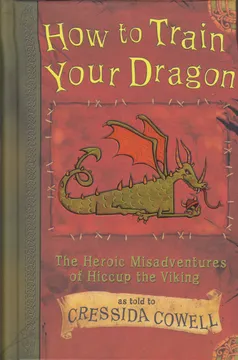


Plot Summary
Prologue
The book opens with an older Hiccup1 recalling a world in which dragons are vanishing into the sea. He presents his account as a childhood memory and warns that he was never a natural hero: becoming one required effort, mistakes, and a great deal of fear. The framing turns the adventure into both a coming-of-age story and a record meant to keep dragons from being forgotten.
The retrospective frame gives the comic adventure a quiet undertow of loss. Hiccup speaks from a future in which dragons may be gone, so every absurd or frightening encounter also becomes testimony. His insistence that heroism had to be learned resists the usual legend-making impulse to explain courage as an inborn gift. The story therefore asks readers to attend to the imperfect process behind the remembered victory, and to consider how easily a living world can become a doubtful tale once its witnesses disappear.
Berk's Cruel Initiation
On the frozen island of Berk, Hiccup Horrendous Haddock III,1 the slight son of Chief Stoick,1 is ordered to lead eight other boys through their first test of Viking belonging. Their instructor, Gobber the Belch,6 sends them up a cliff to steal sleeping dragon hatchlings from a crowded nursery. Any boy who returns empty-handed will be exiled.
Hiccup1 knows enough about dragons to understand that waking one could rouse thousands, but the other boys prize size and status over caution. Snotlout,5 Hiccup's swaggering cousin,5 openly treats him as unfit to lead. With the cave waiting above them and his future on Berk at stake, Hiccup1 follows the team into the dark.
The test makes belonging conditional on a performance that rewards bravado while punishing uncertainty. Hiccup's knowledge gives him a clearer view of danger, but in a culture that equates leadership with force, that awareness looks like weakness. Snotlout's contempt is not merely schoolyard cruelty: he wants the authority Hiccup stands to inherit, so each public failure would strengthen his own claim. The setup places Hiccup between two kinds of pressure, the physical risk of the nursery and the social risk of refusing the tribe's definition of courage.
The Dragon Nobody Wanted
Snotlout5 seizes command during the climb and sends Hiccup1 into the cave first. When Fishlegs,4 Hiccup's bespectacled friend,4 accidentally wakes a dragon, the boys flee through the tunnels as the nursery erupts behind them. Hiccup1 gives Fishlegs4 the dragon he has already caught, then turns back into danger to find another.
Gobber6 hauls the boys from the cliff as the dragons pour out, and they escape into the freezing sea. Hiccup1 survives with a second hatchling, but it is a tiny, toothless Common or Garden dragon. Snotlout5 mocks it, and Hiccup1 calls it Toothless.2 The training manual Gobber6 recommends contains only the advice to yell, so Hiccup1 must find his own way.
Hiccup's defining choice arrives before anyone can call him heroic: he risks his escape to make sure Fishlegs is not left without a dragon. That act complicates the tribe's harsh arithmetic, in which individual survival and status are supposed to come first. The reward appears almost designed to mock him, because Toothless is visibly unimpressive in a society that reads size as worth. Yet the useless manual creates room for Hiccup's own expertise. His obstacle is no longer simply whether he can obey instructions, but whether his less conventional understanding of dragons can count as knowledge.
A Giant Stirs Below
While Hiccup1 worries about his new dragon, the story shifts to the ocean floor, where a gigantic Sea Dragon11 has slept for centuries after swallowing a Roman legion. A killer whale notices movement in the creature's eyelid and flees. Soon the fish and other small sea life vanish from the surrounding waters, signs that the sleeping animal is stirring.
The danger remains far below the island, unknown to Berk's Vikings, who are occupied with the boys' initiation and the coming festival. This ancient predator11 is not another hatchling for a boy to train. Its awakening quietly changes the scale of the story, even as Hiccup1 begins the smaller, daily struggle of learning how to live with Toothless.2
The ocean interlude plants a threat that dwarfs the village's familiar contests. Its slow signs of waking contrast with the Vikings' loud confidence: they believe danger is manageable when it can be challenged face to face, while this creature has been hidden beyond their attention for generations. The scene also gives the book's dragon lore a double function. It is comic natural history on the surface, but its details establish that dragons have lives, histories, and powers outside human control. The threat begins not with an attack, but with the retreat of everything that senses it first.
Toothless Finds His Voice
Weeks later, Toothless2 wakes hungry and immediately bites Hiccup1 for fish, then lunges at the family cat. Hiccup1 tries to speak Dragonese, the language he has secretly studied, but Toothless2 listens mainly for food and resents being controlled. When Stoick3 enters, Toothless2 attacks his beard; Stoick's3 thunderous shouting works better than Hiccup's1 polite requests, though it does not make Hiccup1 believe shouting is the answer.
Fishlegs4 invents a grand royal pedigree for Toothless2 to keep Stoick3 from dismissing him. Hiccup1 then hides the little dragon from Stoick's3 hunting dragons, which threaten him. He smuggles Toothless2 into bed, where the dragon's warmth finally lets the cold, often sleepless boy rest.
Hiccup's care is neither sentimental nor immediately effective. Toothless is not a grateful pet waiting to be won over; he is a hungry creature with his own purposes, and the story lets that friction remain funny without pretending it is harmless. Hiccup's secret fluency gives him a possible bridge, but language does not erase the difference between their needs. Meanwhile, Fishlegs' fabricated royal identity exposes the tribe's appetite for rank: Stoick is reassured by pedigree more readily than by Hiccup's genuine attention. The warmth of the shared bed offers a quieter bond, based on companionship rather than mastery.
Jokes Win the Hunt
Hiccup1 tests the accepted methods of training on Toothless.2 Threats fail, indulgence makes the dragon greedier, and praise cannot hold his attention. Meanwhile, Fishlegs4 has better luck yelling commands at Horrorcow,13 his placid brown dragon. Hiccup1 studies his notes on dragon motivation and tries rewards, vanity, and revenge, but Toothless2 refuses to cooperate until Hiccup1 promises him a joke after a successful hunt.
A taunt from Fireworm,10 Snotlout's5 impressive red dragon, gives Toothless2 an extra reason to prove himself. He flies out, catches fish, and returns for more jokes. His first tooth appears, and Hiccup1 realizes the unimpressive hatchling can hunt after all. For the first time, he has a real chance of passing the final test.
The successful method is not a magic technique but a negotiation tailored to Toothless. Hiccup notices that humor can motivate a dragon without requiring either submission or affection, and that observation makes him more effective than the manual's blunt command to yell. The episode also separates cooperation from moral transformation: Toothless helps for entertainment and self-interest, not because he has become obedient. Hiccup's progress comes from accepting that distinction. He can build a working relationship without demanding that the dragon want what he wants for the same reasons.
One Taunt, Twenty Failures
At the Thor'sday Thursday festival, Hiccup1 enters the final initiation test beside Snotlout5 and the Meathead champion Thuggory.8 Toothless2 manages the early exercises, then catches fish after Snotlout's5 mockery stokes his pride. He cannot resist taunting Fireworm,10 however, and she attacks. Her fight spreads to the other dragons until all twenty novices lose control of their animals.
Under the tribe's law, every boy has failed and must be exiled. Stoick3 announces the sentence, including for his own son,1 because he believes the law protects the tribe. Hiccup1 answers with anger at his father3 and at a community that has no place for ordinary boys. The storm prevents their immediate departure, but not their banishment.
The test exposes how a system built to measure discipline can produce the opposite: the boys compete for prestige, their dragons mirror that rivalry, and one insult turns the arena into a collective failure. Hiccup does not cause the disaster alone, though Snotlout is quick to make him the scapegoat. Stoick's choice shows the emotional cost of treating law as a substitute for judgment. His decision may feel dutiful to the tribe, but to Hiccup it confirms that his father's public role outranks their private bond. The storm delays exile and gives the story a narrow opening for change.
Two Monsters on Shore
During the storm, two enormous Sea Dragons wash onto Berk. One, the Green Death,11 devours the other dragon on the beach; the Purple Death12 lies elsewhere on the island. The Vikings gather and try their usual solution, shouting at the Green Death11 from the cliffs. It tears Gobber's6 clothes, flings him away, and sets the fleet ablaze, leaving the island trapped.
The adults have no useful advice, and Hiccup's1 Dragonese suddenly matters. Stoick3 offers to cancel the banishment if Hiccup1 approaches the monster and learns whether it comes in peace or war. Hiccup1 accepts, knowing that the creature may kill him, and walks down to the beach alone.
The giants make the tribe's central habit, answering uncertainty with louder force, visibly useless. The destruction of the ships removes escape as well as military confidence, converting the island into a closed system where every earlier choice now matters. Stoick's offer to restore Hiccup's place is morally complicated: the boy is valued when his skill becomes necessary, after being judged unworthy under the initiation rules. Still, Hiccup's knowledge is not a convenient superpower dropped into the plot. It grows from the private study and listening that his community had treated as eccentric.
The Boy Who Bargained
The Green Death11 greets Hiccup1 with a cruel performance, eating a sheep and describing humans as future meals. It says it intends to kill him and the rest of the island, but its curiosity gives Hiccup1 an opening. Remembering his notes on dragon motives, Hiccup1 draws the creature into a conversation about its elaborate philosophy of life and death.
The Green Death11 recognizes Hiccup's full name,1 though neither understands why, and delays eating him so it can continue talking after a nap. Hiccup1 returns to the village with the bad news that the monster's apparent peace is only temporary. Behind him, the remaining sheep escape, and ahead of him the Vikings must face a threat their usual rules cannot solve.
Hiccup survives the meeting by treating attention as a tactical resource. He does not overpower the Green Death or persuade it to become kind; he finds a subject that flatters its vanity and keeps it occupied. The exchange makes wit a form of courage, not a decorative substitute for action. The monster's recognition of Hiccup's name adds a thread of fate, but the moment remains unresolved and unsettling rather than explanatory. Hiccup's return with no easy victory also matters: he has acquired time, not safety, and must now translate a private act of survival into a plan others can use.
Feathers Against Giants
The elders argue while the Green Death11 sleeps, so Hiccup1 steps away and the other novices follow. Thuggory8 backs him, and together they discover that a second giant, the Purple Death,12 has landed on the far side of Berk. Hiccup1 proposes using the two monsters' tempers against each other.
The boys will drop bundles of feathers into their nostrils to trigger sneezing, while their dragons provoke each giant and draw them toward the same headland. Snotlout5 objects, but Thuggory8 forces him to cooperate. The dragons, who had considered abandoning their masters, return to the boys. Hiccup's1 plan gets underway, and the Green Death11 and Purple Death12 collide at Death's Head Headland.
Hiccup's authority begins to form because other boys witness what he can do and choose to trust his judgment. Thuggory's support is crucial: a confident rival to Snotlout, he makes room for Hiccup's thinking without pretending the group has suddenly become harmonious. The plan is improvised from observed weaknesses rather than conventional strength, turning the Vikings' limited resources into a form of leverage. The dragons' return is equally important. Their loyalty is uncertain, and their decision to obey for now is strategic, not sentimental. Hiccup's leadership therefore depends on coordination among beings who retain their own interests.
The Plan Breaks Open
The feather bombs make the Green Death11 sneeze, while Fireworm10 insults it and draws it toward the Purple Death.12 For a time, the two monsters fight each other, tearing up the coast until both collapse in the surf. The boys begin to celebrate, but Hiccup1 hears no death song. The wounded Green Death11 rises, asks where Hiccup1 is, and attacks the group.
It catches Hiccup1 and drops him into its mouth. By chance, his shirt snags on an ancient Roman spear lodged in the dragon's throat, keeping him above the digestive juices. As he hangs in darkness, Hiccup1 studies the small openings that release the monster's fire and realizes that the spear may not hold him for long.
The apparent success of Hiccup's plan turns into its most dangerous failure. His tactics can manipulate the giants' attention and vanity, but cannot guarantee that a dying animal will behave predictably. This is a crucial limit on cleverness: the plan creates an opening, not control. Hiccup's survival inside the monster depends on observation under terror, echoing the careful attention that distinguished him from the other boys at the nursery. The old spear links the dragon's enormous present threat to the human past it swallowed, while the fire openings convert a frightening spectacle into a physical problem Hiccup may be able to solve.
Toothless Chooses Courage
Toothless2 had refused to join the attack, but when Stoick3 finds him and leads him toward the headland, he sees Hiccup1 disappear into the Green Death's11 mouth. Toothless2 turns back instead of fleeing. He flies into the giant's nostril and tickles it until the monster sneezes, throwing Hiccup,1 the spear, and Toothless2 out across the landscape.
Toothless2 catches Hiccup1 and slows his fall. The Green Death11 tries to breathe fire at Stoick,3 Hiccup,1 and Toothless,2 but Hiccup1 had wedged his helmet's horns into the fire openings inside its throat. The blocked breath builds pressure until the monster explodes. Stoick's3 shield deflects a flying tooth before it can strike Hiccup.1
Toothless's decision marks a shift that neither training nor reward could force. He acts against his own safety when Hiccup is in danger, suggesting that their shared life has formed a bond more consequential than either dragon or boy can admit. Hiccup's escape, by contrast, depends on his capacity to notice and act within the creature's anatomy. The victory is not a triumph of brute force, but a convergence of observation, improvisation, and attachment. Stoick's shield also gives the father's role a concrete, protective form, even as his earlier insistence on law remains unresolved between them.
Hiccup the Useful
Hiccup1 wakes two days later and learns that Toothless2 was judged dead from his stillness and a chest wound. The Vikings have already begun a hero's funeral, sending a burning ship out to sea. Hiccup1 recognizes that Toothless2 may be in a dragon sleep coma and rushes to stop the ceremony, but the flaming arrows are already in flight.
As the boat burns, Toothless2 bursts into the sky, alive and performing daring loops before returning to Hiccup's shoulder.1 Stoick3 publicly welcomes Hiccup1 into the tribe as Hiccup the Useful.1 The boys who failed initiation are admitted too, because their actions saved Berk. Hiccup1 has gained a place not by meeting the old test, but by showing what the tribe needed.
The funeral nearly repeats the story's original error: human assumptions about strength and weakness lead the Vikings to mistake a dragon's stillness for death. Hiccup's specialist knowledge saves Toothless from a ritual intended to honor him, and the rescue makes knowledge inseparable from care. Stoick's public recognition repairs some of the injury caused by the exile, though it does not erase the earlier conflict. The new title is significant because usefulness is not the same as conventional heroism. Hiccup earns belonging through attention, invention, and cooperation, while the entire group is admitted on the strength of what they accomplished together.
Epilogue
In the epilogue, the older Hiccup1 says that all nineteen other novices were admitted to the tribes after the battle. Their victory becomes Viking legend, though few bards remain to sing it and people begin to doubt that such immense dragons ever existed.
Hiccup1 still imagines them sleeping beneath the sea. The barnacle-covered shield and its great dragon tooth remain vivid evidence to him, and he hopes his account will help future heroes if dragons return.
The epilogue refuses a tidy closure in which the adventure becomes safely past. Hiccup's evidence is material, but it cannot guarantee belief once the dragons disappear and the witnesses age. Memory becomes an act of stewardship: telling the story preserves not only the monsters, but the knowledge that helped humans meet them. His hope that dragons may return keeps the ending open without promising a sequel's certainty. The book's central lesson therefore reaches beyond Hiccup's recognition. A society must remember the skills and forms of attention it once dismissed, because the world can change faster than its confidence does.
Analysis
The novel makes a child’s social problem and a community’s survival problem parts of the same argument. Hiccup1 is judged by a culture that confuses visible power with competence, while the dragons repeatedly demonstrate that force does not guarantee obedience. The training manual’s command to shout is a miniature version of the tribe’s larger mistake: it assumes the world can be mastered without being understood.
Hiccup’s1 strengths are practical forms of attention. He watches sleeping dragons closely, notices Toothless’s2 motives, reads the Green Death’s11 vanity, and studies its anatomy when fear would make looking away easier. His ingenuity is not detached cleverness. Saving Fishlegs,4 protecting Toothless,2 and risking himself for the island show that observation becomes useful because he cares what happens to others. The book therefore links empathy with intelligence without claiming that kindness makes dangerous creatures harmless.
The tribe’s law also changes meaning as the danger grows. At first, the threat of exile makes Hiccup’s1 difference painful; later, the failure of every novice shows that the rule is not simply cruel to him, but poorly suited to the community it claims to protect. The boys survive by cooperating across tribal rivalries, and their shared success suggests that belonging should be measured by contribution rather than resemblance to an ideal warrior.
Finally, the frame story complicates the happy ending. The dragons vanish, the witnesses grow scarce, and evidence becomes easier to dismiss. Hiccup’s1 account is an act of preservation, but also a warning: a society that forgets how to listen to the unfamiliar may discover too late that it has lost the knowledge needed to face it.
Review Summary
Readers largely enjoy How to Train Your Dragon, praising its imaginative world, humor, and lovable protagonist Hiccup. Many highlight David Tennant's audiobook narration as exceptional, often elevating their ratings. A common theme is the book's significant differences from the DreamWorks film — notably Toothless's smaller, sassier portrayal — with most preferring the movie's story. Parents report success reading it aloud to children. Some criticisms include the absence of female characters, crude humor, and a lack of emotional depth. Overall, it's considered a fun, witty children's adventure that adults can also enjoy.
People Also Read

Characters
Hiccup Horrendous Haddock III
The unlikely strategistHiccup is the small, freckled son and heir of Stoick3, but he lacks the size and swagger his tribe associates with leadership. He studies dragons in secret, noticing their habits rather than assuming that force will make them obey. His caution can look like fear, and his intelligence does not spare him embarrassment or doubt. He is also willing to risk his own safety for Fishlegs4, a choice that reveals a loyalty deeper than his concern for status. Hiccup's character is built around the gap between how his community measures ability and what he can actually do. He wants to belong, but his strongest instincts repeatedly lead him toward forms of courage the tribe does not yet recognize.
Toothless
The stubborn small dragonToothless is a tiny Common or Garden dragon with no teeth at first, a fierce appetite, and little patience for commands. He speaks Dragonese haltingly and treats food, jokes, and personal amusement as stronger motives than human approval. His selfishness is not a disguise for easy obedience; he remains unpredictable, vain, and capable of refusing Hiccup1 outright. Yet he is also curious and responsive to the particular relationship Hiccup1 builds with him. Toothless challenges the idea that a useful companion must be subdued or grateful. His bond with Hiccup1 develops through shared routines and mutual adjustment, rather than through the instant mastery the Vikings expect.
Stoick the Vast
The lawbound fatherStoick is the powerful chief of the Hairy Hooligans and Hiccup's father1. He is physically imposing, proud of his position, and accustomed to treating tradition as the foundation of tribal strength. His affection for Hiccup1 exists alongside a public duty that makes him judge his son by the same severe standards as everyone else. Stoick's instinct is to solve problems through authority and force, which often leaves him poorly equipped for situations that require listening or adaptation. He is not indifferent to his son, but he struggles to reconcile private care with the model of leadership he inherited. That tension shapes both his parenting and his understanding of what makes a Viking worthy.
Fishlegs
Hiccup's loyal friendFishlegs is Hiccup's bespectacled friend1, a thoughtful boy with a reptile allergy and little confidence in the tribe's heroic ideal. His clumsiness helps trigger the nursery disaster, but Hiccup's1 choice to save him makes their friendship concrete. Fishlegs repays that loyalty by defending Hiccup1, inventing a royal identity for Toothless2, and recognizing Hiccup's1 unusual ability to communicate with dragons. He is often anxious, yet he can speak up when someone else is being treated unfairly. His bond with Hiccup1 offers a gentler counterweight to the boys' competitive culture.
Snotlout
The ambitious rivalSnotlout is Hiccup's muscular cousin1 and a confident, accomplished boy who expects to become chief. He uses ridicule and intimidation to make Hiccup1 appear unfit, while his own desire for power gives the rivalry real stakes. Snotlout prizes visible strength, public admiration, and an impressive dragon, particularly his red Monstrous Nightmare, Fireworm10. His confidence is not the same as sound judgment: he tends to interpret disagreement as an insult and competition as proof of worth. He embodies the heroic ideal Hiccup1 is measured against, while exposing how easily that ideal rewards swagger over responsibility.
Gobber the Belch
The shouting instructorGobber trains the young Vikings and presides over their initiation. Huge, loud, and fond of military spectacle, he believes in toughness and expects the boys to prove themselves through dangerous tests. His methods make him both comic and intimidating, but his role also exposes the gap between traditional instruction and practical expertise. Gobber trusts the tribe's rules until the dragons make those rules useless. He is not the story's strategist, yet his presence gives the boys' ordeal its institutional shape.
Old Wrinkly
The eccentric seerOld Wrinkly is Hiccup's maternal grandfather1, an amateur soothsayer who sees more possibility in the boy than the tribe does. His predictions are often questionable, but his advice encourages Hiccup1 to treat imagination and knowledge as strengths. He understands that the old model of leadership may not meet new dangers, even if he cannot supply a complete alternative. His affection comes wrapped in eccentricity, and his perspective helps Hiccup1 imagine that being unlike Snotlout5 need not mean being useless.
Thuggory
The steadfast MeatheadThuggory is the strong son of the Meathead chief and a formidable rival at the initiation festival. Unlike Snotlout5, he is willing to recognize ability in someone smaller and less imposing. When Hiccup1 proposes a response to the sea dragons, Thuggory supports him and helps keep the other boys focused. His physical confidence gives him authority among his peers, but he is not trapped by the assumption that strength must mean domination.
Valhallarama
Hiccup's Viking motherValhallarama is Hiccup's mother1 and Stoick's wife3. She appears within the household and at the festival, where her practical, robust affection reflects Berk's blunt family culture. She is less involved in the tribe's public contests than Stoick3, but her presence situates Hiccup1 inside a family that is larger than its chief's judgments.
Fireworm
Snotlout's proud dragonFireworm is Snotlout's5 red Monstrous Nightmare, an impressive hunter who shares her master's appetite for status and mockery. She boasts of her pedigree and treats smaller dragons as beneath her. Her pride makes her easy for Hiccup1 to provoke, though her confidence and skill make her genuinely dangerous. Fireworm shows how a dragon can reflect its handler without becoming a mere copy of him.
Green Death
The ancient sea terrorThe Green Death is an immense Sea Dragon, old enough to have slept for centuries and powerful enough to make a fleet seem fragile. It is vain, intelligent, cruel, and fascinated by its own ideas about death and survival. Its conversational manner makes it more unsettling, not less: it can treat a threat as a joke while remaining perfectly serious about its appetite. The Green Death represents danger on a scale that makes the Vikings' usual displays of force look inadequate.
Purple Death
The second sea giantThe Purple Death is another vast Sea Dragon, discovered on the opposite side of Berk. Its presence means the island faces more than one overwhelming threat. It is not a rival the Vikings can challenge directly, but its existence gives Hiccup1 a possibility: the creatures may be turned against each other.
Horrorcow
Fishlegs's gentle dragonHorrorcow is Fishlegs's4 large, brown dragon, notable for her calm temperament and apparent lack of interest in hunting. Fishlegs4 tries to train her through shouting, with more success than Hiccup1 has with Toothless2. Her placidity complicates the boys' assumption that every dragon should be fierce to be useful.
Plot Devices
The initiation law
Belonging under threatThe Hairy Hooligans and Meatheads require young candidates to catch and train dragons before accepting them as full members. Failure means exile, so Hiccup's1 private struggle with Toothless2 carries public consequences. The festival test also reveals the weakness of a system that treats obedience and force as the only proof of worth. When the boys fail together, the rule threatens the whole next generation and raises the cost of the approaching crisis.
Dragonese
A bridge to dragonsHiccup's1 secret knowledge of Dragonese lets him understand dragon behavior and communicate with Toothless2. It is forbidden by the tribe, which prefers to command dragons through shouting, so Hiccup's1 skill begins as private study rather than approved training. The language does not give him control: Toothless2 remains self-interested and difficult. Instead, Dragonese helps Hiccup1 notice motives and make better choices when force fails.
The Dragon-training manual
Bad advice, good contrastGobber's6 stolen book by Professor Yobbish offers only a single crude method: yell at the dragon. Its uselessness forces Hiccup1 to draw on his own observation and develop a more individual approach. The manual also supplies a running contrast between authority that claims expertise and knowledge that has actually been tested. Later, when the Vikings face a giant Sea Dragon, the same book fails them again, making Hiccup's1 practical understanding essential.
Feather bombs
Small tools, giant reactionsHiccup1 uses bundles of feathers to trigger the sea dragons' sneezes. The bombs are not meant to injure the giants; they confuse and irritate them long enough for the boys' dragons to taunt them and draw them together. The tactic transforms an apparent mismatch of scale into a contest of attention and temperament. Its success is temporary, however, and the supply line becomes difficult to maintain as the monsters move along the coast.
The fire openings
A hidden weaknessInside the Green Death's11 throat, Hiccup1 discovers the small openings that release its fire. He wedges the horns of his helmet into them, blocking the creature's breath. When the Green Death11 later tries to breathe fire, pressure builds inside its body. The solution depends on an earlier moment of observation while Hiccup1 is trapped, and turns the monster's own weapon into a danger to itself.
Download PDF
Download EPUB
.epub digital book format is ideal for reading ebooks on phones, tablets, and e-readers.








