

Key Takeaways
Apply Alinsky's organizing logic to politics, but don't confuse force with truth.
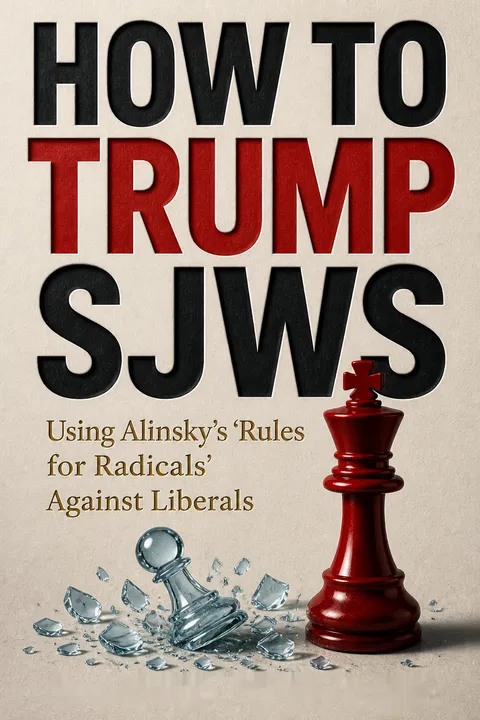
A partisan frame. Manon Welles presents campus protests, speech disputes, and activist campaigns as part of a radical left movement, tracing its origins through Marx, Gramsci, and Saul Alinsky. Her central proposal is strategic reversal: conservatives should study Alinsky's organizing methods and use them against progressive activists. Donald Trump's 2016 campaign is the book's main example, especially his willingness to dominate attention and reject conventional political decorum.
A necessary distinction. The book treats diverse activists as a coordinated movement and sometimes presents disputed claims as settled. Its value is clearest as a polemic about political tactics, not as a neutral history. Its central tension is that it condemns intimidation while arguing that the Right must learn to fight by similar means.
The book is most illuminating when read as a case study in how political actors interpret their opponents, not as an impartial account of the left. That distinction matters because a strong strategic lens can still distort the facts it organizes. Political psychology shows that group identities encourage people to notice an opponent's worst behavior and their own side's best intentions. The book's account of mobilization is therefore useful alongside a question it rarely asks: what evidence would change the author's mind about the groups being criticized?
Make genuine support visible before opponents define your movement as marginal.
Visibility signals strength. In Alinsky's framework, power comes from money, people, and what opponents believe a group can mobilize. The book argues that protests, rallies, and repeated public messages can make a cause appear more influential than its numbers suggest. It points to Trump's large rallies and his habit of publicizing crowd sizes and poll results as ways of projecting momentum.
Visibility is not proof. Welles also describes tactics designed to inflate the appearance of support, including coordinated calls and letters. These can create noise, but they do not establish broad agreement. The more durable lesson is to demonstrate real participation, communicate it clearly, and avoid treating a highly visible minority as a majority simply because it dominates the screen.
Visible participation can change what people believe is politically possible. Research on social norms and collective action suggests that people often join when they see others acting, because participation appears safer and more effective. That makes public demonstrations strategically meaningful even when they do not represent everyone. But manufactured signals carry a cost: once exposed, they undermine trust in both the cause and its evidence. A movement that wants lasting influence benefits more from transparent counts, credible supporters, and sustained local work than from the illusion of a crowd.
Give supporters language they can repeat without simplifying away the policy.
Speak for easy recall. The book advises organizers to choose language and activities that fit their supporters' knowledge and comfort. It presents Trump's direct phrasing as an advantage over elaborate policy explanations, reporting that his campaign announcement speech scored at a fourth-grade reading level on the Flesch-Kincaid test. Simple phrases and vivid images, such as a border wall, were easier for audiences to remember than technical arguments.
Challenge the other side carefully. Alinsky's inverse tactic is to take opponents into unfamiliar territory with detailed questions and facts. Welles describes this as a way to expose shallow slogans. The strongest version is not to assume opponents are incapable of reasoning, but to make claims specific enough that everyone can examine their evidence and implications.
Cognitive fluency helps explain why short, familiar language travels: people process it more easily and are more likely to remember it. Yet ease of processing can also make a claim feel true before it has been checked. The best political communication uses plain language to open a door, then supplies enough detail to support scrutiny. A memorable slogan is an invitation to understand a policy, not a substitute for one. This distinction protects accessibility from becoming a license for misleading simplification.
Defend free expression by applying the same standard to allies and opponents.
Speech rules need consistency. Welles criticizes campus speech codes, restrictions on speakers, and the use of microaggression policies to police ordinary remarks. She calls the practice of preventing controversial speakers from appearing at an event no-platforming. Her central example is Yale's 2015 Halloween costume dispute: faculty member Erika Christakis questioned whether students should be free to choose costumes that others might dislike, and the controversy contributed to her and her husband leaving their university roles.
Offense and harm differ. The book argues that discomfort alone should not decide who may speak. It is strongest when it asks whether rules are applied consistently, and weaker when it treats every speech restriction as equivalent. Institutions still need to address threats, targeted harassment, and disruption without treating disagreement as proof of danger.
A free-expression principle earns credibility when it protects speech that a community dislikes, including speech from political adversaries. That is more demanding than defending only one's own side. At the same time, campus disputes often involve competing duties: open inquiry, student access, and protection from targeted harassment. A useful standard distinguishes a controversial argument from conduct that prevents others from participating. The book's warning about censorship is important, but its own partisan framing makes consistency especially worth testing.
Use evidence to reveal hypocrisy, not personal insults to replace argument.
Contradictions attract attention. Alinsky's approach includes forcing opponents to answer to their stated principles. Welles describes activists invoking Christian teachings to criticize refugee policy, for example, and recommends redirecting the exchange toward the actual policy question rather than getting trapped in a debate about theology. The book also uses examples of politicians whose public positions appear inconsistent with their conduct.
Ridicule is a sharper tool. The author urges conservatives to answer name-calling with ridicule and personal embarrassment, not merely calm rebuttal. That tactic may energize an audience, but it can also turn a dispute into a contest over humiliation. The sounder lesson is to identify a verifiable contradiction, explain why it matters, and leave room for the other person to respond.
Hypocrisy is persuasive because it tests whether a principle is real or merely convenient. In argumentation, however, exposing inconsistency does not by itself prove that the opposing position is false. A politician can violate a principle that remains valid. Satire can puncture inflated authority and make contradictions memorable, but personal mockery shifts attention from evidence to status. The most durable critique therefore separates the person from the claim, and asks whether the standard can be defended even when it hurts one's own side.
Keep civic action engaging, but never let spectacle outrun credibility.
Participation needs energy. Alinsky argues that tactics work better when participants find them enjoyable and when a campaign changes methods before attention fades. Welles contrasts routine political activity with rallies, stunts, and media events designed to attract an audience. She highlights conservative pranksters and undercover video campaigns as examples of tactics that generated attention, including James O'Keefe's widely publicized ACORN recordings.
Attention has ethical costs. Some of the methods celebrated in the book rely on deception or staged provocation. Such tactics may create a memorable news moment, but they can also make evidence harder to trust and turn civic participation into entertainment. The practical lesson is to design activities people want to join while being honest about what happened and how it was documented.
Enjoyment is a real resource in organizing. Social movements depend on repeated participation, and rituals, humor, and shared experiences can make that participation feel worthwhile. Yet spectacle rewards whatever provokes the strongest reaction, not necessarily whatever clarifies the issue. Deceptive media stunts can produce a short burst of attention while damaging the credibility needed for persuasion. A campaign can be vivid without being dishonest: humor, clear storytelling, and public demonstrations do not require fabricating evidence.
Sustain pressure on institutions, while checking whether the pressure is proportionate.
Persistence can change outcomes. The book argues that a single protest may be easy to ignore, while repeated actions can make an institution respond. Its account of the 2015 University of Missouri protests describes a hunger strike, followed by football players refusing to practice or play until university leaders resigned. The president resigned soon after the boycott began, and the chancellor also announced his departure.
A response is not a verdict. Welles presents the sequence as evidence that sustained pressure works. But an institution's concession does not establish that every allegation was accurate or every demand justified. The useful organizing lesson is to set a clear goal, track how decision-makers respond, and judge the result by its consequences, not only by whether pressure produced a visible win.
Sustained pressure can correct institutional inertia, especially when leaders have incentives to avoid reputational or financial damage. It can also silence people who lack equal access to publicity or leverage. The key distinction is between accountability and coercion: a campaign should make a case that can withstand public examination, rather than treating capitulation as proof of justice. The Missouri episode shows how quickly a public dispute can become an organizational crisis, but the book's account gives less attention to the complexity behind the competing claims.
Stand firm against pressure, but distinguish principled resolve from empty bluster.
Anticipated costs shape decisions. Alinsky's framework holds that a threatened action can influence an opponent before it happens, because leaders imagine the disruption or expense it might cause. Welles applies this idea to the pressure campaign that led Macy's to stop selling Trump's products after his comments about immigration. She argues that Trump's refusal to apologize or retreat helped him appear independent of corporate pressure.
Resolve is not infallibility. The book treats apologies as signs of weakness unless a person believes they were wrong. That is too simple: a sincere correction can strengthen credibility, while refusing to acknowledge a mistake can destroy it. The strategic point is narrower. Before conceding to public pressure, identify what is being demanded, what evidence supports it, and what a defensible response would be.
In negotiation, a threat matters only if it is credible, and a concession can signal that further pressure may work. But public life is not merely a bargaining game. Refusing every demand can look courageous to supporters while appearing reckless to everyone else. Trust depends on showing that a person can distinguish unfair pressure from legitimate criticism. The stronger form of resolve is not never changing course; it is explaining what evidence would justify a change and then acting consistently with that standard.
Offer a workable alternative before asking people to reject the existing system.
Protest needs a destination. Alinsky distinguishes practical organizers from what he calls rhetorical radicals, whose demands may express anger without a plausible route to change. His rule is that an attack should be paired with a constructive alternative. Welles applies this to political campaigns, arguing that criticism of taxes, immigration, or campus policies needs a concrete proposal that supporters can explain.
Compromise makes change possible. The book praises negotiation and treats partial gains as more useful than demands that cannot pass. It presents Trump's campaign as effective partly because it attached public dissatisfaction to recognizable promises, including a border wall and an America-first message. Slogans can focus a coalition, but an alternative becomes credible only when its costs, tradeoffs, and implementation are addressed.
Movements become governing forces when they translate diagnosis into institutional design. That shift is difficult because a coalition may agree on what it opposes but divide over funding, priorities, and tradeoffs. Political feasibility is not the same as moral correctness, yet ignoring feasibility can leave a movement with no path beyond protest. The book's emphasis on alternatives and compromise is one of its strongest strategic insights. Its own examples would be more persuasive if they examined the practical constraints on their preferred proposals as carefully as those of their opponents.
Personalize accountability without turning individual opponents into targets.
A named target concentrates pressure. Alinsky's method of selecting, personalizing, and isolating a target can focus public attention on a decision-maker. Welles describes Mozilla CEO Brendan Eich, who resigned in 2014 after criticism of his past donation to a California ballot initiative and a boycott campaign against Firefox. She also recounts doxxing, the publication of someone's private identifying information, as part of the book's broader account of online political conflict.
The tactic can become persecution. The book criticizes activists for targeting individuals, yet it also urges conservatives to retaliate and treat opponents as enemies. That contradiction matters. Criticism of a public decision is part of democratic accountability; exposing private details, threatening people, or seeking revenge can intimidate bystanders and make open debate less possible.
Personal responsibility is easier to communicate when a decision-maker is identifiable. That is why investigative reporting and public oversight often focus on named officials rather than abstract systems. The danger appears when accountability becomes punishment for association or private belief, rather than scrutiny of conduct relevant to a public role. Such campaigns can chill expression across a whole community. The book documents that chilling effect clearly, but its call to answer targeting with counter-targeting risks reproducing the same intimidation it condemns.
Analysis
This book is a 2016 political polemic built around a tactical reversal: it portrays progressive activism as an Alinsky-inspired campaign and urges conservatives to use comparable organizing methods. Its narrative moves from a disputed genealogy of Marxist influence, through campus conflicts and speech controversies, to a practical account of pressure, ridicule, visibility, and targeting. Donald Trump's campaign supplies the book's emblematic case of a politician who broke established expectations, made conflict entertaining, and kept public attention focused on himself.
The most transferable insight is that political influence depends on more than argument quality. Groups compete to define the issue, signal their strength, hold attention, and make institutions anticipate consequences. These dynamics connect to agenda-setting, collective action, and reputational cascades: people often interpret visible support as evidence that a position is gaining legitimacy. The book understands this strategic terrain, but it treats opponents' tactics as coordinated and its own side's tactics as justified resistance. That asymmetry weakens its analysis.
Its most serious contradiction is ethical. Welles condemns intimidation, censorship, and personal targeting, yet presents ridicule, pressure, and retaliatory tactics as necessary weapons. The contradiction is not resolved by saying political opponents play rough. Once deception or humiliation becomes acceptable only when used by one's own coalition, the standard becomes impossible to apply consistently. The resulting incentives favor theatrical conflict over accurate claims, durable persuasion, and shared rules.
The strongest reading separates the book's account of political mechanics from its claims about the character and motives of whole groups. Its tactical lessons are useful as diagnostic questions: who controls attention, what makes participation appealing, and what alternative could make criticism persuasive? They are less reliable as a guide to evidence or political ethics. A democratic movement needs visibility and pressure, but also transparent claims, proportional tactics, and willingness to correct mistakes. Without those constraints, winning the immediate exchange can cost the trust needed for lasting influence.
Review Summary
How To Trump SJWs receives mostly positive reviews, with readers praising its tactics for countering left-wing arguments. Supporters find it informative and applicable, while critics argue it misunderstands Alinsky's principles. Some reviewers appreciate the book's practical advice and references. Others view it as essential reading for conservatives and those seeking to understand current political dynamics. A few readers express concerns about the book's approach, suggesting it may oversimplify complex issues or potentially escalate conflicts.
Glossary
Rules for Radicals
Alinsky's organizing guideSaul Alinsky's 1971 manual on organizing people with limited institutional power to challenge established authorities. It describes tactics for building visible support, choosing targets, sustaining pressure, and turning conflict into leverage. Welles adapts its ideas as a counterstrategy for conservatives, presenting the book's organizing logic as useful across political movements.
Virtue signaling
Public display of moral alignmentA term the book uses for public expressions of support for a moral or political cause that primarily signal the speaker's virtue to peers. Welles applies it especially to online posts and protests, arguing that such activity can improve a person's reputation without producing practical change. The term is used pejoratively and does not establish the motives of any particular activist.
Microaggression
Subtle, perceived group slightA brief remark or action that is interpreted as expressing a negative assumption about a person's identity or group. Welles describes university guidance that labels certain everyday questions and statements as microaggressions, and argues that such policies can encourage excessive speech policing. The term's meaning and application are contested, and the book presents a critical view rather than a neutral survey.
No-platforming
Preventing a speaker's appearanceThe practice of opposing or preventing a person from speaking at an event or institution. The book uses the term for efforts to exclude speakers whose views are considered offensive or harmful, including cases at universities. It treats no-platforming as a threat to free expression, while a full assessment also requires distinguishing viewpoint-based exclusion from rules addressing threats or disruption.
Red herring
A diversion from the issueAn argument that draws attention toward a related-sounding but irrelevant point, diverting discussion from the question at hand. Welles uses the term for arguments that shift a policy debate into a dispute over a person's religious identity or moral consistency. The concept is useful for detecting distraction, though a speaker's principles can still be relevant to evaluating a policy claim.
Doxxing
Publishing private identifying informationThe online publication of identifying details about a person, such as a home address, phone number, or workplace, often without consent. The book describes doxxing as a means of exposing a target to harassment, threats, or efforts to damage employment and education. It presents the practice as part of the intimidation surrounding political disputes, not as legitimate argument.
Rhetorical radicals
Radicals without practical routesAlinsky's label for activists who make sweeping demands or call for destroying the existing system without offering a workable way to change it. Welles uses the distinction to emphasize the need for practical alternatives, coalition building, and compromise. The term contrasts expressive opposition with organizing that aims to produce achievable institutional results.
Crybully
Aggressor claiming victimhoodA pejorative used in the book for someone portrayed as bullying an opponent while presenting themselves as the injured party. Welles applies it to activists who use public pressure or accusations while claiming to speak for vulnerable groups. Because it is an accusatory label, it describes the author's interpretation of behavior, not an independently established category.
Download PDF
Download EPUB
.epub digital book format is ideal for reading ebooks on phones, tablets, and e-readers.








