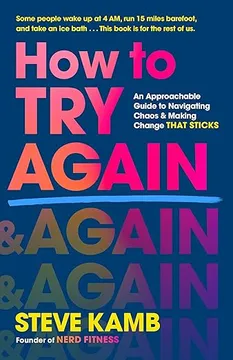


Key Takeaways
Separate a failed attempt from your identity before shame writes the story.
A setback is not a self. Kamb opens with his own losses: a skin cancer diagnosis, the end of a nine-year marriage, and a business that lost 75 percent of its website traffic, once 1.5 million monthly visits. Even as someone who taught change for a living, he needed eighteen months to apply his advice to himself. His distinction is simple: a person can fail at something without becoming a failure. The book traces how failure shifted from describing a bad outcome to judging a person's character. At the Museum of Failure, product flops sit beside notes from visitors confessing painful private setbacks. Seeing those notes, and sharing his own, helped Kamb feel less alone.
The separation between behavior and identity resembles a useful distinction in psychology: a specific action can be examined and changed, while a global self-condemnation tends to make change feel futile. Shared stories also counter the false impression that everyone else is coping flawlessly. Still, normalizing failure should not erase responsibility. Shame is often a poor teacher, but honest accountability can identify harm, prompt repair, and prevent repetition. Compassion works best as a basis for looking clearly, not as a way to avoid looking.
Return with lessons from every attempt; restarting is not erasing progress.
Past effort leaves knowledge. Someone returning to the gym after a long break may have lost strength, but has not forgotten how to find the building, use the equipment, or manage the first intimidating visit. Those earlier steps still count. Kamb illustrates this with the video game Outer Wilds, where an astronaut relives the same 22-minute cycle. Each failure reveals something about the solar system; eventually, knowledge makes a challenge that once seemed impossible solvable within one cycle. A new attempt can work the same way. Experience may expose which obstacles to expect and which strategies to avoid. Starting again is not starting from nothing; it is beginning with information the previous version of you had to earn.
This is a practical model of cumulative learning: an outcome can be unsuccessful while the attempt still improves the next decision. The important step is making experience explicit. Without reflection, repeated attempts can simply reproduce the same conditions and produce the same result. A brief review of what happened, what was controllable, and what to change converts memory into usable knowledge. The metaphor also has limits: some setbacks remove resources or create new barriers, so progress is not always linear. Accumulated insight matters, but it cannot guarantee an easier restart.
Pause when effort points the wrong way; protect capacity before chasing progress.
First, stop the drift. In 2013, surfer Brett Archibald fell from a boat off Indonesia and found himself alone in the ocean. He initially swam in what he thought was the direction of land, then tested the current with a piece of paper and realized he was moving against it. He stopped swimming and conserved energy by treading water. A rescue boat found him 28 hours later, about 50 nautical miles from where he fell. The lesson is not to quit, but to ask whether more effort is helping. During a crisis, a short walk, one nourishing meal, or a few minutes of exercise may be enough to preserve a routine without demanding a full performance.
The story captures a principle of decision-making: effort has value only when its direction and cost make sense. A pause can preserve options, especially when exhaustion narrows attention and encourages impulsive choices. In ordinary life, minimal maintenance can protect a valued practice until capacity returns. The ocean analogy should not be mistaken for a prescription to wait passively through every emergency. Real crises may require seeking help, changing circumstances, or making urgent decisions. The useful question is not simply whether to persist, but what action conserves the ability to respond well.
Build for the life you have, not the normal you keep waiting for.
Today's disorder counts as normal. A busy parent, unpredictable job, or caregiving responsibility can keep disrupting the routine that supposedly returns next week. Kamb describes Mike, a golf podcaster whose hobby became a business, adding new work and family demands. Instead of apologizing for an imagined return to his former schedule, Mike built flexible workouts and backup meals around the life he actually had. Acceptance does not mean approving of every circumstance or abandoning ambition. It means seeing constraints clearly enough to choose. The chapter also encourages facing uncomfortable problems rather than postponing them, and pairing an honest admission with a next step: life is difficult, and some action remains possible.
This approach resembles adaptive planning: plans are useful when they respond to conditions, not when they require reality to cooperate. Acceptance is especially valuable when a situation cannot be changed immediately, because it distinguishes the facts from the struggle against the facts. But acceptance can be misused if it turns preventable burdens into personal duties to endure. The question is whether a constraint is fixed, negotiable, or unfairly imposed. Naming that distinction protects the insight from becoming passive resignation, while leaving room for practical change and requests for support.
Treat your next change as a test, not a verdict on your character.
Investigate before prescribing. Kamb suggests examining a past attempt like a detective, asking why several times rather than labeling the problem laziness. A missed workout might trace back to a late bedtime, which might trace back to work and caregiving demands. The apparent motivation problem may actually be a shortage of time, energy, or support. Then act like a scientist: form a practical hypothesis, test it for a defined period, and review what happened. The book calls this Zoom In, Zoom Out. For example, someone might cook several meals at home each week for a month, then assess whether the plan was enjoyable and workable. Choose measurements carefully: a number can steer behavior toward the wrong goal.
Turning a goal into a bounded experiment reduces the psychological stakes and makes adjustment legitimate rather than shameful. It also resembles scientific practice: a hypothesis invites evidence, including evidence that the initial idea was wrong. Short trials are particularly useful when preferences and circumstances are uncertain. Yet personal experiments rarely isolate one variable as cleanly as laboratory studies. Illness, workload, and other changes can influence results. The best use of tracking is therefore not to claim certainty, but to notice patterns, combine measurements with lived experience, and decide what is worth testing next.
Start badly enough to give reality something to improve.
A rough first version creates options. George Lucas's early Star Wars drafts differed sharply from the finished story; one was so confusing that a friend dismissed it as nonsense. Rewriting and feedback helped the film take shape. Kamb links this process to stand-up comedy, where performers test jokes before audiences and revise the wording, pauses, and punch lines in response. The point is to begin with a plausible first attempt rather than waiting for certainty. Because outcomes are not fully controllable, he also recommends deciding in advance to accept whatever result comes. That reduces the pressure to prove personal worth through a single workout, draft, audition, or other attempt.
Iteration is a powerful alternative to perfectionism because it replaces prediction with feedback. It is especially effective when the work can be revised and errors are affordable. However, feedback is not automatically wise: audiences can be unrepresentative, and early criticism can discourage more than it informs. Choosing a trusted test audience and asking specific questions improves the signal. Accepting uncertain outcomes also does not mean lowering standards. It means separating the quality of the process from guarantees about reception, then using the result to make a better next decision.
Make consistency elastic enough to survive missed days and chaotic weeks.
Build a flexible floor. Kamb offers strategies for making a chosen activity easier to repeat: seek a quick initial success, make it enjoyable, connect it to a personal reason, bring it closer, or find people who already do it. Remove distractions in advance, set boundaries around time, and shrink the task when life gets crowded. A workout can range from a full gym session to a few movements at home. If a day is missed, resume the next day instead of treating the interruption as a broken identity. A jar filled with a small token after each completed attempt can make accumulated effort visible. The goal is not perfect streaks, but repeatable returns.
The strategies work on several sources of friction at once: environment, social expectations, motivation, and the cost of starting. This is more realistic than treating adherence as a pure test of willpower. Flexible minimums can also protect continuity when a person's time or energy fluctuates. The caution is that a tiny version should remain a bridge, not a permanent substitute for the aim. Periodic review can establish whether the scaled-down practice still serves the underlying purpose. A missed day is ordinary; repeatedly missing because the plan is unworkable is information worth acting on.
After devastation, reset obligations and choose hope you can act on.
Hope need not promise recovery. Kamb recounts Jodi Ettenberg's sudden, chronic spinal fluid leak, which severely limited her mobility and ended her life of international travel. She found that forced optimism and advice to stay positive made her feel more isolated. Instead, she had to grieve, face her changed circumstances, and conserve energy previously spent on anger. The book's idea of Expectation Bankruptcy means setting aside old goals and obligations when a crisis makes them unrealistic. Reasonable hope focuses on actions still available: drawing on relationships, remembering identities beyond the loss, or contributing where possible. Ettenberg found new ways to support the spinal fluid leak community and share her expertise.
This is a humane corrective to the assumption that resilience means returning to a previous baseline. For chronic illness, bereavement, or disability, that expectation can compound suffering by making adaptation look like failure. Hope as action can preserve agency without predicting an outcome. It must also remain an invitation, not another demand placed on people who are already depleted. Meaning-making cannot replace medical care, income, accessibility, or social support. The strongest version of this idea holds both truths: some losses are profound and enduring, and practical forms of connection or contribution may still be possible.
Steer by changing conditions instead of demanding a perfect life map.
Navigate from where you are. Polynesian wayfinders crossed vast stretches of ocean by reading stars, currents, weather, and bird behavior rather than relying on modern maps. In 1976, the canoe Hōkūle‘a sailed from Hawaii to Tahiti, about 2,500 miles, using traditional navigation. Kamb uses wayfinding as a model for life: choose a general direction, notice what the journey reveals, and adjust course. That can mean trying a different career role, developing skills across fields, or following an unexpected opportunity without assuming every detour is wasted. The future is too uncertain for a rigid route to remain accurate. A useful plan guides the next move without requiring a complete picture of the destination.
Wayfinding joins intention with responsiveness. It avoids two extremes: treating a plan as destiny, and drifting without criteria for choice. The navigators' attention to multiple signals is particularly instructive; no single clue determines the route. In careers and personal projects, small trials can likewise reveal fit before a major commitment. Still, openness to possibility is easier for people with financial and social room to experiment. The model should not romanticize precarity or imply that every detour is beneficial. Flexibility is most useful when paired with resources, reflection, and a clear sense of what matters.
Live before the goal arrives; today's imperfect life is not a waiting room.
Do not postpone being alive. The book begins its closing movement with a person describing life on hold until weight loss, followed by years of inconsistency and regret. Kamb argues that worth and participation should not depend on reaching a target first. He draws on wabi-sabi, a Japanese aesthetic that values the imperfect, impermanent, and incomplete. A cracked mug bearing his encouraging motto became a reminder of a messy period; he repaired it with gold-flecked lacquer rather than hiding the break. His practical measure of a day became modest: time for meaningful work, movement, and people he cares about. Perfection is unavailable, and waiting for it can cost the life already happening.
This takeaway challenges conditional self-worth, the belief that life begins only after a person changes enough. Goals can organize effort, but they become harmful when they also function as permission to be seen, loved, or included. The repaired mug offers a concrete image of continuity without pretending damage never occurred. There is a necessary nuance: appreciating imperfection should not excuse preventable suffering or block efforts to improve conditions. The point is not to prefer hardship, but to stop making dignity contingent on a flawless body, schedule, or future.
Analysis
The book's central contribution is not a novel theory of habit formation. It is a change in the emotional contract around behavior change. Conventional advice often treats lapses as evidence that commitment was insufficient. Kamb instead treats them as information about fit, resources, timing, and expectation. That shift matters because shame can narrow attention toward self-punishment, while curiosity makes diagnosis and repair more available.
The PACT framework gives this stance a memorable sequence: interrupt reactive effort, acknowledge actual conditions, revise the approach, and test a next move. Its value lies less in technical novelty than in combining ideas that are often separated. Crisis management, self-compassion, experimentation, and long-range adaptation become parts of one repeatable practice. The book's strongest stories make that practice tangible, especially Archibald conserving energy at sea and Ettenberg rebuilding meaning under severe physical constraints.
The framework is most convincing when it distinguishes what can be changed from what must be endured for now. Its potential weakness is that flexibility can sound like an individual solution to problems rooted in money, health, caregiving, or unequal power. The book does acknowledge support and external limits, but readers should not conclude that better self-talk can solve structural obstacles. Sometimes the next effective change is asking for help, obtaining treatment, negotiating work, or changing the surrounding conditions.
The result is a practical philosophy for people who repeatedly restart, not a promise that persistence guarantees success. Its deeper claim is that a worthwhile life cannot be postponed until a person becomes optimized or a crisis resolves. Progress can include learning, recalibrating, resting, grieving, and beginning again. That makes the approach less triumphant than standard motivational writing, but more credible for lives that do not follow clean plans.
Review Summary
Readers consistently praise How to Try Again for its compassionate, humor-filled approach to failure and personal growth. Many highlight the practical PACT framework (Pause, Accept, Change, Try) as a standout feature, appreciating how it addresses what happens after motivation disappears. Reviewers frequently note the book's conversational, relatable tone and its rejection of toxic positivity. Some longtime self-help readers found the content familiar, and a few felt it was repetitive, but the majority found it genuinely useful, actionable, and emotionally validating across various life circumstances.
Glossary
PACT framework
A four-part resetA repeatable approach to disruption: pause before reacting, accept the conditions that are actually present, change the strategy or expectations, and try a revised action. The framework is designed for repeated use rather than as a one-time solution, especially when a previous approach no longer fits.
Doom Loop
A cycle of overcommitmentA recurring pattern in which someone feels inadequate, becomes excited by a supposedly perfect solution, commits to it completely, then abandons it when ordinary life interferes. The lapse produces more self-criticism, which renews the sense of inadequacy and starts the cycle again.
Tread water
Maintain a minimal baselineA temporary strategy for periods of high strain. Instead of pursuing full progress, a person does the smallest useful actions that preserve energy and prevent complete disengagement. Examples include a short walk or one manageable meal choice. It is a way to stay functional while conditions remain difficult.
Zoom In, Zoom Out
Test, then reviewA method for running a bounded personal experiment. Zoom in by focusing on a specific behavior for a set period, often several weeks. Zoom out at the planned review point to assess what happened and decide whether to continue, adjust, or replace the approach, without treating the result as a verdict on character.
self-efficacy
Belief in personal capabilityPsychologist Albert Bandura's term for a person's belief that they can carry out actions needed to make change. Kamb highlights four influences: successfully doing a task, seeing a relatable person do it, receiving encouragement, and one's emotional or physical state. Small wins can provide evidence that strengthens this belief.
Ulysses Pact
A safeguard for future choicesA commitment made while feeling clear or motivated that limits choices during a future moment of temptation or low resolve. The name refers to the story of Ulysses arranging to be restrained so he could hear the Sirens without steering toward danger. Modern examples include blocking distracting apps or setting a financial commitment.
Premortem
Anticipate likely obstaclesA planning exercise that imagines a project or behavior has failed, then asks what may have caused the failure. By identifying likely barriers in advance, a person can prepare backup options before stress or disappointment makes problem-solving harder. It is meant to increase readiness, not predict every difficulty.
Expectation Bankruptcy
Reset demands after upheavalA deliberate release of goals, obligations, and standards that no longer make sense after a major setback. Borrowing the idea of starting a budget from zero, it lets a person rebuild expectations around current capacity instead of measuring themselves against a life that has changed or disappeared.
reasonable hope
Hope grounded in possible actionA way of relating to an uncertain future without promising that circumstances will improve. It acknowledges real constraints while identifying choices still available, such as seeking support, protecting a valued relationship, or taking one feasible step. Hope is treated as a practice rather than a guarantee or mood.
wayfinding
Navigate by ongoing evidenceA Polynesian navigation practice that uses observations of stars, currents, weather, and animal behavior to steer across open ocean without depending on modern maps or instruments. As a life strategy, it means choosing a broad direction, reading changing conditions, and correcting course as new information appears.
invisible scripts
Unexamined rules shaping choicesLearned beliefs and assumptions that influence behavior without always being noticed. They may come from family, culture, or past circumstances, and can shape attitudes toward money, food, work, exercise, and relationships. The term encourages people to examine whether inherited rules still serve their current lives.
wabi-sabi
Value imperfection and changeA Japanese aesthetic and philosophical sensibility that appreciates the imperfect, impermanent, and incomplete. In the book, it supports loosening the demand for control or a finished life, and finding value in the present despite flaws, change, and visible marks of experience.
Download PDF
Download EPUB
.epub digital book format is ideal for reading ebooks on phones, tablets, and e-readers.








