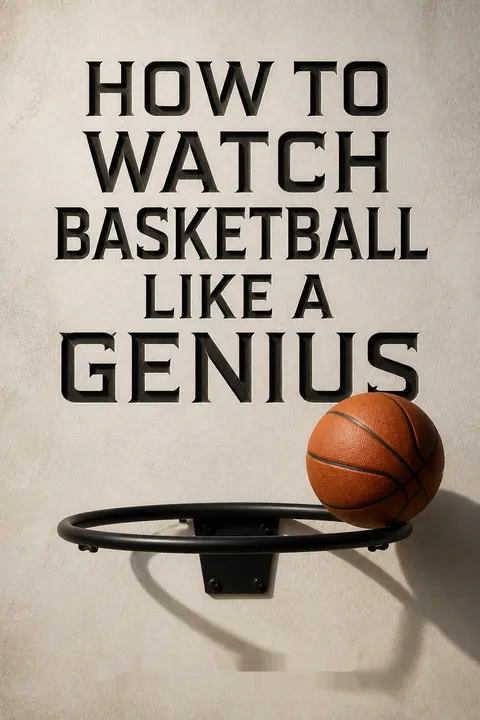


Key Takeaways
Borrow other disciplines' eyes to see what basketball hides.
A game, many lenses. Nick Greene explores basketball with game designers, physicists, a ballet director, a magician, a therapist, and other specialists. Their outside perspectives uncover details that conventional sports commentary often misses: how rules create room for invention, why defensive success can be invisible, and why a pass depends on anticipating where a teammate will be. The book is not a guide to playing better. It is a guide to noticing more, grounded in the idea that anyone can bring a useful perspective to the sport.
The game keeps changing. Basketball began with James Naismith’s thirteen rules in 1891, but its familiar form emerged through generations of players, rule-makers, and spectators. The book follows that evolution through stories, science, and cultural oddities, showing how the sport rewards many kinds of attention.
What's striking is that the book treats expertise as a change of viewpoint, not merely a larger store of facts. A ballet director notices the control in a dunk; a game designer notices how constraints make invention possible. This resembles interdisciplinary research, where a problem becomes newly legible when another field supplies different concepts. The method has a limit: an analogy can reveal a feature without proving that two fields work identically. Its value is not replacing basketball knowledge, but giving familiar action fresh questions.
Treat rules as scaffolding, not sacred furniture.
Constraints invite invention. Naismith’s original Rule 3 prohibited running with the ball. Players soon found a workaround: dribbling, initially described as passing the ball to oneself. The practice violated the expected spirit of the rule, yet Naismith came to praise it as an exciting part of the game. Dribbling is a vivid example of play changing the rules from the inside, before formal rule-makers catch up.
Gaps can become features. Game designer Eric Zimmerman explains that rules limit possible actions, but those limits also create the space in which players make surprising choices. Basketball has repeatedly changed as players explored that space, from dribbling to new moves and tactics. The book’s larger point is that the game’s identity rests less on preserving every original rule than on maintaining its central experience: using skill and teamwork to score against resistance.
This account connects to a broader distinction in design: a rule can be a boundary that supports creativity or a barrier that suppresses it. Players often discover possibilities that designers did not anticipate, a process visible in everything from games to software. But not every workaround improves the system. Dribbling made basketball more dynamic; other forms of rule-bending, such as flopping, can undermine trust. The useful question is not simply whether a rule was broken, but whether the change enriches play for participants and spectators.
Use constraints to create pace, then remove them when they distort it.
A clock stopped the stalling. In 1950, Fort Wayne beat Minneapolis 19 – 18 after holding the ball to keep it away from star George Mikan. Syracuse owner Danny Biasone proposed a 24-second shot clock by dividing the 2,880 seconds in a 48-minute game by 120 shots, the approximate total he wanted per game. In its first season, scoring rose by an average of 13.4 points per game, and attendance increased by 40 percent.
A different ending, a different incentive. Nick Elam’s Elam Ending removes the game clock near the finish and sets a target score, so teams must score rather than stop time with intentional fouls. In the 2020 NBA All-Star Game, the target format helped turn a usually casual exhibition into a competitive finish. The clock works well for pacing most of a game; at the end, it can reward the very delays it was meant to prevent.
Biasone’s solution is a striking example of designing backward from the experience people want. Instead of asking how teams could be punished for stalling, he changed the incentive that made stalling rational. Elam’s format applies the same logic to a different bottleneck. Together, the examples show that constraints are not inherently good or bad; their effects depend on the behavior they reward. The tradeoff is real: clocks provide predictable duration, while target endings can vary in length. Good design chooses which cost matters most.
Change a shot's reward, and the entire court changes with it.
The arc moved basketball outward. The American Basketball Association adopted the three-point line to make its games more distinctive and give smaller players another way to score. The NBA added it in 1979, but teams initially used it sparingly. By 2018 – 19, NBA teams averaged 32 three-point attempts per game, and 36 percent of all shots came from beyond the arc.
The incentives were lopsided. Kirk Goldsberry’s analysis found that mid-range shots produced about 0.85 points per attempt, while shots behind the arc produced more than 1.05. The extra point made long shots unusually valuable, encouraging teams to spread the floor and favor players who could shoot from distance. Traditional centers who could not defend or score far from the basket lost value. A small line on the court helped alter the sport’s positions, tactics, and aesthetics.
The three-point line shows how a small change in a reward structure can reorganize an entire system. Once teams saw the efficiency advantage, training, roster decisions, and defensive tactics shifted around it. This is a familiar pattern in economics and institutions: people adapt to incentives, often more thoroughly than the rule-makers anticipate. Yet efficiency is not the same as quality in every sense. Expected points explain why teams shoot more threes, but they do not settle whether the resulting game is more varied, dramatic, or beautiful.
Build around your strengths instead of copying the dominant model.
Grinnell chose its own game. When David Arseneault took over a struggling Division III team, traditional, physical basketball was not working. His players could shoot from the perimeter, so he built an offense around speed, pressing, frequent substitutions, and a high volume of three-pointers. The approach, called The System, was designed to suit the players Grinnell had, not imitate teams with stronger big men.
The experiment had its own goals. Grinnell sought to take at least half its shots from three-point range and used a deep rotation to keep players fresh. Arseneault said the team won 97 percent of games when it met its statistical targets. In 2012, Jack Taylor scored a record 138 points within the approach. The System was not simply a plan to win; Arseneault emphasized that it gave players an unusual, enjoyable way to participate.
Grinnell’s strategy resembles a general principle of adaptation: a weaker competitor can change the terms of competition rather than accept the incumbent’s advantages. That can produce both better results and greater engagement, especially when a team’s design makes more people meaningful contributors. The numbers, however, belong to a distinctive college context and should not be treated as universal proof that high-volume shooting is always best. A strategy is successful partly because it fits its environment, opponents, and purpose.
Practice mechanics until pressure cannot rewrite them.
Free throws isolate the shooter. The game stops, the distance stays fixed, and no opponent can block the shot. Yet NBA free-throw averages have hovered around 75 percent for decades. Researchers Larry Silverberg and Chau Tran modeled millions of attempts and found that a high arc, low release speed, and backspin help. For most NBA players, their model’s ideal launch angle is about 52 degrees.
A repeatable motion matters. The model cannot remove nerves. Shaquille O’Neal shot far better in practice than during games, while Andre Drummond’s free-throw percentage improved after he rebuilt his motion to remove a hitch. Record-setting shooter Bob Fisher described his method as knowledge, practice, and time, or KPT. The point is not to copy one perfect form. It is to use feedback and repetition to find a motion the body can reliably repeat under pressure.
The free throw makes a useful distinction between knowing the mechanics and performing them under stress. A technically sound method is only one part of a reliable skill; the performer must also learn to reproduce it when attention and emotion interfere. Deliberate practice helps by pairing repetition with feedback, rather than merely repeating errors. Still, laboratory conditions cannot fully reproduce an arena, and no single form suits every body. The practical lesson is to use science as guidance, then test what remains stable for the individual.
See the dunk as an aesthetic event, not merely two points.
Flight changes the viewer’s experience. The dunk is worth two points, but its visual force comes from much more than its scoring value. Ballet director Graham Lustig was struck by how basketball players combine height, control, and split-second decisions in the air. A practiced ballet leap is planned; a basketball player may have to adjust mid-flight to a defender or a changing pass.
Replay makes the extraordinary legible. Slow-motion footage of Michael Jordan’s dunks gave viewers time to see the body’s position and movement, intensifying the sense of suspension. Researcher Melanie Rudd’s work on awe helps explain why: people experience awe when they encounter something impressive enough to challenge their understanding. The dunk’s value is partly social, too. It gives the crowd a shared moment of astonishment that a routine made basket rarely produces.
This section treats sports as both competition and performance. A dunk may have the same score as a layup, but it can carry more expressive force because viewers see risk, skill, and apparent defiance of gravity in one brief act. Slow motion does not merely repeat the event; it changes what viewers can notice. There is a productive tension here: if every play is framed as spectacle, spectacle can become ordinary. The dunk remains powerful partly because its difficulty and spontaneity keep it from feeling routine.
Judge defense by the shots opponents never dare take.
Prevention hides its own success. A block is easy to see, but it may follow a defensive breakdown that allowed a player near the rim. Strong team defense can be quieter: closing driving lanes, disrupting passes, and making an opponent abandon a preferred shot. Utah center Mark Eaton observed that opponents sometimes stopped attempting shots near him, leaving fewer blocks for the statistics to record.
Discipline beats gambling. In the 2016 Finals, Cleveland’s J. R. Smith disrupted Andre Iguodala’s layup without fouling, giving LeBron James time to arrive for a famous block. Later, Kevin Love resisted Stephen Curry’s pump-fake and forced a difficult shot. Both plays depended on restraint. Defense resembles cybersecurity in this respect: protection succeeds when threats are anticipated and prevented, although that success can be hard to see or count.
Preventive work is difficult to evaluate because success often appears as nothing happening. That is true in defense, public health, and cybersecurity: the missing crisis leaves less visible evidence than the dramatic rescue. Pace-adjusted measures can make basketball comparisons fairer by accounting for how many possessions teams defend, but no single statistic captures anticipation, communication, or deterrence. The key is to distinguish visible activity from actual effect. A defender who avoids a spectacular gamble may be doing more than one who creates a highlight.
Pass for your teammates' needs, not your own reputation.
Sharing can still serve the self. Wilt Chamberlain led the NBA in assists in 1967 – 68, but he openly pursued the record partly to disprove critics who called him selfish. His 702 assists helped him win MVP, yet Philadelphia lost after he barely shot in the deciding playoff game. By contrast, LeBron James studies how teammates prefer to receive the ball and adjusts his passes to help them shoot comfortably.
The box score is incomplete. An assist is awarded when a statistician judges that a pass directly contributed to a made basket, so the measure is partly subjective. Ball movement can create a good shot without producing an assist at all. The triangle offense, a system based on spacing, movement, and players reading one another, illustrates how coordinated choices can matter more than any individual statistic.
The contrast between Chamberlain and James separates the appearance of generosity from its relational purpose. A pass can be self-promotional, while a player who takes the final shot can still serve the team. In organizations, the equivalent question is whether cooperation builds shared capacity or merely earns the collaborator credit. The assist statistic captures some useful work, but its subjectivity and narrow definition make it a poor stand-in for trust. The deeper measure is whether teammates become more capable of acting together.
Treat every miss as the next possession's beginning.
A miss creates another chance. Rebounding keeps basketball moving by turning a failed shot into a contest for possession. Dennis Rodman studied how teammates’ shots spun and where they tended to carom, then used those patterns to position himself. His approach made rebounding less like random hustle and more like informed anticipation.
Failure belongs to the game. James Naismith’s first class made only one basket, but the sport survived its awkward beginning. Game designer Colleen Macklin describes failure as part of what makes a game replayable: a setback can teach a player how the system works and invite another attempt. Basketball’s misses, rebounds, and rule changes all reinforce this cycle. The book closes on that practical insight: the game remains compelling because its outcome is never settled by the last mistake.
Rebounding offers a compact model of resilience: an error does not disappear, but it can become the starting condition for a new action. Rodman’s preparation shows that persistence need not mean blind effort; pattern recognition can make recovery more effective. Games also make failure unusually tolerable because players can try again within a bounded system. Real life is less forgiving, so the analogy has limits. Still, the underlying habit is useful: examine what went wrong, notice what the system permits next, and re-enter the play.
Analysis
The book’s central argument is less about basketball technique than about how to perceive a complex, evolving system. Greene uses the sport as a meeting ground for disciplines that rarely share a vocabulary. Game design explains why rules can enable invention. Engineering clarifies why a free throw is both a repeatable experiment and a psychologically unstable performance. Ballet and studies of awe make athletic spectacle newly visible. Cybersecurity and astrophysics offer models for defense and prediction. These connections turn routine acts into questions about incentives, perception, coordination, and change.
Its historical narrative gives those questions consequence. Basketball does not simply progress toward a more efficient form. Dribbling, the shot clock, the three-point line, and the jump shot each alter what players can do and what audiences value. The book’s strongest insight is that a small adjustment can reorganize an entire ecology: one new reward changes practice, personnel, tactics, and aesthetics. But this does not imply that every innovation is beneficial. The three-point revolution made scoring more efficient while narrowing the range of players and styles that could thrive. Efficiency and richness are related, not identical.
The book also makes a persuasive case for spectatorship as a learned practice. Watching like a genius does not mean memorizing statistics or identifying every play call. It means shifting attention: from the blocked shot to the drive that was prevented, from the assist total to the teammate’s needs, from the dunk’s points to its effect on a crowd. Those shifts are especially powerful because they preserve pleasure while adding explanation.
The method has an inherent risk. Cross-disciplinary analogies can become charming decoration if they are not connected to evidence. Greene often grounds them in history, data, or specific plays, but some comparisons are intentionally speculative. The result is best read not as a unified scientific theory of basketball, but as a guided tour of ways to notice more. Its unifying claim is that games become meaningful through interaction among rules, players, spectators, and time. Basketball stays alive because no one perspective can finish describing it.
Review Summary
How to Watch Basketball Like a Genius received mixed reviews. Many praised its unique approach, blending basketball analysis with insights from unrelated fields. Readers appreciated the humor, historical context, and fresh perspectives on the sport. Some found it enlightening and fun, while others felt the analogies were strained or irrelevant. The book's coverage of basketball's evolution and key figures was well-received. Critics noted its focus on US basketball and occasional lack of depth. Overall, it was seen as an entertaining and thought-provoking read for basketball enthusiasts.
People Also Read

Glossary
Elam Ending
Target-score game endingA basketball format that stops the game clock near the end and sets a target score, usually by adding points to the leading team’s total. The first team to reach that target wins. It removes the incentive for trailing teams to extend the game through intentional fouls and ensures that the final play is a made basket or free throw.
The System
Grinnell's high-tempo offenseThe distinctive style developed by Grinnell College coach David Arseneault for a team that lacked the size and strength to succeed with conventional basketball. It combined full-court pressure, frequent substitutions, rapid possessions, and a very high volume of three-point shots. Its design emphasized exploiting the team’s available strengths and giving many players meaningful minutes.
triangle offense
Read-and-react team offenseAn offensive system associated with coach Tex Winter, in which players create triangular spacing and react to defenders through cuts, passes, screens, and post play. Rather than relying primarily on a coach calling fixed plays, it depends on players recognizing options and anticipating teammates’ movements. The Chicago Bulls and Los Angeles Lakers used versions of it during championship runs.
Knowledge practice time (KPT)
Learning through informed repetitionBob Fisher’s shorthand for the ingredients he believed helped people improve at basketball shooting: knowledge, practice, and time. The method emphasizes learning useful principles, repeating a skill, and using feedback to make adjustments. It rejects the idea that every shooter must copy one prescribed form, since bodies and comfortable movements differ.
adjusted defensive efficiency
Defense measured per possessionA pace-adjusted measure of how many points a basketball team allows per possession. It helps compare defenses across teams and games that move at different speeds, rather than relying on raw points allowed per game. The book discusses this kind of tempo-adjusted analysis through Ken Pomeroy’s work on college basketball statistics.
Download PDF
Download EPUB
.epub digital book format is ideal for reading ebooks on phones, tablets, and e-readers.








