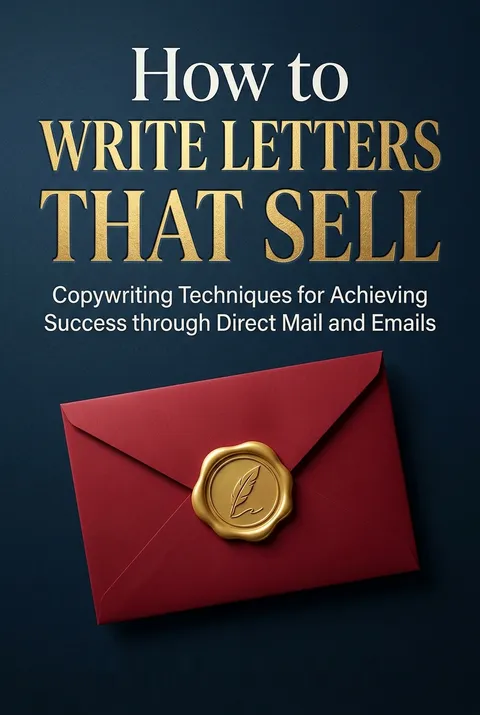


Key Takeaways
Make every letter earn attention before it asks for a sale.
Attention comes first. A sales letter can be beautifully written and still fail if nobody opens it. The book cites research suggesting that some recipients discard direct mail immediately, while many decide within about 20 seconds whether to keep looking. The envelope, the first visible part of the letter, and its headline must therefore work together to earn a closer look. A typical mailing also includes a letter, supporting material, an order form, and a return envelope. Each part should make the next step easier, not compete for attention.
Writing became his sales force. Godefroy describes moving from failed ventures and financial insecurity toward copywriting, a way to sell without relying on face-to-face charisma. The letter becomes a salesperson that can reach many people and keep working after it is written. That is the book's central promise, but not a guarantee of easy money: a campaign still has costs, risks, and a product that must deliver.
What's striking is the book's insistence that persuasion begins before the argument. This resembles interface design, where a useful service can be invisible if its first screen is confusing. An envelope's role now often belongs to an email subject line or a landing page, but the underlying problem remains: earn a moment of attention, then justify it. Attention itself is not consent, though. A clever hook should help the right reader recognize relevance, not disguise an unwanted pitch as personal correspondence.
Promise the result your reader already wants, not the feature you built.
Sell the felt benefit. The book uses Maslow's five levels of need as a way to imagine what may motivate a buyer: physical necessities, security, belonging, recognition, and personal fulfillment. A thermal garment can be presented as protection from cold; insurance as protection against financial uncertainty. The product's construction matters less to a prospect than what it can help them do or avoid.
Choose a real motive. Godefroy also suggests using familiar desires such as saving effort, gaining status, or avoiding loss to generate possible promises. These are prompts, not proof that every person wants the same thing. A useful copywriter asks which need is urgent for this particular audience, then makes a clear, credible promise connected to it. A headline should not promise an outcome the product cannot reasonably provide.
The useful move is translating a product's mechanics into a human consequence. This is close to user-centered design, which begins with the task someone needs to accomplish rather than the tool's feature list. The needs pyramid can prompt good questions, but it is not a precise map of every buyer. People may pursue belonging while also seeking security, and their priorities shift with context. Treating the categories as hypotheses to investigate, rather than fixed types of people, keeps the copy relevant without reducing readers to marketing stereotypes.
Write from the customer's inner life, not the seller's ego.
Listen before you write. The book argues that writers often mistake their own interests for the reader's. Its proposed check, the Egometer, counts first-person references such as I and we against second-person references such as you and your. In the author's analysis of 150 successful headlines, you appeared 44 times and your 19 times. In a separate sample of eight writers' work, you appeared 405 times across 8,930 words. These counts are the author's observations, not universal laws.
Build empathy deliberately. Godefroy advises talking with people from different backgrounds, listening more than speaking, restating what someone has said to check understanding, and keeping notes on their language and concerns. He also encourages personal stories and emotion when they help a reader recognize a real problem. A reader-centered letter can still sound like a person, rather than a bland machine repeating pronouns.
The Egometer is valuable because it turns a vague instruction, focus on the reader, into something a writer can inspect. Its deeper lesson resembles customer research: attention to someone's actual vocabulary is more reliable than assuming what they think. Yet a high you-to-I ratio is easy to imitate without genuine understanding. A letter can say you repeatedly while still manipulating or misreading its audience. The stronger test is whether readers recognize their situation in the copy and whether the offered solution respects their ability to choose.
Give the headline the work time it deserves.
The headline opens the argument. Godefroy treats it as a promise that should make a suitable reader curious enough to continue. Strong approaches identify an audience, offer a benefit, introduce useful news, or pose a question whose answer matters. The book highlights familiar forms such as how-to headlines and secrets, but warns against vague claims, company names used as headlines, and technical descriptions that say nothing about the buyer's gain.
Generate before choosing. The author says beginners often fail because they settle too quickly, and recommends spending substantial time on headline development. One exercise is to write multiple candidates from different benefits, leave them overnight, and then compare them. Sentences inside a finished letter can also be adapted into headlines, a process the book calls internal promotion. The final choice should be clear, credible, and relevant to the actual offer.
A headline is a compact decision aid: it helps readers decide whether the rest of the message deserves attention. That makes clarity as important as cleverness. The book's claim that headlines account for half a letter's success is best read as a practitioner warning about leverage, not a universal measurement. A headline may raise clicks while attracting the wrong audience or setting false expectations. Its real quality depends on what happens after the click, including whether the body fulfills the promise.
Turn product facts into vivid outcomes through disciplined idea generation.
Explore before drafting. The book recommends learning the product firsthand, reading customer comments and existing materials, and collecting effective advertisements for reference. Group brainstorming should first welcome ideas without criticism, then evaluate and combine them. A discovery matrix pairs customer needs with what a company can actually do; a tree diagram branches outward from a central idea. These techniques help a writer find routes beyond the first obvious pitch.
Reformulate the feature. The author calls it reformulation: translating a product characteristic into a practical advantage. His example is an inflatable device that uses a car's exhaust to lift the vehicle. Rather than dwell on its construction, copy can explain how it helps change a tire or lift a car from mud. Each claimed advantage still needs to be accurate. Creativity expands the possible explanations; it does not excuse inventing product capabilities.
This process resembles a useful discipline in product strategy: connect what a tool does to the job a person needs done. It also separates idea generation from evaluation, reducing the tendency to reject an unusual but promising angle too early. The book's language about left-brain and right-brain creativity is less useful as a modern explanation of cognition. The practical exercises stand without that claim. Research, variation, and careful revision are enough to explain why a structured search can produce more relevant sales arguments.
Keep readers moving with suspense, proof, and readable pages.
Give attention somewhere to go. A headline may earn the first glance, but a story, question, surprising fact, or customer account can carry a reader into the letter. Godefroy compares this to a mystery that leaves a question open. Testimonials can help readers imagine themselves using a product, but the letter should make clear who is speaking and what they actually experienced.
Make reading easy. The book reports a Chilton Research study in which 64.4 percent of readers noticed an ad's heading, 24.4 percent began the body, and 13.7 percent read more than half. It recommends short sentences, simple words, and paragraphs generally no longer than six lines. It also cites research by Tinker and Patterson reporting that a version with six times as many paragraphs was read 7.3 percent faster. Layout is part of the argument, not decoration.
This is a strong combination of narrative and cognitive accessibility. Suspense gives readers a reason to continue; concise formatting reduces the effort required to do so. The approach aligns with cognitive fluency, the tendency for easily processed information to feel easier to engage with. But ease of processing is not evidence of truth. A vivid anecdote can make an unusual result seem typical, while a testimonial can conceal selection bias. Good copy uses stories to clarify a supported claim, not to replace evidence.
Make the offer feel safe, valuable, and almost effortless to accept.
Remove avoidable friction. The book recommends a clear offer, a meaningful guarantee, and a related free gift that adds perceived value. It also gives the postscript unusual importance. In an account of a mailing for a Marines academy magazine, a version that retained a postscript reportedly produced three times as many subscriptions as a version without one. The P.S. can restate a benefit, explain a gift, or answer a final concern.
Make buying straightforward. The order form should summarize the offer, price, conditions, guarantee, and any deadline. It should leave space for the buyer's information and include a return envelope, so the reader need not invent the next steps. A lift-letter, a separate note from a senior or trusted figure, can address common objections and reinforce assurances. Each device works best when its claims and terms match the rest of the mailing.
The underlying principle is friction reduction: every extra question or task gives a hesitant buyer another reason to stop. This connects direct mail to choice architecture, where defaults, clear options, and a simple path can improve completion. Guarantees also redistribute perceived risk, but only when the seller can honor them. A free gift or authority figure can strengthen trust, yet it can also simulate intimacy or credibility. The distinction is straightforward: make genuine terms easier to understand, rather than using design to obscure them.
Follow up with a fresh reason, while the numbers still justify it.
A first no may mean not now. The book argues that people postpone decisions, forget offers, or need another explanation. It recommends follow-up mailings that remain consistent with the original offer while emphasizing a different argument, such as price justification, future value, or easier payment. It also suggests explaining why the sender is writing again, rather than pretending the earlier contact never happened.
Count the economics. In one example, a $5,000 mailing produced $20,000 in sales, or $15,000 after mailing costs. Three follow-ups, each costing $1,000, produced $14,000, $10,000, and $8,000 in sales. In the example, total profit rose to $44,000. This is an illustration, not a typical outcome: follow-ups make sense only when incremental revenue exceeds their costs and continued contact remains welcome.
Follow-up is a sensible answer to the gap between interest and action. Many decisions are delayed for mundane reasons, so a clearer explanation or a different payment option can help without changing the underlying product. The example also makes an important business point: evaluate each contact by incremental return, not by the original campaign's success. Repetition has limits, however. Persistence can become pressure, and response rates alone cannot tell whether recipients feel respected or whether customers remain satisfied.
Change one element at a time, and let measured results choose.
Treat copy as testable. The book's testing rule is to alter one element, such as a headline or envelope, while keeping the rest of the mailing the same. A split-run compares different versions within a publication, while coded order forms can identify which version generated each response. For a limited budget, Godefroy suggests sending most of the mailing with the established version and a smaller share with the alternative.
Measure what matters. A test should track orders and the economics behind them, not merely which version attracted more attention. The author also recommends retesting offers and other parts of the mailing, since small changes may affect sales. A failed variation still provides information about what did not work. The process is iterative: write, test, compare, and revise, rather than declaring a favorite copy successful based on taste.
The book's most durable discipline is replacing preference with comparison. Modern experimentation gives this idea a rigorous form: isolate a change, use comparable groups, and define the outcome before seeing results. Small samples can produce noisy winners, so a test's apparent improvement should not be mistaken for certainty. It also matters which outcome is measured. A headline that increases response but reduces profit or attracts poor-fit customers is not a genuine improvement. Testing is most useful when commercial performance and customer value are considered together.
Analysis
This is a practitioner's manual for turning written persuasion into a repeatable sales process. Its sequence is the real framework: earn attention, connect an offer to a felt need, establish credibility, sustain reading, make action easy, and learn from the response. The author moves from his own account of financial setbacks and shyness toward selling through letters, giving the practical advice a narrative motive. The central idea is not that elegant prose sells, but that a message designed around a reader's concerns can function as a scalable salesperson.
The book is strongest when it translates that idea into observable choices. It asks writers to examine the envelope, opening, headline, offer, proof, order form, and follow-up as parts of one experience. Its advice to turn features into outcomes, simplify sentences, and test a single variable remains useful well beyond postal marketing. Email subject lines, web pages, and digital checkout flows face similar problems of attention, comprehension, and friction.
Its evidence requires more caution than its confidence suggests. Response figures come from studies and campaign anecdotes whose methods are not consistently supplied, and mail performance depends on audience, product, price, timing, and channel. Claims about right-brain creativity and fixed human need hierarchies should be treated as dated explanatory shortcuts, not established laws. The book's own testing advice is therefore more trustworthy than any universal percentage it offers: measure the specific campaign rather than importing a benchmark.
There is also an ethical tension. The book presents urgency, emotional triggers, free gifts, and personalized-looking mail as instruments of persuasion. Used honestly, these can clarify value and help a reader decide. Used to manufacture scarcity, imply a false personal relationship, or inflate evidence, they undermine the trust the copywriter is supposed to build. The strongest modern interpretation is disciplined, reader-centered selling: make a relevant promise, prove it, disclose the terms, and let the reader decline without deception. That standard preserves the book's commercial craft while separating persuasion from manipulation.
Review Summary
How to Write Letters that Sell receives mixed reviews, with an overall rating of 4.06 out of 5 based on 18 reviews. While some readers find value in the book, others note its outdated focus on traditional mail marketing. One reviewer gave it 3 out of 5 stars, acknowledging that despite its old-fashioned approach, the book still contains useful information. The reviewer suggests that there are "some gems" to be found within the content, indicating that certain principles and techniques presented may still be applicable in modern contexts.
People Also Read

Glossary
Egometer
Measures reader-centered languageA simple copywriting check that counts references to the writer, such as I and we, against references to the reader, such as you and your. Godefroy uses it to reveal when a letter spends too much space on the seller's perspective. The count is a diagnostic prompt, not a guarantee that a message truly understands its audience.
Maslow's pyramid
Maps broad human needsA hierarchy of five categories of need associated with psychologist Abraham Maslow: physiological needs, security, love and belonging, recognition, and self-realization. The book uses the categories to help copywriters identify motives that might make an offer relevant. It presents the pyramid as a practical guide to headline ideas, rather than a detailed account of individual behavior.
internal promotion
Finds headlines inside copyA technique for developing headlines by reviewing a completed sales letter and identifying its strongest sentences or claims. Those lines can be reshaped into headline candidates, rather than beginning with a blank page. The candidates still need to be judged for clarity, relevance, and credibility, and the book recommends testing the strongest alternatives.
lift-letter
Addresses buyer objectionsA separate letter included with a mailing, often signed by someone with greater authority than the original sender. It reinforces the offer, answers likely objections, and may repeat assurances such as a guarantee or free gift. Its purpose is to persuade hesitant readers who have not responded to the main letter.
discovery matrix
Pairs needs with capabilitiesA grid used to generate product or marketing ideas by matching customer needs with an organization's financial, technical, marketing, sales, or personnel capabilities. Each intersection prompts questions about possible solutions and more original alternatives. The method helps connect what a business can offer with problems or desires expressed by customers.
tree technique
Branches ideas from a coreA visual idea-generation method that places a central topic on a page and connects related ideas around it, then expands those branches with further associations. Godefroy presents it as an alternative to a linear list, particularly useful for exploring multiple angles on a product or sales argument.
reformulation
Turns features into advantagesA copywriting technique that translates a product's characteristics into benefits a prospective customer can recognize. Instead of describing how an item is built, the writer explains what it enables, what problem it addresses, or what effort it may save. The resulting claims must remain faithful to what the product can actually do.
split-run
Compares versions in printA test in which different versions of an advertisement or mailing run in comparable portions of a publication or audience. The copywriter keeps the material the same except for the element being tested, such as the headline, and uses response identifiers to compare results.
Lancaster Touch
Makes the next action obviousA closing approach attributed in the book to insurance salesman Lancaster. After explaining an offer and confirming its advantages, the seller makes the next step feel like a natural continuation, reducing uncertainty about what the prospect should do. In a written offer, the equivalent is to summarize value and give explicit, simple instructions for responding.
Download PDF
Download EPUB
.epub digital book format is ideal for reading ebooks on phones, tablets, and e-readers.








