Key Takeaways
1. Death's Undignified Reality
I have not often seen much dignity in the process by which we die.
Demythologizing death. The author challenges the pervasive myth of a "death with dignity," arguing that modern dying, often hidden in hospitals, is frequently a series of destructive events leading to the disintegration of humanity. Society's yearning for a peaceful, spiritual end is largely a self-deception, fueled by a primitive fascination with death that we simultaneously fear and eroticize. This denial prevents us from confronting the biological reality.
Concealed suffering. Unlike the "ars moriendi" (art of dying) traditions of past centuries that celebrated a good death, contemporary death often occurs in specialized units like ICUs, cleansed of its organic blight and packaged for burial. This sanitization, while well-intentioned, obscures the true nature of physical deterioration. The author recounts a patient's despair over her mother's "undignified" death, highlighting how expectations clash with the messy reality of pain and medical intervention.
Truth as preparation. Only by a frank discussion of the details of dying can we shed the fear of the unknown that leads to disillusionment. Death is not a confrontation to be won, but an event in nature's rhythm; disease is the true enemy. Understanding the biological truth, even if unpleasant, prepares us to make choices that mitigate suffering and allows for a more authentic end.
2. The Heart's Inevitable Failure
Ischemic heart disease (or coronary artery disease, or coronary heart disease, as it is variously called) is the leading cause of death in the industrialized nations of the world.
The heart's betrayal. The heart, a masterpiece of nature, is nourished by coronary arteries that, when diseased, betray it. Atherosclerosis, the hardening and narrowing of these arteries by plaques, is the primary culprit. This process, often exacerbated by lifestyle choices like diet, smoking, and lack of exercise, starves the heart muscle of oxygen, leading to:
- Angina pectoris: "Charley horse of the heart," a warning pain.
- Myocardial infarction: Heart attack, where muscle tissue dies.
- Ventricular fibrillation: Chaotic electrical activity, often causing sudden death.
Sudden vs. gradual demise. While some, like James McCarty, experience sudden cardiac arrest, many others, like Horace Giddens, face a slower, more agonizing decline into chronic congestive heart failure. Here, the weakened heart struggles to pump blood efficiently, causing fluid backup and swelling (edema) in organs like the lungs, liver, and kidneys. This leads to:
- Shortness of breath, especially when lying down.
- Chronic fatigue and listlessness.
- Swelling in extremities or lower back.
Vicious cycle of failure. The failing heart attempts to compensate by enlarging and speeding up, demanding more oxygen than narrowed arteries can provide, creating a vicious cycle. This chronic state often culminates in acute pulmonary edema (drowning in one's own fluid), cardiogenic shock (heart too weak to maintain blood pressure), or lethal arrhythmias. Modern medicine can delay these events, but for many, the progression of atherosclerosis is unremitting, making heart disease the planet's biggest killer.
3. Aging: Nature's Programmed Decline
No one dies of old age, or so it would be legislated if actuaries ruled the world.
The unlisted cause of death. Despite official classifications that attribute death to specific pathologies, the author argues that many elderly individuals truly die of "old age"—a natural wearing out of the body's systems. This perspective, shared by figures like Thomas Jefferson, recognizes that our "machines" simply cease motion after decades of use, regardless of specific disease labels.
Gradual systemic breakdown. As we age, the body undergoes a universal process of decline:
- Heart: Muscle cells wear out, leading to decreased cardiac output, slower filling, and increased blood pressure.
- Kidneys: Lose weight, develop scarring, and filter less efficiently, leading to fluid and salt imbalances, and eventually uremia.
- Brain: Loses weight, neurons die, and responsiveness decreases, manifesting as forgetfulness, irritability, and withdrawal.
- Immune System: Becomes "threadbare," less effective at recognizing and fighting off infections.
Beyond disease labels. While specific pathologies like chronic heart failure, stroke, or pneumonia are often listed on death certificates, these are frequently terminal events in a body already debilitated by senescence. The author's grandmother, Bubbeh, exemplified this slow drawing away from life, with failing vision, mobility, and cognitive function, culminating in a stroke and pneumonia. To call these natural processes "diseases" is, for the author, a "legalized evasion of the greater law of nature," a first step in a futile attempt to "cure" the inevitable.
4. The Brain's Gradual Surrender
The fundamental pathology of Alzheimer’s disease is the progressive degeneration and loss of vast numbers of nerve cells in those portions of the brain’s cortex that are associated with the so-called higher functions, such as memory, learning, and judgment.
Stroke: A sudden assault. Stroke, the third leading cause of death, occurs when blood flow to a specific brain region is cut off, leading to immediate dysfunction or death of nerve tissue. This ischemia can be caused by:
- Atherosclerosis blocking carotid artery branches.
- An embolus (plaque fragment) plugging a vessel.
- Hemorrhage into the brain, often due to hypertension.
Symptoms vary based on the affected area, often including sensory loss, paralysis, language difficulties (aphasia), or coma.
Alzheimer's: A slow, cruel erosion. Alzheimer's disease is a progressive neurodegenerative disorder characterized by:
- Loss of vast numbers of cortical nerve cells.
- Decreased acetylcholine, a key neurotransmitter.
- Microscopic "senile plaques" (beta-amyloid core) and "neurofibrillary tangles" (fibrils within cells).
This leads to a multifaceted loss of intellectual abilities, personality changes, and behavioral issues, as seen in Phil Whiting's agonizing decline into confusion, aggression, and eventual oblivion.
The emotional toll. Both stroke and Alzheimer's inflict immense suffering, not just on the patient but on their families. Alzheimer's, in particular, is a "degrading sickness" that strips away a person's identity and dignity, leaving caregivers to witness the slow, relentless disintegration of a loved one. The patient often remains unaware of their plight, while families grapple with ambivalence, helplessness, and the profound sorrow of losing someone who is physically present but mentally absent.
5. Oxygen: The Breath of Life's End
Death may be due to a wide variety of diseases and disorders, but in every case the underlying physiological cause is a breakdown in the body’s oxygen cycle.
The ultimate necessity. Life depends on oxygen. From the lungs, oxygen binds to hemoglobin in red blood cells, travels to the heart, and is pumped to every cell. There, it's exchanged for carbon dioxide. Any disruption to this cycle leads to cellular death and, eventually, the death of the organism.
Shock: Inadequate blood flow. Shock describes a state where blood flow is insufficient to meet tissue needs, leading to oxygen deprivation. Common types include:
- Cardiogenic shock: Heart's pumping action fails (e.g., heart attack).
- Hypovolemic shock: Major decrease in blood volume (e.g., hemorrhage).
- Septic shock: Infection products cause blood redistribution and pooling.
The brain, being highly sensitive to oxygen and glucose deficiencies, fails quickly, leading to unconsciousness and brain death.
Agonal phase and clinical death. Before permanent mortality, there's often an "agonal phase" of struggle, followed by "clinical death"—a brief period where circulation, breathing, and brain function cease, but resuscitation might still be possible (typically within 4 minutes). The body's appearance changes rapidly:
- Face takes on a gray-white pallor.
- Eyes become glassy, then dulled, pupils dilate.
- Skin loses elasticity and sheen.
This sequence, from oxygen deprivation to cellular death, is the universal mechanism of dying, whether sudden or prolonged.
6. Violence: A Premature Exit
The traumatic death of a human being serves no useful purpose. It is as tragic to the species as to the family left behind.
Trauma's grim statistics. Trauma, or physical injury, is the leading cause of death for those under 44 in the U.S., claiming 150,000 lives annually. It robs the species of its progeny and violates the natural cycle of renewal. Major causes include:
- Automotive accidents (35%), often alcohol-related.
- Gunshot wounds (10%) and stabbings.
- Falls (17%), affecting the very old and young.
The body's surprising serenity. In sudden, violent deaths, like Katie Mason's murder, victims sometimes exhibit a remarkable tranquility, a "look of surprise" rather than terror. This phenomenon, also described by Montaigne and Livingstone, is attributed to the release of endorphins—the body's self-generated, morphine-like substances. These endogenous opiates alter sensory awareness, raise pain thresholds, and modify emotional responses, serving as a survival mechanism to prevent panic.
Suicide: A complex choice. Suicide, particularly among the young, is a growing concern, often linked to remediable depression. While some, like Percy Bridgman, make a "rational suicide" decision in the face of terminal illness, many others act impulsively. Methods vary:
- Barbiturates: Induce coma, respiratory obstruction, cardiac arrest.
- Carbon Monoxide: Hemoglobin binds to CO, depriving the brain and heart of oxygen, leading to a cherry-red appearance.
- Hanging/Drowning: Mechanical asphyxia, often involving laryngeal spasm and fluid aspiration.
The medical community grapples with the ethics of physician-assisted suicide, emphasizing the need for uncoerced, informed decisions in the face of unendurable suffering, as exemplified by Dr. Timothy Quill's case.
7. AIDS: The Immune System's Betrayal
There has never been a disease as devastating as AIDS.
A unique plague. AIDS, caused by the Human Immunodeficiency Virus (HIV), is devastating because it attacks the very immune cells (CD4 lymphocytes) meant to fight it. This unique pathophysiology leaves the body defenseless against a multitude of "opportunistic infections" that would be harmless to a healthy person. The virus also hides in cells and mutates, making it incredibly elusive.
The relentless progression. HIV infection progresses through stages:
- Early: Brief flu-like symptoms, then a long dormant period (3-10 years) where the virus slowly destroys CD4 cells in lymph nodes.
- Late: CD4 count drops dramatically, leading to opportunistic infections.
Patients like Ishmael Garcia suffer a relentless onslaught of diseases, including: - Pneumocystis carinii pneumonia (PCP): Leading cause of death, causing respiratory failure.
- Toxoplasmosis: Brain infection causing confusion, seizures, coma.
- Mycobacterium avium complex (MAC): Widespread bacterial infection causing wasting.
- AIDS dementia complex: HIV-induced brain atrophy.
- Kaposi's sarcoma (KS) and lymphoma: Cancers thriving in immunocompromised states.
Beyond the clinical. AIDS inflicts profound physical and emotional suffering, often leading to severe cachexia (wasting), organ failure, and malnutrition. The "caregiving surround" of friends and family, particularly in the gay community, becomes crucial, providing love and support in the face of societal judgment and the "inversion of the expected life cycle" where parents bury their children. Despite scientific advancements like AZT, the virus's complexity means death remains a grim certainty for many, often marked by sepsis and multiple organ failure.
8. Cancer: The Malignant Anarchy Within
Cancer is best viewed as a disease of altered maturation; it is the result of a multistage process of growth and development having gone awry.
A cellular rebellion. Cancer is not a parasite but a "malignant anarchy," a disease of altered cellular maturation. Normal cells differentiate and mature, losing their rapid proliferation capacity. Cancer cells, however, are "fixed at an age where they are still too young to have learned the rules," retaining an infinite capacity to reproduce without purpose. They are:
- Autonomous: Leaderless, uncontrolled growth.
- Anaplastic: Deformed, immature appearance, "without form."
- Immortalized: Unlike normal cells, they don't die on schedule.
Local invasion and distant metastasis. Cancer cells aggressively invade surrounding tissues, pushing aside normal cells and engulfing vital structures. Their most menacing characteristic is metastasis, the ability to travel through blood or lymph to distant organs (bones, liver, lungs) and establish new colonies. This process is difficult, but successful metastases lead to widespread destruction.
The toll on the body. Cancer kills in numerous ways:
- Local encroachment: Obstructing organs (intestine), destroying vital centers (brain), eroding blood vessels (anemia).
- Cachexia: "Bad condition" of weakness, poor appetite, altered metabolism, and muscle wasting, often exacerbated by tumor-secreted substances like cachectin.
- Immunosuppression: Weakened immunity increases susceptibility to infections like pneumonia and sepsis, often the immediate cause of death.
Despite its malevolence, significant progress has been made in treating certain cancers, like Hodgkin's disease and childhood leukemia, offering hope for cure or prolonged survival.
9. Hope's True Meaning in Terminal Illness
Hope resides in the meaning of what our lives have been.
Beyond cure. Physicians often mistakenly equate hope with cure or remission, leading them to offer "baseless hope" that prolongs suffering. The author, reflecting on his brother Harvey's terminal cancer, admits to this error, driven by a desire to protect his brother from the truth and his own inability to accept defeat. This misguided hope can lead to futile, debilitating treatments that diminish the patient's final months.
Redefining hope. For the terminally ill, hope must be redefined. It can be found in:
- Dignity of life lived: The most abiding hope, as exemplified by Robert DeMatteis, who found courage to live his last Christmas fully, determined to be remembered for how he lived.
- Acceptance and control: Choosing to forgo aggressive treatment and embracing a peaceful end.
- Spiritual companionship: Sharing the truth with loved ones, fostering a "final consummation" that prevents dying alone.
The burden of denial. Denial, a powerful subconscious mechanism, complicates end-of-life decisions. Patients may refuse to confront their prognosis, even when they've signed advance directives. Caregivers, too, may conspire in this denial, believing they are protecting the patient, but ultimately creating a "terrible solitude" where the dying person cannot share their deepest fears or wishes. True hope emerges from honesty, allowing patients to make informed choices about their remaining time and find meaning beyond the struggle for survival.
10. The Doctor's Dual Role: Healer and Riddle-Solver
It is The Riddle that drives our most highly skilled and the most dedicated of our physicians.
The Riddle's allure. The author reveals a fundamental schism in medicine: while physicians are driven by "love of mankind" and a desire to relieve suffering, their most intense passion and professional self-image are tied to solving "The Riddle" of disease. This intellectual challenge, the pursuit of diagnosis and cure, often overshadows the patient's best interests, especially at the end of life.
Paternalism and futility. The drive to solve The Riddle can lead doctors to push for treatments "beyond reason," even when futility is evident. This "doing something" often serves the doctor's need to avoid defeat rather than the patient's desire for peace. The author's experience with Miss Hazel Welch, an elderly woman who wished to die but was operated on against her will, illustrates this conflict. He prioritized saving her life (solving The Riddle) over respecting her autonomy and desire for a "gracious way to die."
The "Invisible Death." Modern medical technology, while offering hope, can also distance physicians from patients and contribute to an "Invisible Death." ICUs, with their monitors and machines, symbolize society's denial of death's naturalness. Patients, isolated among strangers and subjected to relentless interventions, may lose their hope for a tranquil end. The author argues that doctors must confront their own motivations and recognize when their quest to solve The Riddle conflicts with the patient's right to a peaceful, unhindered departure, surrounded by loved ones.
Last updated:
Review Summary
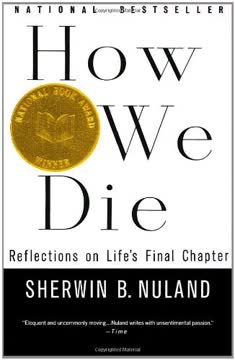
How We Die by Sherwin B. Nuland receives widespread praise (4.07/5) for demystifying death through detailed medical descriptions of common ways people die—heart disease, cancer, Alzheimer's, AIDS, and accidents. Readers appreciate Nuland's clinical yet compassionate approach, combining technical accuracy with personal stories. The book challenges the myth of "dignified death," arguing dignity comes from how we lived, not how we die. While some find it dated (published 1993) and repetitive, most consider it essential reading for understanding end-of-life realities and making informed medical decisions. Critics note its emotional weight and recommend reading when emotionally prepared.
Similar Books