

Key Takeaways
Musk's hubris built the rocket, then made correction feel like sabotage
Conviction created momentum. In 2018, as television showed the SEC accusing him of misleading investors, Musk laughed with Tesla staff. The moment captures the book's central argument: the force behind his rise also weakened his response to limits. Musk's early ventures, Zip2 and PayPal, made the money that helped fund SpaceX and Tesla. His willingness to reject conventional automotive thinking helped make electric cars exciting rather than dutiful.
Success became its own evidence. Repeated wins encouraged Musk and his followers to treat confidence as proof that his next gamble was sound. When employees, regulators, or investors challenged a plan, he could frame their caution as obstruction of a mission larger than any company. That made boldness useful for starting difficult projects, but dangerous when it crowded out correction.
What's striking is that the book does not reduce success to luck or failure to personality. It shows how a useful leadership trait can become a liability when an organization stops testing it. High-reliability fields such as aviation and medicine treat dissent as a safety mechanism: people closest to a problem must be able to report bad news without being punished. Vision can set a destination, but evidence has to govern the route. The account is strongest when it traces that shift in behavior, rather than trying to diagnose Musk's inner life.
A noble mission cannot turn experimental road users into acceptable collateral
A fatal test case. In 2018, Apple engineer Walter Huang used Tesla Autopilot on his commute, despite previous problems with the car drifting toward a highway barrier at the same location. Distracted by a mobile game, he failed to respond to warnings. The Tesla followed a damaged lane marking, accelerated, and struck a concrete median. Huang died. The NTSB sought Tesla's cooperation in investigating the crash; after Tesla publicly discussed the probe, Musk angrily argued that investigators' actions would cost lives.
Public support mattered too. Tesla had benefited from a $465 million Department of Energy loan and from selling emissions credits to other automakers. The contrast is important: government support helped the company grow, while safety oversight was sometimes cast as interference. Other drivers, pedestrians, and workers also bore risks they had not chosen.
The hard question is not whether innovation carries risk. It is who gets to choose the risk, who receives the benefit, and who can stop the experiment. In public-road testing, a driver may consent to using a beta feature, but nearby pedestrians and motorists do not. This resembles research ethics, where a participant's consent cannot authorize risks imposed on bystanders. Musk's argument for faster deployment has a serious premise: safer automation could prevent deaths. But that promise needs measurable evidence and protections, not just faith in the eventual payoff.
Judge autonomy by safeguards, not by how convincingly a car imitates driving
Assistance is not autonomy. Tesla's Autopilot supports driving but requires an attentive human; Full Self-Driving extends those features to city streets and remains supervised. A car's polished performance can blur that distinction. Tesla's 2016 promotional video showed a car navigating a route without intervention, but reporting and testimony described a premapped route and an accident omitted from the final edit.
The numbers demand context. Data collected after federal crash reporting began included 736 reported crashes involving Teslas using Autopilot and 17 fatal incidents by 2023. Those reports do not establish that the software alone caused each crash, but they show why monitoring matters. In December 2023, Tesla recalled more than two million vehicles to add driver alerts and checks, after years of warnings about drivers using the system outside its intended conditions.
A useful way to assess automation is to ask what happens when it fails, not only how often it works in a demonstration. Safety engineering calls for layered defenses: sensors, software limits, driver monitoring, and independent review should catch different classes of error. If several protections depend on the same camera or the same inattentive human, the system has a common point of failure. The crash figures also need careful interpretation: reporting systems capture patterns, not a clean experiment proving comparative risk. That uncertainty is a reason to improve data and safeguards, not a reason to dismiss the evidence.
A board that fears losing its founder stops governing the company
The deal began with Musk. In 2017, Tesla's board considered a new performance-based award after Musk's earlier package had generated enormous returns. Musk proposed milestones tied to increases in Tesla's market value, and the board approved a plan that could grant him options equal to 1 percent of outstanding shares for each $50 billion increase. The process was not an arm's-length negotiation: the court later found Musk had substantial influence and that several directors lacked independence.
A record payout followed. The award was valued at about $56 billion. In 2024, Delaware's Court of Chancery rescinded it, finding the process unfair to shareholders. A later shareholder vote did not persuade the judge to reverse that decision. The episode shows how fear of losing a crucial leader can turn a board from an oversight body into a source of reassurance and reward.
This is a classic principal-agent problem: shareholders entrust directors to oversee executives, but directors may become socially or financially dependent on the person they are meant to supervise. A founder's unusual contribution can justify unusual compensation, yet it makes independent process more important, not less. The case also separates performance from governance. Tesla's growth may have benefited investors, but that does not settle whether the board negotiated fairly or disclosed conflicts adequately. Boards protect long-term value by making decisions that survive scrutiny, including scrutiny from a founder who dislikes the answer.
A prototype can win applause while production exposes the actual promise
The launch became a stress test. At the Cybertruck reveal, Tesla presented the pickup as exceptionally tough. During a staged demonstration, a metal ball shattered its supposedly resilient window, twice. The awkward moment became a joke, but it also pointed toward a larger gap between spectacle and delivery. Tesla collected hundreds of thousands of low-cost reservations, while the truck took about four years to reach customers.
The finished vehicle changed the bargain. At delivery, Tesla offered a model with less range and a higher price than the figures originally promoted. Customers and reviewers also raised concerns about towing, corrosion, build quality, and safety. Tesla did deliver a striking product, and its unusual design drew attention. But attention is not the same as usefulness, affordability, or manufacturing readiness.
The Cybertruck story illustrates a broader distinction between a prototype's signaling value and a product's operating value. A dramatic unveiling can attract customers, capital, and talent before the engineering and supply chain have resolved basic constraints. That can be a rational way to test demand, but it becomes misleading when reservations or applause are treated as evidence that the promised product is feasible. Manufacturing expertise often consists of unglamorous repetition, quality control, and repairability. Those capacities rarely make a viral demo, yet they determine whether a moon-shot design works outside the showroom.
A penalty that leaves control untouched is a warning, not a reset
One tweet shook Tesla's governance. In 2018, Musk announced on Twitter that he was considering taking Tesla private and claimed financing was secured. The SEC charged him with securities fraud; he and Tesla each paid $20 million, and Musk gave up the board chairmanship. The board appointed Robyn Denholm, whom Musk later acknowledged he had selected. He also said he could call a shareholder vote to get what he wanted.
Formal consequences had limits. In a 2023 investor lawsuit over the tweet, a jury found Musk not liable, even though the SEC settlement remained in place. The distinction matters: a legal verdict on investor losses is not a general endorsement of the tweet or a guarantee of better governance. The book presents the episode as a reprimand that changed titles more than it changed Musk's practical control.
Accountability is not measured by whether a fine was paid or a title changed. The deeper test is whether incentives and decision rights change enough to prevent the same conduct from recurring. Corporate governance research emphasizes that independence must be substantive: directors need information, authority, and freedom to disagree, not merely an independent label. At the same time, not every allegation meets the legal standard for liability, as the jury's verdict demonstrates. A fair reading keeps those questions separate: legal culpability, ethical judgment, and the quality of a company's checks and balances are related but distinct.
Do not turn a grievance into a $44 billion acquisition
A principle became a purchase. Musk had criticized Twitter's content moderation and described the platform as essential to public debate. The suspension of the satirical Babylon Bee account helped sharpen his interest in buying it. In April 2022, he offered $54.20 per share, valuing Twitter at about $44 billion, and recruited a range of investors and lenders to help finance the deal.
The exit attempt became a court fight. Musk later argued that Twitter had misrepresented the scale of spam and bot accounts, and tried to terminate the merger. Twitter sued to enforce the agreement. Facing an unfavorable path in Delaware court, Musk agreed to complete the purchase at the original price. The acquisition joined a public-speech mission to an enormous financial bet, with the actual platform and its business problems less understood than the rhetoric suggested.
The episode is a reminder that a compelling moral rationale can coexist with weak due diligence. Free expression is a serious civic value, but owning a platform is not the same as defending that value: ownership also means managing advertisers, security, moderation, staff, and financial obligations. A grievance can reveal a genuine problem, yet it is a poor substitute for a business case. The deal's financing also spread risk to banks and investors, illustrating how celebrity confidence can mobilize capital faster than sober analysis can assess what that capital is buying.
Cutting headcount is not the same as simplifying a complex system
Twitter's first overhaul moved fast. Musk dismissed senior executives, cut roughly half the workforce, and later gave remaining employees an ultimatum to commit to an intensely demanding version of the company or leave. More than a thousand reportedly chose to go. He also pushed an $8 verification subscription, whose rushed launch enabled impersonators, including a fake Eli Lilly account claiming insulin would be free. The company paused the feature.
Hidden dependencies remained. Musk's team cut infrastructure costs and shut down a major data center. The site later suffered outages, and Musk said he had not been told how much code depended on that facility. The pattern undercuts the idea that a large organization is just excess payroll. Some apparent overhead is institutional memory, redundancy, and maintenance that keeps a complex service functioning.
Cost cutting works best when it distinguishes waste from resilience. In complex systems, spare capacity can look inefficient until a failure occurs; redundancy is insurance against a single broken component becoming a crisis. The same principle appears in hospitals, power grids, and software infrastructure. Twitter did have financial and organizational problems before Musk arrived, so preserving every role would not have been a sound strategy either. The lesson is not that layoffs never help. It is that speed without a map of dependencies can destroy the capabilities needed to deliver the very efficiency being sought.
Free speech needs rules that bind the owner as well as users
Control tested the principle. Musk described himself as a defender of free expression, restored some previously banned accounts, and criticized content moderation. Yet he also suspended an account tracking his private jet and journalists who had reported on it, restricted links to competing social networks, and used the platform to elevate his own posts. These decisions were often made personally and changed quickly, leaving users unsure which standards applied.
The platform was also political power. After conflict with California officials over pandemic factory restrictions and a perceived snub from the Biden White House, Musk's public politics shifted rightward. He treated disputes involving his companies and personal beliefs as evidence of a broader ideological fight. The book argues that this development followed a pattern of personal grievance, not a sudden change in character.
Free speech is not simply the absence of moderation. It also depends on predictable rules, due process, and protection against arbitrary control by whoever owns the megaphone. A platform owner has legitimate safety and security concerns, but exceptions made for personal benefit weaken the claim that the system is neutral. Political realignment is harder to explain with a single cause: policy disputes, personal experiences, and strategic incentives can all matter. The book's useful contribution is to connect these threads while leaving room to question how much any one incident explains a larger political transformation.
Build institutional brakes before one founder's mission becomes public policy
The setting changed; the pattern did not. The book closes as Musk, after supporting Donald Trump's 2024 campaign, is named to help lead the new Department of Government Efficiency. His businesses have long depended on public contracts, subsidies, and decisions by agencies that also scrutinize them. The author warns that a style built around bypassing rules and treating obstacles as existential threats carries different stakes when it reaches government.
The central question is accountability. Musk's stated ambitions include sustainable energy and making humanity multiplanetary. The book does not deny that his companies produced consequential innovations. It asks whether those accomplishments justify concentrating more public influence in one person, especially when corporate boards, regulators, and media institutions have struggled to constrain him. The concern is not only what Musk intends, but what safeguards exist when his judgment is wrong.
The final argument is strongest as a question about institutional design, not a prediction about one person's motives. Democracies distribute authority because even capable leaders have blind spots and private interests. Conflict-of-interest rules, transparent procedures, independent expertise, and judicial review are not bureaucratic decoration; they are ways to make power answerable. Yet institutions can also be slow, underfunded, or captured, and the book shows why reform may be necessary. The challenge is to improve public capacity without replacing accountable administration with personal discretion.
Analysis
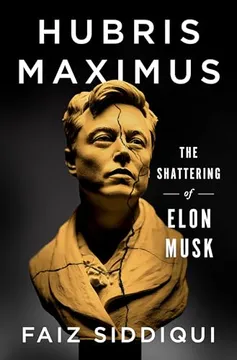
Hubris Maximus is an investigative biography structured around a recurring institutional sequence: Musk makes an ambitious bet, resists scrutiny when execution meets limits, and often emerges with more practical power than the formal consequences suggest. The book's engine is not simply the question of whether Musk is a genius. It is the harder question of how successful companies and public institutions respond when a leader's track record becomes a substitute for oversight.
The narrative's strongest evidence comes from concrete episodes rather than broad psychological claims: Huang's fatal crash and the dispute with the NTSB, the founder-shaped compensation process, the Cybertruck's distance between spectacle and delivery, and Twitter's rapid layoffs followed by operational failures. These cases span engineering, corporate governance, and public communication, making the central pattern visible across settings. They also complicate a simple villain story. Tesla helped normalize electric cars, SpaceX achieved major technical milestones, and Musk's willingness to accept risk is part of that record. The question is whether past achievement can validate present decisions in domains where other people bear the cost. The book is openly critical, and some causal claims deserve caution. Stock movements, product performance, employee decisions, and political shifts have multiple causes. Anonymous accounts can reveal how organizations work, but they are not identical to independently adjudicated findings. The strongest reading therefore distinguishes documented events, allegations, reported interpretations, and the author's broader thesis. It also avoids treating political evolution as proof of a fixed personality.
The most durable insight is systemic: when an organization depends on one person for vision, credibility, financing, and daily decisions, its checks can become ceremonial. That concentration may accelerate action during a genuine crisis, but it also makes correction harder precisely when stakes rise. Musk's story becomes a case study in the bargain between speed and accountability, and in the danger of confusing the ability to break constraints with the ability to know which constraints should remain.
Review Summary
Hubris Maximus receives mixed reviews, averaging 3.58/5. Readers praise Siddiqui's thorough research and journalistic rigor, particularly his coverage of Tesla's self-driving controversies and the Twitter acquisition. Many appreciate its timely relevance, calling it eye-opening and important. Critics, however, find the writing dry and repetitive, noting its circular structure and lack of groundbreaking revelations. Several readers wished it covered more of Musk's personal life and his later DOGE involvement, which fell outside the book's timeline due to traditional publishing constraints.
Glossary
Autopilot
Tesla driver assistanceTesla's branded suite of driver-assistance features, including steering, lane following, speed control, and some lane changes. It is not a fully autonomous driving system. Drivers are expected to remain attentive and responsible for controlling the vehicle, even though the name and marketing have sometimes encouraged greater confidence in the system.
Full Self-Driving
Supervised driving softwareTesla's more advanced driver-assistance package, designed to extend capabilities such as steering and speed control to city and residential streets, including turns and traffic signals. Despite its name, the software described in the book still requires active driver supervision. Its rollout and marketing became a central source of safety and regulatory disputes.
operational design domain
Conditions a system supportsThe specific conditions and environments in which an automated driving feature is designed to operate. These can include road type, visibility, and other situational limits. In the book, investigators use the concept to explain why a driver-assistance system suitable for controlled-access highways should not automatically be treated as safe on roads with cross traffic.
sensor fusion
Combining sensor inputsAn autonomous-driving approach that combines information from different sensors, such as cameras, radar, and LiDAR. The systems can compare signals to build a more reliable picture of surroundings when one sensor is obscured or misleading. The book contrasts this approach with Tesla's decision to rely increasingly on cameras and software.
phantom braking
Braking without a real hazardAn unintended slowdown or brake application when a vehicle detects a threat that is not actually present or is not in its path. The book describes a wave of Tesla owner complaints after software changes, including abrupt braking on highways. The reports prompted a federal investigation into an estimated 416,000 vehicles.
Tesla Vision
Camera-only driving approachTesla's name for an approach that relies on cameras and software rather than combining camera input with radar or LiDAR. The stated aim is to infer depth and surroundings computationally. The book presents the approach as an engineering choice that reduced hardware complexity and cost while raising questions about redundancy and performance in difficult conditions.
Special Purpose Vehicle
Pooled investment entityA separate investment vehicle created to gather money from multiple investors for a particular transaction. During Musk's Twitter acquisition, such vehicles offered wealthy participants a way to contribute to the takeover without investing individually. The arrangement helped broaden the funding pool and gave some large investors access to confidential company information.
material adverse effect
Major damaging business changeA contract term referring to a sufficiently serious negative change in a company's business, financial condition, or prospects. Musk's legal team invoked the concept while arguing that Twitter's disclosures about spam accounts and security problems justified ending the acquisition agreement. The Delaware court case examined whether the claims met the contract's demanding standard.
Twitter Files
Released internal platform recordsA series of internal Twitter documents selected and published by journalists with Musk's approval after his acquisition. Musk presented the releases as evidence of unfair content moderation and government influence. The material showed internal decisions and contacts with political actors, but the initial releases did not establish the broad conspiracy some supporters expected.
Download PDF
Download EPUB
.epub digital book format is ideal for reading ebooks on phones, tablets, and e-readers.








