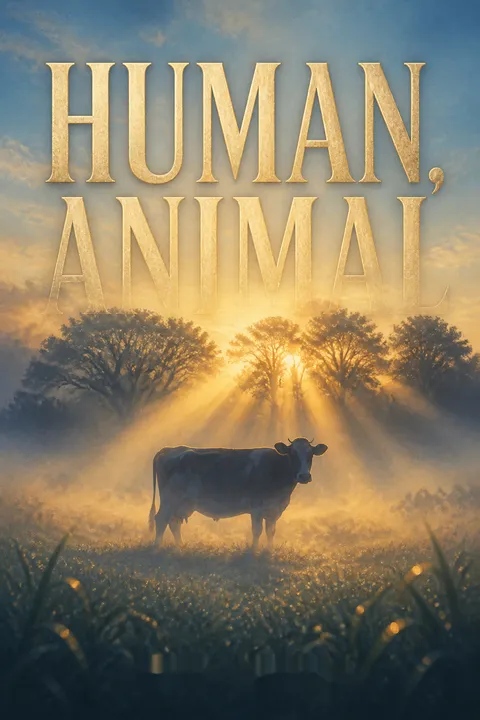


Plot Summary
The Calf on Camera
At Alderdown Farm, George Calvert already feels the strain of age: his ninety-year-old mother, Maggie, wanders outside at night, confusing the present with wartime fears, while his younger son, Tom, avoids farm work and condemns dairy farming. Then animal-rights activists enter the cowshed and film muddy bedding, an ailing cow, and Maisy lying on her newborn calf, which has been crushed.
George insists the farm is being misrepresented, but the dead calf is real, and the footage catches a failure his family had not noticed. Tom watches his father dismiss the evidence. He is ashamed because he helped make the visit possible, and because the camera has recorded the cost of the farm's ordinary routines.
The footage does not invent cruelty, but it frames a real lapse as a complete account of the farm. George's defensiveness grows from a genuine sense of care, yet his conviction that good intentions settle the question keeps him from examining what the camera shows. For Tom, the dead calf makes a private ethical disagreement public and undeniable. The farm's claim to be a family home and its function as a business now occupy the same image, with no clean way to separate them.
Tom Opens the Shed
Tom has been living with the Calverts' arguments since returning from university, where veganism and a first, tentative understanding of their gender identity unsettled the role their father expected them to inherit.
After George serves vegetables cooked in butter and dismisses Tom's objection, Tom messages Luke Underwood, a charismatic LivestockAid campaigner, with details about the farm. Luke plans the filmed visit, and Tom gives the activists access. When the video spreads, strangers flood the family with threats; George wants to fight back, while Sandra tries to contain the damage.
Tom volunteers to manage the farm's online accounts, hiding his responsibility beneath a useful task. Luke tells Tom that their cause and the family's future can still be made to serve one another.
Tom's complicity is neither a simple political conversion nor a calculated attack on his family. The video offers a way to challenge a system he believes harms animals, while also giving him a route toward the recognition he cannot yet ask his family to provide. Luke's attention makes that route feel intimate. George, meanwhile, treats the online backlash as an external assault rather than a consequence of the farm's exposure. Each character mistakes partial control for a solution, and the gap between them widens.
A German Farmer's Welcome
In 1943, German pilot Stefan Becker parachutes into England after his aircraft is hit. Captured and sent through several prison camps, he is eventually assigned to Alderdown, where farmer Herb Edwards needs labor during wartime shortages.
Stefan arrives carrying the shock of combat and the expectation that any kindness may be withdrawn. Herb gives him work and a place in the hayloft; Herb's daughter Maggie teaches him to handle the cows, and her younger sister Lizzie befriends him.
Stefan proves useful by learning the herd's movements and helping with farm repairs. When London evacuees arrive and treat him as an enemy, Herb continues to defend his conduct. The farm becomes more than a posting: it is a fragile community in which Stefan can begin to belong.
Stefan's wartime chapters complicate the moral ease of dividing people into enemies and innocents. He is a prisoner, but not a blank symbol of the nation that sent him to war; the Edwards family are vulnerable hosts, not merely representatives of Britain. Work creates trust, although it also makes Stefan valuable to those who control his freedom. The farm's welcome is real and conditional at once. That tension prepares the novel's later question: how much belonging can survive when power, fear, and family loyalty demand a boundary?
The Kiss in the Woods
Stefan and Maggie grow close as they work together, sharing farm knowledge and the quiet intimacy of people whose days depend on one another. After they hunt a fox that has killed chickens, Maggie kisses Stefan; he cannot return her feelings openly, both because he is a German prisoner and because Maggie is being courted by Jim Calvert, a local farmer.
Stefan's letters from home bring another loss when his fiancée, Emilia, ends their engagement. Soon Maggie becomes pregnant. Her father, Herb, fears the military authorities will send Stefan back to camp, while Maggie's relationship with Jim offers a socially acceptable explanation for the child.
Stefan is removed from Alderdown. He leaves without knowing what will become of Maggie or the baby, carrying the belief that he has lost the family he found.
Maggie and Stefan's bond forms inside a structure that treats their private lives as matters of public order. Herb's fear is protective as well as controlling: he knows that a scandal could cost Stefan his farm placement and harm Maggie's future. Yet the solution preserves respectability by transferring the burden onto the young couple and concealing the truth. Stefan's removal shows how affection can be genuine without being powerful enough to overcome the institutions around it. The novel sets this old wound beside the Calverts' present conflicts, where silence will again be mistaken for protection.
Snowbound Cows Run Wild
Months after the first video, three local teenagers chain themselves inside the cowshed and try to release the herd. One cow, Maisy, escapes into the snow, and George slips while chasing her. Inside, he tackles Barney, the teenage boy filming the protest, but the struggle leaves George with a fractured arm and bruises.
The police identify the trespassers and advise the family not to press charges, while the boy's footage of George lunging at him appears online. Luke removes LivestockAid's original film and condemns the violence, but the family is already frightened and furious.
Tom argues with Luke privately, insisting the campaign has helped inspire the attack. He is beginning to see that public pressure can endanger the very people and animals it claims to defend.
The confrontation turns abstract online conflict into physical risk. George's instinct to protect the herd is understandable, but the camera makes his fear and anger available for public judgment, while the activists' concern for animals does not prevent them from frightening those animals. Tom's position becomes more painful because he has helped set events in motion without controlling their consequences. The competing videos cannot establish a full truth; each captures a fragment and invites viewers to treat it as the whole. The family is left living inside that distortion.
Tam Names Themself
As Maggie's memory worsens, the family considers moving her into a care home. George discovers Tam in their bedroom wearing makeup and, later, a drunken argument over family loyalty and animal welfare drives the subject into the open.
Tam tells their parents that they are not a man and are not Tom, though they struggle to find language that fully explains their nonbinary identity. Sandra is stunned; George responds with anger and treats Tam's self-understanding as another rejection of the family.
When Tam says they cannot stay, George tells them to leave. Tam moves to London, where friends and housemates offer pronouns, practical help, and room to experiment. The departure grants Tam distance, but it also makes the family's silence harder to mistake for acceptance.
Tam's coming out does not occur in a calm conversation of their choosing. It emerges through conflict, alcohol, and the pressure of being watched, so self-recognition arrives alongside humiliation and fear. George hears a new name as an accusation against the identity he assigned his child; Tam hears his rejection as confirmation of a fear they have carried for years. Their departure is necessary for safety and self-discovery, but it is also a rupture. The novel refuses to make identity itself the family crisis: the deeper crisis is whether love can be offered without demanding conformity.
The Farm Goes Public
George appears on television to defend Alderdown against Luke, arguing that a family dairy farm can care for animals even when it sends them to slaughter. Luke counters with the separation of calves from mothers and the killing built into dairy production.
George struggles to answer without retreating to tradition. In London, Tam begins an internship at the progressive organization Snowballed, makes friends, and attends Pride with Simon, Heath, and Jack. Luke's attention initially helped Tam feel seen, but he also presses them to help transform Alderdown and treats their family ties as leverage.
When Tam refuses to keep assisting LivestockAid, Luke withdraws. Tam recognizes that their new community offers a sturdier kind of belonging than the campaigner's approval, though the hurt of wanting him remains.
The television debate stages two forms of moral certainty: George trusts practical care and inherited knowledge, while Luke treats the system itself as the offense. Both can describe real harms, but neither initially makes room for the people caught inside the argument. Tam's London life provides a counterexample to Luke's claim that change requires pressure at any cost. Friends and colleagues recognize Tam without requiring them to become useful to a cause. This distinction between being welcomed and being recruited becomes central to Tam's growing ability to judge intimacy.
A Map, A Warning
Alderdown remains financially strained, and George rejects Harry's interest in a robotic milker, fearing that automation will take the farm further from the humane, hands-on ideal he trusts. LivestockAid escalates its campaign with Take Stock, a map of dairy farms intended to encourage local investigations.
Friedrich Becker, Stefan's grandson, contacts the family with a translated journal describing his grandfather's time at Alderdown. When Tam learns that LivestockAid plans a much larger nighttime action at the farm, they warn George, choosing their family's safety over the campaign.
Friedrich arrives on the same evening, and George calls the police. Officers prepare to meet the activists, while the family waits in the dark, unsure whether Tam's warning has arrived in time.
Economic pressure makes George's resistance to change more than stubbornness: Alderdown's debt gives every new method the weight of a possible last chance. Yet his attachment to manual work also shields him from considering whether familiar practices are sufficient. Tam's warning marks a shift from seeking Luke's approval to accepting responsibility for the danger their earlier choices helped create. Friedrich's journal arrives as a second kind of evidence, one grounded not in a viral image but in a private record kept across decades. The farm's past is about to unsettle its present.
Luke Names the Betrayal
At nightfall, about a dozen LivestockAid activists cross the fields toward Alderdown, carrying tools to reach the animals. Police officers intercept them in the yard and begin arresting those who refuse to leave. George, relieved to have stopped the break-in, confronts Luke.
Luke then reveals that Tam had originally supplied access and helped LivestockAid film inside the cowshed. George and Sandra call Tam, who tries to explain that they wanted the family to listen, not to be harmed.
Their parents hear only the months of concealment and the danger the campaign has brought to their home. Sandra says she feels betrayed; George ends the call and tells Tam they have chosen the activists over their family. The people Tam hoped to bring together now feel abandoned by them.
The disclosure changes the meaning of earlier events without making them simpler. Tam's actions were driven by conviction and a longing to be heard, but those motives do not erase the risks imposed on the family. Luke chooses the moment of greatest vulnerability to use the truth as a weapon, though he presents himself as merely exposing it. George and Sandra respond to betrayal by closing the door before Tam can explain, repeating the family's habit of treating silence as safer than uncertainty. The result is not a victory for either side, only a sharper isolation.
The Father in the Journal
After Friedrich leaves the translated journal, George reads through the night. Stefan's pages describe Maggie's pregnancy, his expulsion from Alderdown, and a later meeting with Herb, who tells him that Maggie's young son is named George and is being raised by Jim. George understands that Jim, the father he remembers, was not his biological father; Stefan was.
Maggie had kept the secret because there seemed to be no way to return to the life she and Stefan had lost. The discovery makes George reconsider the father whose approval shaped his life, and the same rigid expectations he imposed on Tam. He admits to Sandra that he helped drive their child away, then calls and texts Tam to apologize. They do not answer.
Stefan's journal does not simply supply a missing fact. It shows how an adult's attempt to manage scandal became a child's lifelong explanation for feeling unwanted. George has spent years interpreting his father's distance as a verdict on his own worth, then reproducing that distance with Tam. The revelation creates empathy, but it does not cancel harm or guarantee reconciliation. By accepting responsibility without expecting immediate forgiveness, George makes his first meaningful break from the family pattern. The journal gives him a history, not an alibi.
A City Without Shelter
Tam receives no reply from Luke after confronting him about revealing their role in the campaign. They drink, go to his flat, and discover that he cares more about the public fallout than about helping them through it. After an argument, Tam leaves alone and disappears.
At Alderdown, Harry and Lauren announce that they are expecting a child, but the family's joy collapses when Sandra learns Tam has not been seen for two days.
The police trace Tam's last movements from bar CCTV: they were followed through a London alley by three unidentified attackers, who beat them and took their phone and wallet. The family finds Tam in hospital, unconscious with a head injury and broken wrist. Their old quarrels shrink beside the fact that Tam may not wake.
Tam's crisis exposes the cost of building belonging around someone else's attention. Luke's rejection repeats the abandonment Tam feared at home, but now they have also lost the illusion that the campaign will protect them. The assault is not presented as a neat moral consequence of their choices; it is violence done to a vulnerable person, with its motive uncertain. For the Calverts, the search reverses the emotional direction of the story: instead of judging Tam's decisions, they must face how much they want them alive. Love becomes urgent before it becomes articulate.
The Gate Comes Loose
After several days, doctors bring Tam out of an induced coma. Their parents and London friends take turns at the bedside, and Tam eventually explains how Luke drew them into LivestockAid and then abandoned them when they stopped helping.
George apologizes for his part in the family's rupture and tells Tam he supports them, though he is afraid of the danger they face. Tam says that living openly in London has been the happiest time of their life. They choose to return to Alderdown for a visit, not to erase the past but to see what might be possible.
As the family drives home, they find cows roaming the road: the gate has been removed and the hedge cut. Tam and George stand together while Harry and Lauren herd the animals, leaving the cause of the breach unresolved.
Reconciliation here is deliberately incomplete. Tam returns by choice, and George offers recognition without claiming that his fear or apology settles everything. Their walk outside the hospital gives both room to speak without the family home dictating who is allowed to be heard. The final breach at Alderdown keeps the ethical conflict alive: some cows seek the fields, others linger near familiar shelter, and no single gesture can decide what freedom means for every animal. Tam and George's shared watch is a small but consequential change in how they face uncertainty.
Analysis
Human, Animal sets two family crises beside each other: a German prisoner of war in 1944, and a queer young person in a rural family in 2016. The histories are not equivalent, but both show how institutions decide who may belong, whose private life is acceptable, and whose suffering can be ignored. Stefan's treatment as an enemy and Tam's experience of being misrecognized arise from different forms of power, yet each story turns on the consequences of making a person fit a role before listening to them.
Alderdown is more than a setting. It is home, workplace, inheritance, and an economic system that makes care inseparable from use. George's devotion to the cows is real, as are the industry's harms. The novel refuses the comforting choice between a sentimental portrait of farming and an activist account that treats every farmer as interchangeable with the system. Likewise, Tam's vegan conviction does not make their collusion harmless, and the activists' moral cause does not excuse intimidation. The story insists on holding intention and consequence together.
Its most persistent pattern is inherited silence. Herb tries to protect Maggie by containing her story; George inherits the emotional cost without knowing its cause, then repeats a similar failure with Tam. The journal interrupts that pattern, not by absolving anyone, but by making the old decisions legible. George can finally recognize that toughness was the language he learned from his father, not proof that it worked.
The ending offers neither a settled agreement about animal agriculture nor a simple return to family life. Tam comes home temporarily as themself, and George begins to listen, but the breached gate leaves the question of liberation unresolved. That uncertainty is honest: reconciliation can begin before ideology is resolved, while care still demands more than good intentions. The novel's hope lies in the possibility of staying present through disagreement, rather than demanding that love wait until everyone becomes alike.
Review Summary
Human, Animal by Seth Insua is a powerful debut novel exploring family, identity, and animal rights on a dairy farm. Readers praise its nuanced characters, thought-provoking themes, and emotional depth. The story follows a farmer, his queer son, and a German POW, weaving past and present. Many reviewers found it compelling, raw, and beautifully written, appreciating its exploration of complex issues without being preachy. The book's examination of generational conflicts, tradition vs. change, and personal growth resonated strongly with readers, who predict it will win awards and become a lasting work of literature.
People Also Read





Characters
Tam Calvert
The searching farm heirGeorge and Sandra's younger child, Tam returns from university vegan, estranged from the farm's assumptions and only gradually able to name their nonbinary identity. They want to protect animals, but also want their family to notice who they are beneath the arguments. That longing makes Luke's attention powerful and leaves Tam vulnerable to confusing political usefulness with affection. Their intelligence and capacity for empathy let them understand both the farm's economic pressures and the activists' moral claims, though understanding does not spare them from causing harm. Tam's story follows the difficult work of becoming visible without surrendering the complicated attachments that make Alderdown home.
George Calvert
The burdened farm patriarchGeorge runs Alderdown with a farmer's practical knowledge and a deep belief that caring for the herd means preserving the family business. He is proud, physically worn down, and quick to hear disagreement as disrespect, especially from Tam. His own father left him feeling inadequate, so George relies on rules and hard work to prove his worth. He loves the land and animals, but that love can become a defense against examining the harm built into farming. Beneath his bluster is a man who fears that the farm, his marriage, and his family are all slipping beyond his control.
Maggie Calvert
The farm's remembering heartGeorge's mother, Maggie grew up on Alderdown and knows its animals and routines from the inside. In old age, her memory falters, but her affection and independent streak remain vivid. Her present-day confusion echoes a younger life shaped by wartime danger and choices made by others on her behalf. She offers Tam patient companionship and represents a form of belonging that does not depend on being useful or conventional. Her life links the farm's present family to its buried history, though she cannot always give that history a clear account.
Sandra Calvert
The family's quiet mediatorGeorge's wife and mother to Harry and Tam, Sandra keeps the household moving while carrying much of its emotional labor. She is more alert than George to the family's finances, the online backlash, and the cost of leaving Maggie without enough support. Her creativity and interests sit uneasily beside the farm life she chose, and she often mediates rather than openly challenging George. Sandra wants to protect her children, but fear can make her cautious when they most need a direct response. Her care is practical, persistent, and not always enough to bridge the silences in her marriage.
Harry Calvert
The dependable elder sonGeorge's elder son, Harry has stayed close to Alderdown and is accustomed to carrying out the work his father assigns. He is blunt, physically capable, and protective of the farm, yet his confidence can turn into bullying when Tam challenges the family order. His marriage to Lauren gives him a life beyond the cowsheds, while the farm still defines his sense of responsibility. Harry is less interested in ideology than in keeping the business functioning. His relationship with Tam shows how sibling loyalty can coexist with old habits of dominance and misunderstanding.
Stefan Becker
The displaced German prisonerA German pilot captured during the Second World War, Stefan arrives at Alderdown as a prisoner of war and becomes one of Herb Edwards's farmhands. He is observant, disciplined, and wary of kindness because his freedom depends on authorities who can move him at will. Work with Maggie and the herd offers him a rare sense of usefulness and human connection. His journal records both his gratitude and his awareness that he remains an outsider. Stefan's story gives the novel a second generation's perspective on how conflict can govern private lives long after the immediate danger has passed.
Luke Underwood
The polished campaignerA charismatic public face of LivestockAid, Luke is skilled at turning animal suffering into compelling campaigns. He believes the dairy system must end and sees direct action as a way to force people to confront what they would rather ignore. His confidence and beauty attract Tam, who initially experiences his attention as recognition. Yet Luke's commitment to the cause can eclipse the individual people caught in its wake. He is neither merely a fraud nor a reliable rescuer: his genuine convictions coexist with a willingness to use intimacy and urgency to recruit others.
Friedrich Becker
The keeper of Stefan's pagesStefan's grandson and a translator, Friedrich contacts Alderdown to share the journal his grandfather left behind. He approaches the family with curiosity and respect, understanding that the record may alter their sense of their own past. His visit is awkwardly timed, but he does not force the revelation on them; he gives them the pages and lets them choose when to read. Friedrich links the present family to a history that its elders never openly discussed.
Lauren Calvert
The independent sister-in-lawHarry's wife, Lauren is renovating a disused barn into a wedding venue to bring new income to Alderdown. She is sociable, creative, and willing to pursue work George initially considers frivolous. Her ease with Tam makes her a welcome presence, while her clear-eyed sympathy helps her recognize that the family conflict cannot be reduced to politics. Lauren is building a future that includes the farm without simply repeating its traditions.
Varsha
Tam's candid housemateA food writer and one of Tam's London housemates, Varsha offers practical support and an outspoken commitment to animal rights. She is willing to challenge Tam when their loyalty to family becomes a reason to evade difficult choices. Her own experience of online abuse gives her a personal understanding of how public campaigns can turn cruel. Varsha's honesty can sting, but she also recognizes when Tam must choose between protecting a friend and warning their family.
Herb Edwards
Stefan's wartime employerThe farmer who employs Stefan during the war, Herb is practical and protective of his family and farm. He defends Stefan against prejudice, but his hospitality has limits once Maggie's future and the possibility of military scrutiny become involved. Herb's choices are shaped by the wish to keep everyone safe and respectable in a dangerous period. He embodies the compassion and control that can exist together in a person trying to manage a crisis.
Mary Edwards
The wartime household anchorHerb's wife and Maggie and Lizzie's mother, Mary helps maintain the farm and household during wartime. She welcomes Stefan as a worker and, at a moment of danger, insists that everyone under her roof face the threat together. Her steadiness gives the family a moral center without making her immune to fear or social pressure.
Lizzie Edwards
The observant younger sisterMaggie's younger sister, Lizzie is a child during Stefan's time at Alderdown. She is curious, affectionate, and more perceptive than the adults sometimes expect. Her attachment to Stefan and her observations help reveal how easily a child's innocent closeness can be misread in an atmosphere shaped by suspicion.
Jim Calvert
Maggie's local suitorA farmer from a neighboring farm, Jim is Maggie's childhood friend and suitor during the war. He belongs to the local community and offers a conventional future that contrasts with Stefan's precarious position as a prisoner. His place in Maggie's life is shaped by affection, circumstance, and the expectations of the people around them.
Simon
Tam's affirming colleagueTam's colleague at Snowballed, Simon is thoughtful, attentive, and shy about expressing himself. He trusts Tam's eye for style and becomes a companion at Pride, where they can share a public space without having to explain themselves.
Dan
Tam's first confidantTam's former boyfriend at university, Dan is the first person they confide in about their gender feelings. The relationship gives Tam a fleeting experience of being seen, but Dan's response also leaves them cautious about being understood.
Mike Calvert
The absent farming idealGeorge's younger brother, Mike was deeply devoted to Alderdown and had an instinctive relationship with its animals. His example weighs on George's sense of what a good farmer should be and on the way George measures himself against his family.
LivestockAid activists
The movement's hard edgeThe activists enter Alderdown to record conditions and challenge dairy farming. Their concern for animals is sincere, but their confrontational tactics expose the farm family and herd to risks they cannot control. The group contains different temperaments, not a single shared motive.
Plot Devices
Stefan's journal
A past left in writingFriedrich brings Stefan's wartime journal to Alderdown, where it supplies a first-person account of the German prisoner's life on the farm. The pages reveal how affection, state power, and family decisions shaped the past, while also challenging the Calverts' inherited version of their own history. Because the journal is personal rather than official, it preserves emotional detail that public records would omit. Its arrival does not instantly repair the family, but it gives George evidence with which to question the habits he has mistaken for destiny.
The LivestockAid video
A farm made publicThe activists' recording converts private farm conditions into a viral public argument. It shows real details, including muddy bedding, an unwell cow, and a calf killed beneath its mother, but its editing and narration encourage viewers to treat those images as a complete verdict. The footage brings threats, scrutiny, and public attention to Alderdown. Later recordings of a confrontation add another contested account, showing how cameras can document harm while also turning partial moments into weapons.
Tam's name and presentation
A self made visibleTam's chosen name, makeup, clothes, and pronouns give physical form to an identity they have struggled to express. These choices are not a disguise or a sudden transformation; they let Tam test how it feels to be recognized on their own terms. The contrast between their bedroom at Alderdown and the more accepting spaces of London makes visibility feel both intimate and risky. Their identity is entangled with the family's conflict, but it is not caused by veganism or by the campaign.
The Alderdown herd
Care and control made concreteThe cows are central to the Calverts' work and to the activists' moral challenge. Calving, milking, illness, winter housing, and release into pasture make the practical obligations of farming visible, while the separation of calves and the eventual slaughter of cattle reveal the system's costs. Individual animals such as Maisy and Brenda make those questions personal. Their behavior also unsettles simple claims about freedom: some move readily toward open fields, while others remain near familiar shelter.
The wedding barn
A second economic futureLauren's plan to convert a disused barn into a wedding venue offers the farm a source of income beyond dairy. George initially resists the idea because he sees it as a distraction from proper farming, but the family's debts make diversification increasingly necessary. The barn also holds a marked beam that prompts Tam and Lauren to imagine a history hidden inside the farm's ordinary structures. It represents a possible future that preserves the land while changing how the family depends on it.
Download PDF
Download EPUB
.epub digital book format is ideal for reading ebooks on phones, tablets, and e-readers.








