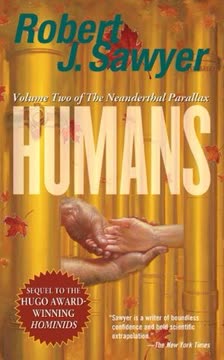
Plot Summary
Parallel Worlds Collide Again
The story resumes with the accidental but now intentional contact between two parallel Earths: one where Homo sapiens dominate, the other ruled by Neanderthals (Barasts). Neanderthal physicist Ponter Boddit, who previously visited the human world, is at the center of efforts to reestablish the portal. Both societies are cautious, aware of the risks—disease, violence, cultural contamination—but also the immense potential for knowledge and exchange. The narrative sets the stage for a new era of contact, with Ponter and human geneticist Mary Vaughan's personal connection symbolizing the broader possibilities and tensions between the two worlds.
Mary's Wounds, Ponter's Longing
Mary Vaughan, still reeling from a recent rape, struggles to reclaim her life and sense of safety. Her scientific mind is at odds with her emotional scars, and her budding feelings for Ponter are complicated by her trauma. Meanwhile, Ponter, back in his own world, is haunted by unfinished business with Mary and the loss of his woman-mate, Klast. Both are drawn to each other, but their pain and the gulf between their worlds make connection fraught. Their longing is set against the backdrop of scientific and cultural upheaval, as each tries to find healing and meaning in the other.
Council Debates and Decisions
The Neanderthal High Gray Council debates whether to reopen the portal, balancing the promise of trade and knowledge against fears of disease and violence. Ponter and his man-mate Adikor advocate for contact, emphasizing the scientific and cultural benefits. The council's deliberations reveal the Barasts' methodical, consensus-driven approach, contrasting with the more impulsive, individualistic tendencies of the human world. Ultimately, the council agrees to a controlled reopening, setting strict protocols and appointing Ponter as envoy. The decision marks a turning point, opening the door to unprecedented interworld exchange.
Reopening the Portal
The technical and emotional challenges of reopening the portal are immense. Both sides prepare meticulously: decontamination protocols, security measures, and diplomatic contingencies. Ponter and Ambassador Tukana Prat cross into the human world, greeted with awe and suspicion. The event is historic, but not without tension—military presence, media frenzy, and the ever-present threat of misunderstanding. The portal itself becomes a symbol: a fragile, shimmering link between worlds, full of promise and peril. The crossing is both a scientific triumph and a leap of faith, setting the stage for deeper entanglement.
Crossings and Quarantines
Ponter and Tukana are quarantined, subjected to medical scrutiny and bureaucratic wrangling. Their presence sparks intense curiosity—scientists, politicians, and the public all clamor for access. Mary, now working for a U.S. think tank, is drawn back into Ponter's orbit, her professional expertise and personal feelings intertwined. The quarantine is both literal and metaphorical: a space of isolation, reflection, and negotiation. As barriers slowly fall, the characters confront the realities of interspecies contact—prejudice, hope, and the challenge of truly seeing the other.
Cultural Mirrors and Contrasts
The narrative delves into the profound differences between Barast and human societies. The Barasts' communal, transparent, and nonviolent culture is juxtaposed with the humans' individualism, secrecy, and history of war. Issues of gender, sexuality, justice, and technology are explored through dialogue and observation. Mary and Ponter serve as cultural translators, each fascinated and appalled by aspects of the other's world. The contrasts are not merely academic—they force both societies to question their assumptions and values, and to confront the possibility that their way is not the only, or even the best, way.
Forgiveness and Old Wounds
Ponter and those around him grapple with the legacy of past hurts—Klast's death, Daklar's betrayal, Adikor's violence. Forgiveness emerges as a central theme, both as a personal virtue and a societal necessity. The Barasts' approach to justice—focused on prevention and rehabilitation rather than punishment—contrasts with the humans' more retributive system. Mary, too, must find a way to forgive herself for not reporting her rape, and to move beyond the paralysis of guilt. The process is painful and imperfect, but essential for growth and connection.
Science, Faith, and Identity
The two worlds' differing views on science and religion come to the fore. The Barasts are atheistic, rational, and skeptical of metaphysical claims; humans are steeped in faith, tradition, and the search for meaning beyond the material. Mary and Ponter's debates about God, the afterlife, and the soul are both intimate and emblematic of their cultures. The discovery that Neanderthals and humans are separate species—marked by a difference in chromosome number—raises questions of identity, kinship, and the boundaries of humanity. The search for truth is both a scientific and existential quest.
The Return of the Neanderthals
The Barasts send a delegation of their greatest minds—scientists, artists, philosophers—to the human world, offering their expertise freely. The gesture is both generous and strategic, intended to cement peaceful relations and demonstrate the value of continued contact. The human response is a mix of gratitude, envy, and anxiety. The Barasts' gifts—technologies, medical advances, cultural treasures—highlight the potential for mutual enrichment, but also the risk of dependency and cultural erosion. The delegation's presence is a living challenge to human exceptionalism and a call to humility.
Diplomacy and Danger
The fragile peace is shattered when Ponter is shot by a human assailant, and Tukana kills the attacker in self-defense. The incident exposes the deep-seated fears and prejudices on both sides, threatening to derail the entire project. Diplomatic efforts intensify, with both worlds scrambling to manage the fallout and prevent a rupture. The episode forces a reckoning with the reality of human violence, the limits of idealism, and the need for vigilance. The portal, once a symbol of hope, becomes a potential vector for catastrophe.
Violence and Aftermath
The shooting and its aftermath prompt soul-searching and debate. The Barasts consider closing the portal, fearing for their safety and the corrupting influence of human violence. Ponter, recovering from his wound, is torn between his commitment to peace and his desire for justice. Mary, haunted by her own trauma, is forced to confront the inadequacies of human justice and the temptation of vengeance. The lines between right and wrong blur, and the characters must navigate a world where good intentions are not always enough.
The Cost of Justice
When Mary's rapist is identified as a colleague, Cornelius Ruskin, but the legal system proves inadequate, Ponter takes matters into his own hands. He confronts and castrates Ruskin, enacting a form of Barast justice. The act is both a relief and a burden—Ponter is wracked with guilt, aware that he has violated both his own society's laws and Mary's values. The episode raises profound questions about justice, retribution, and the limits of forgiveness. The personal and societal costs of violence are laid bare, and the characters are left to grapple with the consequences.
Love Across Species
Mary and Ponter's relationship deepens, culminating in physical and emotional intimacy. Their love is both a personal triumph and a symbol of the possibility of unity across difference. Yet it is fraught with challenges—cultural expectations, jealousy, the demands of family and tradition. The question of where and how to build a life together looms large. Their bond is tested by the realities of their worlds, but also strengthened by their willingness to confront those realities honestly. Love, in the end, is both a risk and a reward.
The Weight of the Past
Both societies are haunted by their histories—wars, extinctions, injustices. The Vietnam Veterans Memorial becomes a focal point for reflection on the meaning of sacrifice, the dangers of forgetting, and the seductive power of comforting lies. Ponter is appalled by humanity's capacity for violence, but also moved by its yearning for meaning and connection. Mary is forced to confront the limits of her own culture's ideals, and the ways in which the past continues to shape the present. The struggle to learn from history is ongoing, and the stakes are nothing less than the future.
Choices and Consequences
The characters are faced with difficult choices—whether to forgive, to seek justice, to pursue love, to risk everything for a chance at happiness. Each decision carries consequences, both intended and unforeseen. The Barasts' policy of sterilizing violent offenders and their relatives is revealed to be both effective and morally troubling. Mary's decision to report her rape, and Ponter's to take justice into his own hands, are acts of courage and desperation. The narrative insists that there are no easy answers, only the necessity of choosing and living with the results.
New Beginnings, Old Fears
As the portal remains open and the two worlds grow more intertwined, the possibilities for cooperation and conflict multiply. Scientific discoveries—about genetics, consciousness, and the impending collapse of Earth's magnetic field—raise both hope and alarm. The future is uncertain, and the characters are acutely aware of the fragility of their achievements. Yet there is also a sense of renewal: new relationships, new understandings, new opportunities. The story ends on a note of cautious optimism, with Mary and Ponter resolved to try to build a life together, whatever the odds.
The Human Condition Examined
Throughout the narrative, the question of humanity—its definition, its possibilities, its limits—is explored from every angle. The encounter between Barasts and humans is a mirror, reflecting both the best and worst of each. Issues of violence, compassion, faith, reason, love, and justice are interrogated, not as abstract concepts but as lived realities. The story refuses easy answers, insisting that to be human is to struggle, to hope, to fail, and to try again. In the end, it is the willingness to reach across divides, to forgive, and to love that defines us.
Hope, Uncertainty, and Continuance
The novel closes with Mary and Ponter, battered but unbroken, choosing to face the future together. Their love is a fragile bridge between worlds, a testament to the possibility of connection and change. The portal remains open, but the dangers—personal, cultural, existential—are ever-present. The story ends not with resolution, but with commitment: to each other, to the pursuit of understanding, and to the ongoing work of being human. The final note is one of hope, tempered by the knowledge that hope alone is not enough, but that it is, perhaps, the best we have.
Characters
Ponter Boddit
Ponter is a Neanderthal physicist whose accidental crossing into the human world sets the trilogy's events in motion. He is intellectually brilliant, emotionally open, and deeply ethical, embodying the best of Barast society—transparency, nonviolence, and communal responsibility. Yet he is also marked by loss: the death of his woman-mate Klast, the trauma of separation from his children, and the burden of being an outsider in both worlds. His relationship with Mary is both a source of healing and a crucible for his values, forcing him to confront the limits of forgiveness, the meaning of justice, and the possibility of love across species. Ponter's journey is one of self-discovery, as he learns to balance loyalty to his people with the demands of his conscience and heart.
Mary Vaughan
Mary is a human geneticist whose expertise and empathy make her the ideal bridge to the Neanderthal world. She is intelligent, compassionate, and fiercely independent, but also deeply wounded by trauma—her recent rape and the isolation that follows. Her relationship with Ponter is both a lifeline and a challenge, forcing her to confront her own fears, prejudices, and desires. Mary's scientific curiosity is matched by a spiritual longing, and her debates with Ponter about faith, science, and the soul are central to the novel's exploration of what it means to be human. Her arc is one of healing and growth, as she learns to forgive herself, to seek justice, and to risk love again.
Adikor Huld
Adikor is Ponter's man-mate, a fellow scientist and steadfast friend. He is supportive, pragmatic, and emotionally intelligent, providing a counterbalance to Ponter's idealism and impulsiveness. Adikor's own history is marked by violence—he once injured Ponter in a fit of rage—but he has since embraced the Barast ethos of forgiveness and self-improvement. His relationship with Ponter is deep and complex, encompassing love, rivalry, and mutual respect. Adikor's presence grounds Ponter, reminding him of his responsibilities and the importance of community. He is also a source of wisdom and perspective, helping both Ponter and Mary navigate the challenges of cross-cultural connection.
Daklar Bolbay
Daklar is the former woman-mate of Ponter's late partner, Klast, and the legal guardian (tabant) of Ponter's daughters. She is intelligent, strong-willed, and emotionally volatile, her actions driven by grief, jealousy, and a desperate need for connection. Daklar's accusation against Adikor nearly destroys him, but she later seeks forgiveness and healing. Her relationship with Ponter is fraught—part rivalry, part longing, part shared mourning. Daklar embodies the complexities of Barast society: its capacity for both harm and healing, its emphasis on accountability, and its belief in the possibility of change. Her arc is one of struggle and growth, as she learns to let go of the past and seek a new future.
Tukana Prat
Tukana is the Barast ambassador to the human world, tasked with navigating the treacherous waters of interspecies diplomacy. She is experienced, articulate, and principled, but also unprepared for the violence and complexity of human society. Her killing of Ponter's attacker is both a personal trauma and a diplomatic crisis, forcing her to confront the limits of her training and the realities of a world very different from her own. Tukana's journey is one of adaptation and self-discovery, as she learns to balance honesty with tact, and to find common ground across profound differences.
Jasmel Ket
Jasmel is Ponter's elder daughter, on the cusp of adulthood and forging her own path. She is intelligent, independent, and loving, embodying the best of both her parents. Her bonding ceremony is a focal point for the novel's exploration of family, tradition, and change. Jasmel's choices reflect the possibilities and challenges of a world in transition, as she navigates the expectations of her society and the example of her father's extraordinary life.
Cornelius Ruskin
Cornelius is a human geneticist and Mary's colleague, whose outward respectability masks a capacity for violence and resentment. His crimes—rape and the destruction of evidence—are a chilling reminder of the dangers lurking beneath the surface of even the most civilized societies. Ruskin's actions force Mary and Ponter to confront the inadequacies of human justice and the temptation of vigilante retribution. His fate—castration at Ponter's hands—is both a form of justice and a source of moral ambiguity, raising questions about the limits of forgiveness and the cost of safety.
Lurt Fradlo
Lurt is Adikor's woman-mate and a chemist, providing Mary with shelter, guidance, and perspective during her stay in the Barast world. She is pragmatic, empathetic, and open-minded, helping Mary navigate the complexities of Barast society and her own feelings for Ponter. Lurt's advice is grounded in experience and a deep understanding of her culture's values. She serves as a confidante and sounding board, encouraging Mary to pursue happiness while acknowledging the difficulties ahead.
Jurard Selgan
Selgan is a Barast therapist who helps Ponter process his guilt, trauma, and conflicting loyalties. He is insightful, patient, and unafraid to ask difficult questions, guiding Ponter through the labyrinth of his own motivations and fears. Selgan's sessions with Ponter are a microcosm of the novel's larger themes: the struggle for self-understanding, the tension between justice and mercy, and the search for meaning in a world without easy answers.
Jock Krieger
Jock is the director of the Synergy Group, a U.S. government think tank tasked with managing the implications of interworld contact. He is ambitious, analytical, and sometimes ruthless, focused on maximizing the benefits and minimizing the risks of the new relationship. Jock's perspective is pragmatic, often clashing with the idealism of others. He represents the power and limitations of human institutions, and the challenge of steering history in the face of uncertainty.
Plot Devices
Parallel Worlds as Reflective Mirrors
The central device of the novel is the existence of parallel Earths—one dominated by Homo sapiens, the other by Neanderthals. This structure allows for a direct comparison of two civilizations, each shaped by different evolutionary, cultural, and moral choices. The portal between worlds is both a literal and metaphorical bridge, enabling characters to confront their assumptions, fears, and hopes. The device is used to explore questions of identity, progress, and the nature of humanity, with each world serving as a mirror for the other's strengths and weaknesses.
Scientific and Philosophical Dialogue
The novel is structured around a series of dialogues—between Mary and Ponter, between Ponter and Selgan, between diplomats and scientists. These conversations are not mere exposition; they are the engine of character development and thematic exploration. Issues of faith, science, justice, and love are interrogated through debate, with each character forced to defend, revise, or abandon their beliefs. The device allows for a nuanced, multifaceted examination of complex issues, and for the gradual emergence of understanding and empathy.
Foreshadowing and Thematic Echoes
The narrative is rich in foreshadowing—subtle hints of future conflict, scientific discovery, or personal revelation. The impending collapse of Earth's magnetic field, the recurrence of violence, and the repetition of historical mistakes all serve to create a sense of inevitability and urgency. Thematic echoes—of forgiveness, the search for meaning, the struggle for justice—recur throughout, binding the disparate threads of the story into a coherent whole.
Interwoven Personal and Societal Arcs
The novel's structure interlaces the intimate journeys of its protagonists with the broader currents of societal change. Mary and Ponter's relationship is both a private drama and a symbol of interworld reconciliation. Decisions made in council chambers reverberate in bedrooms and laboratories, and vice versa. The device underscores the interconnectedness of individual and collective destinies, and the impossibility of separating the two.
Moral Dilemmas and Unresolved Questions
The story is driven by moral dilemmas—whether to forgive or punish, to risk or retreat, to trust or fear. These dilemmas are not neatly resolved; the narrative resists easy answers, insisting on the complexity and ambiguity of real life. The open-endedness of the story—will the portal remain open? Can Mary and Ponter build a life together?—invites the reader to continue the work of interpretation and judgment.
Analysis
Robert J. Sawyer's Humans is a masterful exploration of what it means to be human, using the device of parallel worlds to interrogate the deepest assumptions of our civilization. By juxtaposing the rational, communal, and nonviolent Barast society with the individualistic, faith-driven, and often violent world of Homo sapiens, Sawyer forces us to confront both our achievements and our failures. The novel is unflinching in its examination of trauma, justice, and the limits of forgiveness, refusing to offer easy answers or comforting illusions. At its heart, Humans is a story about the possibility of connection—across species, cultures, and wounds. It insists that love, understanding, and the willingness to try are the only antidotes to the cycles of violence and misunderstanding that have plagued our history. The novel's lessons are both timely and timeless: that progress is possible but never guaranteed, that justice must be tempered by mercy, and that the future is unwritten, shaped by the choices we make—individually and together. In an age of division and uncertainty, Humans offers a vision of hope grounded in humility, courage, and the enduring quest for meaning.
Last updated:
Review Summary
Humans by Robert J. Sawyer elicits sharply divided reactions. Many readers criticize the book for problematic content including sexism, poorly written romance between Mary and Ponter, and controversial views on eugenics and privacy. Several reviewers found the characters cardboard-like and the narrative preachy, with excessive focus on romance over scientific ideas. However, supporters praise Sawyer's thoughtful social commentary comparing Neanderthal and human societies, particularly regarding religion, environment, and cultural values. Most agree the book works better when exploring the Neanderthal world than the human relationships, with ratings ranging from enthusiastic five-stars to harsh one-star reviews.