

Key Takeaways
Read Silver's alien-origin thesis as a hypothesis, not a discovery

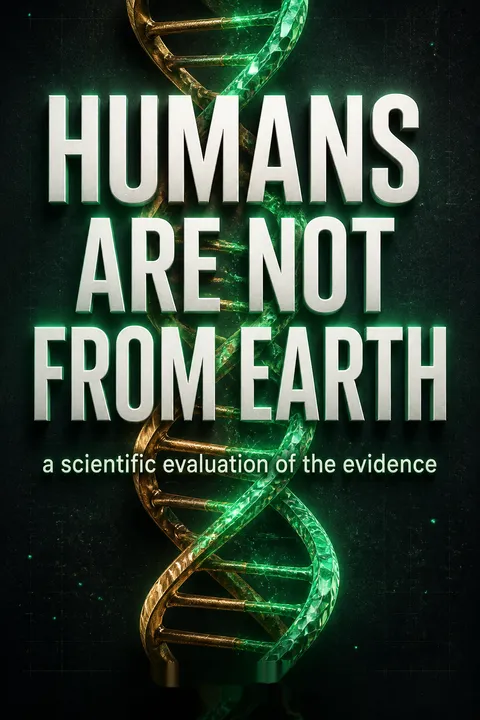
A provocative starting point. Ellis Silver opens with an everyday puzzle: sunlight can dazzle and damage human eyes, while many other animals have physical or behavioral ways to cope with it. From that observation he builds a much larger claim: humans did not evolve on Earth, but were brought here from another planet, perhaps repeatedly, and may have been genetically altered to survive here. The book ranges from physiology and ancient history to DNA, UFO reports, and theology in support of this idea.
The claim outruns the proof. The chapters assemble observations and disputed reports into a single origin story, but the existence of a puzzle does not establish its proposed answer. The extraterrestrial account should therefore be read as Silver's speculative interpretation, not as a demonstrated scientific finding.
What's compelling is the book's instinct to begin with ordinary experience rather than abstract theory. The leap from a bodily inconvenience to a cosmic origin, however, is not a small one. A strong hypothesis needs evidence that distinguishes it from competing explanations, not simply a long list of things it might explain. Readers can enjoy the book's imaginative reach while keeping a crucial distinction intact: a question can be worth asking even when its most dramatic answer remains unproven.
A body poorly suited to Earth does not prove it came from space

The mismatch dossier. Silver treats human vulnerability as his main evidence. He points to sunburn, skin cancer, cataracts, vitamin D difficulties, limited body hair, back pain, difficult childbirth, seasonal depression, food sensitivities, and a body clock he describes as running closer to 25 hours than Earth's day. His argument is that a species shaped by millions of years on Earth should fit its environment more comfortably.
From discomfort to origin. He imagines humans evolving on a mild, cloudy world with little seasonal change, less direct ultraviolet light, and food unlike Earth's. In that setting, he argues, our weaknesses would make more sense. But the book's examples vary greatly in strength, and many are claims about health or behavior rather than evidence of where a species originated.
The useful question is not whether humans are perfectly designed, but how adaptation balances competing demands. A body can be vulnerable in one setting and advantageous in another; biological traits often involve trade-offs rather than flawless engineering. Sun exposure, for example, creates both risks and benefits, while childbirth reflects interacting constraints rather than a simple design error. A catalogue of discomforts can reveal real biological tensions, but counting them does not tell readers which explanation is correct.
Explain human adaptations before treating every discomfort as alien evidence

Evolution has trade-offs. The book discusses conventional explanations for several traits, even as it argues against them. Hairlessness may help cooling during sustained activity. Human childbirth is difficult in part because large-brained infants pass through a pelvis adapted for upright walking. Food preferences can reflect ancient pressures to seek calories, even when modern abundance makes that impulse costly. Silver finds these accounts incomplete, then treats the remaining uncertainty as support for off-world origins.
A missing link becomes a hinge. He also argues that modern human skulls differ too sharply from those of other hominins to fit the accepted evolutionary family tree. He suggests an abrupt leap or hybridization instead. Yet the book's challenge to mainstream evolution depends heavily on selective readings of fossils and timelines, and presents evolutionary gaps as stronger evidence than they are.
What's at stake is the difference between an incomplete explanation and a failed explanation. Evolutionary biology does not predict perfect bodies or a neat ladder of fossils; populations change through branching, uneven processes, and traits shaped by multiple pressures. The book is right that scientific accounts can be revised as evidence changes. Its weaker move is to treat unresolved details as if they favor one specific alternative. Uncertainty opens a field of possibilities; it does not select an alien intervention by itself.
An anomalous artifact raises questions, but cannot identify its maker
History's unusual objects. Silver gathers ancient sites, disputed artifacts, and reports of technologies that seem out of place in familiar timelines. He highlights the Antikythera mechanism, an intricate ancient Greek device for astronomical calculations, and Göbekli Tepe, a monumental site built by people he considers too primitive to have made it. He also cites alleged artifacts found in very old rock layers and maps said to depict Antarctica before its modern discovery.
Evidence is not one category. The book's examples do not all have the same status. The Antikythera mechanism and Göbekli Tepe are genuine archaeological subjects; claims about some embedded objects or extraordinary map origins are far more disputed. Silver himself rejects several celebrated anomalies, including the London Hammer and Coso artifact, as likely natural or modern objects. His strongest lesson here is that old societies could be more capable than later generations assume.
The chapter is most valuable when it asks readers to take ancient engineering seriously. The Antikythera mechanism, for instance, is remarkable without needing an extraterrestrial maker. A good investigation separates the object, its dating, its context, and the interpretation placed on it. Bundling secure finds with weakly documented claims can make the whole collection feel persuasive while blurring crucial differences. Curiosity is best served by sharper categories, not by treating every mystery as the same kind of proof.
A gap in life's origin does not establish extraterrestrial design
The origin question remains open. Silver reviews experiments that produce amino acids from simple chemicals and research exploring how early genetic molecules might have formed. He stresses how far these results remain from explaining a living cell, which needs genetic material, enzymes, a boundary, energy use, and the ability to reproduce. He argues that the steps seem too improbable to have occurred on Earth, and considers intelligent design or life arriving from space.
Panspermia relocates the puzzle. Panspermia is the proposal that life, or its building blocks, can travel between worlds. Silver discusses natural transfer by rocks and comets as well as deliberate seeding. But even if life arrived here from elsewhere, that would not explain how it first began. The book's own discussion recognizes this: moving life's origin to another planet changes the location of the mystery, not the mystery itself.
The distinction between making life's ingredients and making life is genuinely important. Demonstrating a possible chemical route is not the same as reconstructing the full origin of a reproducing organism. But improbability arguments can mislead when they imagine a finished system assembling all at once by random chance. Chemical environments, repeated reactions, and selection among stable forms matter to the question. The honest conclusion is that the origin remains difficult, not that a particular designer or extraterrestrial cause has thereby been identified.
DNA's complexity and borrowed genes do not certify alien engineering
A genome is not a simple recipe. Silver explains that humans have roughly 20,000 genes, while most DNA does not directly encode proteins. He describes this non-coding DNA as involved in regulating gene activity and other functions. The book emphasizes unusual human genes, genetic changes, and DNA fragments with viral origins, then proposes that extraterrestrials may have inserted genes from themselves or Earth's hominins to create a hybrid species.
Known transfer, speculative cause. Horizontal gene transfer means genetic material moves between organisms rather than passing only from parent to offspring. Silver notes that viruses and other organisms can contribute genetic material, then extends that possibility to deliberate alien manipulation. He cites orphan genes and genomic scars as clues, but the book does not establish that they were designed or inserted by extraterrestrials. The existence of genetic complexity is not proof of an outside engineer.
The chapter captures a real conceptual shift: genomes are not static blueprints, and genetic material can have complicated histories. That insight makes the subject more interesting, not less. Yet evidence that genes have moved or changed naturally cannot be converted into evidence of intentional manipulation without an additional test. A claim of engineering should identify a distinctive signature, a mechanism, and independent ways to check it. Otherwise, natural complexity and deliberate design remain competing interpretations rather than settled conclusions.
Demand testable evidence before turning secrecy into confirmation
Witnesses and hidden programs. Silver recounts reports from astronauts, pilots, military personnel, scientists, and political figures who allegedly encountered UFOs or knew of secret government programs. He describes the Roswell incident, alleged agreements with extraterrestrials, classified research, and officials who supposedly intimidate witnesses. He argues that ridicule, compartmentalization, and public skepticism help conceal the truth.
A theory that absorbs denial. In this account, missing evidence, official denials, and career risks are explained as parts of the cover-up. That makes the theory difficult to disprove: evidence supports it, while lack of evidence can also be treated as evidence of suppression. Testimony may justify further inquiry, but reports of sightings or secret dealings are not the same as independently verifiable proof of alien contact.
Institutions can conceal information, and professional incentives can discourage people from pursuing risky questions. Those possibilities deserve serious treatment rather than automatic dismissal. But a claim becomes less informative when every possible outcome confirms it. If disclosure, denial, missing records, and contradictory testimony all count as support, no observation can meaningfully challenge the account. The practical standard is to ask what evidence would change the conclusion, then seek records, objects, and results that others can examine independently.
Treat "Eden" as a story built from assumptions, not a mapped destination
An imagined home world. Silver calls the proposed human home planet Eden and infers its conditions from the traits he considers poorly suited to Earth. He imagines a warmer, cloudier world with weaker sunlight, fewer seasons, steady temperatures, plentiful water, and perhaps a stronger magnetic field or a binary star. He identifies nearby star systems as possible locations, especially Alpha Centauri, while acknowledging that no specific home planet has been found.
Many origins, one preferred story. The book surveys alternatives including panspermia, alien-human hybridization, a prison planet, an alien experiment, a cosmic collection, simulation, and divine creation. Silver's preferred account combines several: humans evolved elsewhere, were brought here in stages, and were genetically adjusted. The details of Eden and the migration timeline are deductions built on his earlier assumptions, not independent confirmation of them.
The imagined planet gives the book narrative force: every bodily mismatch becomes a clue about a lost home. It is also an example of how a theory can generate vivid predictions without yet producing a testable target. The proposed climate and star system are inferred from the same traits they are meant to explain, so the reasoning risks circling back on itself. The model would become more compelling if it made predictions that could be checked independently of the original assumptions.
Keep the ecological warning; discard the unsupported cosmic certainty
The human footprint. Silver portrays humans as unusually destructive: we transform habitats, consume resources, drive species toward extinction, and understand the damage while continuing to cause it. He notes that even early hunter-gatherers changed landscapes through hunting, fires, and plant management. In modern life, corporations, political choices, and consumer culture can magnify that impact. He likens humanity to an invasive species, while also recognizing that responsibility is not evenly shared.
A moral argument survives. Silver connects human violence, greed, and environmental harm to the possibility that people were expelled from another world or placed on Earth as an experiment. Those explanations are speculative. The environmental question does not depend on them: whether humans are native or not, our actions have consequences, and the book asks readers to notice the gap between understanding ecological damage and changing behavior.
This is the book's most durable challenge because it does not require belief in aliens. The image of humans as an invasive species makes the scale of our impact hard to ignore, while the emphasis on powerful institutions helps avoid blaming every person equally. The cosmic origin story risks making ecological failure seem like an alien inheritance rather than a human responsibility. The stronger reading keeps the urgency and drops the excuse: the damage is real whether or not Silver's origin theory is.
Analysis
Silver's book is best understood as a speculative synthesis, not a conventional scientific evaluation. It begins with bodily discomfort, expands through disputed archaeological claims and questions about life's origins, then culminates in an elaborate account of alien transport, hybridization, government secrecy, and a lost home world. The accumulating narrative is memorable because each new claim appears to reinforce the last. Its central weakness is that much of the evidence is not independent: the same assumptions used to infer an alien origin are then used to interpret artifacts, genes, human behavior, and missing records as confirmation.
The book raises questions that science does take seriously. Human evolution has unresolved details, the origin of life remains an active research problem, and ancient societies achieved feats that invite careful investigation. But those open questions do not overturn the broader evidence for human evolution and African origins. Modern paleoanthropology places Homo sapiens in Africa, with a branching evolutionary history and limited interbreeding with Neanderthals and Denisovans. Known horizontal gene transfer and viral remnants in genomes do not demonstrate extraterrestrial engineering. Nor do unusual artifacts identify aliens as their makers. The book repeatedly moves from anomaly to a highly specific cause without excluding simpler explanations.
Its account of scientific suppression also deserves careful separation from its evidence claims. Funding incentives, institutional conservatism, and secrecy can shape research, but they do not make a disputed interpretation true. A hypothesis becomes stronger when it risks failure by making predictions that can be independently tested. Silver's cover-up framework often turns missing evidence into support, leaving few observations that could count against it.
Readers can still gain value from the book's insistence that inherited timelines and familiar explanations should be examined rather than memorized. The best way to honor that impulse is to apply the same scrutiny to Silver's own claims: distinguish documented finds from hearsay, established mechanisms from conjecture, and genuine uncertainty from proof. The book offers a striking story about belonging and human destructiveness. Its story is most useful when treated as an invitation to investigate, not as a substitute for evidence.
Review Summary
Humans are not from Earth presents a controversial hypothesis that humans originated on another planet. Reviews are mixed, with some finding it thought-provoking and well-researched, while others criticize its lack of scientific rigor and repetitive arguments. Positive reviews praise the book's ability to challenge conventional thinking and provide interesting insights into human biology and evolution. Negative reviews highlight logical fallacies, unsupported claims, and poor writing quality. Overall, readers acknowledge the book's intriguing premise but question its scientific validity.
Glossary
Panspermia
Life traveling between worldsPanspermia is the hypothesis that life, or its precursors, can spread through space and reach planets on comets, meteorites, or other material. Silver also discusses directed panspermia, in which an intelligent agent deliberately seeds a world. The idea may address how life arrived on Earth, but by itself it does not explain how life first originated.
Out of Africa theory
African origin and migration modelThe Out of Africa theory holds that modern humans originated in Africa and that populations later migrated outward, replacing or mixing with other hominin groups. Silver disputes its conventional timeline and argues that human populations existed elsewhere much earlier. The book's alternative account depends on contested interpretations of fossils, artifacts, and dates.
Multiregional Model
Multiple regional human originsThe Multiregional Model is a family of explanations proposing that modern human populations developed across several regions, often through migration and interbreeding with local hominins. Silver considers it closer to the evidence than a single late migration from Africa, but says it still cannot explain his proposed extraterrestrial origins.
Aquatic ape hypothesis
A proposed semi-aquatic ancestryThe aquatic ape hypothesis proposes that some human traits, such as reduced body hair, subcutaneous fat, and voluntary breath control, developed during a period when human ancestors spent substantial time in water. Silver reviews these proposed similarities and objections, then suggests that aquatic traits could instead have entered human ancestry through alien genetic mixing.
horizontal gene transfer
Genes moving between organismsHorizontal gene transfer is the movement of genetic material between organisms outside ordinary parent-to-offspring inheritance. It occurs in biological systems, including through viruses, and can affect genomes and evolution. Silver accepts this general mechanism but speculates that some unusual human genes may have been transferred deliberately by extraterrestrials, a claim the book does not demonstrate.
genetic memory
Inherited ancestral responsesSilver uses genetic memory to mean inherited emotional tendencies or responses shaped by experiences of earlier generations, rather than memories consciously recalled by an individual. He proposes that such inherited tendencies could have preserved knowledge or behavior even if aliens erased people's personal memories. The term is speculative in the book and should not be confused with established genetic inheritance.
Intervention Theory
Alien influence on human historyIntervention Theory is the broad proposal that extraterrestrials have actively influenced life or human history. In Silver's account, intervention may include transporting human groups to Earth, altering genomes, monitoring populations, and sharing or withholding technology. The book presents multiple possible motives, including experimentation, containment, and assistance, without establishing that these events occurred.
prison planet hypothesis
Earth as human confinementThe prison planet hypothesis proposes that humans were transported to Earth as punishment, containment, or isolation from a wider galactic society. In Silver's version, the transporters may have erased human memories and monitored whether humanity would become less violent. The proposal is one of several origin stories in the book, not a conclusion supported by independently verified evidence.
FAQ
What's Humans Are Not From Earth about?
- Main Thesis: The book argues that humans did not evolve on Earth but were brought here from another planet. Ellis Silver presents evidence suggesting our physical and psychological traits are ill-suited for Earth.
- Evidence and Theories: Silver discusses over fifty factors, including our poor ability to cope with sunlight and chronic health issues, and explores hybridization with extraterrestrial beings.
- Exploration of Origins: The book delves into potential home planets and conditions that might have existed there, proposing that our original environment was vastly different from Earth.
Why should I read Humans Are Not From Earth?
- Challenging Perspectives: The book encourages questioning mainstream scientific beliefs about human evolution and considering alternative theories, offering a unique viewpoint on human origins.
- Comprehensive Research: Silver compiles extensive research and evidence, making it a thought-provoking read for those interested in anthropology, genetics, or extraterrestrial life.
- Engaging Narrative: The author’s accessible writing style makes complex ideas easier to understand, captivating readers with the exploration of humanity's place in the universe.
What are the key takeaways of Humans Are Not From Earth?
- Humans Are Ill-Suited: The book emphasizes that many human traits suggest we are not from Earth, supported by over fifty factors discussed throughout the text.
- Hybridization Theory: Silver proposes that humans may be hybrids of Earth’s native hominins and extraterrestrial beings, challenging traditional views of human evolution.
- Need for Exploration: The author suggests our innate desire to explore may stem from our origins on another planet, inviting readers to rethink human behavior and societal structures.
What are the best quotes from Humans Are Not From Earth and what do they mean?
- "The evidence against us having evolved on Earth is overwhelming.": This quote highlights the extensive evidence Silver presents to support his claim that humans are not native to Earth.
- "We survive, but we don’t thrive.": Reflects the author's view that while humans can live on Earth, they do not flourish due to environmental and biological mismatches.
- "We can mend ourselves (and other animals).": Points to the unique human ability to heal and perform medical procedures, raising questions about our evolutionary history.
What evidence does Ellis Silver provide to support his claims in Humans Are Not From Earth?
- Physical Traits: Silver discusses how human characteristics, like our lack of body hair and eye structure, are poorly adapted to Earth’s environment.
- Health Issues: Highlights the prevalence of chronic illnesses in humans, arguing these conditions are atypical for species evolved in their natural environments.
- Behavioral Anomalies: Points out human behaviors, such as violence and greed, are not seen in other species to the same extent, suggesting extraterrestrial origins.
How does Humans Are Not From Earth address the concept of evolution?
- Critique of Mainstream Evolution: Silver challenges the traditional narrative, arguing the evidence does not support the idea that we evolved from Earth’s hominins.
- Hybridization Hypothesis: Introduces the idea that humans may be hybrids of Earth’s native species and extraterrestrial beings, suggesting a more complex evolutionary history.
- Evolutionary Design Flaws: Discusses design flaws in the human body indicating a lack of adaptation to Earth, arguing these issues would have been resolved if we evolved here.
What alternative hypotheses does Silver propose in Humans Are Not From Earth?
- Panspermia: Suggests life on Earth may have originated from microorganisms brought here from another planet, aligning with the notion of extraterrestrial origins.
- Experiment Hypothesis: Proposes humans were part of an experiment by extraterrestrial beings, implying our development was manipulated for specific purposes.
- Digital Simulation: Raises the idea that we might be living in a digital simulation, questioning the nature of reality and our existence on Earth.
How does Humans Are Not From Earth explain the origins of modern races and cultures?
- Multiple Drop-off Points: Theorizes different human groups were brought to Earth at various times and locations, leading to the diversity of races and cultures.
- Genetic Modifications: Posits extraterrestrial beings may have modified human DNA, resulting in different traits seen in modern humans.
- Cultural Similarities: Points out similarities in ancient civilizations' structures and beliefs, attributing them to a common extraterrestrial influence.
What role do genetic modifications play in Humans Are Not From Earth?
- Evidence of DNA Manipulation: Discusses signs of human DNA being altered, suggesting extraterrestrial beings enhanced human survival on Earth.
- Hybridization Theories: Posits humans may be hybrids of extraterrestrial and Earth-based species, explaining certain genetic anomalies.
- Future Implications: Raises questions about future genetic modifications and the potential to correct inherited conditions and enhance capabilities.
How does Humans Are Not From Earth relate to the concept of cognitive dissonance in science?
- Resistance to New Ideas: Discusses how scientists often experience cognitive dissonance when confronted with evidence contradicting established beliefs.
- Impact on Scientific Progress: Argues resistance to change can hinder scientific advancement and limit understanding of complex issues like human origins.
- Call for Critical Thinking: Advocates for questioning mainstream narratives and considering evidence presented in the book, potentially leading to new discoveries.
What criticisms does Humans Are Not From Earth make about mainstream science?
- Dogmatic Adherence: Criticizes scientists for rigid adherence to established theories, arguing it limits exploration of alternative explanations for human origins.
- Ignoring Anomalies: Points out many anomalies in the fossil record and genetic studies are often ignored, suggesting these should prompt reevaluation.
- Lack of Open-Mindedness: Calls for a more open-minded approach to scientific inquiry, suggesting alternative theories deserve consideration.
Download PDF
Download EPUB
.epub digital book format is ideal for reading ebooks on phones, tablets, and e-readers.








