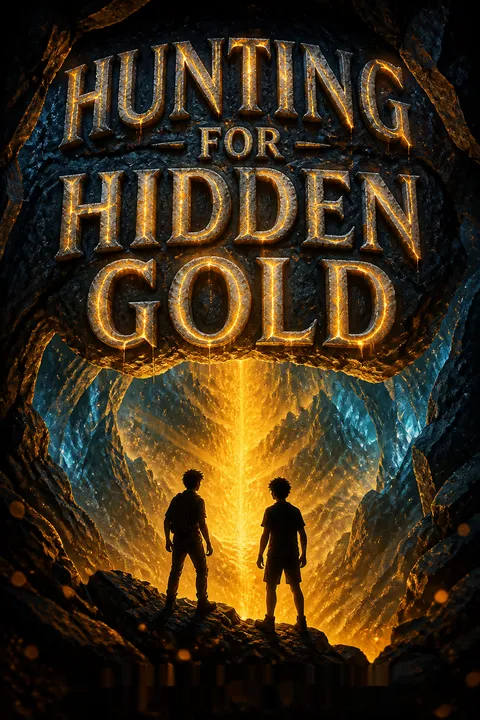


Plot Summary
A Trapper’s Wounded Message
While Frank and Joe Hardy camp with friends in the Montana-bound woods, careless hunters shoot Mike Onslow in the leg. The brothers carry him to shelter, where they learn their father, detective Fenton Hardy, needs help tracking a gang near Lucky Lode. Onslow recognizes the name of the country and tells them how he once struck gold with the Coulson brothers and pilot Bart Dawson.
When Black Pepper’s gang attacked, Dawson escaped with the gold in a plane and never returned. Onslow gives Frank a map to the old claim. After a doctor treats him, the brothers leave him in their family’s care and hurry toward the West, now pursuing both their father’s case and Onslow’s missing fortune.
The story’s two mysteries begin as one act of care. The Hardys interrupt their own plans to rescue Onslow, and his history gives their journey a second purpose: an old injustice may still be legible in the landscape. The map is more than a clue. It turns inherited memory into a practical obligation, joining Fenton’s present investigation to Onslow’s unfinished past. Frank and Joe are motivated by urgency, but also by loyalty to a stranger whose injury has made him vulnerable.
The Chicago Switch
During a layover in Chicago, a well-dressed stranger claiming to be Fenton’s associate Hopkins persuades Frank and Joe to leave the airport for important reports. Two thugs join them in the car, take the brothers to a house, and steal Onslow’s map. Once their captors lock them in a closet, Frank and Joe loosen each other’s bonds and escape with their money and tickets.
A waiting taxi seems like luck until Frank spots that the driver’s identification photograph belongs to someone else. The brothers jump out at a traffic light, hail a genuine cab, and alert a Chicago police contact that the stolen taxi may be intended for a robbery. They reach the departing plane just in time, carrying the warning west with them.
The kidnapping punishes the brothers for acting on incomplete trust, but it also shows how quickly they revise a mistake into useful knowledge. Their escape depends on cooperation, observation, and restraint: they do not attack the taxi driver in moving traffic, but wait for a safe opening. The stolen map makes the old gold matter to the criminals as well as to the boys. By alerting police before boarding, Frank and Joe turn a narrowly personal escape into a disruption of the gang’s wider plans.
A Bomb Beneath the Baggage
At Cold Springs, the closest airport to Lucky Lode, armored-car owner Bob Dodge meets the brothers and explains that a payroll truck was robbed and two guards shot. Fenton helped recover the money and arrest two members of the gang, but he believes leader Big Al remains nearby. Dodge says Fenton is recovering from broken ribs after a fall from his horse.
Before boarding Dodge’s helicopter, Frank and Joe inspect its baggage hatch with a rope; opening it fires a concealed shotgun, which they leave for police to examine. They then reunite with their father at Hank Shale’s cabin. That night, a boulder crashes through the kitchen wall, nearly starting a fire. Its painted warning orders the Hardys to leave town.
The boys arrive in a frontier setting where ordinary infrastructure is fragile: the helicopter is a weapon, and a cabin wall offers little protection. Their rope test converts caution into survival, while the warning boulder makes clear that the gang knows their names and location. Fenton’s injury limits his ability to lead, so the brothers must act without simply borrowing their father’s authority. Their competence is tested against a threat that has already reached into the family’s temporary home.
Lights Above Cemetery Hill
Searching the hillside for whoever pushed the boulder, Frank and Joe find the Coulson brothers’ graves and meet Ben Tinker, who reports a blinking blue light, footsteps, and piano music near the abandoned cemetery. The boys catch the light themselves and overhear two men discussing Big Al’s orders, a meeting at Shadow of the Bear, and a visit to Brady’s Mine.
They lose the bulky figure leaving the cemetery, then investigate the supposed ghost music in the old dance hall. Rats inside the piano explain the sound, but a masked gunman shoots at them and chases Frank across the ghost town rooftops. The attacker escapes. The brothers recover his modified pistol and learn the term Slip Gun, giving them a name for the gang’s unknown contact.
Folklore and criminal signaling occupy the same ground here. Ben’s ghost story is not simply dismissed: the boys test its elements and discover that one is natural, while the blue light points toward human coordination. Their method depends on separating what can be explained from what remains dangerous. The masked shooter converts curiosity into bodily risk, yet the abandoned town also provides clues. The boys’ willingness to investigate does not mean they are fearless; it means fear has become a reason to observe more closely.
Brady’s Mine Trap
Following the overheard lead, Frank and Joe ride to Brady’s Mine, where tapping sounds draw them into a tunnel. They find a crowbar marked with fresh red paint and coded letters. When Joe pulls it free, the rotten mine supports collapse, sealing their entrance beneath rock and dirt. The brothers follow a draft through a second passage and crawl toward daylight, only to hear the gang’s Slim and Jake waiting outside.
The men admit that the crowbar was planted to trigger the cave-in. When Jake leaves to fetch their horses, the Hardys burst out and tackle Slim before he can draw his revolver. They escape on their horses as Jake returns, and reach Lucky Lode with a warning that Big Al’s men are prepared to kill them.
The mine turns the Hardy boys’ usual strength, their appetite for clues, into the mechanism of their danger. The painted code is bait, and Joe’s decision to force the bar shows how investigative confidence can become vulnerability. Survival requires a shift from decoding to physical improvisation: Frank notices the air current, and both boys follow it despite not knowing where it leads. Once outside, they act decisively against Slim. The experience leaves them with a clearer measure of the gang’s intent and their own fallibility.
The Bear Shadow Meeting
Taking Hank’s difficult Ambush Trail toward Windy Peak, the brothers encounter a blocked path and loose shale. The slope gives way beneath them, throwing them and their horses into an icy river. They save one another and the pack mare, but lose much of their supplies and their compass briefly to a pack rat.
After recovering it, they follow the canyon until a bear-shaped rock leads them to a hidden meeting place. From above, they hear Big Al berate Slip Gun and order a search for a crashed plane and its gold. He also orders the spy to kill Fenton. The brothers realize Big Al is the old outlaw Black Pepper, still seeking the treasure he failed to seize from Onslow and the Coulsons.
The wilderness strips the investigation of its conveniences: maps are incomplete, supplies vanish, and even the compass can be carried off by an animal. Frank and Joe persist by treating each setback as a problem to solve rather than proof that the journey should end. The meeting beneath the bear-shaped rock changes the scale of the danger. The gold explains the gang’s interest in Onslow’s map, while the order against Fenton makes the case an immediate threat to their family.
Burke’s Broken Knife
Hank has already moved Fenton to Ben’s cabin for safety when the brothers return. At the Hardy cabin, storekeeper Jim Burke is bruised after a fight with Dodge, whose whereabouts are unknown. Burke recalls that Dodge once bought red paint, but the evidence remains uncertain. The next morning, Frank spots that Burke’s pocketknife has a broken blade matching a fragment found at the canyon.
The brothers pretend they know where the gold lies and let Burke believe they will camp there. With Hank and Sheriff Kenner hidden nearby, they wait behind decoy bedrolls. Slim and Jake ride in with Big Al. The sheriff arrests the henchmen, but Big Al escapes through the passage. Frank and Joe pursue him, leaving the others to secure the prisoners.
The evidence against Burke and Dodge remains deliberately unsettled, so the brothers do not confuse suspicion with proof. Frank’s bait is a calculated use of the gang’s greed: he offers the criminals a story they want to believe, while arranging for law enforcement to be present. Yet the plan cannot control every consequence. Big Al’s escape pulls Frank and Joe away from the safer task of helping the sheriff, revealing the tension between disciplined investigation and the brothers’ impulse to confront the central threat themselves.
The Waterfall Passage
Big Al disappears at a frozen waterfall, but Frank finds his tracks entering a tunnel behind the falling water. The brothers ride through the mountain and pick up the outlaw’s trail on the far side. On a narrow ledge, a noose drops around Joe’s shoulders; Frank catches the rope before it can drag his brother over the cliff.
Big Al escapes again, then climbs a towering boulder and vanishes from sight. With night falling, the brothers camp near their horses, but discover in the morning that the animals are gone. A raven’s nest on the cliff reveals the ledge where Big Al hid. Forced to continue on foot, Frank and Joe follow his tracks up the peak and reach a cabin beside a lone pine.
The pursuit repeatedly changes what counts as a path: a waterfall conceals a tunnel, a cliff edge becomes an ambush point, and an apparent fall hides a refuge. Big Al understands the terrain well enough to turn it into a weapon, while the brothers keep moving through exhaustion and uncertainty. Frank’s quick grip on the noose saves Joe, but their repeated near-captures show that courage alone is not protection. Losing the horses removes their last margin of safety and makes the cabin a necessary risk.
The Lost Pilot Remembers
At the cabin, the brothers find Dodge bruised and disoriented. He identifies himself as Bart Dawson and remembers the crash that followed his escape from Black Pepper’s attack: he carried the gold from the wreck and hid it in an old mine with bluish walls. Frank and Joe infer that the blow Dodge suffered in Lucky Lode has stirred memories lost for twenty-five years.
Big Al, hidden in the shed, overhears the account and rides off toward the valley. Dawson takes the gang’s contact list and returns to alert Fenton. The brothers set out after Big Al, but a blizzard separates them. Reunited by Frank’s fire the next morning, they find Dawson’s plane beneath the snow, then enter a cave and encounter a pack of wolves.
Dawson’s memory turns a long-standing accusation into a more complicated history. Onslow believed his partner had taken the gold for himself, while the recovered past shows a man who carried it away to keep it from the gang. The truth arrives under pressure and cannot be safely held: Big Al hears it too, so knowledge immediately becomes a race. The storm separates the brothers just after the revelation, briefly making each vulnerable alone. Their reunion restores the partnership that the search, like the case itself, depends upon.
Gold Beneath Lone Tree
The wolves drive Frank and Joe into a lower passage, where mine timbers confirm they have found Dawson’s old diggings. Blue-gray earth walls match his memory, and the brothers uncover four bags of gold.
Big Al arrives with a gun and threatens them, but the boys extinguish their lights, throw their shovels toward the muzzle flash, and wrestle him until Joe knocks him unconscious. They bind the outlaw, recover the gold, and lead him back toward Lucky Lode. Sheriff Kenner and Hank meet them on the trail.
They report that Slim and Jake are in custody and Burke has confessed to serving as Slip Gun, the gang’s local spy. Dawson is safe, Fenton is recovering, and the gold can be returned to Onslow. Police have also caught Hopkins’s Chicago crew after the brothers’ warning.
The final discovery resolves both the physical hunt and the moral uncertainty surrounding the missing fortune. The gold is found not through a miraculous clue, but by connecting Dawson’s remembered description, the wreck, the cave, and the mine’s distinctive walls. In the confrontation, darkness briefly deprives Big Al of his advantage, while the brothers use the tools of excavation to defend themselves. The resolution restores more than property: Onslow’s trust in his old partner can be reconsidered, and the gang’s scattered network is exposed beyond Montana.
Analysis
Hunting for Hidden Gold builds its mystery by layering one investigation over another. Fenton’s case concerns a recent armored-car robbery, while Onslow’s story reaches back twenty-five years to a stolen fortune and a vanished partner. The two plots converge because Big Al is not merely hiding from the law; he is returning to an old failure. The boys’ clues therefore carry different kinds of time. A map, a cemetery light, and a plane wreck connect present danger to an unresolved past. The book’s adventure structure repeatedly tests the Hardy brothers’ confidence against the physical world. Mines collapse, trails give way, snow erases tracks, and a blizzard separates the boys. Each danger punishes haste, but the brothers survive through collaboration and attention to material evidence. Frank’s caution and Joe’s boldness are not competing virtues so much as complementary habits. The story lets both fail or prove useful in different moments, keeping their partnership more important than individual heroics.
Its treatment of suspicion is similarly concrete. Burke and Dodge both seem capable of serving as the town spy, and the boys gather evidence without immediately treating an impression as proof. Dawson’s recovered memory complicates the tale Onslow has carried for decades, while the gold’s discovery allows that history to be revisited rather than simply repeated. The ending restores the fortune and exposes the gang, but its deeper resolution is the correction of an old account. In this world, justice depends on recovering not only what was taken, but also the truth that time and rumor have obscured.
Review Summary
Hunting for Hidden Gold receives mixed reviews, with an average rating of 3.93/5. Readers appreciate the adventure and fast-paced plot but note some unrealistic elements. Many compare the original 1928 version to the 1963 revision, highlighting differences in character development, vocabulary, and cultural references. Some find the Western setting enjoyable, while others criticize the outdated language and stereotypes. Overall, fans of the Hardy Boys series generally enjoy this installment, though some consider it weaker than other books in the series.
Characters
Frank Hardy
The careful field detectiveFrank is the older Hardy brother and the more measured investigator. He watches for inconsistencies, tests dangerous objects before touching them, and often thinks through what a clue can and cannot prove. His caution does not keep him out of danger; it gives him a way to act when danger arrives. He is protective of Joe and attentive to the people their cases affect, including the wounded Mike Onslow. Frank’s strength is not solitary brilliance but a habit of linking details and adjusting plans when new facts undermine his assumptions. His partnership with Joe lets him balance restraint with the quick decisions a field investigation demands.
Joe Hardy
The bold quick-thinkerJoe is Frank’s younger brother, energetic, physically daring, and quick to commit when an opening appears. That readiness helps him escape captors and face the gang, though it can also lead him to act before a clue is fully tested. Frank’s cautions and Joe’s momentum work best together: Joe moves decisively, while his brother helps set limits around the risk. Joe is also compassionate, helping care for Onslow and worrying about the people caught in the case. His courage is practical rather than invulnerable; he feels fear, but usually meets it by doing the next necessary thing.
Fenton Hardy
The injured detective fatherFenton Hardy is a respected private detective and the father of Frank and Joe. He is investigating the armored-car robbery when an accident leaves him with broken ribs and limits his mobility. His sons value his judgment, but his injury forces them to take responsibility for the fieldwork themselves. Fenton offers context and strategic direction without taking the mystery out of their hands. His relationship with the boys is affectionate and trusting, though his protective instincts remain strong. He represents the professional standard they admire while giving them room to develop their own methods.
Mike Onslow
The wounded old prospectorOnslow is a veteran trapper and prospector who knows the mountains around Lucky Lode from an earlier chapter of his life. His gunshot wound brings him into the Hardys’ care, and his account of the lost gold gives their western journey its second mystery. Years of disappointment have made him skeptical that the treasure can still be found, but he remains willing to help by drawing a map. His story also shows how a person can preserve loyalty to former partners even after believing one of them betrayed him.
Bob Dodge
The armored-car ownerDodge owns an armored-car business and hires Fenton to investigate the robbery of one of his trucks. He travels by helicopter and is capable in the rugged country around Lucky Lode, yet keeps much of his personal history private. That reserve makes him difficult for the Hardy boys to read as threats and clues begin to point in several directions. He is connected to both the present robbery and the region’s older story, though the boys initially know him only through his business and his role as their father’s client.
Big Al
The outlaw in hidingBig Al is a dangerous gang leader believed to be hiding near Lucky Lode after an armored-car robbery. He directs men across a broad network and is intent on unfinished business in the Bitterroot country. His commands reveal a practical, controlling mind: he treats secrecy, terrain, and other people’s mistakes as tools. He is willing to threaten the Hardy family when the brothers interfere with his plans. Big Al’s fixation on the old gold gives his criminal ambition a long memory, and his experience in the mountains makes him a persistent physical threat.
Hank Shale
The Hardy boys’ western allyHank Shale is a red-haired local and old friend of Fenton Hardy who provides the brothers with shelter and knowledge of the surrounding trails. He is practical, generous, and comfortable in the rough country, while his humor helps ease the strain of the case. Hank warns the boys about the dangers of Ambush Trail and backs their plans with real assistance. His loyalty to Fenton extends naturally to Frank and Joe, but he does not mistake support for control; he lets the boys make decisions even when he worries about their safety.
Ben Tinker
The cemetery’s wary neighborBen Tinker lives beside Lucky Lode’s abandoned dance hall and cemetery. He is suspicious of strangers and keeps a rifle close, but he is willing to share what he has observed once he trusts the Hardys. His reports of lights, footsteps, and music sound supernatural until the boys investigate them. Ben’s place in the old town gives him an unusual view of its nights and its history. He is an observant witness whose eccentric reputation makes the brothers work out which parts of his account deserve testing.
Jim Burke
The general-store keeperBurke runs Lucky Lode’s general store, which also houses the town’s post office, telephone switchboard, and telegraph office. His position gives him a broad view of local activity, and the Hardy boys consider whether that makes him useful to Big Al’s gang. He is outwardly sociable and knows the town’s habits, but the brothers’ investigation makes his ordinary role difficult to separate from suspicion. Burke’s presence at the center of local communication makes him an important figure even before the boys know what to make of him.
Chet Morton
The hungry camping friendChet is one of the Hardy boys’ friends and a partner in their shared cabin project. He is good-humored, fond of food, and more cautious about the risks of wilderness travel than the brothers are. He helps care for Onslow after Frank and Joe bring the injured trapper to shelter.
Biff Hooper
The loyal outdoorsmanBiff is a friend of Frank and Joe and part of their camping group. He reacts angrily when careless hunters nearly shoot Joe, showing his protectiveness toward the brothers. He also helps bring Onslow inside and make him comfortable.
Tony Prito
The teasing companionTony is another of the Hardy boys’ friends and a co-investor in their cabin. He jokes that Frank and Joe are likely to be pulled away by a mystery, recognizing how often their investigations interrupt shared plans. He helps care for Onslow before the brothers leave.
Slim
Big Al’s thin henchmanSlim is one of Big Al’s men and participates in efforts to mislead and capture the Hardy boys. He is impatient, scheming, and eager to impress his boss, though his plans depend on the boys behaving as he expects. His conversations with other gang members provide the Hardys with crucial information.
Jake
The gang’s stocky henchmanJake works with Slim on the gang’s traps and ambushes. He is more careless than his partner and leaves openings the Hardy boys use to escape. His practical role in the gang’s plans makes him a source of danger as well as a liability to his own side.
Sheriff Kenner
The local lawmanKenner is the rugged sheriff from nearby Bear Creek. He joins Hank and the Hardy boys in the canyon operation, providing the authority and backup needed to arrest gang members. He is direct and alert to the danger of pursuing armed criminals, even when the brothers are tempted to rush ahead.
Hopkins
The Chicago contactHopkins appears at the Chicago airport claiming to have important reports from Fenton. His polished manner contrasts with the rougher men who surround the brothers during the trip. At the time, Frank and Joe have no reliable way to verify his connection to their father.
Lenny Haskins
The helpful local driverLenny is the son of hotel owner George Haskins and helps the Hardy boys reach their cabin by jeep. His quick errand brings the brothers the message that sets the western investigation in motion.
Plot Devices
Onslow’s map
The stolen trail to goldOnslow’s hand-drawn map connects his old prospecting claim to the Hardys’ new investigation. It gives Frank and Joe a starting point in a vast mountain region, but its theft in Chicago reveals that the gang also wants the location. The map cannot solve the mystery by itself; the boys must combine it with local knowledge, the bear-shaped landmark, and Dawson’s memories. Its changing usefulness turns a piece of paper into evidence of how the past has become a target.
Cemetery signals
A false haunting masks a spyThe blinking blue light on Cemetery Hill draws the Hardys toward a meeting between gang members. Ben Tinker’s reports of nighttime footsteps and piano music initially lend the hill a ghostly reputation, but the boys test the music and discover rats moving inside the abandoned piano. Separating the harmless explanation from the criminal signal lets them follow the gang’s real trail without treating every local story as fact.
Shadow of the Bear
A landmark times the meetingThe unusual rock formation gives the gang a concealed rendezvous point in a box canyon. Its shadow makes the meeting place recognizable from above, while the hidden entrance keeps the men out of sight. Frank and Joe use the overheard reference to find the location, where they learn the gang is hunting a crashed plane and its gold. The landmark transforms an odd phrase into a practical clue and brings the two strands of the story together.
The lost plane
The final link to the goldDawson’s vanished plane ties the decades-old mining story to Big Al’s present search. The gang believes the wreck contains the treasure, but the snow and the valley’s terrain hide it from their earlier searches. Dawson’s recollection supplies the direction, and the plane’s exposed wing confirms the brothers’ estimate of where he crashed. Following that evidence leads them to the cave and the old mine where the gold was concealed.
The Hardy Boys Series
Download PDF
Download EPUB
.epub digital book format is ideal for reading ebooks on phones, tablets, and e-readers.








