

Key Takeaways
Use fiction to test reality, not merely to escape it.
Stories as instruments. Carrere presents Dick's science fiction as a way to test what people call real. A staged town, altered memories, or a rewritten history lets him ask whether the impossible explanation might be more truthful than everyday appearances. He started in pulp markets, but the genre became his tool for examining perception, power, and identity.
Life entered the fiction. Dick's novels drew on his fears and relationships, while their plots shaped how he interpreted his own experiences. Carrere's subject is a feedback loop: Dick invented unstable worlds, then recognized his life inside them.
What's distinctive is that fiction serves not only as expression but as a rehearsal for doubt. Speculative stories make assumptions visible by changing one condition and watching the world reorganize around it. That is useful well beyond literature: scenarios help people expose the hidden premises of a decision. But a recurring pattern in fiction is not proof that the author's life followed the same design. The novels offer a powerful map of Dick's concerns, not a transparent recording of his mind.
Treat shared reality as an agreement, not a view from nowhere.
Two kinds of world. Dick used idios kosmos for a person's private experienced world, shaped by memory and perception, and koinos kosmos for the shared world people agree they inhabit. He wondered whether this common reality was more than a negotiated overlap among private viewpoints.
A mind becomes a landscape. In Eye in the Sky, a particle-accelerator accident traps characters inside one another's inner worlds. Each new world reveals its maker's beliefs and fears, from religious rigidity to paranoia. The story turns a philosophical question into a physical predicament: what seems normal to one person may be a nightmare to another.
The distinction anticipates a useful idea in social epistemology: shared knowledge is built through communication, correction, and trust, not obtained from a perfectly neutral vantage point. That makes consensus valuable but fallible. Groups can stabilize mistaken beliefs, while an individual's unusual perception can sometimes reveal what the group overlooks. The hard part is distinguishing insight from error. Dick's framework captures the problem vividly, but it cannot by itself tell which private world deserves belief.
Ask who benefits when authorities get to define what is real.
Power edits history. In The Man in the High Castle, Nazi Germany and Japan have won the Second World War and divided the world. A novel circulating under occupation imagines the opposite outcome, unsettling characters who have learned to accept the official version. The question is not only which history is true, but who has the power to make one version feel inevitable.
Reality as a set. In Time Out of Joint, Ragle Gumm lives in a carefully staged 1950s town, where neighbors and familiar routines conceal his actual role in a future war. Authorities preserve his false surroundings to keep using his ability to predict attacks. The comforting world is also a mechanism of control.
These plots connect political authority to control over memory and attention. Propaganda is most effective when it does not merely argue for a conclusion, but narrows the range of realities people can imagine. That remains a sharp way to read institutions and media. The caution is equally important: suspicion of official narratives can expose real manipulation, but it can also make every ordinary event look engineered. A good critique needs evidence that can distinguish power from coincidence.
Let chance unlock a story, but do not mistake it for proof.
The oracle as co-writer. Dick began consulting the I Ching, an ancient Chinese text used for guidance and divination, by tossing coins to form one of its sixty-four hexagrams. He asked it about ordinary choices as well as fiction. While writing The Man in the High Castle, he used its answers to shape characters, settings, and plot turns, allowing chance to disrupt his plans.
A suggestive ending. The novel's fictional writer has also consulted the oracle. When asked what his alternate-history book means, the response points toward inner truth, but does not explain how to verify it. Dick took the process as evidence that the story was being discovered rather than simply invented.
Random procedures can be creatively fertile because they interrupt a writer's habitual choices. Artists have long used chance constraints to generate forms they would not have selected deliberately. The useful distinction is between a method that produces surprising material and a method that establishes facts about the universe. The I Ching gives Dick a structure for exploration, but its flexible interpretations make it poor independent evidence. A prompt can open a question without settling it.
Do not confuse a person's fictional portrait with the whole person.
Marriage became material. Dick wanted Anne to help him leave science fiction for mainstream literature. Instead, his novel Confessions of a Crap Artist portrayed a bitter marriage in ways that echoed their life together. He insisted the book was fiction, yet its anger made clear that his writing was registering feelings he could not discuss directly.
The gap remains. Carrere shows Dick repeatedly casting partners as rescuers, tyrants, or ideal companions, then revising those roles as the relationships changed. The novels reveal his emotional conflicts, but they do not tell the whole story of the women around him. His private account of a relationship could be perceptive, self-serving, or both.
Autobiographical fiction can disclose emotional truths that a straightforward confession avoids. At the same time, vivid self-expression can turn another person into a character whose motives are assigned by the writer. That tension matters in any account of intimate life: emotional accuracy is not the same as fairness to everyone involved. Carrere's approach makes Dick's inner logic legible without making that logic the final authority on his partners.
Altered consciousness changes perception, not necessarily the truth of reality.
Chemistry and fear. Dick relied heavily on prescription drugs, including stimulants that helped him write and sedatives meant to manage their effects. His first LSD experience, in 1964, was not the promised path to peaceful insight. He experienced a terrifying world of darkness and persecution, and worried that the trip had shown him either ultimate reality or his own deepest fears.
No guaranteed revelation. His fiction repeatedly explores drugs that transport users into convincing alternate worlds. In The Three Stigmata of Palmer Eldritch, a new drug threatens to make its users unable to distinguish an imposed universe from ordinary life. Dick's own experiences gave that invention an intimate force, but did not resolve what caused his visions.
Perception is an active construction: changes to attention, expectation, or brain chemistry can radically alter what feels present and meaningful. That makes altered states valuable evidence about experience, but not automatic evidence about an external realm. The distinction protects both sides of the question. A vision can matter deeply without being a literal message from beyond, and a clinical explanation does not erase its emotional impact. Dick's case also warns against treating a frightening experience as a reliable guide.
Make empathy part of the human test, then question the test.
Beyond imitation. Alan Turing proposed judging a machine by whether its responses could convince a human examiner that it was thinking. Dick took up that challenge in Do Androids Dream of Electric Sheep? His bounty hunter Rick Deckard must identify androids that look and act human, sometimes carrying memories implanted to make them believe they are human.
The moral complication. Dick adds empathy as a measure of humanity: the capacity to care about another being's suffering. Yet people can lack empathy, while a machine might convincingly display it. The test therefore becomes more than a puzzle about intelligence. It asks whether a being deserves sympathy when no observer can prove what it feels inside.
The story separates two questions often collapsed in debates about artificial intelligence: whether a system behaves intelligently, and whether it has subjective experience or moral standing. Turing's test addresses the first more readily than the second. Empathy offers an ethical lens, since it shifts attention from resemblance to how beings treat one another. But empathy is difficult to measure, and making it a gate to humanity risks excluding real people who struggle to express care.
Notice when every coincidence becomes evidence for one consuming explanation.
A sign changes everything. In 1974, after having a wisdom tooth removed, Dick was struck by the gold fish pendant worn by a pharmacy delivery worker. He connected the early Christian symbol to a sudden conviction that he was remembering life under Roman rule, hidden beneath modern America. He named the supposed intelligent presence behind these revelations Valis.
Conviction meets evidence. Dick also believed he received information about his infant son's dangerous hernia, which a doctor confirmed. But other signals led him to report imagined political plots to the FBI. Carrere leaves the reader with the tension between powerful personal experience and beliefs that became increasingly persecutory.
Humans are built to detect patterns and infer causes, a capacity that helps them navigate a complex environment. Under stress, however, unrelated events can acquire the force of a coordinated message. Respecting someone's experience does not require accepting every interpretation of it. The hernia episode is striking precisely because it resists an easy dismissal, while the surrounding conspiratorial claims show how one compelling coincidence can strengthen an entire belief system.
Treat a vast explanation as a question, not a completed answer.
A life under review. After his 1974 experiences, Dick began the Exegesis, an eight-year attempt to interpret his visions, novels, memories, and religious ideas. He produced roughly eight thousand pages. In his later fiction, he divided himself into the believer Horselover Fat and the skeptical writer Phil Dick, letting each challenge the other's account.
No final synthesis. The notes accumulated possibilities rather than closing the case. Divine revelation, mental illness, drug effects, and memory all remained in play. Writing gave Dick a way to inspect these explanations, but it also allowed each new theory to absorb contradictions and continue the search.
An interpretive practice can help a person externalize competing thoughts instead of letting one explanation dominate unnoticed. Dick's dialogue between selves is a striking literary version of that process. Yet a system that can explain every possible outcome may stop learning from evidence: agreement confirms it, and disagreement becomes another sign of concealment. The Exegesis is valuable less as a solution than as a record of what happens when the need for certainty keeps generating new questions.
Test cosmic theories against ordinary life, without forcing a final verdict.
The concrete pushes back. In The Transmigration of Timothy Archer, Dick contrasts a bishop's search for religious certainty with Angel Archer's attention to ordinary life and Bill's practical questions about a car. When the bishop offers an abstract analogy, Bill asks about the actual vehicle and its leaking fluids. The scene gently exposes how grand theories can evade the details they claim to explain.
The question survives. Dick's final novel still ends with a supernatural possibility, so the grounded perspective does not erase mystery. In 1982, after a series of strokes, Dick died at fifty-three. He was buried beside Jane, the twin sister whose death had shadowed his life. Whether his visions were revelation or illness remains unresolved.
Checking an abstract claim against concrete details is a basic discipline of good inquiry. Specific observations can reveal where an elegant theory stops matching the world. But the book does not reduce Dick's life to a lesson in skepticism: his hunger for meaning was real, and the evidence never grants a clean verdict. The ending is strongest when treated as a limit on interpretation, not as proof for either a supernatural or clinical conclusion.
Analysis
Carrere's biography is built around a problem it refuses to solve: Philip K. Dick's fiction repeatedly imagines that ordinary reality is fabricated, while Dick himself sometimes experienced that possibility as fact. The result is not simply a portrait of a troubled writer, nor a case for mystical revelation. It is an inquiry into how a person can distinguish a world-changing insight from an interpretation produced by fear, drugs, memory, or illness.
The narrative's great strength is its double vision. It takes Dick's ideas seriously enough to show why they mattered, then keeps visible the cost of believing them. His novels make political questions tangible: who controls history, what makes a shared world trustworthy, and how can anyone know another mind? His life gives those questions emotional weight through grief, unstable marriages, addiction, and recurring terror. The biography also recognizes that the same appetite for hidden meaning can animate art, religious faith, and paranoia.
That method carries a risk. Carrere imaginatively reconstructs scenes and inner states, drawing on Dick's writing and on testimony, as he explains in the preface. The vividness can make an interpretation feel like direct access to the subject's mind. Readers should therefore distinguish the documented events from Carrere's literary rendering of what Dick may have thought. The book is partly biography and partly an experiment in entering a consciousness that distrusted appearances.
Its most useful conclusion is not that reality is unknowable, or that every theory deserves equal weight. It is that experience can be compelling without being self-verifying. Dick's life shows why people seek a final explanation, and why such explanations can become prisons when every contradiction is absorbed into the theory. Carrere honors the imaginative power of that search while leaving open the question it could never settle.
Review Summary
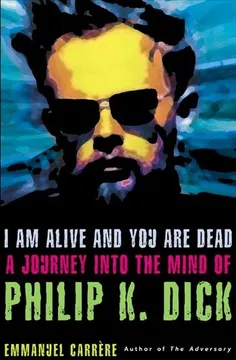
Reviewers broadly praise this biographical portrait of Philip K. Dick, appreciating Carrère's immersive, inside-out approach that blends biography with literary analysis. Many highlight how effectively he connects Dick's turbulent personal life — his paranoia, drug use, failed marriages, and mystical experiences — to his fiction. Some caution that the book is best appreciated by existing Dick fans, and a few find the detailed plot summaries and theological digressions exhausting. Critics note the writing style mirrors Dick's own disorienting sensibility, making I Am Alive and You Are Dead both an unsettling and illuminating reading experience.
Glossary
idios kosmos
Private experienced worldDick's term for the private universe of perceptions, memories, fears, and assumptions through which an individual experiences existence. It is not merely an opinion about a shared world, but reality as it appears from inside one person's consciousness. In Eye in the Sky, characters' inner worlds become environments that others must inhabit.
koinos kosmos
Shared world of agreementDick's term for the apparently objective world people take to be common to them. He treats it as a practical agreement among separate minds, rather than a reality any person can access without mediation. In his fiction, that agreement can prove unstable when characters discover that their surroundings reflect someone else's private perspective.
Rat Game
Rules-changing party gameA variation on Monopoly in which the player called the Rat can change the rules at will, often issuing arbitrary decrees that apply to everyone else. Dick's family played it as a game of confusion and manipulation. Carrere also uses it to describe Dick's conversational style, in which he could reverse positions and alter the terms of an argument.
I Ching
Coin-based divination textAn ancient Chinese text organized around sixty-four hexagrams, formed in Dick's practice by tossing three coins six times. Each figure comes with a judgment and commentary that can be used for reflection or divination. Dick consulted it for practical decisions and used its results to guide choices while writing The Man in the High Castle.
Turing Test
Imitation-based machine testA thought experiment proposed by mathematician Alan Turing to assess whether a machine can convincingly imitate human responses in a text exchange. An examiner questions both a person and a computer without seeing them, then tries to tell which is which. Dick uses the test to explore whether outward behavior can establish that a machine thinks or feels.
simulacrum
Artificial humanlike doubleIn Dick's vocabulary, a simulacrum is an artificial imitation of a human being, especially a robot or android. The term raises the question of what separates a person from a convincing copy. In Do Androids Dream of Electric Sheep?, advanced androids have human appearances and implanted memories, making that distinction increasingly difficult.
empathy box
Shared suffering deviceA small device used by followers of Mercerism in Do Androids Dream of Electric Sheep? Users grip its handles and experience the suffering of Mercer, a figure climbing a mountain under attack. The device also connects users to others taking part at the same time, making shared pain a ritual of solidarity and religious feeling.
Mercerism
Collective suffering religionThe quasi-religious practice followed by many people in Dick's imagined future. Through an empathy box, participants share the painful ascent of Mercer and feel united with other users. A television host later claims the experience is a staged fraud, but the novel questions whether exposing the mechanism cancels the comfort or meaning people find in it.
kipple
Entropic clutter and decayA term Dick uses in Do Androids Dream of Electric Sheep? for the accumulation of useless objects and disorder as things deteriorate. It expresses a broader movement toward decay that can overtake both possessions and human environments. The word gives a domestic, material form to the novel's anxieties about entropy and loss.
Ubik
Anti-decay spray and forceIn the novel Ubik, the name belongs to a consumer product advertised as a spray that protects against deterioration. It also takes on a larger, mysterious role as a force opposing decay and death. The gap between its mundane packaging and its possible cosmic significance reflects Dick's interest in sacred power appearing in ordinary forms.
Valis
Living intelligent systemDick's name for the presence he believed was communicating with him after his 1974 experiences. He expanded it as a description of a vast, active, living, intelligent system, avoiding the more familiar word God. In his account, Valis sent information through dreams, texts, songs, and ordinary events, though he continued to question what the experiences meant.
Exegesis
Lifelong interpretive notebooksDick's name for the thousands of pages of notes he wrote while trying to interpret his visions, memories, novels, and religious ideas. In its traditional theological sense, exegesis means interpreting a sacred text. Dick treated his own experiences and writings as material requiring sustained interpretation, but the project accumulated competing explanations rather than reaching a definitive conclusion.
Download PDF
Download EPUB
.epub digital book format is ideal for reading ebooks on phones, tablets, and e-readers.








