

Key Takeaways
Treat religious harm as trauma, even when your community calls it faith.
Comfort can become danger. Levings begins with a tomato that recalls church: a sensory comfort tied to a faith that also taught her to endure abuse. That contradiction is central. Religion may offer belonging and solace to some, while doctrines, leaders, or practices can harm others. The book cites research suggesting religious trauma affects one in five Americans, while acknowledging that experiences and traditions vary.
Her own history includes Christian patriarchy, domestic violence, and church leaders who urged submission rather than safety. Recovery begins by naming the harm without letting others decide whether it counts. This is not a case against every faith. It is a case for putting human safety ahead of an institution's preferred story.
What's powerful is the distinction between a tradition's promise and its effects on a particular person. That distinction resembles trauma-informed care, which asks what happened and what support is needed instead of judging a person's reaction. The book's scope is deliberately survivor-centered, not a comparative study of religion. Readers should not treat its population estimate as a diagnosis or assume that every painful religious disagreement is trauma. The useful test is the lasting impact on safety, agency, and daily life.
Give shock time to settle before asking yourself to make sense of it.
Stabilize before interpreting. After escaping a violent marriage, Levings entered a period of psychological shock. She was disoriented, frightened, and still trying to care for her children. Choices made during that emergency, such as sleeping apart from them to shield them from her night terrors, later brought regret. She argues that this does not make those choices evidence of failure: shock narrows attention and makes clear thinking difficult.
She calls the vulnerable period after an event the aftermath. It is a time for safety, care, and recovery, not pressure to resume ordinary life or explain everything. Her agricultural metaphor gives the period a second meaning: ground left raw after harvest can also become fertile. Recovery needs air, light, and time.
The emphasis on timing is a valuable corrective to cultures that reward composure and quick return to productivity. Decision science likewise recognizes that acute stress can narrow attention and favor immediate coping over long-range planning. That does not mean every decision made under stress is invalid, or that someone should delay urgent protective action. The distinction is practical: secure immediate safety first, then postpone nonessential, irreversible choices when possible. Regret can be examined without turning a survival decision into a verdict on character.
Treat fear of telling as evidence, and build privacy before disclosure.
Fear can mark a boundary. Levings learned that church culture could frame disclosure as gossip, disloyalty, or an attack on a good man's reputation. The resulting fear may persist long after someone leaves. She treats that fear as information about power and safety, not proof that a survivor is exaggerating. At the same time, silence may be a reasonable short-term protection, not a moral failure.
Before recounting painful events, she recommends creating a private, bounded place for the work. For her, that meant a trauma-informed therapist, a journal, a partner, and a few trusted friends. She also distinguishes abuse or crime from ordinary interpersonal conflict: a church's internal process may not be a safe or adequate response to violence.
This approach aligns with the principle of informed consent: a person should control when, how, and with whom a story is shared. It also recognizes that disclosure can carry real social, financial, or legal risks. However, fear alone cannot identify the safest next step; trusted professionals and advocates can help assess options, especially when someone faces immediate danger. The book's strongest contribution here is refusing to equate public disclosure with healing. Privacy can be a foundation for agency, not a tool of concealment.
Belong to yourself by questioning beliefs without deciding the answer first.
Keep inquiry genuinely open. Levings defines deconstruction as examining a belief's origins, teachers, effects, and outcomes, then deciding whether it still fits. It need not mean rejecting faith, and it does not require rebuilding the old system in a new form. The process matters precisely because a predetermined answer turns questioning into persuasion.
Her childhood story of wandering through Michigan woods supplies another image: adults called her lost, but she remembers feeling curious and oriented. The difference between their account and hers illustrates centrality, her term for being at the center of one's own experience. High-control religion often assigns identity through roles. Recovery asks what remains when those roles no longer dictate a person's beliefs, relationships, or ambitions.
Open inquiry is a defense against both indoctrination and reverse indoctrination. It lets a person retain practices that genuinely help while rejecting coercive interpretations, rather than forcing an all-or-nothing identity. The method also has limits: tracing a belief's history does not by itself establish whether it is true or false. Evidence, lived consequences, and ethical scrutiny each answer different questions. Levings's insistence on not fixing the conclusion in advance makes the process more intellectually honest and more respectful of personal agency.
Read triggers as clues, then address what keeps your body alarmed.
Follow the alarm backward. Levings describes the stress response cycle as the body's movement from alarm toward settling after danger passes. Fight, flight, freeze, and fawn are survival reactions, not character defects. Fawning means appeasing a threat through caretaking, compliance, or people-pleasing. When stress is repeated or safety never arrives, a person may remain reactive and interpret reminders of past danger as present threats.
Her practical question is not simply, Why did I react? It is also, What in my current life is preventing recovery? She traces a car-related startle response to past threats from her first husband, then asks to drive herself. Movement, breathing, rest, warmth, and other forms of bodily care help her settle, alongside therapy and attention to present conditions.
Treating a trigger as information can replace shame with investigation, but bodily reactions are signals, not infallible proof of what caused them. Stress can affect health, yet a symptom should not automatically be attributed to trauma. Medical evaluation remains important, particularly for new or severe symptoms. The book's practical insight is to consider both context and body: a calming technique may help regulate distress, while changing an unsafe environment may be necessary to stop the alarm from being repeatedly activated.
Reclaim your body and voice from rules that keep women childlike.
Control can shape expression. Levings argues that purity culture does more than restrict sexual behavior. It can withhold useful information, teach girls to fear their own bodies, and frame women's sexuality as something owned or managed by men. She connects these lessons to a prescribed feminine performance: a soft voice, meek behavior, and silence when something feels wrong.
Her own experiences of sexual trauma and dissociation made it difficult to distinguish desire, fear, and bodily reaction. She describes learning to use her adult voice as part of recovery, including speaking plainly about what happened and setting limits. She recommends reliable medical and therapeutic support, not treating a book or a religious promise as a substitute for individualized care.
The connection between sexual agency and ordinary speech is especially revealing: both depend on being able to notice a preference and communicate it without punishment. That insight applies beyond religion, wherever gender norms reward compliance. Still, a high or soft voice is not itself evidence of abuse, and sexual difficulties can have many causes. The book is most persuasive when it describes one survivor's pattern rather than implying a universal explanation. Its call for accurate education and responsive health care is the more broadly useful principle.
Separate grief from guilt, then repair the harm that is yours.
Hold two truths apart. Levings writes about having been harmed by a system and also having participated in practices that harmed her children. She does not use coercion or good intentions to erase the impact. Nor does she treat responsibility as proof that she alone caused everything. Her approach is to examine what happened, who was affected, what influences shaped her actions, and what can still be changed or repaired.
Grief concerns losses that cannot be restored, including childhood, health, and missed time with family. Guilt concerns actions and consequences that may call for accountability or amends. The distinction helps prevent self-blame from swallowing the whole story. The book discusses therapy, journaling, and EMDR as ways she processed memories, rather than promising that a single exercise can resolve them.
This distinction avoids two common traps: using victimhood to evade accountability, and using accountability to deny the conditions under which a person acted. Restorative practices make a similar distinction between naming harm, listening to those affected, and taking concrete responsibility. Repair is not always possible or welcome, however, and an apology does not entitle the person who caused harm to renewed contact or forgiveness. The book's strongest ethical stance is that context explains behavior, while the impact on others still matters.
Choose boundaries by safety and evidence, not reflexive peacekeeping or permanent rupture.
Let behavior guide distance. Levings describes boundaries as personal limits that protect autonomy, not rules for controlling other people. A boundary may mean saying no, leaving a room, limiting a visit, or taking time before answering. She also examines family estrangement with care: distance can be necessary when contact is unsafe, but it can also carry grief and should not be treated as a universal cure.
Her preferred questions are concrete: Is change possible? Are stated limits respected? Is there a safe way to communicate or make amends? The answers may support closer contact, a temporary pause, or continued distance. Her own history makes clear that hope is not the same as assuming someone will change, and that boundaries can be revised as circumstances become clearer.
This is a useful alternative to both obligatory family loyalty and the idea that cutting contact is always empowering. Relational decisions are often constrained by safety, money, children, health, and power, so a single moral rule cannot settle them. The book's openness to revising a boundary reflects good decision practice: make the safest workable choice with current evidence, then reassess when conditions change. In situations involving violence or coercion, safety should take precedence over reconciliation.
Make daily care a refusal to spend your body for an ideology.
Care belongs in ordinary life. Levings's Recovery Habit is a practical collection of recurring choices that support her health and autonomy. She focuses on essentials such as enough food, sleep, medication, movement, clarity, bathroom breaks, comfort, and protection from sensory overload. She also gives herself time to adjust to new surroundings and avoids filling every day with obligations.
These routines are not a new purity test. They are adjustable supports, not proof of moral success. Levings describes taking herself off church volunteer lists, resting when ill, and pausing before taking responsibility for another person's needs. The goal is not perfect calm or solitary self-sufficiency. It is to stop treating exhaustion and self-neglect as the price of being good, faithful, or useful.
The focus on mundane care gives recovery a durable structure. Food, sleep, movement, and medication are not glamorous, but they can expand the capacity to think, relate, and make decisions. The anti-consumption argument also links private wellbeing to labor: systems often depend on unpaid care that remains invisible until someone stops providing it. This is not a reason to blame individuals for structural constraints. It is a reason to treat rest as a need, while recognizing that access to rest and health care is unequally distributed.
Analysis
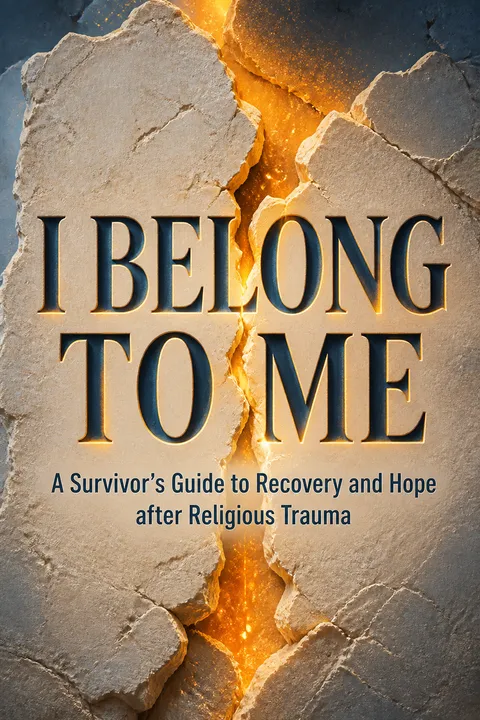
I Belong to Me works as both memoir and recovery guide. Its organizing logic is not a clinical protocol but a change in vantage point: a survivor moves from being defined by a religious system to becoming the interpreter of her own experience. The tomato, the woods, the camper, the ocean, and the yoga mat give abstract ideas physical locations. That narrative strategy matters because religious trauma often involves not only propositions but rituals, bodily memories, family loyalties, and daily habits. Levings links these layers without requiring readers to share her exact theology or outcome.
The book's most durable framework is a sequence of permissions: take pain seriously, stabilize before analyzing, establish privacy, investigate inherited beliefs, identify what the body signals, and take responsibility for one's own actions. Its refusal to prescribe a single spiritual destination is a strength. So is its insistence that a person can be harmed and still have harmed others. That complexity prevents the recovery story from collapsing into either total victimhood or total self-condemnation.
The same breadth creates a limitation. The text moves between personal testimony, historical critique, neuroscience, therapy, and political analysis. Some bodily and neurological explanations are presented with more confidence than a lay account can settle, and readers should distinguish the author's experience from universal clinical guidance. The book itself points toward therapists and medical professionals, a necessary safeguard. Its practical recommendations are most credible when framed as prompts for reflection and care, not as diagnostic tests.
At its core, the title is an ethical claim about authority. Belonging to oneself does not mean rejecting all community or refusing obligation. It means participation must remain voluntary, reciprocal, and accountable. Recovery is portrayed not as arriving at a perfect identity but as gaining enough agency to question, choose, change course, and repair harm. The closing vision is modest and demanding at once: a life in which no idea is worth more than a person's humanity, including one's own.
Review Summary
Glossary
Religious trauma
Trauma in a religious contextLevings uses this term for traumatic experiences connected to religious beliefs, leaders, communities, or practices that threaten or harm physical, emotional, mental, sexual, or spiritual safety. The term describes a person's impact, not a judgment that all religion is harmful. She emphasizes that symptoms and recovery needs vary.
Spiritual bypassing
Using faith to avoid painThe use of spiritual beliefs or practices to avoid addressing emotional wounds, psychological distress, or unfinished developmental needs. In Levings's account, comparing someone's suffering to sacred suffering, or urging forgiveness without attending to safety and harm, can bypass the person's immediate need for care and acknowledgment.
Deconstruction
Examining beliefs and their effectsA process of naming a belief, tracing where it came from, examining how it is practiced, and considering its effects and evidence. Levings does not define deconstruction as automatic rejection of faith or as a requirement to rebuild a new system. Its outcome remains open while the questions are being asked.
Centrality
Being central to your experienceLevings's term for recognizing oneself as the central subject of one's own life and the primary witness to one's experience. It counters stories imposed by family or institutions, such as labeling a child lost when the child experienced herself as curious and oriented. Centrality supports self-trust without implying that every interpretation is automatically correct.
Aftermath
The vulnerable period after traumaThe period following shock in which a person begins to regain stability and make sense of what happened. Levings treats this interval as a necessary space for protection, care, and recovery, not a demand to quickly return to normal. The term also carries her metaphor of damaged ground that can become fertile with care.
Fawning
Appeasing a perceived threatA survival reaction in which a person tries to reduce danger by pleasing, caretaking, agreeing with, or adapting to a more powerful person. Levings connects fawning with people-pleasing and learned compliance. It can be useful in an unsafe moment, but may continue to shape relationships after the original danger has passed.
Stress response cycle
The body's alarm and recovery processLevings's description of how the body responds to a stressor, becomes activated, and then needs a route back toward steadiness. She discusses fight, flight, freeze, and fawn reactions, along with movement, rest, and other forms of bodily regulation. Ongoing danger or repeated stress can interrupt recovery.
Window of tolerance
Capacity to handle stressA person's shifting capacity to experience emotion or stress while remaining able to think, communicate, and function. When demands exceed that capacity, Levings describes movement toward hyperarousal, such as panic or rage, or hypoarousal, such as numbness or dissociation. The window can be affected by safety, rest, food, and stress.
Internal Family Systems (IFS)
Therapy model for inner partsA therapeutic model that understands the mind as containing different parts with distinct protective roles, rather than as a single, uniform voice. In the book, Levings uses its terms for vulnerable parts, managers that try to prevent harm, and firefighters that react when distress overwhelms other protections. The aim is compassionate understanding and greater internal integration.
Recovery Habit
Daily practices supporting recoveryLevings's name for a flexible set of everyday practices that support her physical and emotional wellbeing. These include nutrition, rest, movement, medication, clarity, attending to bodily needs, comfort, sensory protection, slower travel, and time to acclimate. The habits are supports to adjust, not a strict formula or measure of worth.
Download PDF
Download EPUB
.epub digital book format is ideal for reading ebooks on phones, tablets, and e-readers.








