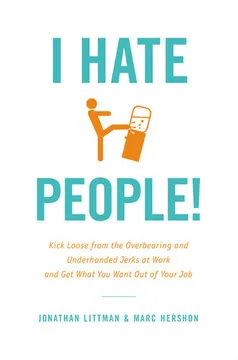


Key Takeaways
Use productive People Hating to stop difficult coworkers from owning your workday.
Frustration is information. The book argues that workplace misery often comes not just from workload, but from people who block, exploit, or constantly interrupt others. A Towers Perrin survey cited in the book, covering 90,000 employees in 18 countries, found that only about one-third believed senior managers communicated openly and honestly. The point is not to despise everyone. It is to stop pretending every work conflict is your fault, or that being agreeable will fix it. The authors call the practical response People Hating: notice which interactions are draining your time or damaging your work, then set limits and redirect your effort.
Aim at conduct, not character. A colleague may be helpful in one situation and obstructive in another. The book even notes that everyone can sometimes behave like one of its troublesome archetypes.
What's useful here is the refusal to confuse politeness with trust. Organizational life works better when people can name obstruction, credit theft, and chronic interruption instead of converting every conflict into private self-blame. Yet the phrase People Hating carries a risk: contempt can become a shortcut that turns a temporary behavior into a fixed identity. The more durable application is precise criticism. Identify what happened, what it cost, and what boundary or process would prevent a repeat. That preserves the book's candor without making cynicism the price of competence.
Name the behavior, then choose a defense that fits it.
Different problems need different moves. The Ten Least Wanted is the book's set of workplace archetypes, organized around people who block progress, redirect it, or consume time. A Stop Sign reflexively finds reasons an idea cannot work. A Flimflam pitches vague work that quietly becomes yours. A Bulldozer dominates through pressure, while a Switchblade appears supportive but undermines colleagues behind the scenes.
Make the response concrete. For the Flimflam, ask for the task, scope, and deadline in writing before agreeing. For the Stop Sign, acknowledge the concern and ask what would make the idea viable. For a Bulldozer, document incidents and calmly name unacceptable conduct. The book warns that these patterns can overlap, and that a person may be useful in one context and obstructive in another.
The archetypes work best as a diagnostic vocabulary, not as a personality test. Naming a recurring pattern can reduce the fog of conflict and help colleagues choose a proportionate response. That resembles incident reporting in safety-critical work: specific observations are more actionable than labels like difficult or toxic. The limitation is that a memorable label can harden into confirmation bias. A manager who is called a Bulldozer may have made one forceful intervention, while an apparently pleasant coworker may cause real harm. Track repeated actions and their effects before drawing conclusions.
Make room for solo invention before asking the group to approve it.
Create before consensus. A Soloist is the book's model of someone who works effectively alone and collaborates selectively, rather than treating constant teamwork as proof of productivity. The authors cite the Ringelmann effect, based on rope-pulling experiments: in an eight-person group, the average participant exerted about half the effort of someone pulling alone; even groups of three showed a notable per-person decline.
Let outsiders reframe problems. Phil Baechler, a newspaper reporter with no mechanical-design background, wanted to jog with his infant son. Existing strollers failed him, so he borrowed an idea from mountain bikes and developed the three-wheeled Baby Jogger. The example suggests that distance from a field's assumptions can open a path insiders overlook. Solo work is not automatically superior, but it can protect early ideas from premature conformity.
The strongest version of this argument is about sequencing, not choosing individualism over teamwork. Early exploration benefits from room to generate unusual possibilities; evaluation and execution often benefit from other people's expertise. Research on brainstorming also points to coordination costs when people must take turns speaking, which helps explain why a group can produce fewer ideas than its combined talent suggests. Still, the rope-pulling result does not establish that groups are generally less capable. For complex work, complementary knowledge can outweigh coordination loss. The practical question is which phase needs independence and which needs collaboration.
Build a small, trusted Ensemble around a clear creative goal.
Collaboration can stay lean. An Ensemble is a flexible, small group of capable people who help a Soloist move a project forward, often without becoming a large formal committee. The book suggests working with roughly three to five people, chosen for complementary strengths, and allowing the membership to change with the task.
Roger Bannister's record was shared work. Before breaking the four-minute mile in 1954, Bannister trained with two friends who helped pace his attempt. When their interval times stalled, the trio took a break from running to climb in the Scottish Highlands. Refreshed, Bannister returned to the track and soon ran the mile in 3:59.4. The story presents collaboration as focused support, not constant proximity: one person may own the achievement while trusted partners supply timing, perspective, and renewal.
A small Ensemble is a useful middle ground between isolated genius and sprawling committee. It preserves clear ownership while giving a project access to challenge, expertise, and encouragement. That structure also resembles a well-designed team in which roles are interdependent but not interchangeable. The key is not a magic group size; it is whether each person contributes something the task needs. A small circle can still reproduce the same conformity as a large group if members share assumptions or fear disagreement. Trust should make candor safer, not make scrutiny disappear.
Reserve quiet time before interruptions fragment your attention.
Protect a real interval. The Quick 10 is the book's practice of setting aside ten interruption-free minutes at a consistent time, then gradually extending the block if colleagues respect it. The authors cite estimates of roughly 73 interruptions per office worker per day, while research they discuss finds that returning to a task can require substantial recovery time. Even interruptions related to the work can break concentration.
Make the boundary visible. Tell coworkers when you are unavailable and when you will reconnect. The book also describes a newspaper editor who used a red cap to signal that she needed uninterrupted time; within months, colleagues had learned to leave her alone while she wore it. The point is not that ten minutes solves an overloaded job. It is to make focused work an explicit part of the workday.
A small protected block is credible because it asks for a change in routine, not a new culture overnight. It can also make attention visible to coworkers, who may otherwise interpret an open door or available status as an invitation. The evidence on interruption costs supports the underlying concern, although its magnitude varies by task and workplace. A ten-minute window may help someone begin a report, but deep creative work often needs longer stretches. The useful move is to start with a boundary that can be defended, then negotiate the amount of focus the actual task requires.
Clear your plate with honest delegation, deliberate delay, and a clear no.
Choose what stays yours. The Three Ds are the book's method for managing demands: Delegate work to someone reliable, Delay it by setting a realistic timeline, or Deny it when it does not merit your capacity. Delegation should not simply transfer a problem to someone who cannot solve it. Delay works best when expectations are explicit and then met. A lawyer cited in the book handles urgent client requests by explaining that he is overloaded and proposing a later delivery date, rather than silently accepting an impossible deadline.
Do not let silence become strategy. The book cautions that delaying a response can slide into a non-response, leaving colleagues unable to act. When someone repeatedly fails to respond, change the communication channel, set a deadline, or find another resource. The goal is to keep commitments and priorities visible, not to escape accountability.
The Three Ds convert boundary-setting from a mood into a decision process. Their value lies in making tradeoffs explicit: every yes consumes capacity that could serve another commitment. This fits research on role overload, where incompatible demands can impair both performance and well-being. The harder issue is power. A junior employee may not be able to refuse a senior leader as freely as an executive can. In that case, a useful version of no is a tradeoff question: which existing task should move if this new one takes priority? That keeps the boundary factual and collaborative.
Treat workplace rules as negotiable only when outcomes and ethics allow.
Separate policy from habit. The book distinguishes formal rules from unwritten customs, such as assuming no one can leave before the boss. Theresa, a brand manager at Clorox, arranged to work from home one day a week because no policy prohibited it, and protected her evenings by leaving at a reasonable hour. She says she performed strongly despite working fewer hours than some colleagues.
Protect intrinsic motivation. The authors also discuss Teresa Amabile's poetry study: writers given external reasons to create, such as money or approval, produced less creative work than those writing for interest or without those prompts. This is not an argument that all rules or rewards are harmful. It is a reason to question procedures that favor appearances over results, while preserving genuine requirements around safety, fairness, and law.
This section connects autonomy with motivation: people often do better work when they have discretion over how to achieve a goal. The distinction between a rule and a custom is especially practical, since organizations often enforce inherited habits without examining their purpose. But autonomy is not a universal good in every setting. Rules can protect workers from favoritism, harassment, and unsafe shortcuts. The sound test is not whether a rule feels bureaucratic, but whether it serves a legitimate function and whether a less burdensome alternative would serve it equally well.
Claim a physical Cave that makes focused work feel possible.
Space shapes attention. A Personal Cave is a place a worker claims for concentration and creative work. It might be a home office, a café, a quiet corner, or a customized part of a company workspace. The book argues that a Cave is less about expensive equipment than about having a setting that supports the way a person works.
Make the space yours. The authors point to IDEO, where designers displayed prototypes, unusual materials, and personal interests. Dennis Boyle's informal collection of materials grew into the company's Tech Box, a shared resource for inspiration. That story shows how an individual's workspace can seed ideas for others. Not everyone can redesign an office or work remotely, but even a modest change in location, sound, or visual surroundings can help establish a reliable signal for focused effort.
A dedicated place can function as a cue: entering it tells the mind which kind of work is expected. Environmental psychology similarly examines how light, noise, privacy, and personal control shape concentration and comfort. The book's strongest point is that space is not merely a perk or status symbol; it is part of the work system. Still, privacy should not be confused with isolation. Some jobs require quick coordination, and open environments can help people who benefit from social contact. A flexible workplace offers both protected focus areas and accessible shared spaces.
Plan small escapes that reset attention without abandoning responsibility.
Change the scene on purpose. Island Hopping means taking short, restorative breaks from the usual workplace, whether by walking, visiting a café, exercising, or pursuing a hobby. The book presents breaks as a way to recover perspective and return with fresh attention, not as a disguise for neglecting work.
Results can matter more than presence. At Best Buy, a group developed a results-only work environment with no mandatory meetings or fixed requirement to be physically present. The book reports an average 41 percent productivity increase for participating teams. That figure comes from the program as described in the book, not a guarantee that every flexible-work arrangement produces the same result. The broader lesson is to judge work by its outcomes where the role permits, and to design breaks around both personal needs and clear responsibilities.
The idea of a planned escape treats recovery as part of performance rather than a guilty interruption. Short breaks can help restore attention, while changes of setting can expose workers to cues and perspectives unavailable at a desk. The Best Buy example also challenges the assumption that visible presence is a reliable proxy for contribution. Yet flexibility depends on the work: a service desk, laboratory, or collaborative deadline may impose real constraints. A fair results-based arrangement must define outputs clearly and avoid shifting hidden availability demands onto workers outside their scheduled hours.
Analysis
I Hate People! is a deliberately provocative guide to a familiar problem: workplaces often praise teamwork while allowing interpersonal behavior to consume the time and attention needed to do the work. Its central contribution is to redirect productivity advice from individual discipline alone toward the social environment. Instead of telling readers simply to become more patient, it offers recognizable behavior patterns, boundary-setting tactics, and ways to create space for independent thought.
Its most useful distinction is between working alone and rejecting collaboration. The Soloist develops ideas independently, then uses a small, purposeful circle when collaboration adds value. That model helps reconcile two realities: groups can lose effort through coordination and social loafing, yet complex work often depends on complementary expertise. The book's emphasis on sequencing is stronger than any blanket claim that individual work is superior.
The book is also rooted in its 2009 moment. Its examples of email, instant messaging, mobile phones, and corporate meeting culture remain recognizable, but its statistics and technology landscape should be read historically rather than as current measurements. Its research anecdotes are persuasive illustrations, not universal guarantees. A cited increase in productivity under one flexible-work program does not mean every role can adopt the same arrangement.
The main risk is rhetorical. Archetypes make bad behavior easier to spot, but they can also turn a colleague into a caricature and encourage readers to see hostility where a process problem may be responsible. The strongest use of the framework is behavioral: record what happened, examine its effects, and respond proportionately. Its lasting message is not that people are obstacles by nature. It is that attention, autonomy, and honest boundaries need deliberate protection, especially in organizations that mistake constant interaction for productive work.
Glossary
People Hating
Practical workplace self-protectionThe book's deliberately blunt name for recognizing and responding to workplace behavior that obstructs work, drains time, or undermines colleagues. It does not require disliking everyone. Its practical purpose is to replace automatic niceness or self-blame with clear observation, boundaries, and strategies for dealing with difficult interactions.
Ten Least Wanted
Workplace behavior archetypesA collection of ten recurring workplace character types that interfere with getting work done. The book groups them as Stumbling Blocks, Wrong Turns, and Time Wasters. Examples include the Stop Sign, who blocks proposals, the Flimflam, who makes vague requests that shift work onto others, and Minute Man, who repeatedly consumes colleagues' time.
Soloist
Independent, selective collaboratorA worker who can produce effectively alone and collaborate with a small number of people when useful. A Soloist is not necessarily a recluse or loner. The concept emphasizes individual initiative, focus, and ownership within organizations that may overvalue large teams, constant availability, or visible busyness.
Solocrafting
Protected individual creative workThe Soloist's practice of setting aside time and space to concentrate, create, or advance important work, often away from interruption. It can involve independent work, a small collaboration, or a personal pursuit that renews energy. The method includes shaping schedules and surroundings to reduce the disruptive influence of workplace demands.
Ensemble
Small, flexible working groupA small group assembled around a Soloist or project, whose members contribute complementary skills and focused support. Unlike a large formal team, an Ensemble can change with the task and may operate informally. The book suggests keeping the group manageable so coordination does not overwhelm the creative or practical work.
Quick 10
Daily protected focus intervalA daily ten-minute period reserved for uninterrupted work or personal reset. The practice begins by announcing a clear window of unavailability and can be extended if colleagues learn to respect it. Its purpose is to establish a visible boundary around attention and create a starting point for longer focused sessions.
Three Ds
Delegate, delay, or denyA decision framework for handling new demands on limited time. Delegate work to a capable person, delay it by setting a realistic timeline, or deny the request when it should not be accepted. The approach aims to protect priorities without relying on misleading excuses or leaving others uncertain about commitments.
Personal Cave
Claimed space for concentrationA physical setting made useful for focused or creative work. It may be a home office, a café, a park, or a defined area in a conventional workplace. The concept stresses personal control and a supportive atmosphere more than expensive furnishings, allowing workers to create a dependable place to think and work.
Island Hopping
Restorative changes of sceneA practice of taking deliberate breaks from the normal work setting or routine. Islands can be places, such as libraries, cafés, parks, and gyms, or activities such as a hobby, exercise, or a short mental diversion. The aim is to refresh attention and perspective while remaining responsible for work commitments.
Ringelmann effect
Reduced individual group effortThe decline in individual effort observed as people work together in groups, named for French engineer Maximilien Ringelmann's rope-pulling experiments. The book cites lower per-person effort in larger groups and uses the effect to question assumptions about teamwork. It is an illustrative finding, not proof that groups always underperform individuals.
Download PDF
Download EPUB
.epub digital book format is ideal for reading ebooks on phones, tablets, and e-readers.








