

Key Takeaways
Stop postponing contentment until the small upgrade arrives
Small wants can steal whole days. Strickler describes feeling content on a quiet Saturday, then scrolling past a prettier home and better-dressed family. In seconds, her own ordinary comforts seemed inadequate. A news story about people facing disaster swung her back toward gratitude, revealing how strongly comparison depends on whose life is nearby. The point is not that wanting a better kitchen is foolish, but that waiting for it to feel happy can make the present disappear.
Climb the life at hand. The book compares this work to Alex Honnold’s careful preparation for a dangerous climb: study the route, learn from mistakes, and keep moving. Strickler pairs practical changes with Christian faith, treating both as supports for enjoying her particular life rather than wishing it away.
The opening scene captures how quickly attention can alter the felt value of a life. This resembles social comparison research, where judgments of well-being depend partly on the reference group, not only on material conditions. Gratitude can interrupt that process by directing attention toward what is present. Still, comparison with people facing catastrophe should not become a tool for silencing ordinary needs. A cramped home, chronic stress, or financial strain may call for real change. The useful distinction is between making a needed change and treating the change as the price of permission to be content.
Make your home serve your family, not an imaginary magazine
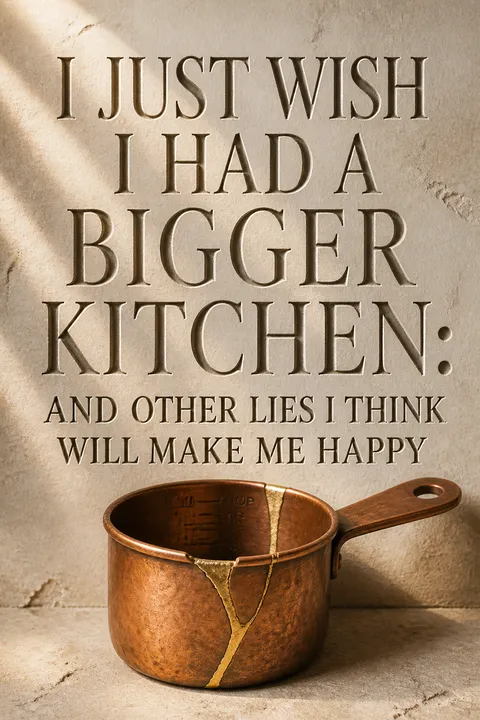
Use beats appearance. Strickler’s Charleston kitchen lacks room for all her cooking equipment, which ends up in closets and the laundry room. At first, she treats a bigger kitchen as a likely route to a better life. Then she visits Meg, a friend whose tiny, crowded kitchen produces a wonderful salad and, more importantly, a feeling of welcome. The home reflects the family living there, not an ideal staged for photographs.
Design for this season. The practical question becomes whether the space works for its occupants. Strickler suggests removing unused clutter, storing appliances wherever they fit, and creating one calm corner for retreat. A home can be beautiful because it is used: children’s art, dishes, and scuffs may signal that the space is doing its job of sheltering and gathering people.
This reframes interior design as a question of function and belonging, not merely taste. Environmental psychology often distinguishes spaces that support the activities people value from spaces that simply look impressive. A family home can be arranged to reduce friction, invite connection, and accommodate a season of life. Yet function is not a universal standard: a crowded room may feel lively to one person and overwhelming to another. The strongest lesson is permission to define usefulness locally, rather than letting the polished image of someone else’s home dictate what comfort must look like.
Parent from your values, not the internet’s endless checklist
Good parenting is not a shopping list. Online advice can make every choice feel permanent: what children eat, where they go to school, which activities they quit, and how much time a parent spends with them. Strickler’s anxious moment over frozen waffles and a homesteading mother’s homemade bagels exposes the trap. She does not actually want to make bagels or milk a cow; she wants reassurance that her own choices are enough.
Filter the comparison. Before adopting another family’s standard, ask whether they are in a different parenting season, whether they have different help, and whether they share the same values. Strickler also shifts attention from tasks to character: her husband remembers that his imperfect father genuinely liked him, while she remembers her mother’s confidence in her. Parents cannot prevent every regret, but they can apologize and show children how to repair mistakes.
The three-question filter makes comparison more contextual. It recognizes that visible parenting choices are shaped by resources, life stage, and priorities, factors that online images rarely disclose. The shift from flawless execution to character also aligns with attachment: children need dependable care and a sense that they matter, not a parent who optimizes every meal or milestone. This is not a claim that nutrition, schooling, or time together are irrelevant. It is a reminder that a checklist can confuse personal preferences with moral obligations, leaving parents ashamed without necessarily helping their children.
Give your spouse generous interpretations before building a case
Do not convict on guesswork. After Nate asks about a smoothie cup left soaking in the sink, Strickler interprets the request as proof he ignored all her other efforts that morning. Both spouses feel unseen, and a minor inconvenience becomes a fight. She recognizes a habit of assuming the worst when he is late or forgets a chore, despite having little evidence that he meant to hurt or disregard her. She adapts the legal idea of the presumption of innocence: allow a benign explanation unless facts point elsewhere.
Love the person backstage. Marriage also means knowing a partner’s private habits, fears, and unpolished moments, not only the public version. Romance may look less like elaborate dates and more like sharing chores, making coffee, or accepting an apology. Repeated acts of patience and care build a shared history, while trusted friends can make private struggles feel less isolating.
The presumption of innocence is a useful antidote to mind-reading, a common source of conflict in close relationships. When an ambiguous act is treated as evidence of bad intent, each partner responds to a story rather than to the event itself. A generous interpretation creates room to ask what happened and explain what was needed. That generosity should not become a rule to excuse repeated harm or avoid direct conversations. Its value lies in replacing automatic accusation with curiosity, while retaining the ability to recognize patterns when evidence does emerge.
Build belonging through honest depth, not a crowded calendar
Friendship needs repeated contact. College friendships grew through shared rooms, classes, and long stretches of unplanned time. Making friends as a parent was slower, with children interrupting conversations and schedules limiting contact. Strickler kept notes about people she met at the park, but some of her closest local friendships deepened when friends offered school pickups during her difficult postpartum period. Accepting help, rather than immediately balancing the favor, gave those relationships a chance to grow.
Popularity is a poor measure. Strickler once edited a meal-train sign-up to hide empty dates, treating the public list as a count of who cared about her. But a full calendar or many invitations cannot guarantee that someone knows and accepts you. She argues for fewer, more candid relationships: share something real, invite another person into conversation, and remember that logistical limits or exclusion do not automatically measure personal worth.
The chapter distinguishes social quantity from relational security. Repeated, low-pressure contact can create familiarity, while honest disclosure can deepen trust by inviting reciprocity. The awkwardness of receiving help matters because people often confuse dependence with failure, even though mutual care rarely stays perfectly balanced at every moment. At the same time, vulnerability is not an obligation to disclose to everyone; trust should develop with attention to safety and response. A small circle can meet important needs, but people with few opportunities for contact may also need practical access to community, not just encouragement to be more open.
Treat your body as a life story, not a ranking
The mirror can become a scoreboard. As a teenager, Strickler restricted food and exercised heavily after a friend suggested her clothes might not fit. Compliments reinforced the belief that a smaller body meant greater worth, even while she disliked her appearance. Years later, living briefly in an apartment with almost no mirrors reduced opportunities to inspect and criticize herself. Her daughter’s worry about being judged for her clothes showed how early these comparisons can start.
Choose care that lasts. Strickler questions routines built around rapid transformation. Her husband began with a modest daily run, then added other manageable changes over several years, losing weight without attempting an all-at-once overhaul. She applies the same long view to exercise and aging: health matters, but the body also carries the marks of living. She suggests reducing harmful social media exposure and asking whether a health goal is sustainable.
The chapter connects body dissatisfaction to repeated evaluation: mirrors, clothing sizes, filtered images, and comments can turn appearance into a constant performance review. Reducing unwanted cues may interrupt that cycle, while sustainable movement can shift attention toward capability and well-being. There is an important boundary here: appearance concerns can be severe, and simply removing mirrors will not resolve every form of distress. Medical, therapeutic, or nutritional support may be appropriate. The broader insight remains valuable: care for the body need not depend on treating it as a project that must continually prove its worth.
Keep money goals from moving every time your neighbors upgrade
Price and status are different things. At sixteen, Strickler spent her entire birthday budget on designer jeans whose main advantage was the signal they sent. Later, a luxury car appealed to her despite an equally priced newer car offering more practical value. These examples show how purchases can promise not only an object but also a feeling of status or belonging. Yet an expensive item does not reliably provide the happiness attached to it.
Decide what enough means. The book describes the moving goalpost: after earning more, people often spend more and compare themselves with wealthier neighbors. Strickler remembers feeling content in a poorer newlywed season, when a small gift mattered and friends made life rich. A budget, waiting before purchases, and occasional spending pauses can help reveal which desires are genuine and which are attempts to keep up.
The account fits the economic idea of positional goods, whose appeal comes partly from how they compare with what others own. That makes satisfaction unstable: the reference group can change faster than income. Waiting before buying can help separate lasting preferences from the short-lived urgency of advertising or social comparison. Still, money is not merely symbolic. It buys safety, health care, housing, and choices, and financial hardship cannot be solved by perspective alone. The useful target is not spending less as a virtue in itself, but spending in ways that support chosen priorities rather than unexamined status demands.
Protect empty space before busyness eats the hours you reclaimed
Efficiency can hide exhaustion. Strickler used to pack each day with errands, activities, and work, then crash and repeat. During the pandemic, fewer plans helped her notice that her children enjoyed walks and play more when they were not hurried. Later, her husband left a demanding legal job to work with her, giving the family more control over its time. But she quickly filled the new hours with more tasks, showing that extra time alone does not create margin.
Make room for what restores you. A month away from posting online helped her recover some pleasure in cooking. Making a homemade pie required attention and waiting, and the process felt worthwhile rather than wasteful. Strickler recommends assessing which commitments are necessary, which are optional, and which activities give life. Some demands cannot be declined, and resources can help, but efficiency is not a reason to keep doing work that need not exist.
Time management often focuses on optimizing tasks, while this story asks whether the tasks deserve a place at all. The homemade pie makes a compelling case for process: an activity can matter because it is absorbing and meaningful, not because it produces the fastest result. Yet time poverty is not always self-created. Care work, inflexible jobs, disability, and limited income can sharply constrain choice. Personal boundaries help most when there is genuine agency to exercise them. The practical question is therefore twofold: what can be removed, and what support would make meaningful time possible?
Practice living with uncertainty instead of rehearsing every disaster
Worry cannot control outcomes. After losing an uncle in a car accident and witnessing other tragedies, Strickler became afraid that good fortune could not last. She mentally rehearsed disasters as if knowing every detail might prepare her. But worry did not make anyone safer. A near-accident, a child’s pool emergency, and frightening stories online all made uncertainty feel immediate, even when the feared event had not happened.
Take small steps toward what fear blocks. Strickler’s fear of flying eased after she took more flights, an experience she describes as informal exposure practice. She also uses gratitude to notice that ordinary safety and provision are not fully under her control. A card game illustrates resulting, the mistake of judging a decision only by its outcome: luck can produce a win after poor choices or a loss after sound ones. Serious anxiety may need professional care, not willpower alone.
The chapter separates risk from the illusion of control. Repeated exposure can reduce avoidance for some fears, because safe experience updates expectations that remain untouched by reassurance alone. The card-game example adds a crucial reasoning lesson: outcomes contain luck, so they are imperfect evidence of decision quality. Exposure should be gradual and appropriate, not a dare to ignore genuine danger. Gratitude can broaden attention beyond threats, but it is not a substitute for treatment when anxiety is disabling. Together, these ideas offer a more balanced response: act where action helps, and do not confuse rumination with protection.
Choose your own scorecard before comparing your life with hers
Online life is a highlight reel. Strickler uses Barbie Land, an imagined world of polished perfection, to show how attractive an edited life can appear when its struggles remain out of view. A family photo may preserve one good moment from a difficult day, but viewers can mistake it for the whole day and compare it with their own unedited hours.
Define the game you want to play. An inner scorecard measures success by personal priorities rather than public approval. Strickler wants a welcoming home more than a spotless one, and generosity matters more than stretching spending to its limits. Jerry Seinfeld’s daily writing practice illustrates that visible achievement requires trade-offs; a person cannot excel at everything simultaneously. Naming which areas deserve high effort, and which can remain merely adequate, makes those choices easier to own.
An inner scorecard gives comparison a more stable reference point: not whether another person has more, but whether one’s choices serve one’s own commitments. The distinction also exposes hidden costs behind visible success, since a public achievement rarely shows what was sacrificed to produce it. However, personal standards are not beyond criticism. A chosen goal can conflict with care for others or be shaped by unequal opportunity. The scorecard is most useful when it clarifies priorities while remaining open to feedback, rather than becoming a private excuse to ignore responsibilities.
Let disappointment teach compassion without pretending pain is good
Reality rarely follows the plan. Strickler hoped for an easy postpartum period with her fourth child, but instead faced anxiety and difficulty nursing. Her sister’s hoped-for birth-center deliveries became C-sections. The family’s long-awaited Disney trip ended with a stomach illness and an early departure. These experiences were painful even though each story also included reasons for gratitude. Measuring distress against someone else’s worse hardship did not erase what the person was feeling.
Use the letdown to understand others. Strickler’s struggles with a baby who would not sleep softened her judgment of parents having the same problem. Disappointment can reveal how little any one person controls and make it easier to offer help. Her Christian perspective frames life as imperfect and faith as support through it, not as a guarantee against grief. The aim is to welcome joy while preparing to meet setbacks with humility, repair, and care.
The strongest distinction here is between accepting that disappointment happens and claiming that suffering is inherently beneficial. A difficult birth, mental health struggle, or family loss need not be justified by the empathy it may produce. Still, experience can widen a person’s capacity to recognize distress that once seemed inexplicable. This is a form of learning through contact rather than abstract advice. The chapter’s practical emphasis on helping others matters because compassion becomes more than sentiment when it turns into a meal, a ride, or sustained presence.
Analysis
The book’s central argument is that contentment is not a reward delivered by better circumstances. It is a practiced way of attending to the life already being lived, while still making reasonable changes to improve it. Its most effective device is the ordinary scale of the complaints: a kitchen that feels too small, a spouse who misses a cue, a body that changes, or a trip that goes wrong. These are not presented as equivalent to bereavement or crisis. They are the daily frictions through which people can lose contact with what they value.
The memoir form strengthens the advice because the author does not claim to have conquered comparison. Her reversals, from the immaculate online kitchen to the cluttered family one, make the practices feel revisable rather than doctrinal. The recurring shift from outward measures to personally chosen priorities also links otherwise separate subjects: homes, parenting, spending, time, and appearance all become questions of whose standards are governing attention.
The book’s Christian framework supplies a larger account of dependence and hope. Readers who do not share that faith can still recognize the practical insight that human control is limited and that gratitude need not be earned through perfection. Yet the advice is strongest when it avoids turning gratitude into a moral test. Some readers genuinely need more money, space, time, support, or treatment. Contentment should not excuse preventable hardship or place all responsibility on an individual mindset.
That tension is also the book’s useful invitation: distinguish a change that serves a real value from an upgrade pursued to escape comparison. The distinction cannot be settled once and for all. It requires repeated attention to circumstances, trade-offs, and relationships. The book offers no universal formula for a happy life. It offers something more plausible: ways to notice when imagined improvements are consuming the actual goods of an imperfect, specific life.
Glossary
I just wish
A small dissatisfaction refrainThe recurring thought that one modest improvement would make life feel complete, such as having a larger kitchen, more money, or a different body. In the book, the phrase matters because its seemingly minor desires can redirect attention from a life that is already meaningful and adequate in many ways.
behind the curtain
Private, unpolished lifeStrickler’s metaphor for the parts of a person that are not usually presented publicly: fears, habits, insecurities, failures, and private joys. In marriage, knowing someone behind the curtain means encountering the whole person rather than an edited public image, and choosing intimacy and care despite that fuller knowledge.
presumption of innocence
Assume no bad intentA legal principle that a person is treated as innocent unless evidence establishes guilt. Strickler adapts it as a relationship practice: when a spouse’s action is ambiguous, resist immediately assuming a hurtful motive. The practice encourages curiosity and forgiveness, while leaving room to address repeated behavior when evidence supports concern.
inner scorecard
Personal measure of successA way of evaluating life according to personally chosen priorities rather than public status or other people’s visible achievements. The book uses the idea to help readers define what deserves effort, what can remain imperfect, and what trade-offs are acceptable. It is contrasted with an outer scorecard based on how successful a life appears to others.
resulting
Judging choices by outcomesA term associated with poker player Annie Duke for the error of evaluating a decision solely by what happened afterward. Outcomes are partly shaped by luck, so a favorable result does not prove a decision was wise, and an unfavorable result does not prove it was foolish. The concept helps separate decision quality from chance.
one sane space
A small calm areaA designated corner or room kept relatively peaceful and orderly within a home that may otherwise feel busy. Strickler draws on Myquillyn Smith’s term and describes using such a place as a modest refuge, not as a demand that the entire home remain tidy or visually perfect.
Download PDF
Download EPUB
.epub digital book format is ideal for reading ebooks on phones, tablets, and e-readers.








