

Key Takeaways
Treat the brain as an evolved patchwork, not a flawless command center
Survival came first. The brain evolved to keep the body alive before it acquired language, reflection, and planning. Older systems still regulate movement and basic bodily needs, while newer conscious systems can interfere with them. The familiar split between a primitive “reptile” brain and the neocortex is only a shorthand, not a complete map of brain organization.
Useful systems can clash. Motion sickness may occur when the inner ear signals movement while the eyes and body suggest stillness. One leading explanation is that the brain treats the conflicting signals as possible poisoning and triggers vomiting. Eating is similarly complicated: stomach stretch and appetite hormones matter, but habits, mood, learned disgust, and reward can overrule bodily cues.
The useful shift is from asking why the brain behaves irrationally to asking what each response was built to do. A system optimized to prevent starvation or detect danger may misfire in a car or a modern food environment without being defective in its original setting. This resembles legacy software: old components keep running while new functions are layered on top. The metaphor has limits, since brain regions cooperate rather than operate as separate managers, but it helps explain why deliberate reasoning does not always control bodily reactions.
Sleep is active brainwork, even though its ultimate purpose remains unknown
Sleep is not simply rest. The body’s metabolism falls only modestly during sleep, and animals that hibernate still enter sleep states. Scientists have proposed roles in healing, memory organization, emotional regulation, and clearing cellular waste, but the book emphasizes that no single purpose is settled. Circadian rhythms, influenced by daylight and melatonin, help set when sleep arrives; changing time zones disrupts that timing.
The sleeping brain stays busy. During REM sleep, brain activity rises and movement is normally inhibited, which helps prevent people from physically acting out dreams. Sleep also appears to support memory, while too little sleep impairs attention, mood, and problem-solving. The book links exhaustion among engineers to major accidents, including Chernobyl, Three Mile Island, and the Challenger disaster.
Sleep is a reminder that visible inactivity does not mean biological inactivity. Its unresolved purpose also makes a useful distinction between a strong practical conclusion and an incomplete theory: the evidence supports sleep’s importance even while its full function remains uncertain. That is a sound model for reading neuroscience more broadly. Yet disaster examples can make the case feel more definitive than any single incident permits. The central point survives without treating sleep loss as the sole cause of complex failures: it degrades capacities that safety-critical work depends on.
Treat memory as a reconstruction, not a recording of your past
Recall is an active process. Working memory, the limited mental workspace used to hold and manipulate information, can handle about four items at once. Long-term memory is more durable, but memories still depend on encoding, storage, and retrieval. Context can help: in one study, divers who learned information underwater recalled it better underwater than on land.
The past gets edited. Egocentric bias is the tendency for memory to make a person seem more central or capable than the facts support. John Dean, a Watergate participant, remembered himself as more influential in planning than recordings later showed. Memory is also vulnerable to suggestion: Elizabeth Loftus’s research found that how witnesses are questioned can alter what they report. Confidence in a memory, then, is not proof of its accuracy.
This account makes humility about personal recollection a practical habit, especially in arguments, family disputes, and eyewitness settings. Memory is not useless because it is reconstructive; it is a flexible system that helps interpret the present using traces of the past. But that flexibility means confidence can arise from a coherent story rather than a faithful record. The appropriate response is neither blanket distrust nor unquestioning belief. For consequential decisions, contemporaneous records and independent accounts can provide checks that introspection cannot supply.
Expect false alarms: the brain sees patterns and danger before proof
Pattern finding can overreach. Apophenia is the perception of meaningful connections between unrelated events. Someone who wears an inside-out shirt and then wins a scratch card may treat the coincidence as a rule. The same tendency can help conspiracy theories feel convincing: unrelated events appear linked, and a hidden cause seems more satisfying than chance. Superstitions also offer an action that can create a feeling of control.
Fear learns quickly. A phobia can develop when the brain connects an object or situation with danger, even if the person knows the fear is excessive. Avoiding the trigger may bring short-term relief while preserving the association. Fear is not always unpleasant entertainment, either: horror stories and thrill rides can feel rewarding when danger ends and the person remains in control of the experience.
A mind that searches for patterns is valuable in a world where missed threats can be costly. The trouble is that the same machinery treats coincidences as clues and imagined danger as urgent. This explains why simply telling someone that a fear is irrational may not resolve it: conscious knowledge and learned alarm are not the same process. The account also distinguishes safe fear from genuine threat. Enjoyment depends partly on believing that the danger has boundaries, a distinction that becomes crucial when thrill seeking exceeds a person’s ability to manage risk.
Your senses deliver clues; the brain builds the scene and misses details
Perception is constructed. Less than one percent of the retina, the fovea, provides the sharpest detail. The eyes move it across the scene, and the brain combines those fragments with blurrier peripheral information to create the impression of a stable, detailed world. The brain also integrates senses: with the nose blocked and eyes covered, people can mistake an apple for a potato using taste alone.
Attention has limits. In the “door study,” at least half of participants failed to notice that the person asking them for directions had been swapped while a door briefly blocked their view. This change blindness shows how easily attention misses a conspicuous change. Even hands-free phone conversations can impair driving because the conversation competes for attention, not merely for the driver’s hands or eyes.
The brain’s perceptual shortcuts are not merely flaws; they let a person act quickly without processing every scrap of sensory input. Their cost is that a confident experience of seeing is not the same as complete observation. This matters in ordinary settings, from driving to recalling who was present during a brief exchange. The lesson is not that perception is hopelessly unreliable, but that attention is selective. When accuracy matters, slowing down, checking the scene again, or using an external record is often wiser than trusting the vividness of an impression.
Measure intelligence cautiously, and never mistake confidence for competence
IQ is a comparison, not a raw meter. A properly standardized test sets the population average at 100, so it indicates where someone falls relative to others rather than measuring a fixed quantity of intelligence. Spearman’s g describes a general ability underlying performance across different tasks. The book distinguishes fluid intelligence, which handles unfamiliar problems, from crystallized intelligence, the knowledge accumulated in long-term memory.
Self-assessment can fail. In the Dunning-Kruger effect, people who perform poorly on a task may overestimate their ability, partly because judging one’s own shortcomings requires skill. High performers can underestimate themselves. The book also rejects easy brain-boost promises: practice can improve particular skills, but broad gains in adult fluid intelligence are difficult, and puzzle games do not establish general improvement.
The most useful consequence is to separate ability from its public performance. A confident speaker may be persuasive without being accurate, while a cautious expert may sound uncertain precisely because the subject has complications. Test scores can still be informative, but they are shaped by the test, the population used for comparison, and the abilities it samples. Treating one number as a complete account of a person turns a rough instrument into an identity label. Better judgment combines measures with demonstrated performance and awareness of what remains untested.
Personality traits describe tendencies, not a complete blueprint for a person
A useful map is not the territory. The Big 5 model describes openness, conscientiousness, extraversion, agreeableness, and neuroticism as broad personality traits. Twin studies cited in the book suggest genetic influences, but behavior also varies with context and experience. A person may be outgoing among friends and reserved at a funeral, which is one reason situation matters as much as a trait label.
Tests can oversell certainty. The Myers-Briggs Type Indicator is widely used in business, but the book says it lacks scientific support as a definitive way to classify people. Its tidy categories may appeal to managers because they make employees seem predictable. The account of Phineas Gage, whose brain injury was said to change his personality, also shows how difficult personality is to measure: later retellings exaggerated what the evidence could establish.
Trait models are valuable when treated as summaries of recurring tendencies, not explanations of every choice. They can help people notice patterns while leaving room for situation, learning, and change. The appeal of neat types is understandable: organizations need shorthand for coordinating work. But shorthand becomes harmful when used to constrain hiring, assign ability, or predict an individual with unwarranted certainty. A better question than “What type is this person?” is “What does this person tend to do in this setting, and what evidence supports that expectation?”
Make motivation self-chosen; external rewards can weaken intrinsic interest
Motivation has several sources. The self-determination theory describes intrinsic motivation through autonomy, competence, and relatedness: people are more driven when they have agency, can become capable, and feel connected to others. In one study, children who were rewarded for using art supplies were less motivated to use them later than children who had played without a reward. External incentives can change how an activity is understood, from enjoyable in itself to something done for payment or approval.
Unfinished tasks linger. The Zeigarnik effect describes the tendency to remember interrupted tasks better and feel pulled toward completing them. It helps explain why unresolved stories can hold attention. The book treats motivation as more than pleasure seeking: people also act from goals, identity, obligation, and beliefs about what they can control.
The distinction between choice and reward is especially useful in education and management. Incentives can help initiate an unpleasant task, but they may also crowd out curiosity when they imply that the activity has no value on its own. That does not mean pay or recognition should disappear; the book’s point is that rewards interact with existing motives rather than simply adding motivation. The practical challenge is to make room for agency and mastery while keeping external incentives fair. An unfinished task can spark action, but unresolved pressure is not a sustainable substitute for meaningful commitment.
Group belonging can overpower judgment, empathy, and personal responsibility
Agreement has social force. In Solomon Asch’s line-comparison experiments, participants sometimes gave an obviously wrong answer after a group of planted participants did so first; 75 percent conformed at least once. In Stanley Milgram’s obedience study, 65 percent of participants continued what they believed were painful electric shocks because an experimenter told them to proceed. These studies show how belonging and authority can outweigh private judgment.
Groups can intensify beliefs. Group polarization occurs when discussion pushes members toward a more extreme version of their shared view. The book also describes the just-world bias: people may blame victims rather than accept that undeserved harm can happen randomly. Together, these tendencies explain how group loyalty can harden opinions and make compassion conditional, even among people who would judge themselves fair-minded.
The studies are memorable because they reveal how conduct depends on structure, not only character. A unanimous group, an authoritative setting, or an apparent consensus can change what an individual feels able to say or do. That insight is useful wherever decisions affect outsiders, including teams and institutions. Still, laboratory demonstrations do not predict every person or every real-world crisis; the book notes variation among participants and the limits of the original bystander story. The practical safeguard is to make dissent possible and assign responsibility clearly, rather than assuming decent intentions will survive group pressure unaided.
Depression and stress are conditions, not evidence of weak character
Distress is not a choice. Depression is more than ordinary sadness: it can affect mood, sleep, concentration, motivation, and a person’s sense of worth. The book challenges claims that depression or suicide reflects selfishness, noting that depression can distort how someone evaluates themselves and the effect they have on others. Its causes are not captured by a simple chemical-imbalance explanation; sleep, stress systems, brain plasticity, life events, and vulnerability may all matter.
Pressure has a useful range. The Yerkes-Dodson law describes how moderate stress can improve performance, while excessive stress can impair it. When stressors persist, recovery becomes harder and a person may enter a damaging cycle of exhaustion and coping behaviors that create further strain. The diathesis-stress model describes how existing vulnerabilities and accumulated pressures can combine to precipitate serious difficulty.
This framing replaces moral judgment with a more accurate question: what pressures and vulnerabilities are interacting, and what support is available? It also resists a false choice between biology and circumstance. A person’s brain and environment affect each other, so acknowledging a physical basis need not erase personal history or social conditions. The stress-performance curve is a useful caution for workplaces that mistake urgency for productivity. Yet no single curve or model can diagnose an individual. The strongest application is practical: take persistent impairment seriously and avoid treating distress as proof of laziness.
Hallucinations reveal how fragile the brain's reality-checking can be
Inner and outer signals can blur. Hallucinations are perceptions without an external source; one proposed explanation is that the brain misattributes internally generated activity to the outside world. The systems involved include sensory processing and regions that monitor thought, action, memory, and emotion. This helps explain why people may hear internal speech as a separate voice, though the book stresses that the mechanisms remain under study.
Beliefs can protect a faulty explanation. Delusions are strongly held beliefs that conflict with available evidence. In Capgras delusion, someone may believe a loved one has been replaced by an impostor. One theory is that the person recognizes the face but lacks the expected emotional response, and the brain settles the mismatch with an explanation that feels coherent. Unusual beliefs are not automatically disorders; cultural context matters.
These examples show that reality testing is an achievement of coordinated brain processes, not a simple window onto the world. They also encourage humane interpretation: an explanation that seems implausible to an observer may be the person’s attempt to make sense of confusing experiences. At the same time, the account is careful not to turn every spiritual or culturally shared belief into a symptom. Diagnosis depends on distress, functioning, context, and clinical judgment. The distinction matters because pathologizing difference can harm, while dismissing severe disruption can leave someone without help.
Addiction changes the brain, so willpower alone is an incomplete explanation
Drugs can bypass ordinary rewards. The mesolimbic reward pathway helps produce pleasure and reinforce behavior. Many drugs of abuse increase dopamine activity in this pathway directly, creating a powerful signal to repeat the experience. The brain adapts to repeated stimulation, producing tolerance: a person may need more of the substance to get the same effect. When use stops, those adaptations can make withdrawal difficult and, for some substances, dangerous.
Cues and priorities shift. Objects, routines, and settings associated with drug use can become emotionally charged reminders. Drug seeking may rise above work, relationships, and other needs, while negative consequences lose influence. These changes do not make every person’s path to addiction identical, and the book describes social, psychological, and genetic factors. But they show why addiction is better treated as a serious condition than condemned as a simple moral failure.
The account avoids two unhelpful extremes: portraying addiction as a free choice repeated without constraint, or as a mechanism that makes recovery impossible. Brain adaptation helps explain craving and relapse, while the varied routes into substance use leave room for individual circumstances and treatment. This is a more productive basis for policy and care than blame, because it makes both biological vulnerability and social context visible. It also preserves agency without pretending agency operates independently of dependence, learned cues, and altered reward priorities.
Analysis
The book’s most durable idea is not that the brain is foolish, but that its intelligence is specialized. It evolved to keep an organism alive, learn from experience, anticipate danger, and coordinate with other people. Those jobs reward speed and practical adequacy more than perfect accuracy. A reconstructed memory, an overactive fear response, or a perceptual shortcut can be a reasonable adaptation in one setting and a costly mistake in another. The comic framing makes this mismatch easy to remember without making the underlying biology seem mystical.
The book also models a valuable scientific attitude: explanations are provisional. Sleep has no settled single purpose; personality measures capture only part of a person; depression cannot be reduced to a simple chemical formula; and brain scans do not translate activity into a complete account of thought. That caution is especially important in popular neuroscience, where a named region or neurotransmitter can be mistaken for a full explanation. The book sometimes uses vivid brain-area metaphors that risk making distributed processes seem more localized and settled than they are. Its own repeated reminders of uncertainty help counterbalance that tendency.
A modern reader can apply the book as a guide to designing checks around predictable cognitive weaknesses. Memory can be checked against records, attention protected from competing demands, and group decisions opened to dissent. None of these practices makes the brain accurate in every circumstance. They recognize a deeper point: reliable judgment often comes from systems around the mind, not from demanding that an individual mind become perfectly rational. The book’s humor is therefore more than style. It lowers defensiveness around human error, making it easier to see that understanding a bias is not an excuse for it, but a starting point for managing it.
Review Summary
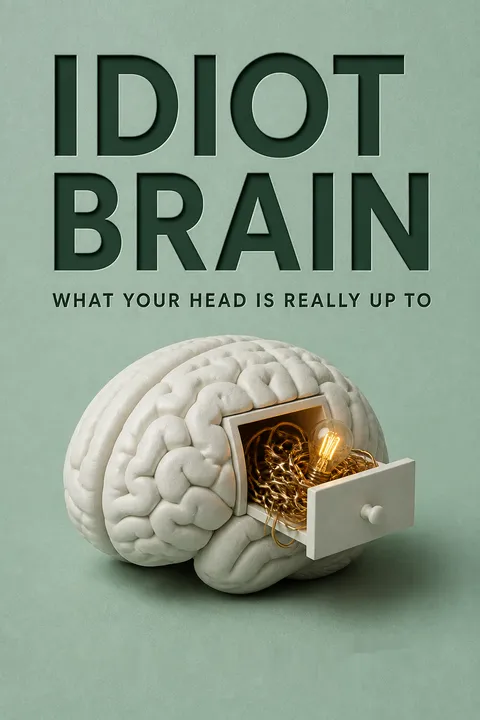
Idiot Brain receives mostly positive reviews for its accessible, humorous approach to neuroscience. Readers appreciate Burnett's ability to explain complex brain functions in an entertaining way. Many find it informative and engaging, praising the author's wit and writing style. Some criticize certain sections as shallow or redundant. The book covers topics like memory, fear, intelligence, and mental health. While some readers found parts basic or overly simplified, most recommend it as an enjoyable introduction to neuroscience for non-experts.
Glossary
Working memory
Active mental workspaceWorking memory is the short-lived system used to hold and manipulate information currently being considered. It is distinct from long-term memory, which stores information more durably. The book describes its capacity as about four items at a time, with chunking allowing related pieces of information to be handled as a single unit.
Egocentric bias
Self-favoring memory distortionEgocentric bias is the tendency for people to remember events in ways that make their own role seem more important or their performance better. The process is generally unconscious, rather than deliberate lying. For example, someone may sincerely remember contributing more to a group decision than recordings or other evidence support.
Apophenia
Seeing patterns in coincidenceApophenia is the perception of meaningful connections among events or details that are unrelated. It can make a coincidence seem like evidence of a rule, or encourage people to infer a hidden plan behind separate events. The book links this tendency to the brain’s habit of searching for patterns and resisting randomness.
Spearman's g
General intelligence factorSpearman's g is a proposed general ability that contributes to performance across different intellectual tasks. It emerged from statistical analysis of test results showing that people who did well in one area often did well in others. The book presents g as a useful account of shared cognitive capacity, not a complete definition of every ability.
Dunning-Kruger effect
Misjudging limited abilityThe Dunning-Kruger effect describes a pattern in which people who perform poorly on a task may overestimate their performance, while stronger performers may underestimate theirs. The proposed explanation is that judging competence requires some of the same abilities needed to perform well. The effect is a research finding, not a claim that every confident person is incompetent.
Big 5
Five broad personality traitsThe Big 5 is a model that organizes personality into openness, conscientiousness, extraversion, agreeableness, and neuroticism. Each trait describes a range of tendencies rather than a fixed category. The book notes evidence that the traits are relatively consistent, while stressing that this framework does not capture every aspect of personality or determine behavior in every situation.
Zeigarnik effect
Unfinished tasks stay salientThe Zeigarnik effect is the tendency to remember interrupted or incomplete tasks more readily than completed ones. The book describes observations and experiments in which people retained unfinished tasks and felt motivated to complete them. It is also used to explain why unresolved storylines can keep an audience interested.
Group polarization
Group views grow more extremeGroup polarization occurs when discussion among people who share a general position shifts the group toward a more extreme version of that position. The book connects it to social approval and competition for standing within a group. It can distort decisions when harmony is prized and outside criticism is excluded.
Yerkes-Dodson law
Stress has an optimal rangeThe Yerkes-Dodson law describes a relationship in which some stress or arousal can improve performance, while excessive stress reduces it. The relationship is not a license to apply pressure without limit. The book uses it to explain why deadlines may sharpen performance in some circumstances, but chronic or overwhelming stress can impair it.
Diathesis-stress model
Vulnerability plus pressureThe diathesis-stress model explains how a predisposition or vulnerability can combine with stressful experiences to increase the likelihood of a mental health episode. A person with greater vulnerability may be affected by a lower level of stress, while another may tolerate more. The model emphasizes interaction rather than a single universal cause.
Mesolimbic reward pathway
Reward and reinforcement circuitThe mesolimbic reward pathway is a network involving the ventral tegmental area and nucleus accumbens that contributes to reward, pleasure, and reinforcement. It helps strengthen behaviors associated with positive outcomes. The book describes how drugs can activate this system directly, leading to intense reward signals and adaptations such as tolerance.
Capgras delusion
Loved one seems replacedCapgras delusion is the belief that a familiar person, such as a partner or family member, has been replaced by an identical impostor. One explanation discussed in the book is that a person recognizes the familiar face but fails to experience the expected emotional response. The impostor belief then resolves the mismatch, despite evidence to the contrary.
FAQ
What's Idiot Brain about?
- Exploration of brain functions: Idiot Brain by Dean Burnett explores the complexities and quirks of the human brain, focusing on how it often misinterprets reality.
- Humorous yet informative: The author uses humor to make neuroscience accessible, explaining intricate concepts in a relatable way.
- Real-life implications: The book connects scientific insights to everyday experiences, showing how our brains influence our thoughts, feelings, and actions.
Why should I read Idiot Brain?
- Engaging writing style: Dean Burnett's witty prose makes complex neuroscience topics enjoyable to read, blending humor with scientific facts.
- Practical insights: The book offers valuable insights into brain functions, helping readers understand their behaviors and thought processes.
- Broad appeal: Suitable for both science enthusiasts and casual readers, the book's approachable style makes it accessible to a wide audience.
What are the key takeaways of Idiot Brain?
- Brain's imperfections: The book emphasizes the brain's incredible capabilities alongside its flaws and mistakes in processing information.
- Influence of emotions: Emotions significantly impact perception and decision-making, sometimes overriding logical thinking.
- Social dynamics: The brain's wiring for social interaction affects behavior in groups, with concepts like groupthink and the bystander effect explored.
What are the best quotes from Idiot Brain and what do they mean?
- “The brain is a wonderful organ, but it’s also a bit rubbish.”: Highlights the brain's capabilities and frequent shortcomings, setting a humorous tone.
- “We experience the world through a lens of our own making.”: Emphasizes the subjective nature of perception and the influence of mental frameworks.
- “The brain is not a computer; it’s a messy, chaotic, and often irrational organ.”: Reminds readers of the brain's unpredictability and complexity.
How does Idiot Brain explain memory?
- Memory as a reconstructive process: Memory is not a perfect recording but a reconstructive process, leading to potential inaccuracies.
- Influence of emotions on memory: Emotional states affect memory recall, with traumatic events creating vivid memories and mundane experiences fading.
- Memory biases: The brain favors certain memories, like the egocentric bias, which can distort perceptions of past experiences.
What is the role of attention in Idiot Brain?
- Limited capacity for attention: The brain's limited attention capacity can lead to difficulties in multitasking and missing important details.
- Selective attention: The brain focuses on specific stimuli while ignoring others, crucial for navigating environments but can cause change blindness.
- Influence of social cues: Social cues, like the "cocktail-party effect," capture attention, demonstrating the brain's prioritization of socially relevant information.
How does Idiot Brain address the concept of personality?
- Personality as a brain product: Personality is shaped by brain processes, genetics, and experiences, challenging the mind-body dualistic view.
- Big Five personality traits: The book discusses the Big Five model, explaining how traits influence behavior and interactions.
- Influence of environment: Personality is adaptable and can change over time due to environmental factors, highlighting brain plasticity.
What does Idiot Brain say about fear?
- Fear as a survival mechanism: Fear is an evolutionary response that activates the fight-or-flight response to protect from danger.
- Influence of social factors: Social dynamics can influence fear, leading to mass panic or collective fear responses.
- Phobias and irrational fears: Phobias can develop from learned experiences or social conditioning, with the brain overreacting to perceived threats.
How does Idiot Brain explain the impact of drugs on the brain?
- Direct activation of reward pathways: Drugs stimulate the brain's reward pathways, creating pleasure and potential addiction.
- Tolerance and dependence: The brain adapts to drugs, leading to tolerance and dependence, requiring more substance for the same effects.
- Long-term consequences: Drug effects can persist after cessation, making relapse common and challenging to manage cravings.
What are the neurological underpinnings of mental health issues discussed in Idiot Brain?
- Complex interplay of factors: Mental health issues arise from genetic, environmental, and neurological factors, complicating understanding and treatment.
- Impact of stress on mental health: Chronic stress can lead to anxiety and depression, creating a cycle of negative thoughts and behaviors.
- Neurotransmitter imbalances: Imbalances in neurotransmitters like serotonin and dopamine contribute to mental health disorders, affecting mood and cognition.
How does Idiot Brain address the concept of group dynamics?
- Influence of group membership: Group membership significantly impacts individual behavior, with the brain's social wiring making us susceptible to group influences.
- Groupthink and polarization: Groups may make irrational decisions or adopt extreme views, leading to poor outcomes and reinforcing harmful behaviors.
- Bystander effect: Individuals are less likely to help in emergencies when others are present, illustrating how group dynamics inhibit personal responsibility.
About the Author

Download PDF
Download EPUB
.epub digital book format is ideal for reading ebooks on phones, tablets, and e-readers.








