

Plot Summary
Cranes Beneath the Oven
At seven, the boy from Shobrakheit is sent to live with his grandmother after his mother leaves the family home. She gives him the tenderness and freedom he cannot find elsewhere, folds paper figures, and buys him a camera. When he is sixteen, his mother sells the house that legally belongs to him. Police evict the boy and his grandmother, crushing her paper collection and forcing them back into his parents’ household.
Her independence shrinks to rationed meals and a shared bed. After she dies by suicide in the oven, the boy carries her plywood coffin through the village. At nineteen, with money his grandmother had hidden for him, he leaves for Cairo, carrying the camera and the grief that will shape his life there.
The boy’s departure begins as an escape from a home that has become unlivable, but the loss is more intimate than geography. His grandmother gave him a model of care that did not depend on obedience or respectability; her eviction strips away both that refuge and his claim to a future she imagined for him. The camera joins the paper figures as an inheritance of attention: a way to make something, and to see what others overlook. His later pride and vulnerability grow from this contradiction. He leaves the village, yet carries its measure of dignity into a city that repeatedly tests whether dignity can survive poverty.
The Camera in Tahrir
In Cairo, the boy studies mass communications, takes low-paid camera work, and survives on the money his grandmother left him. During the 2011 revolution, he photographs the crowds in Tahrir Square and sells images to foreign news organizations.
For a brief, fierce period, he believes the people can build a fairer country together. He also uses cocaine, first amid the sleepless, chaotic occupations and later as a way to keep working and endure the crash.
When political hopes fail and the crackdown intensifies, he sees that footage once meant to preserve the uprising can help authorities identify protesters. He stops trusting photography as a weapon for justice. By the time he meets Noor, he is an addict trying to quit, with a broken camera hanging from his neck.
The revolution gives the boy a collective identity that his village and city life have denied him, but the camera makes that belonging morally unstable. Images preserve names and losses, yet the same record can be repurposed by the state against the people who trusted the photographer. His withdrawal from photography is therefore not simple despair or artistic block. It is a response to the collapse of the belief that witnessing is inherently protective. Cocaine offers a counterfeit version of revolutionary intensity: stamina without solidarity, power without consequence. When Noor appears, his camera and his sobriety are both unfinished projects, not symbols of recovery already secured.
The Passport That Doesn't Fit
In 2017, Noor, an Egyptian-American woman with a shaved head, returns to Cairo after years in New York. Her American passport gets her through the airport, but her weak Arabic and unfamiliarity with the city mark her as an outsider. Her mother has arranged her downtown apartment and a teaching job at the British Council, yet the ready-made landing only deepens Noor’s question about why she came.
People challenge her choice to leave America for a country many are trying to escape. Cairo overwhelms her with traffic, harassment, poverty, and daily errands that seem to require a private map. Sami, the café owner’s nephew, and Reem, his close friend, offer companionship at Café Riche, where Noor can briefly feel understood.
Noor’s return reverses the usual migration story without escaping its hierarchy. Her passport grants mobility, while her speech and appearance expose how little cultural fluency can be inherited at a distance. She wants a relationship to Egypt that is not merely an idea passed down by her parents, but Cairo refuses to confirm that desire on her terms. The city’s practical obstacles make identity bodily: crossing traffic, negotiating service, absorbing public scrutiny. Her friendship with Sami and Reem offers a temporary social shelter, though Café Riche’s polished atmosphere also hints that access and belonging are shaped by class as much as by nationality.
The Spoon at Riche
Noor first notices the village photographer at a basement stationery shop, though she does not remember seeing him there. Their real introduction comes at Café Riche, where he sits with Sami and Reem, twitching, smoking, and carrying a camera he rarely uses.
When Sami humiliates a group of poorer girls by turning them away, Noor watches without knowing how to respond. Later, the boy explains that the exclusion was about money, not religion. Noor is horrified, and he feels she has taken his side.
She borrows his spoon to scoop the coffee grounds from her cup, a casual gesture that becomes charged with intimacy. He has been clean from cocaine for seventeen days; her attention gives him another reason to stay near the café rather than face withdrawal alone.
Their bond begins in a moment of recognition, but the recognition is uneven. Noor sees an injustice and imagines that her outrage makes her an ally; the boy experiences it as evidence that she might understand the class violence he lives with every day. The spoon becomes a small, intimate bridge, though neither can know what the other has placed on it. Their attraction is shaped by projection from the start: Noor is drawn to the man she cannot easily read, while he sees a rare witness who may validate his account of Cairo. The scene makes tenderness possible without making their worlds equal.
A Home Without a Key
The boy pursues Noor through elaborate messages, sharing films, history, and imagined meals in an Arabic more formal than his spoken language. Noor is moved by the intimacy of a language she associates with childhood, and soon invites him into her apartment.
Their sex and domestic routine make him feel briefly at home; he shows her how to navigate downtown, while she provides food, shelter, and money. But their class difference keeps entering the rooms with them.
Noor’s independence and salary unsettle him, and his growing jealousy narrows her contact with Sami and Reem. When he discovers a hidden servants’ staircase in the building, he smashes a glass and turns his anger on Noor. She recognizes the danger, and he leaves, ending their shared household.
The apartment first seems to solve each character’s deprivation: Noor finds an embodied connection to Cairo, while the boy gains shelter and the sense of being chosen. Yet the arrangement quietly assigns them incompatible roles. Noor can provide resources without surrendering her autonomy; he reads that imbalance as both love and humiliation. His dependence becomes control, while her wish to understand him makes her slow to name the threat. The servants’ staircase crystallizes the class structure he resents, but his violence is directed at Noor rather than the building. The scene exposes a central danger of intimacy across unequal conditions: empathy can become the excuse for tolerating harm.
The Balcony Across Town
After the breakup, Noor finds another man, William, a British acquaintance who shares her English and seems easier to understand. The boy, meanwhile, relapses, loses his place in the city, and begins watching Noor from the street and from a bridge that gives him a view of her apartment. He imagines rescuing her from an assault, turning her vulnerability into a route back into her life.
One night, a mentally unwell stranger approaches Noor on the street. The boy tackles him and beats him while bystanders intervene. Noor sees that the stranger was not attacking her, but she takes the exhausted boy home so he can wash and eat. She does not restore their relationship, yet their meetings resume, increasingly shaped by her pity and his need.
The boy’s surveillance is not presented as love made pure by suffering. His longing feeds a fantasy in which Noor must be endangered so that he can become indispensable again. When a real stranger approaches her, his intervention blurs protection and possession: he acts, but he also misreads the situation and injures someone who appears unwell. Noor’s decision to take him home is compassionate, yet it opens a channel through which the old attachment can continue without the old intimacy. The shift from lovers to benefactor and dependent preserves closeness while making its imbalance harder to ignore.
A Fall Through the Night
Noor begins seeing William while still meeting the boy, feeding him and slipping him money without naming the arrangement. The boy reads her kindness as a bond he might recover, and he watches her routines from the street. On the night that breaks the fragile truce, Noor is with William in her apartment and has put her phone away. The boy arrives, enters, and finds them together.
He charges at William. William catches him, lifts him, and tips him over the balcony. The fall kills the boy. Noor is left with a death she did not cause but cannot separate from her own choices: the silence, the pity, the renewed access, and the lover who was still in her home. The book leaves the precise intentions of the men contested.
The climax turns the story’s recurring imbalance of power into physical consequence. Noor has tried to maintain boundaries through avoidance and small acts of care, but neither has made the arrangement safe. The boy’s entrance is driven by possessive longing; William’s response is immediately lethal, though the text does not settle whether he intended that result. Noor is neither the agent of the fall nor untouched by its meaning. Her guilt arises from proximity and from the impossible wish that better choices could have prevented another person’s violence. By refusing a clean account of motive, the novel makes certainty itself part of the aftermath.
The Story Goes to Workshop
After the death, Noor withdraws from Cairo and stops answering calls, including those from family across the ocean. When her internet shuts off, the ordinary trip to pay the bill becomes a possible exit: she realizes she could leave the country and avoid the people who know the boy’s name and village.
The novel then frames her account as a manuscript read in a writing workshop. The readers argue over whether the boy was a victim, an abuser, or both, and whether Noor’s grief excuses or distorts her choices.
They also debate how Sami and Reem described the death to the crowd. Noor does not resolve their disagreements. The instructor announces that the manuscript has received a publishing offer, leaving her story exposed to readers who want a verdict.
The workshop turns interpretation into a final event rather than a neutral commentary on the plot. Its readers repeatedly convert ambiguity into familiar categories, then reveal how race, gender, class, and literary conventions shape what they believe. Their demand for a reliable victim, a clear villain, or a morally useful ending echoes the social pressures Noor faced in Cairo. The publication offer complicates any promise that writing will heal or settle the past: telling a story also gives strangers the power to simplify it. The ending does not certify which reader is right. It asks what ethical attention looks like when the person being interpreted cannot control every meaning attached to her account.
Analysis
The novel treats migration not as a clean passage from one home to another, but as a change in who gets to interpret you. Noor returns to Cairo with a passport that grants practical freedom, yet her language and appearance keep marking her as foreign. The boy has the opposite problem: he knows the city intimately but lacks the money and mobility that would let him leave it. Their attraction turns these unequal forms of access into fantasy. Noor imagines cultural belonging through him; he imagines international escape through her. Their intimacy cannot bear the weight of those expectations.
The book’s account of harm is deliberately difficult to classify. The boy can be tender and coercive, wounded and dangerous. Noor can be generous and self-protective, perceptive and slow to name what is happening. Their relationship makes care morally complicated because material help, sexual intimacy, and emotional dependence do not carry the same meaning for each person. The fatal fall does not settle that complication. It intensifies it, leaving Noor to grieve someone who frightened her and to question how much responsibility proximity creates.
Form makes that uncertainty unavoidable. The shifting voices invite readers into private thought, then expose how little any person can know about another. Footnotes offer cultural explanation while also tempting outsiders to consume Cairo as detail. The workshop at the end performs the same struggle in public: its readers want the story to confirm a position on victimhood, culpability, and class, but each position leaves something out. The novel’s lasting challenge is not that truth is unknowable. It is that people often call their preferred interpretation truth, especially when another person’s pain refuses to resolve into a useful lesson.
Review Summary
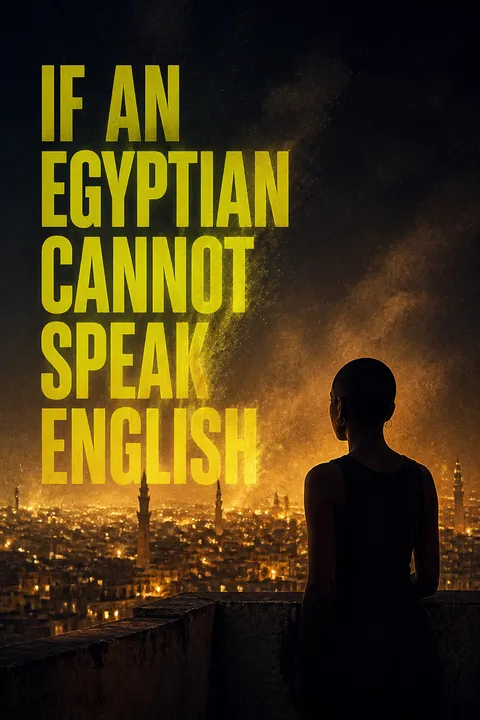
If an Egyptian Cannot Speak English received mixed reviews, with praise for its experimental structure, provocative themes, and exploration of power dynamics. Many readers found the novel thought-provoking and innovative, particularly appreciating the meta-fictional third part. Critics lauded Naga's prose and character development. However, some readers were uncomfortable with the depiction of Egypt and its people, viewing it as stereotypical or harmful. The book's exploration of identity, culture, and post-revolutionary Egypt divided opinions, with some finding it insightful and others problematic.
Characters
Noor
Returning Egyptian-AmericanNoor is an Egyptian-American woman who returns to Cairo from New York, carrying an American passport, a shaved head, and an incomplete command of Arabic. She wants a lived connection to the country her parents left, but resists being reduced to either a wealthy foreigner or a representative of Egypt. Her education and financial security give her options that many people around her lack, even as she encounters gendered scrutiny and linguistic isolation. Noor is observant, curious, and capable of real tenderness, but her wish to understand can become a way of delaying judgment. Her account repeatedly tests the gap between what she sees, what she believes, and what others think her story means.
The boy from Shobrakheit
Village photographerA tall, poor photographer from the village of Shobrakheit, he grew up in the care of a grandmother whose generosity shaped his ideas of love and dignity. In Cairo he becomes a witness to the revolution, then loses faith in photography after images meant to preserve protest are used against protesters. He is imaginative, historically curious, and capable of unusual tenderness, but addiction, economic precarity, and possessiveness distort his attachments. His ornate messages reveal a yearning for beauty and connection that his daily life cannot satisfy. He sees Noor as both a person and a possible passage into a world beyond his own, making their intimacy emotionally intense and dangerously unequal.
Sami
Café Riche insiderSami is the young nephew of a British Council coordinator and the son of Café Riche’s owner. He spends much of his life at the café, where his social ease and family privilege let him control who feels welcome. His wit and pop-culture knowledge help draw Noor into a circle of friends, but his treatment of poorer customers exposes the class boundaries beneath that warmth. Sami is also connected to the boy through unpaid camera equipment, a debt that complicates their friendship.
Reem
Artist and confidanteReem is an exacting mural artist and Sami’s closest friend. Her polished manner hides a sharp appetite for conspiracy, pop culture, and emotional intimacy. She helps Noor make sense of Cairo and becomes attached to her, though Noor does not return that love in the same way. Reem’s care is real, but her social world also reflects the class and cultural circles that leave many Cairenes outside.
The grandmother
The boy's first refugeThe boy’s grandmother raises him after his mother leaves the family home. A maker of paper figures and handmade lace, she gives him affection, imaginative freedom, and his first camera. Her dignity is central to his sense of what a person deserves, especially when poverty and family pressure threaten to strip that dignity away.
Noor's mother
Distant, arranging motherNoor’s mother lives in New York and tries to protect her daughter through practical arrangements, including work, housing, and carefully chosen clothes. Her concern often arrives as control or guilt, while her own unhappiness makes separation difficult. She embodies a version of immigrant survival built on leaving, even as Noor chooses to return.
Noor's father
Father who withdrawsNoor’s father is a dentist who has remade his Egyptian identity into a marketable form in New York. He evades difficult family conversations and turns toward spiritual and wellness pursuits rather than direct emotional engagement. His distance helps explain Noor’s hunger for a kind of paternal tenderness she associates with childhood.
William
British casual loverWilliam is a British man Noor meets in Cairo after her relationship with the village photographer breaks down. Sharing English gives them immediate ease, but William’s assumptions about local people and money reveal a privilege he barely notices. He offers Noor a different kind of intimacy, one that feels familiar without necessarily making her feel understood.
Magdy
The dealer on callMagdy is a cocaine dealer whose protected phone number remains a powerful temptation for the boy. He rarely appears directly, but his access to drugs gives addiction a human point of contact and a voice that can intrude on the boy’s attempts at sobriety.
Sherry
Mother's Cairo connectionSherry, a former classmate of Noor’s mother, helps arrange Noor’s apartment and teaching job. Her polished, privileged outlook gives Noor an early glimpse of the Cairo social circle she has entered.
Saeed
Kind ahwa keeperSaeed runs the boy’s neighborhood ahwa. He offers coffee, cigarettes, and small gestures of respect when the boy has little else, providing care without turning it into a spectacle.
Lulu
Noor's older sisterLulu lives in the United States and remains part of Noor’s distant family life. Her relationship experience and kinder approach to men offer Noor a point of comparison for her own habits and judgments.
The workshop instructor
Workshop's gentle authorityThe instructor moderates the writing workshop where Noor’s manuscript is discussed. He encourages the group to treat the work as memoir and to listen, while also framing the manuscript’s publication as evidence of narrative’s value.
Minnie
Demanding skeptical readerMinnie questions the manuscript’s shifting voices, timeline, and unresolved facts. Her frustration represents a reader’s desire for plot clarity, though her demand for a definitive account can flatten the uncertainty the story deliberately preserves.
Laura
Ethical-minded criticLaura focuses on abuse, victim-blaming, and the social scripts that can make women feel responsible for men who harm them. Her critique is forceful, but it also shows how easily concern for a writer can become a demand that she feel or narrate the past in an approved way.
Candice
Survivor-informed readerCandice relates the manuscript’s fear and grief to her family’s experience of abuse. She argues that naming addiction and harm can be part of honest remembrance, rather than a betrayal of the person who caused them.
Alex
Footnote enthusiastAlex enjoys the manuscript’s explanatory footnotes and asks for more cultural detail. His enthusiasm is generous, but it also risks treating Cairo as a source of exotic information for readers outside the story.
Tim
Class-focused readerTim worries that the workshop’s judgments reduce the village boy to an addict or abuser and notices the class assumptions beneath those labels. His comments complicate the group’s moral certainty without resolving the facts.
Jacques
Form-minded readerJacques presses for a cleaner structure and wonders whether the manuscript should end at the balcony. His preference for symmetry reflects the workshop’s desire to make a difficult story formally and emotionally manageable.
Plot Devices
Alternating first-person voices
Competing inner accountsThe narrative shifts between Noor and the boy from Shobrakheit without always announcing the change immediately. Their voices reveal private histories and motives that the other character cannot fully know. This structure lets the reader see how each person turns the other into an answer to personal longing: Noor seeks a route into Egypt, while the boy imagines a route beyond his poverty. Because neither perspective can provide a complete account, the shifts also unsettle the reader’s confidence about what has been witnessed, inferred, or invented. The device makes misrecognition part of the plot rather than a problem that a single authoritative narrator can solve.
Questions between scenes
Unsettling each answerQuestions interrupt the narrative at moments when a character appears to have settled on an explanation. They connect domestic incidents, memories, and political events without providing a simple moral lesson. Their effect is to make the reader examine the assumptions behind a question as closely as its possible answer. The repeated form also reflects the characters’ unequal access to language: Noor and the boy can share a room while failing to translate what fear, class, or love means to the other. Rather than acting as chapter summaries, the questions keep interpretation open and make certainty feel like another kind of power.
The broken camera
Witnessing without controlThe camera links the boy’s childhood ambitions to his work documenting the revolution and to his later inability to photograph. It once seemed to offer a way to preserve experience and make a living; the use of protest images against demonstrators destroys that confidence. He continues carrying the camera even when it no longer works, turning it into a visible remnant of a former self. Photography also raises the book’s questions about looking, possession, and evidence, especially when Noor asks to be photographed. The device never guarantees truth. Instead, it shows that a record can survive while its meaning and use escape the person who made it.
The writing workshop frame
Readers become the juryThe final section presents Noor’s account as a manuscript being discussed by a workshop. Its participants disagree about form, cultural explanation, guilt, abuse, and the boy’s character, turning the act of reading into part of the story. Their arguments expose how audiences bring ready-made scripts to narratives about violence, race, addiction, and women’s responsibility. The workshop also introduces a gap between lived experience and the version that can be shaped into a publishable book. Its members seek a verdict, but the frame does not grant them one. The device makes the reader confront their own appetite for clarity and the consequences of interpreting someone else’s pain.
FAQ
Synopsis & Basic Details
What is If an Egyptian Cannot Speak English about?
- A diasporic woman returns: The novel follows an Egyptian-American woman who travels to Cairo seeking connection to her heritage after years abroad, navigating the city's post-revolution landscape and her own fractured identity.
- A tumultuous relationship unfolds: She enters a complex and volatile relationship with a young man from a rural village, Shobrakheit, whose life has been deeply shaped by the revolution, addiction, and class disparities.
- Exploring identity, class, and trauma: Told through alternating first-person perspectives and punctuated by rhetorical questions, the story delves into themes of cultural displacement, the aftermath of political upheaval, power dynamics, and the struggle for belonging in a city grappling with its past and present.
Why should I read If an Egyptian Cannot Speak English?
- Unique narrative structure: The novel employs a distinctive dual perspective and a series of probing questions that challenge traditional storytelling, offering a fragmented yet intimate look at the characters' inner lives and the complexities of their relationship.
- Deep cultural and political context: It provides a visceral portrayal of Cairo years after the 2011 revolution, exploring the disillusionment, economic hardship, and social tensions through the eyes of characters living its realities, offering insights into Egyptian society and the diaspora experience.
- Complex psychological exploration: The book delves into the psychological impacts of trauma, addiction, and cultural alienation, presenting flawed, multi-layered characters whose motivations and perceptions are constantly shifting, prompting readers to question reliability and perspective.
What is the background of If an Egyptian Cannot Speak English?
- Post-Revolution Cairo setting: The story is set in Cairo approximately six years after the 2011 Egyptian Revolution, capturing the city's atmosphere of disillusionment, economic decline (e.g., "Twenty pounds to the dollar"), and lingering political tension ("men who had disappeared from their beds at night for tweeting").
- Exploration of Egyptian diaspora: It centers on the experience of an Egyptian-American protagonist returning to a homeland she barely knows, highlighting the cultural disconnect and identity struggles faced by those raised abroad ("We were both more convincing Egyptians in New York than we'd ever be on this side of the Atlantic").
- Class and rural/urban divide: The narrative contrasts the experiences of the privileged, Western-influenced protagonist living downtown with the rural background and economic struggles of the boy from Shobrakheit, revealing deep-seated class divisions and prejudices within Egyptian society ("to be clean in Egypt is just to be free of Egypt").
What are the most memorable quotes in If an Egyptian Cannot Speak English?
- "If an Egyptian Cannot Speak English, who is telling his story?": This question, posed as a chapter title, encapsulates the novel's central concerns about voice, representation, power dynamics, and the inherent limitations and biases in translating one person's experience (especially the marginalized) through another's language and perspective.
- "Photography is a gorgeous corpse turning on the first night in its bed of soil.": The boy's poetic yet morbid description of photography reflects his disillusionment with documenting the revolution, suggesting that capturing reality can feel like observing decay, especially when the images are later used against those they depicted.
- "You are what you think I am.": This epigraph, attributed to an Instagram caption, introduces the novel's preoccupation with perception, projection, and the fluid nature of identity, suggesting that how others see the characters (particularly the protagonist) reveals more about the observers than the observed.
What writing style, narrative choices, and literary techniques does Noor Naga use?
- Alternating First-Person Perspectives: The novel shifts between the unnamed Egyptian-American woman and the unnamed boy from Shobrakheit, offering contrasting and often contradictory accounts of the same events, highlighting their differing perceptions, cultural backgrounds, and internal states.
- Rhetorical Questions as Structure: Each section is introduced by a provocative question, often metaphorical or philosophical, which frames the subsequent narrative and prompts the reader to consider deeper meanings, ambiguities, and the limitations of simple answers ("Question: If you don't have anything nice to say, should your mother be punished?").
- Metafictional Elements and Commentary: Part Three breaks the narrative frame entirely, presenting a workshop discussion about the preceding text. This meta-commentary explicitly addresses reader interpretation, narrative reliability, ethical considerations in storytelling, and the challenges of representing trauma and identity, blurring the lines between memoir and fiction.
Hidden Details & Subtle Connections
What are some minor details that add significant meaning?
- Grandmother's stolen teeth: The recurring mention of the grandmother's teeth being stolen after her death ("singly stolen by a dentist," "pried out by someone") symbolizes the exploitation and indignity faced by the poor, even in death, and fuels the boy's deep-seated resentment and sense of injustice, connecting personal loss to systemic corruption.
- The chained dumpsters and corn sellers: The descriptions of mundane street details like "manhole covers chained to dumpsters and dumpsters chained to lampposts" and corn sellers with no buyers ("yet I've never seen anyone either buying or eating corn") subtly illustrate the city's dysfunction, paranoia, and economic stagnation, suggesting a system where even basic infrastructure and commerce are fraught with unseen tensions or futility.
- The servant's staircase: The protagonist's apartment building having a "servants' staircase" is initially just a detail of its "classist architecture," but it becomes a focal point for the boy's anger and a symbol of the ingrained social hierarchy and inequality that the protagonist, despite her attempts at connection, is still implicitly benefiting from and blind to.
What are some subtle foreshadowing and callbacks?
- The peach symbolism: The opening scene with the mother dividing a peach ("divided it in four," "wondering how best to divide a peach into thirds") foreshadows themes of scarcity, unequal distribution, and the mother's controlling nature, subtly linking the boy's childhood trauma to later instances of perceived deprivation and control in his life and relationships.
- The boy's photography grip: The description of the boy's "unorthodox" grip on his camera ("wraps his right hand around the camera from the front, fingers curling over the top as though it were a pull-up bar") foreshadows his later confession that the camera hasn't worked in years and he only carries it as a prop, hinting at his performance of identity and his inability to truly capture or engage with the present.
- The barking man: The encounter with the "bald as a urinal" man who barks like a dog foreshadows the final confrontation where the boy fights this same man, and the man barks at the protagonist, linking the earlier scene of urban chaos and perceived threat to the tragic climax and highlighting the boy's protective (and perhaps performative) instincts.
What are some unexpected character connections?
- The narrator's father and the boy: The narrator notes the passport officer looks like a "younger version of my father," and later the boy breathes on the phone "like my father does in Shobrakheit," subtly linking the two figures who represent different aspects of Egyptian masculinity and parental relationships in her life, suggesting a subconscious search for or projection onto the boy.
- The narrator and her grandmother: The narrator's act of picking up the boy's spoon by the middle ("She borrowed my spoon to eat the coffee grounds... handed me back the spoon and the metal head was sucked as clean as the tail") is later revealed by the boy to be a gesture his grandmother used ("That you hold spoons by the middle the way my grandmother used to?"), creating an unexpected, intimate connection between the narrator and the boy's cherished memory of his grandmother, suggesting a deeper, perhaps fated, resonance between them.
- Sami and Reem's knowledge of the boy: Despite Sami and Reem's classist dismissal of the girls in hijabs, Sami later reveals he knows the boy ("That kherty comes around Riche because I owe him something"), indicating a hidden connection between the seemingly disparate social circles and suggesting that the boy's presence in "clean" spaces is not random but tied to a transactional history.
Who are the most significant supporting characters?
- The Grandmother: Though deceased, the boy's grandmother is a powerful presence, symbolizing unconditional love, resilience, cultural heritage (origami, lacework), and the trauma of loss and displacement, her memory driving many of the boy's actions and shaping his worldview ("She was the first of all losses").
- Sami and Reem: The narrator's friends in Cairo represent a specific, Western-influenced segment of Egyptian society, acting as cultural guides, foils, and commentators on the city's social dynamics, while also revealing their own prejudices and complexities (Sami's classism, Reem's performative activism and unrequited love).
- The Narrator's Mother: Despite being physically distant in New York, the mother's actions (packing clothes, arranging the apartment and job) and emotional manipulation ("You're leaving me? How can you leave me, with everything I'm going through?") profoundly influence the protagonist's journey and her understanding of love, control, and familial obligation.
Psychological, Emotional, & Relational Analysis
What are some unspoken motivations of the characters?
- The Narrator's search for authenticity: Beyond just "connecting with her roots," the narrator seems driven by a deeper, unspoken need to earn her Egyptian identity, to experience "real things" and "consequence" that she feels are missing in New York, seeking validation through hardship and immersion ("I feel I'm earning it at last. The hazing is belated but confusingly sweet.").
- The Boy's desire for validation and escape: The boy is motivated by a need to prove his worth, particularly to the protagonist, leveraging his knowledge of Cairo and his revolutionary past ("Aren't you lucky to be here with me? Who else could tell you these things?"). His relationship also serves as an escape from his difficult reality, addiction, and the disillusionment of post-revolution life ("using my body for the same escapist purpose: ramming in—in hopes of getting out").
- The Mother's need for control: The mother's actions, from packing the narrator's suitcase to arranging her life in Cairo, stem from an unspoken need to maintain control and connection, a "love language" born perhaps from her own marital disappointments and fear of abandonment ("You're leaving me? How can you leave me, with everything I'm going through?").
What psychological complexities do the characters exhibit?
- The Narrator's identity performance: The protagonist constantly performs different versions of herself – the "clean" American, the "woke" activist in New York, the confused outsider in Cairo, the woman trying to "pass for a Cairene" – revealing a fragmented sense of self and a struggle to reconcile her multiple identities and the expectations placed upon her.
- The Boy's trauma and addiction: The boy exhibits clear signs of trauma from the revolution and his addiction, including physical symptoms ("nerves growing straight out of his scalp," "left leg... full and wet with sand"), erratic behavior (twitching, anger), and a reliance on the protagonist for stability and escape, highlighting the psychological toll of his experiences.
- Mutual fetishization and projection: Both characters project fantasies onto each other: the narrator sees the boy as an authentic, "real" Egyptian, while the boy sees her as a symbol of the West, wealth, and escape. This mutual fetishization complicates their ability to see each other clearly and forms a core psychological dynamic of their relationship ("Can a man and a woman fetishize each other in equal measure...?").
What are the major emotional turning points?
- The narrator's realization of her foreignness: The moment at passport control where the officer searches for the "Egyptian in me" and later when Cairenes switch to English after she asks questions marks a turning point where she confronts the reality that her perceived identity doesn't align with how she is seen, leading to confusion and a desire to blend in.
- The boy's glass-throwing incident: The boy throwing a glass against the wall in the kitchen ("How can you live in a building that used to have a servants' staircase?") is a major emotional outburst that reveals the depth of his anger, frustration, and sense of powerlessness, shifting the relationship dynamic from one of mutual exploration to one marked by his volatile resentment.
- The boy's return after leaving: His reappearance after ghosting the narrator, particularly his physical deterioration and vulnerability ("gauntness of his new face," "smell what he was saying"), marks a turning point where the power dynamic shifts again, evoking pity and a sense of obligation from the narrator, transforming their relationship into one resembling charity or caretaking.
How do relationship dynamics evolve?
- From curiosity and novelty to mutual dependence: The relationship begins with mutual curiosity and fetishization – the narrator drawn to the boy's "authenticity," the boy to her "cleanliness" and foreignness. This evolves into a period of intense cohabitation and dependence, where they rely on each other for emotional and physical intimacy ("We sleep and make love and eat and make love and sleep. We live like a married couple").
- Shifting power dynamics: The power balance is constantly in flux. Initially, the narrator holds power through her wealth and foreignness. The boy gains power through his knowledge of Cairo and his revolutionary past. His addiction and anger introduce volatility, giving him a different kind of control. After he leaves and returns, the narrator gains power through her ability to provide for him, while he becomes dependent, creating a dynamic of caretaker and ward.
- From romantic idealization to harsh reality: The initial romantic connection, fueled by shared secrets and perceived solidarity (the spoon incident, the classism at Riche), gradually erodes as the harsh realities of the boy's addiction, trauma, and anger surface, leading to conflict, disillusionment, and ultimately, tragedy.
Interpretation & Debate
Which parts of the story remain ambiguous or open-ended?
- The reliability of the narrators: The alternating perspectives, particularly the boy's poetic language and the narrator's later self-doubt and the workshop discussion, leave the reader questioning whose account is more reliable, especially regarding the nature of their relationship, the boy's past actions (like the alleged rape fantasy), and the events leading to his death.
- The nature of the "rape": The workshop discussion explicitly debates whether the boy "rapes" the narrator during their first sexual encounter ("When I took off her brassiere, she covered her nipples... She said no but she meant yes"). The text itself presents this ambiguously, focusing on the narrator's perceived coyness and the boy's interpretation of her resistance, leaving it open to reader interpretation and debate.
- The circumstances of the boy's death: While the narrator's account in Part One states William tipped him over the balcony, the workshop participants debate whether the narrator pushed him or if he had a "death wish." The final moments before the fall are described quickly and from the narrator's perspective ("William... doubled over in time to catch his speed... and tip him over the balustrade"), leaving room for interpretation about intent and agency.
What are some debatable, controversial scenes or moments in If an Egyptian Cannot Speak English?
- The depiction of the first sexual encounter: The scene where the boy describes the narrator's perceived resistance ("She said no but she meant yes") and his interpretation of her body ("peach-plump wetness of her lips how the skin of her other, lower lips would look") is highly controversial, raising questions about consent, male gaze, and the narrative's portrayal of sexual dynamics, as highlighted in the workshop debate about whether it constitutes rape.
- The workshop discussion in Part Three: The entire third section is a meta-commentary that is inherently debatable, as the workshop participants offer conflicting interpretations of the preceding narrative, arguing about the narrator's grief, the boy's character, the role of class and race, and the ethical responsibilities of the writer, forcing the reader to confront their own biases and interpretive process.
- The narrator's reaction to the boy's death: The narrator's complex emotional response, including relief, guilt, and a sense of responsibility for his "character assassination" rather than his death, is debated in the workshop ("why were you grieving so much?"), challenging conventional expectations of how a "victim" should react to the death of an "abuser" and prompting discussion about the nuances of trauma and grief.
If an Egyptian Cannot Speak English Ending Explained: How It Ends & What It Means
- A tragic accident and its aftermath: The novel culminates in the boy's accidental death, falling from the narrator's apartment balcony during a confrontation with William, the British man the narrator is with. This violent climax is immediately followed by the meta-commentary of the workshop, where the event and its implications are debated by readers.
- The narrator's escape and unresolved trauma: The narrator leaves Cairo after the death, returning to New York, but the trauma remains unresolved, manifesting in her inability to connect with friends and family and her continued processing of the events through writing (the memoir itself). Her departure is a physical escape but not an emotional one.
- Ambiguity and the power of narrative: The ending emphasizes the ambiguity surrounding the events and the subjective nature of truth. The workshop highlights how readers project their own biases and frameworks onto the story, suggesting that the "meaning" of the ending is not fixed but is constructed through interpretation, leaving the ultimate truth of the relationship and the death open to debate.
Synopsis & Basic Details
What is If an Egyptian Cannot Speak English about?
- A diasporic woman returns: The novel follows an Egyptian-American woman who travels to Cairo seeking connection to her heritage after years abroad, navigating the city's post-revolution landscape and her own fractured identity.
- A tumultuous relationship unfolds: She enters a complex and volatile relationship with a young man from a rural village, Shobrakheit, whose life has been deeply shaped by the revolution, addiction, and class disparities.
- Exploring identity, class, and trauma: Told through alternating first-person perspectives and punctuated by rhetorical questions, the story delves into themes of cultural displacement, the aftermath of political upheaval, power dynamics, and the struggle for belonging in a city grappling with its past and present.
Why should I read If an Egyptian Cannot Speak English?
- Unique narrative structure: The novel employs a distinctive dual perspective and a series of probing questions that challenge traditional storytelling, offering a fragmented yet intimate look at the characters' inner lives and the complexities of their relationship.
- Deep cultural and political context: It provides a visceral portrayal of Cairo years after the 2011 revolution, exploring the disillusionment, economic hardship, and social tensions through the eyes of characters living its realities, offering insights into Egyptian society and the diaspora experience.
- Complex psychological exploration: The book delves into the psychological impacts of trauma, addiction, and cultural alienation, presenting flawed, multi-layered characters whose motivations and perceptions are constantly shifting, prompting readers to question reliability and perspective.
What is the background of If an Egyptian Cannot Speak English?
- Post-Revolution Cairo setting: The story is set in Cairo approximately six years after the 2011 Egyptian Revolution, capturing the city's atmosphere of disillusionment, economic decline (e.g., "Twenty pounds to the dollar"), and lingering political tension ("men who had disappeared from their beds at night for tweeting").
- Exploration of Egyptian diaspora: It centers on the experience of an Egyptian-American protagonist returning to a homeland she barely knows, highlighting the cultural disconnect and identity struggles faced by those raised abroad ("We were both more convincing Egyptians in New York than we'd ever be on this side of the Atlantic").
- Class and rural/urban divide: The narrative contrasts the experiences of the privileged, Western-influenced protagonist living downtown with the rural background and economic struggles of the boy from Shobrakheit, revealing deep-seated class divisions and prejudices within Egyptian society ("to be clean in Egypt is just to be free of Egypt").
What are the most memorable quotes in If an Egyptian Cannot Speak English?
- "If an Egyptian Cannot Speak English, who is telling his story?": This question, posed as a chapter title, encapsulates the novel's central concerns about voice, representation, power dynamics, and the inherent limitations and biases in translating one person's experience (especially the marginalized) through another's language and perspective.
- "Photography is a gorgeous corpse turning on the first night in its bed of soil.": The boy's poetic yet morbid description of photography reflects his disillusionment with documenting the revolution, suggesting that capturing reality can feel like observing decay, especially when the images are later used against those they depicted.
- "You are what you think I am.": This epigraph, attributed to an Instagram caption, introduces the novel's preoccupation with perception, projection, and the fluid nature of identity, suggesting that how others see the characters (particularly the protagonist) reveals more about the observers than the observed.
What writing style, narrative choices, and literary techniques does Noor Naga use?
- Alternating First-Person Perspectives: The novel shifts between the unnamed Egyptian-American woman and the unnamed boy from Shobrakheit, offering contrasting and often contradictory accounts of the same events, highlighting their differing perceptions, cultural backgrounds, and internal states.
- Rhetorical Questions as Structure: Each section is introduced by a provocative question, often metaphorical or philosophical, which frames the subsequent narrative and prompts the reader to consider deeper meanings, ambiguities, and the limitations of simple answers ("Question: If you don't have anything nice to say, should your mother be punished?").
- Metafictional Elements and Commentary: Part Three breaks the narrative frame entirely, presenting a workshop discussion about the preceding text. This meta-commentary explicitly
Download PDF
Download EPUB
.epub digital book format is ideal for reading ebooks on phones, tablets, and e-readers.








