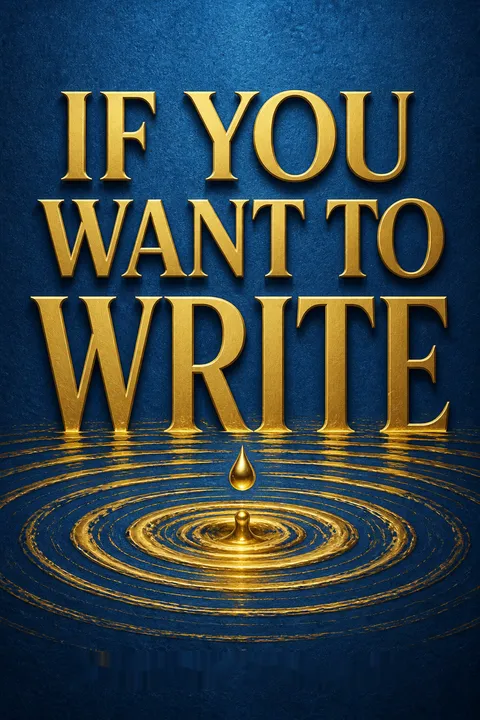


Key Takeaways
Assume you have something worth saying, then prove it by making.
Begin with permission. Ueland taught writers from many walks of life, including people with little formal education. Again and again, she saw that each had original things to express once fear and imitation loosened their grip. Her picture of children putting on plays makes the point vividly: they wrote, acted, built a stage, made costumes, and recruited an audience, all for the pleasure of making something together.
Capacity is not a credential. Ueland does not promise that every attempt will be brilliant or published. Her claim is that creative work is not reserved for a gifted-looking elite. Treat the impulse to make something as worth taking seriously, and develop it through practice rather than waiting for an expert to certify it.
What's useful here is the distinction between permission to begin and a guarantee of excellence. The first is broadly available; the second depends on practice, judgment, opportunity, and sometimes luck. Ueland's democratic claim pushes back against status-based ideas of who gets to create, but it can sound as though talent alone settles questions of craft. It does not. The practical payoff is still substantial: a person who stops treating creativity as a rare credential can start learning by doing.
Make art to understand what you love, not just earn applause.
Creation changes perception. Ueland imagines a Renaissance nobleman writing a sonnet to communicate love, not to place it in a magazine. The writing helps him understand what he feels and distinguish genuine emotion from borrowed romantic language. Art is valuable before it earns an audience or a payment because making something can clarify the thing being made about.
Van Gogh's small drawing. As a young man, Vincent van Gogh sketched a twilight view on ordinary paper to show his brother what he saw. Ueland presents this as the impulse behind art: attention to something loved, followed by an effort to share it. She notes that he earned only about $109 from his paintings during his lifetime, a stark reminder that recognition is a poor measure of the value of making.
The strongest version of this argument is not that artists should ignore money, but that money cannot be the only measure of whether the work mattered. Making forces attention: a painter studies the sky more closely, while a writer must choose what a feeling actually consists of. That inner reward can sustain practice when public approval is absent. Still, intrinsic purpose does not remove material constraints. A person may need income, time, and support to keep creating, so the ideal of working for love should not become a demand to work without compensation.
Let ideas arrive slowly, in solitude, before forcing them into prose.
Make room for incubation. Ueland calls the reflective, unhurried state that lets ideas gather creative idleness. It is not anxious procrastination or collapsing into distraction. It means being alone long enough to notice what is happening within and around you, without demanding an immediate finished thought. She describes taking long walks, sometimes five or six miles, and finding that ideas came when she stopped treating the walk as a chore.
Speed can imitate progress. Ueland found that coffee and cigarettes helped her produce pages quickly, but those pages often felt commonplace or false. She draws on Tolstoy's view that a thought may need time to mature before the writer can judge it clearly. A quiet session at the desk can still count, even when the first thing written is only a stray observation.
This section distinguishes incubation from avoidance by its quality of attention. A walk spent noticing color, sound, and movement differs from time lost to worry, even if both look unproductive from the outside. The useful test is whether the pause leaves the person more observant and ready to make something. Ueland sometimes treats solitude as universally restorative, though it can feel unsafe or impractical for people under stress or with crowded responsibilities. The principle can scale down: a brief interval of undivided attention may be more realistic than a long solitary walk.
Give your own creative work time before duty consumes the day.
Protect a real appointment. Ueland argues that creative work should not be postponed until every obligation is finished, because obligations tend to multiply. She describes Francesca, a violin teacher who spent her daytime teaching and worked on her own book late at night. Francesca kept at it for decades because the project mattered to her, not because success was guaranteed.
Care is not the only contribution. Ueland especially addresses women whose housework and family care leave no time for their own interests. She suggests that a mother who closes the door for an hour of serious work can show her children that making things deserves respect. Her historical language is dated, but the underlying question remains relevant to anyone whose labor is treated as endlessly available: what personal work disappears when service to others takes every open hour?
The argument turns self-expression from a luxury into part of a life worth modeling. Children can learn not only from what adults tell them, but from seeing adults take their own work seriously. Yet an hour cannot simply be claimed by everyone on equal terms. Care work is often unevenly distributed, and isolation or poverty can make protected time difficult to secure. The modern extension is both personal and collective: set boundaries where possible, while also asking who shares the labor that makes those boundaries possible.
Write a reckless first draft before critics take the wheel.
Keep judgment out of the doorway. Ueland saw shy students stall because they were trying to avoid every bad sentence before writing one. She sometimes challenged them to write as badly as they could, a playful way to make failure less frightening. She also admired Francesca's violin teaching: instead of repeatedly pointing out wrong notes, Francesca kept the student's attention on the sound they were trying to make.
Encouragement reveals ability. In Ueland's classes, students often moved from stiff, formal exercises to lively writing when they felt safe enough to describe what they actually noticed. Praise was not empty flattery. It directed attention to a specific living detail, helping a writer recognize an ability already present. The method is to draft freely first, then use judgment to improve the work rather than to prevent it from existing.
The sequence matters. Early evaluation asks a fragile idea to defend itself before it has taken shape; later evaluation can help it become clearer. This is not an argument against standards, but for applying them at the stage where they can do useful work. Encouragement is most credible when it names what is working, as Ueland does with students' observations, rather than offering automatic praise. A writer still needs revision, but revision works better when it has something alive to revise.
Describe one real person exactly enough to make a whole type believable.
Start with the particular. Ueland uses microscopic truthfulness to mean close, unsentimental attention to what is actually seen and remembered. One student, Mrs. B., had been writing conventional fictional characters. Asked to describe a real elderly servant instead, she noticed the woman's face, clothes, guarded manner, and small acts of generosity. The resulting portrait felt vivid because it did not rely on stock signals for age, class, or personality.
Specificity carries meaning. Another student wrote about a childhood afternoon through domestic details: the patched couch, pictures on the wall, a storm, and the child's curious thoughts about a funeral. The particulars let readers infer warmth, fear, and humor without being told what to feel. Ueland's point is not that every detail belongs, but that precise observation can make an individual life recognizable to people who have never lived it.
A convincing particular often does more than a paragraph of general claims because it gives readers evidence from which to build their own understanding. The reader can picture a person's choices instead of being handed a label such as brave, lonely, or kind. But accuracy alone is not enough: a meticulous inventory can still be inert if the writer does not select details that matter. The craft lies in seeing closely and choosing carefully, so that the concrete object or gesture carries emotional weight without being forced to symbolize everything.
Keep a fast, private diary to catch truths your polished voice edits out.
Write before you perform. Ueland recommends a quick, informal diary that records what a person noticed, thought, or felt, without stopping to make it respectable. Her term True Self refers to the immediate, changing perspective that can be obscured by the identity a writer thinks they are supposed to present. In one classroom exercise, a teenager's opinions about Thoreau emerged through conversation and questions before they became a school essay.
Distance reveals the pattern. Ueland suggests putting pages away for months before rereading them. The delay can make familiar experiences look newly specific, and show the writer what they were drawn to before they began explaining or editing it away. A diary is not required to be publishable. Its purpose is to build a record of attention, expose habitual evasions, and give the writer material to understand.
Private writing can serve as a low-stakes laboratory: the writer can notice contradictory feelings without immediately turning them into a public position. That makes it useful for discovering material, not automatically for establishing what is true about other people. Diaries are selective records, shaped by memory and mood, and their first interpretations may be unfair. Ueland's advice works best when the diary is treated as evidence about the writer's experience, not as an infallible account of events. The later act of reflection matters as much as the initial rush.
Let your character show through the work, not through self-advertising.
The person behind the sentences. Ueland calls this the Third Dimension: the writer's personality and way of seeing that readers sense beneath the literal words. A piece may avoid using the word I and still reveal whether its author is attentive, dismissive, generous, or vain. She gives the example of a servant's hurried note about being constantly rushed and longing for an ordinary walk. Its plain language made the writer's daily exhaustion and desire for freedom palpable.
Character is not a pose. Ueland warns that a writer who keeps insisting that a character is admirable may make the reader distrust both the character and the author. Let actions and details do the work. She connects strong writing with compassion and honesty, though not with sugary goodness: a writer must be willing to look directly at selfishness, anger, and sorrow rather than perform a virtuous identity.
Readers do not encounter sentences in a vacuum. Their choices of detail, emphasis, and restraint create an impression of the mind that arranged them. That impression can make even plain prose feel humane or make polished prose feel manipulative. Ueland's ethical emphasis is valuable, but artistic force does not require the writer to be morally flawless. A more practical reading is that sustained attention and resistance to cheap caricature improve the work, while the writer's personality remains visible whether or not the writer intends it.
Write toward a listener, because art is shared feeling.
Give the feeling somewhere to go. Ueland draws on Tolstoy's idea that art transmits an emotion from maker to audience, which she describes as art's infection. A reader need not decode a hidden message before feeling what the work conveys. Van Gogh's effort to show his brother a particular sky is one example: the work begins in an experience and becomes an offer to another person.
Imagine someone listening. Ueland says that a writer can picture a specific listener, even an imagined one, to test whether the story is engaging and clear. This is not the same as chasing applause or changing the work to satisfy every taste. It is a way to remember that writing is an act of communication. The writer's task is to share an honestly felt perception in a form another person can enter.
The listener offers a useful counterweight to both self-display and audience pandering. A writer can ask whether another person can follow the experience without asking whether every person will approve. That distinction preserves artistic independence while making communication part of the craft. Ueland's emphasis on immediate feeling is persuasive for much storytelling, but not every work aims for instant comprehension; some art deliberately asks for patience or rereading. Difficulty is not automatically a trick. The sharper question is whether the difficulty serves the work's experience or merely advertises its sophistication.
Analysis
Ueland's lasting contribution is less a set of writing rules than a theory of creative permission. She argues that people become blocked when they mistake skill for a birthright granted by institutions, or mistake criticism for the only route to improvement. Her answer is to restore an order of operations: notice, make, then judge. The sequence links private attention to public form, and it explains why her practical advice ranges from walking alone to describing a servant's face with care.
A contemporary lens can connect this method to incubation, intrinsic motivation, and psychological safety. In each case, performance improves when exploration is not immediately punished by evaluation. Yet Ueland's spiritual language is not necessary to the method. Readers can interpret imagination as unconscious processing, accumulated perception, or simply the mind's capacity to make connections. The practical instruction survives the metaphysics.
The argument also needs boundaries. Ueland sometimes treats creativity as a universal resource that only requires confidence and time. But time, security, health, education, and freedom from care obligations are distributed unequally. Her insistence that women claim creative lives is forceful, though individual resolve cannot substitute for shared labor or material support. Similarly, personal truth is a starting point, not proof: sincere writing can be mistaken, self-absorbed, or unfair to its subjects.
Taken together, the book offers an unusually humane account of craft. It does not ask writers to choose between freedom and discipline. It asks them to put discipline in service of seeing more truly, instead of using it to avoid the risks of beginning. The result is a practical ethic: protect attention, make the rough thing, stay exact about experience, and revise without erasing the source of the work.
Review Summary
If You Want to Write receives mostly positive reviews for its inspiring and encouraging approach to writing. Readers appreciate Ueland's emphasis on creativity, self-expression, and trusting one's inner voice. Many find the book life-changing and return to it repeatedly for motivation. Some criticize its repetitiveness, dated language, and religious references. While most reviewers recommend it for aspiring writers, a few argue that it oversimplifies the writing process and neglects craft. Overall, the book is praised for its warm, enthusiastic tone and its focus on unleashing individual creativity.
People Also Read

Glossary
creative idleness
unhurried imaginative attentionUeland's term for periods of quiet, unforced attention in which thoughts can develop without demands for immediate productivity. It may happen while walking, sitting alone, or doing a familiar activity. It is distinct from anxious indecision, physical collapse, or passive distraction. The point is to let experience and ideas gather before trying to shape them into finished work.
microscopic truthfulness
precise observation of particularsA writing practice that attends closely to what a person, place, or event actually looked and felt like, rather than relying on conventional types or impressive-sounding generalizations. Ueland presents exact particulars as a path to believable writing. The term does not mean recording every detail indiscriminately; the writer selects observations that make the experience vivid and emotionally legible.
True Self
immediate, changing inner perspectiveUeland's name for a person's direct perceptions, feelings, and thoughts before they are reshaped to satisfy convention, approval, or a desired public image. It is not a fixed personality or a guarantee that every impulse is wise. She treats it as changing and discoverable through creative work, honest attention, and repeated attempts to express what one actually experiences.
Third Dimension
the writer's presence beneath wordsUeland's term for the personality readers sense behind the literal language of a piece. A writer's attention, generosity, vanity, or coldness can shape how the work feels even when the writer does not directly describe themselves. The Third Dimension is conveyed through choices of subject, detail, tone, and treatment of other people, not simply through first-person narration.
Art is infection
feeling passed from maker to audienceUeland's account, drawn from Tolstoy, of art as the communication of a genuinely experienced feeling. The maker gives the feeling form, and another person experiences some version of it through the work. In this view, artistic force depends less on display or explanation than on the work's ability to make an experience felt by someone else.
Divine ego
confidence in ongoing creative powerUeland's contrast to vanity or self-display. The Divine ego is a person's inward sense that they have creative capacity worth using, paired with continued effort, openness, and humility before what they do not yet understand. It does not rest on past achievement or demand public recognition. Its value lies in sustaining work and growth rather than proving superiority.
FAQ
What's "If You Want to Write" about?
- Encouragement for Writers: The book is a motivational guide for aspiring writers, emphasizing that everyone has talent and something important to say.
- Creative Freedom: It advocates for writing with freedom and authenticity, without being hindered by self-doubt or criticism.
- Art and Spirit: Brenda Ueland explores the connection between art, independence, and the human spirit, encouraging readers to express their true selves.
- Practical Advice: The book provides practical advice on how to overcome obstacles in writing and how to nurture one's creative spirit.
Why should I read "If You Want to Write"?
- Inspiration: The book is a source of inspiration for anyone who feels they have a story to tell but are held back by fear or self-doubt.
- Practical Tips: It offers practical tips on how to write freely and authentically, making it a valuable resource for both new and experienced writers.
- Empowerment: Ueland's message is empowering, encouraging readers to trust their own voice and creativity.
- Timeless Wisdom: Despite being written in the early 20th century, its insights into creativity and self-expression remain relevant today.
What are the key takeaways of "If You Want to Write"?
- Everyone is Talented: Ueland insists that everyone has talent and originality, and something important to say.
- Write Freely: She encourages writing with freedom and without fear of criticism, emphasizing the importance of self-trust.
- Creative Power: The book highlights the importance of using one's imagination and creative power, which Ueland equates with the divine.
- Persistence: Ueland advises writers to persist in their efforts, regardless of rejection or self-doubt, as the act of writing itself is valuable.
How does Brenda Ueland define imagination in "If You Want to Write"?
- Divine Power: Ueland describes imagination as a divine power present in everyone, akin to the Holy Ghost.
- Source of Creativity: It is the source of creativity and should be nurtured and expressed freely.
- Slow and Quiet: She emphasizes that imagination works slowly and quietly, and should not be forced.
- Life Itself: Ueland believes that imagination is life itself, and using it is essential for a fulfilling existence.
What advice does Brenda Ueland give about dealing with criticism in "If You Want to Write"?
- Ignore Negative Criticism: Ueland advises writers to ignore negative criticism and focus on their own creative instincts.
- Self-Trust: She emphasizes the importance of self-trust and believing in one's own voice and ideas.
- Critics as Obstacles: Critics are seen as obstacles to creativity, often stifling the imagination with their rules and judgments.
- Encouragement Over Criticism: Ueland suggests that encouragement and support are more beneficial to writers than criticism.
What is the significance of the title "If You Want to Write"?
- Invitation to Write: The title is an open invitation to anyone who has the desire to write, suggesting that the desire itself is enough to begin.
- Focus on Desire: It emphasizes the importance of wanting to write, rather than needing to be perfect or skilled from the start.
- Empowerment: The title empowers readers by suggesting that writing is accessible to everyone, not just a select few.
- Encouragement: It reflects Ueland's overall message of encouragement and support for aspiring writers.
How does Brenda Ueland suggest overcoming writer's block in "If You Want to Write"?
- Write Freely: Ueland encourages writing freely and recklessly in first drafts, without worrying about mistakes.
- Daily Practice: She suggests writing every day, even if it's just for a short period, to keep the creative flow going.
- Embrace Idleness: Ueland believes in the value of idleness and moodling, allowing ideas to come naturally without force.
- Focus on Enjoyment: She advises focusing on the enjoyment of writing rather than the pressure to produce something perfect.
What are the best quotes from "If You Want to Write" and what do they mean?
- "Everybody is talented, original and has something important to say." This quote emphasizes Ueland's belief in the inherent creativity and value of every individual's voice.
- "The imagination works slowly and quietly." It highlights the importance of patience and allowing ideas to develop naturally.
- "Art is infection." Ueland suggests that true art is about sharing feelings and experiences that resonate with others.
- "Be careless, reckless! Be a lion! Be a pirate! When you write." This encourages writers to be bold and fearless in their creative expression.
How does Brenda Ueland view the relationship between writing and self-discovery in "If You Want to Write"?
- Writing as Self-Discovery: Ueland sees writing as a tool for self-discovery, helping individuals understand their true selves.
- Expression of the True Self: She believes that writing allows people to express their true thoughts and feelings, leading to personal growth.
- Overcoming Fear: By writing freely, individuals can overcome fears and doubts, gaining confidence in their own voice.
- Continuous Learning: Ueland suggests that writing is a continuous process of learning and self-improvement.
What role does imagination play in "If You Want to Write"?
- Central Role: Imagination is central to Ueland's philosophy, seen as the driving force behind creativity and writing.
- Divine Connection: She equates imagination with a divine connection, a source of inspiration and insight.
- Encouragement to Use It: Ueland encourages readers to use their imagination freely, without fear of judgment or failure.
- Imagination as Life: She believes that imagination is life itself, and using it is essential for a fulfilling and meaningful existence.
How does Brenda Ueland address the fear of failure in "If You Want to Write"?
- Embrace Mistakes: Ueland encourages embracing mistakes as part of the creative process, rather than fearing them.
- Persistence: She advises writers to persist in their efforts, regardless of rejection or self-doubt.
- Focus on Enjoyment: By focusing on the enjoyment of writing, individuals can overcome the fear of failure.
- Self-Trust: Ueland emphasizes the importance of self-trust and believing in one's own voice and ideas.
What is Brenda Ueland's perspective on the importance of writing in "If You Want to Write"?
- Essential for Growth: Ueland believes writing is essential for personal growth and self-discovery.
- Expression of Truth: It allows individuals to express their truth and share it with others, fostering connection and understanding.
- Creative Fulfillment: Writing is seen as a fulfilling and joyful activity, a way to use one's imagination and creativity.
- Impact on Society: Ueland suggests that if everyone wrote, it would lead to a more compassionate and understanding society.
Download PDF
Download EPUB
.epub digital book format is ideal for reading ebooks on phones, tablets, and e-readers.








