

Key Takeaways
Treat ikigai as a lived source of value, not a perfect career.
Meaning can be ordinary. Ikigai is a Japanese idea for what makes life feel worth living. It may be work, but it can also be family, a personal dream, or the simple sense that life has value. A survey of 2,000 Japanese people cited in the book found that only 31 percent identified work as their ikigai. The concept is therefore broader than finding a job that matches your talents and passions.
Look beyond achievement. The book connects ikigai with curiosity, relationships, and daily activities that make someone feel engaged. Its central invitation is not to invent an impressive life mission, but to notice what gives ordinary days direction and value.
The distinction between a source of value and a career plan is important because modern ambition often turns every interest into a productivity project. Ikigai offers room for meaning that is intimate, relational, and not monetized. That flexibility also makes the idea harder to measure: a person may feel purpose without being able to state a single defining mission. Treating the concept as a lived experience, rather than a label to acquire, preserves its humane scale and avoids making uncertainty feel like personal failure.
Use the four-circle map as a prompt, not a Japanese rulebook.
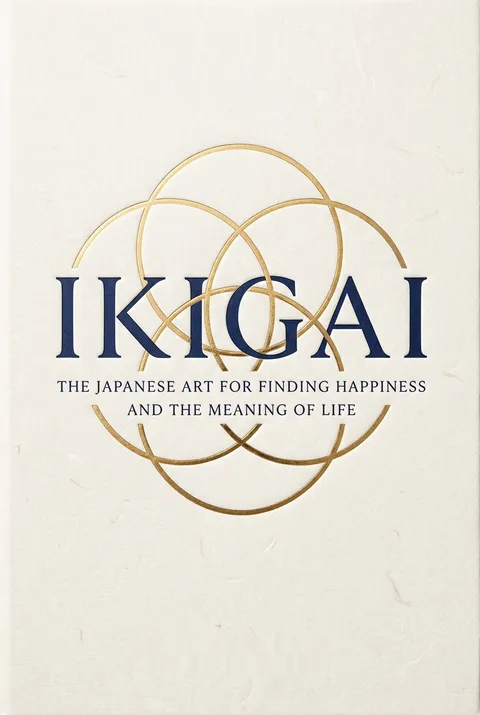
The diagram is modern. The familiar four-part picture asks a person to consider what they enjoy, what they do well, what others need, and what might provide income. The book traces its popular form to Marc Winn, who combined an existing purpose diagram with the idea of ikigai. It notes similarities to Jim Collins's Hedgehog Concept, a model for finding an organization's overlap of strengths, motivation, and economic value.
Keep the distinction clear. This graphic can help organize career reflection, but it is not presented as an ancient Japanese teaching. In Japanese usage, ikigai need not involve employment, money, or one central intersection. Use the questions to generate possibilities, not to conclude that a life without a paid, world-changing vocation lacks purpose.
A useful model can still be a recent invention. Naming its origin helps readers separate the practical value of a diagram from the cultural authority sometimes attached to it. The circles encourage useful comparisons, especially for career decisions, but their neat intersections can imply that every worthwhile life has one solvable center. Real commitments often conflict: care work may matter deeply and pay little, while a stable job may fund a meaningful life outside work. The map is strongest as a conversation starter, not a verdict.
Let purpose emerge through practice, curiosity, and changing seasons.
Purpose can be discovered gradually. The book describes ikigai as something people may find through patient reflection, rather than a revelation that arrives fully formed. It can also change as circumstances change, and a person can have more than one source of meaning. Curiosity helps identify promising directions: Steve Jobs's interest in typography led him to study it, and the book connects that experience with Apple's later attention to computer design.
Notice repeated energy. Danielle Dineen, a burned-out professional, recognized that she most enjoyed listening to friends and helping them think through problems. That pattern prompted her to study social work and become a therapist. Her story suggests a practical method: look for activities that repeatedly feel absorbing, useful, and aligned with existing strengths.
This account treats identity as something partly made through action, not merely uncovered by introspection. Trying an interest gives a person evidence that reflection alone cannot supply: whether the activity remains compelling when it involves effort, practice, or responsibility. The approach also reduces pressure to choose a permanent identity before beginning. Still, energy is only one signal. Novelty can feel exciting without being sustainable, and care duties can be meaningful even when they are exhausting. Patterns across time are more informative than a single burst of enthusiasm.
Protect daily roles and close friendships, especially after formal work ends.
Connection gives life structure. The book describes Okinawan moai, groups of peers who meet and maintain close social ties. It presents these networks, alongside family relationships and community participation, as part of the support surrounding long-lived residents. A sense of belonging can provide companionship, practical help, and a reason to stay engaged with other people.
Retirement need not mean withdrawal. The account emphasizes that many older Japanese people continue activities they enjoy for as long as their health allows. The valuable point is not that everyone should keep a job, but that leaving paid employment need not erase useful roles or regular contact. Walking with others, tending a garden, helping family, or participating in a group can keep daily life connected and active.
Purpose is often treated as an individual achievement, yet this section makes its social conditions visible. A role becomes sustaining partly because other people recognize it, rely on it, or share it. That shifts the question from finding a grand personal mission to building repeated occasions for contribution and contact. The caution is that social obligation can also become a burden, particularly when support is unequal. Connection is most protective when it includes reciprocity and choice, rather than demanding that older people remain productive to justify their place.
Purpose may support longevity, but it is not a biological guarantee.
The longevity link is suggestive. The book points to Okinawa and other so-called Blue Zones, places noted for unusually long-lived populations. It reports that a retrospective study by Robert Butler found that older adults who could describe a sense of direction lived about eight years longer than those who felt rudderless. The book also describes lower rates of some chronic diseases among Okinawan centenarians.
Association is not proof. These observations do not establish that purpose alone adds years to life. The same communities also have social ties, daily movement, distinctive diets, and other shared conditions. The practical lesson is more modest: a reason to stay engaged may support habits and relationships that contribute to well-being, even if it cannot guarantee a longer life.
The most credible reading is that purpose belongs inside a web of influences, not above it as a solitary cause. People with direction may be more likely to maintain routines, seek connection, or care for their health; those same behaviors could also help preserve a sense of direction. The relationship can run both ways. This framing keeps the idea useful without turning longevity into a moral scorecard. People facing illness or hardship are not failing to find purpose, and a long life is not proof of superior meaning.
Align business purpose with capability, genuine need, and financial survival.
The framework also scales to organizations. The book asks companies to examine what energizes their work, what they are good at, what people need, and what customers will pay for. The overlaps can reveal a purpose that is both useful to the world and feasible as a business. A company that offers something people value but cannot deliver well may disappoint; one that excels at an unwanted product may struggle to find a market.
Purpose must become organizational practice. A stated mission matters only if employees can recognize it in the work and feel connected to it. The book argues that a clear reason for being can help workers feel pride and affiliation. Its four-part exercise is best used to test strategic fit, rather than to decorate a brand with uplifting language.
The business application usefully prevents purpose from becoming detached from competence and economic reality. It asks whether good intentions meet actual demand and whether an organization can deliver reliably. Yet the framework does not resolve conflicts between stakeholders: customers may want low prices, workers may need better pay, and owners may prioritize returns. A credible purpose therefore requires decisions about whose needs take precedence when the circles do not align. The model can clarify a strategy, but it cannot replace governance, fair working conditions, or accountability.
Build longevity from ordinary movement, social ties, and varied meals.
The routine matters more than a trick. The book connects Blue Zone longevity with several everyday patterns: people stay active, walk or garden, maintain strong relationships, and eat relatively little meat and processed food. Its ten practical guidelines also emphasize keeping active, easing the pace of life, spending time with friends and nature, expressing gratitude, and staying present. These are ordinary habits, not an intense exercise plan or a single supplement.
Okinawa is one example. The book describes residents moving through daily tasks and gardening rather than relying on strenuous workouts. It also notes that several Blue Zones are islands where people depend on community ties. These observations suggest that health-supporting behavior can be built into daily life, though the text does not show that any one habit explains exceptional longevity.
This account makes health feel less like a specialized project and more like the shape of an ordinary day. Movement can be woven into errands, food can be shared, and social contact can recur through familiar routines. Such arrangements may be easier to sustain than isolated acts of discipline because the environment itself supports them. The limitation is that community habits cannot simply be copied without regard to local conditions, income, mobility, or caregiving demands. The useful question is not how to reproduce Okinawa, but which supportive routines fit a particular life.
Eat varied foods and stop before fullness becomes discomfort.
The Okinawan pattern favors variety. The book cites research describing centenarians who ate many different foods, with vegetables, tofu, and grains as staples. It reports that they consumed an average of 18 kinds of food daily and that vegetables supplied more than 30 percent of calories. Fish appeared several times a week, while pork was eaten less often. The book also compares average calorie and salt intake in Okinawa with higher averages elsewhere in Japan.
Hara Hachi Bu is the practice of stopping when nearly satisfied, before eating to complete fullness. Smaller servings on several plates are one way the book says this custom can be practiced. The text notes that human lifespan effects of calorie restriction remain uncertain, so the sensible emphasis is on nourishing variety and moderation, not extreme restriction.
The most transferable principle here is not a precise calorie target, but attention to both food quality and the point at which a meal stops feeling comfortable. Variety also makes the advice less dependent on a supposedly magical ingredient. Still, the Okinawan diet described in the book is embedded in culture, activity, and local food availability; it is not a controlled experiment that isolates diet's effects. The distinction matters because an appealing food tradition can inspire healthier choices without being treated as proof of a guaranteed lifespan outcome.
Analysis
This book combines a cultural introduction to ikigai with career advice, organizational strategy, longevity claims, and dietary guidance. Its most valuable corrective is its insistence that ikigai is not inherently a job, a source of income, or a single grand mission. Family, friendship, modest pleasures, and the felt worth of ordinary life all remain legitimate sources of meaning. That breadth counters a common Western habit of translating purpose into professional branding.
The book's own account also exposes a tension: it devotes substantial attention to a four-circle diagram, then explains that the popular graphic is a modern synthesis rather than a traditional Japanese framework. That clarification is essential. The diagram can help people compare interests, abilities, social needs, and income, but it should not define the whole concept. A person can have several ikigai, and those sources can change with age and circumstance.
The longevity narrative is best read as a collection of associations, not a causal demonstration. Okinawan elders are described alongside social connection, daily movement, diet, and purpose. The cited comparison between people with and without a stated direction is suggestive, but it cannot isolate purpose from health, resources, or relationships. Likewise, the dietary comparisons and calorie-restriction discussion do not establish that eating less will lengthen an individual's life. The book itself acknowledges uncertainty about human lifespan effects.
Its practical strength lies in lowering the stakes. Instead of demanding that readers discover a singular destiny, it offers questions for noticing energy, skills, contribution, and livelihood, while reminding them that not every answer needs to be paid work. Its weakness is that it sometimes moves quickly from lifestyle observations to broad health claims, and the source text's uneven phrasing makes some assertions difficult to assess. Read as a reflective guide, rather than a definitive scientific account, it offers a useful orientation: build a life with reasons to engage, people to share it with, and routines that make engagement possible.
Review Summary
The reviews for Ikigai by Michael Luck are overwhelmingly negative, with an overall rating of 2.80 out of 5. Readers criticize the book for poor writing quality, with some suggesting it reads as if it was poorly translated. Many reviewers find the content to be unoriginal, describing it as a "rip off" of better works on the topic. The book's structure and argumentation are also criticized, with one reader noting the lack of a coherent argument. Several reviewers couldn't finish the book due to these issues, recommending alternative sources for information on Ikigai.
People Also Read



Glossary
Ikigai
A source of life's valueA Japanese term for a source of value in life or the feeling that life is worth living. It can refer to work, family, a personal dream, or another meaningful activity. The book stresses that ikigai need not be a career, a paid pursuit, or one permanent life mission.
Moai
Okinawan peer groupA close group of peers associated in the book with Okinawan social life. Members meet and sustain relationships, forming part of a wider network of connection and mutual support. The book presents such ties as one feature of community life in regions known for exceptional longevity.
Hara Hachi Bu
Stop before completely fullA Japanese eating practice described in the book as stopping a meal when nearly satisfied rather than continuing until completely full. It is associated with smaller portions and mindful moderation. The book presents it as a traditional habit, not as proof that a particular calorie level guarantees longer life.
Blue Zones
Regions noted for longevityThe book uses this name for five regions associated with unusually long-lived populations: Okinawa, Sardinia, Loma Linda, the Nicoya Peninsula, and Ikaria. Their residents are described as sharing patterns such as daily movement, social ties, and particular food habits. These comparisons are observational and do not isolate one cause of longevity.
Hedgehog Concept
Focus on overlapping strengthsA framework from Jim Collins's business writing, discussed in comparison with the popular four-circle ikigai diagram. It guides an organization to identify the overlap among what it can do especially well, what motivates it, and what supports its economic viability. The book notes that the two models have a family resemblance, while treating the diagram's origin as a modern synthesis.
Download PDF
Download EPUB
.epub digital book format is ideal for reading ebooks on phones, tablets, and e-readers.








