Key Takeaways
1. Modern Dating: A Humorous Marathon of Confusion
It’s been exhausting, but at least I had peanut butter.
Dating is bewildering. The landscape of modern dating is a perplexing maze, far removed from the romanticized notions of previous generations. The author recounts a personal history spanning everything from five OkCupid dates a week to celibacy, nonmonogamy, and even eating peanut butter mid-sex, highlighting the sheer variety and often bizarre nature of contemporary romantic pursuits. This relentless cycle, though draining, provides ample material for reflection and humor.
New rules, new problems. Today's dating game is characterized by phenomena like swiping, ghosting, and breadcrumbing, terms unfamiliar to older generations. These digital-age behaviors create a unique set of anxieties, such as obsessively analyzing why a crush liked a pancake photo but not French toast. The author, having navigated this shift since getting her first iPhone in college, finds herself constantly grappling with the evolving etiquette and emotional toll of dating in a hyper-connected world.
The elusive "fun" factor. Despite the exhaustion, the author questions if dating is even supposed to be fun, contrasting her experiences with her mother's innocent query. She admits to a goal-oriented approach, viewing dating as a means to find a permanent partner, leading to feelings of failure and jealousy when friends settle down. Ultimately, she concludes that if the cycle is inevitable, one might as well try to find amusement in the "heart-wrenching, distressing, infuriating, annoying, terrifying, soul-crushing" institution that is modern dating.
2. Dating Apps: The Illusion of Choice and Ease
Dating apps are marketed as a way to make dating easier, but they’re really just a way to make getting a first date easier.
Quantity over quality. Dating apps, while simplifying the initial connection, often lead to "volume-dating" without genuine connection. The sheer number of profiles creates an illusion that the "perfect match" is always just one swipe away, trapping users in an endless cycle of swiping and accumulating "eighty-nine dick pics." This ease of access can lead to giving time to people with whom there's no real chemistry, simply because the initial interaction was effortless.
A satirical solution. The author humorously proposes "Mutually Scorned," a dating app designed to match people who have rejected each other. The premise is that human insecurity makes people more interested in those who initially disliked them. This satirical concept highlights the often counterintuitive psychology at play in online dating, where users might swipe "yes" for self-esteem boosts rather than genuine interest, a pitfall "Mutually Scorned" aims to exploit by ensuring no user ever feels good about themselves.
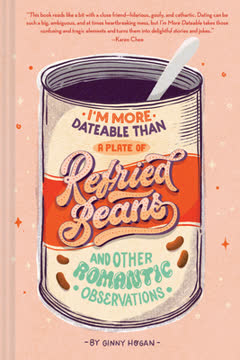
The refried beans experiment. In a quest to prove her own attractiveness, the author details an experiment using Tinder's "smart photos" feature. She created five separate Tinder accounts, each pitting one of her photos against a picture of cold refried beans. This absurd scientific endeavor, complete with overnight-fried beans and eyeliner-recorded data, culminates in a triumphant (and hilarious) victory for the author, underscoring the lengths people go to for validation in the app-driven dating world.
3. Technology's Grip: Texting, Social Media, and Miscommunication
Typing paragraphs, pages, and whole diaries into a device that saves them permanently is nothing short of heroic.
Digital communication chaos. Managing a love life alongside technology is a full-time job, turning social interactions into anxiety-inducing, permanent records. The author highlights the pitfalls of texting and social media, from arguments arising from unseen facial expressions to frustration over a partner not liking an Instagram post. The constant evolution of digital etiquette, like knowing who viewed Instagram stories or the "rules" of Snapchat, makes it impossible to keep up without confusion or anxiety.
The "three-day rule" is dead. The traditional "three-day rule" for texting back is now obsolete, deemed a "lifetime" in the age of instant communication. The author proposes increasingly shorter and more absurd alternatives, such as:
- The 7-Minute Rule (to avoid UberPool cancellation fees)
- The 4-Subtweet Rule (before declaring someone "canceled")
- The 2-Taylor-Swift-Album Rule (before questioning commitment)
These rules underscore the heightened expectations and rapid judgments made in digital interactions.
The ghosting phenomenon. The author humorously transports the concept of "ghosting" to the 1800s in "Phantoms and Prejudice," where Lizzie Bennet is aghast at the idea of Mr. Darcy simply not responding to a letter. This anachronistic scenario highlights the timeless nature of poor communication and the unique cruelty of disappearing without a trace. The piece also includes a "True Life" section on people who actually lost their phones, offering rare, legitimate excuses for unreturned texts, though often with a humorous twist.
4. Red Flags: More of a Checklist for Future "I Told You So's"
If you notice some red flags on the dating apps and want to follow my reasoning for how to ignore them, read on.
Ignoring the obvious. The author humorously asserts that red flags in dating profiles serve one primary purpose: to be cited as proof after a relationship inevitably fails. She provides a "how-to" guide on ignoring these warning signs, suggesting that a proactive approach to self-sabotage is often the chosen path. This cynical yet relatable take on dating behavior highlights the human tendency to overlook glaring issues in the pursuit of connection.
A spectrum of warning signs. The "how-to" guide offers increasingly alarming red flags and the author's tongue-in-cheek methods for dismissing them. Examples range from minor inconveniences to outright criminal behavior:
- "Not looking for anything serious" becomes "You'll change them."
- "Pictures of them holding knives" is rationalized as "A chef! How nice the foie gras will be."
- "They ask for your Social Security number" is interpreted as "They're taking an interest in your life!"
- "An FBI agent just showed up at your house" is met with "Maybe he's single."
The ultimate red flag. The only red flag deemed impossible to ignore is "Their profile says 'Live Laugh Love' on it." This singular exception, amidst a litany of dismissible dangers, underscores the author's specific brand of humor and her disdain for cliché, unoriginal expressions, even when faced with potential financial ruin or federal investigation.
5. Early Dating: Navigating Quirks and Unspoken Rules
With early dating, we’re often so caught up in the excitement of a new person that we go with the flow.
The early-date tightrope. Early dating is a delicate balance of excitement and strategic self-presentation, often leading to overlooking quirks or even adopting new personas. The author recounts going to a comic book museum on a second date, a testament to how much one might "like a person" to endure such an activity. This phase is fraught with unspoken rules—don't have sex too soon, don't text too much—all in the hope of reaching a stage where rules no longer apply.
Sex timing: An overthought dilemma. The author delves into the absurd complexities of when to have sex, humorously questioning if the "third date is too soon to have sex for the third time." She offers convoluted guidelines, such as spacing out "sex instances" between dates and the absolute necessity of 74 sexual encounters by the eighth date for a "successful, long-term relationship and also a UTI." This satirical overthinking highlights the anxiety and arbitrary rules often imposed on sexual encounters.
"Quirky" interpretations. The author, frequently labeled "quirky," offers her "astute assumptions" about what dates actually mean by the term. These interpretations range from "Weird, but bangably so" to "Substantially more interesting than me. This is intimidating." This self-aware humor dissects the subtle insults and backhanded compliments often disguised as observations, revealing the underlying judgments and insecurities that permeate early dating interactions.
6. Relationships: Undefined, Unpredictable, and Often Unromantic
I’m no expert—the only thing I know for sure about relationships is that calling your romantic partner your “partner in crime” should be more illegal than most actual crimes.
The nebulous nature of commitment. Modern relationships often defy traditional labels, existing in a state of "Undefined Partnership." The author humorously outlines "Terms and Conditions" for such a relationship, including clauses on ex-lover disclosure, meeting parents "by accident," and the partner's sole responsibility for apologies. This satirical contract highlights the confusion and lack of clarity that can plague contemporary romantic connections, where even the term "romantic situation" requires careful qualification.
Rom-coms: A source of false hope. The author laments how rom-coms have instilled inaccurate expectations about sex and relationships. She lists "inaccurate things rom-coms taught me about sex," such as it being "over in six seconds, but with an outcome both people find satisfying" or "with a man I hated three scenes ago." This disillusionment extends to "love songs you'll realize are deeply unromantic," dissecting lyrics to expose underlying misogyny, insecurity, or outright creepiness, like OMI's "Cheerleader" or The Cure's "Friday I'm in Love."
The "partner in crime" origin. The author provides a hilarious, convoluted origin story for the phrase "partner in crime," involving star-crossed lovers, a golf course murder, and a police interrogation. The couple, Abner and Beamer, embrace the "partner in crime" label to escape their parents' houses and hide their secret romance, only for a preteen with a smartphone to overhear and popularize the phrase. This tale satirizes the trivialization of serious concepts and the often-absurd ways cultural trends begin.
7. Fighting: An Inevitable Dance of Misunderstandings
I don’t think fights are necessarily unhealthy, but my goal for my next relationship is to get that number down to about 91 percent.
The author's fighting style. The author candidly admits to initiating approximately 92% of her romantic fights, a number she hopes to reduce to 91% in future relationships. She shares "profound realizations" like avoiding text fights and checking for hunger before starting an argument. This self-deprecating humor highlights the common, often petty, triggers for conflict in relationships, acknowledging that some fights are funny in retrospect, while others reveal deep incompatibilities.
Therapist vs. reality. In a recurring segment, the author contrasts "What My Therapist Recommends I Say in a Fight vs. What I Say in a Fight." For instance, when late, the therapist suggests empathy and addressing abandonment fears, while the author simply states, "I'm not late, you're early." This comedic juxtaposition reveals the gap between ideal communication strategies and the raw, often irrational, responses that emerge in the heat of an argument, especially when dealing with royal duties or smashed 800-year-old plates.
The broomstick partner. The author offers a "how-to" guide for dealing with the shocking discovery that "Your New Partner Turns Out to Be a Broomstick in a Trench Coat." This absurd scenario serves as a metaphor for the disillusionment that can occur when a partner isn't who you thought they were. Advice includes:
- Staying calm and giving them a chance to explain.
- Realizing the low risk of STDs and pregnancy.
- Asking if the problem might be you for "human-normalizing."
- Embracing the new life, complete with "sparkly floors."
This extreme example humorously underscores the need for acceptance and adaptability in relationships, even when faced with inanimate objects.
8. Breakups & Exes: The Art of Moving On (or Not)
I’m on fine terms with a lot of my exes, as I don’t hold grudges (I just choose to permanently like people slightly less).
A seasoned veteran of being dumped. The author proudly boasts extensive experience with breakups, having been dumped in various memorable (and often humiliating) scenarios: post-coitus, while attempting to ghost someone, at Quiznos on her birthday, and even at work. She reframes breakups not as romantic defeats but as "successful terminations," and views exes not as antagonists but as sources of Hulu logins and material for reflection.
The "mutual breakup" mystery. In a true-crime investigation parody, the author obsessively tries to determine if a couple's breakup was "actually mutual." She consults a Twitter expert on dating, who suggests "mutual" is used when one is dumped or dumps someone cruelly. The investigation, fueled by Hinge matches and ignored texts, highlights the author's insatiable curiosity and the often-unspoken truths behind relationship endings, ultimately revealing that the couple got back together, and the author was blocked.
Exes ruin everything. The author humorously lists "Things My Exes Have Ruined for Me," demonstrating how past relationships can taint seemingly innocuous aspects of life. These include:
- The Simpsons (now nuclear power plants make her cry).
- Michael Cera (reminds her of a breakup at her sister's graduation).
- Fedoras (no longer a turn-on).
- The Atlantic (too many assigned articles).
- "Women Named 'Karen'" (swipes no on all of them).
- Asparagus (because an ex looked exactly like one).
This segment playfully illustrates the lasting, often irrational, impact ex-partners can have on one's preferences and perceptions.
9. Getting Serious: A Journey Fraught with Societal Pressures
Do you mean to tell me the guy I’m currently splitting $2 tacos with while he tells me about his favorite memes (that meme that’s a “baked potato,” like a potato smoking weed—have you seen it??) might one day be responsible for me adding a new person to the world?
The bewildering path to commitment. The author expresses a mix of understanding and bewilderment regarding friends who get engaged, marry, or even look into preschools. She questions the traditional trajectory of relationships, especially when her own dating experiences involve splitting tacos with meme-loving partners. The idea of "getting serious" feels strange in the context of modern dating, where commitment can seem like "voluntary paperwork."
The "How I Met Your Father" parody. In a satirical "How I Met Your Father, 2034" story, the author recounts a convoluted, unromantic journey to parenthood. It involves matching on Hinge, finding the partner on four other apps, a "super romantic" text four months later, years of "hugging" (including other women), multiple breakups and reconciliations, a flu-induced commitment, and an accidental pregnancy due to a dislodged "princess ring." This narrative humorously critiques the often messy, non-linear reality of modern relationships compared to fairy tales.
The ticking biological clock. The author humorously details "The Hands on My Biological Clock," illustrating the relentless societal pressure on women to reproduce. Her timeline progresses from laughing at IUDs to nervous breakdowns over toddlers and frantic appointments at adoption agencies and fertility clinics. She even submits a "formal request for an extension on my fertility," citing reasons like dating men who use dish soap as shampoo and boycotting Amazon. This segment highlights the anxiety and absurdity surrounding female fertility in contemporary society.
10. Embracing Singlehood: A Deliberate and Often Joyful Choice
I’ll argue until the end of time that we need to let go of the idea that being in a relationship is preferable to being single.
Singlehood: A valid choice. The author challenges the default assumption that everyone desires marriage, arguing that being single can be a deliberate and fulfilling choice. She resents the idea that marriage is the "culmination of a relationship," despite her own fantasies of marrying anyone she's gone on more than two dates with. She emphasizes that time spent in relationships could be used for personal growth, travel, or even learning to juggle, and that choosing singlehood is a perfectly acceptable path.
Friends' perceptions vs. reality. In "My Life as a Single Woman, According to All My Friends in Relationships," the author satirizes the pity and misconceptions her coupled friends hold about her single life. They imagine her as constantly seeking a spouse, envious of their relationships, and "so bored of my vibrator." In reality, she enjoys her freedom, her own bed, and her career, finding happiness in her independence. This humorous contrast highlights the societal pressure to conform to relationship norms.
The struggle to stay single. The author, who claims to be "effortlessly single," offers a "how-to" guide on "Avoid Being Unsingle." Her advice includes:
- Breaking up with current partners via public Facebook comments.
- Throwing iPhones into the sea to delete dating apps.
- Being frugal to avoid spending money on dates.
- Hitting the gym instead of socializing.
- Communicating "effectively" by sending 197 texts back to a potential love interest.
This exaggerated advice underscores the pervasive nature of dating opportunities and the deliberate effort sometimes required to maintain single status, especially when friends are constantly trying to "fix" you.
Last updated:
Review Summary
I'm More Dateable than a Plate of Refried Beans receives mixed reviews with an overall 3.39/5 rating. Readers appreciate Ginny Hogan's humor and satirical take on modern dating apps and relationships, with many finding it hilariously relatable. However, critics note the book's repetitive format of lists, quizzes, and short stories feels like reading BuzzFeed articles. Some found it better consumed in snippets rather than cover-to-cover. The audiobook received criticism for monotone delivery. While praised for witty observations and entertaining content, detractors felt portions were unpolished or failed to deliver consistent laughs.