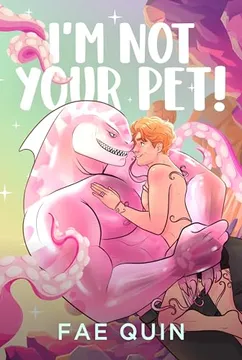


Plot Summary
The VIP Room Goes Quiet
For three years, Hugo1 has survived as a human captive on F’ukYuu, an alien pleasure planet, by turning fear into curiosity. Now the Manager8 orders him to satisfy an important visitor or risk punishment behind the facility’s red doors. Roark,2 a towering pink Sahrk captain, enters the private room and watches Hugo1 dance.
When Hugo1 kneels and reaches for his trousers, Roark2 stops him. Hugo1 thinks he has failed and will be punished, but Roark2 hears the fear beneath his apology and gently comforts him instead. He promises to make things right, then escorts Hugo1 to the Manager,8 determined to protect him from consequences neither can yet discuss.
Their first encounter reverses the expected power dynamic without pretending that Hugo is free. He is still working under threat, and Roark has authority simply by being a wealthy visitor, but he refuses to treat compliance as consent. Hugo’s panic exposes how thoroughly punishment has shaped his choices; Roark’s restraint creates the first moment in which touch means comfort rather than service. The encounter also establishes their shared loneliness: each recognizes something familiar in the other before either can explain it.
Roark Buys a Promise
Roark2 first noticed Hugo1 in a pleasure-house window, where the captive drew constellations in the fogged glass instead of posing for customers. After their private meeting, the Manager8 offers Hugo1 for two million credits.
Buying a person disgusts Roark,2 but he fears refusing will leave Hugo1 vulnerable, so he consults his first officer,3 Mala,3 and decides rescue must come before romance. The next morning, Hugo1 expects punishment when the Manager8 summons him, but Roark2 returns with translation headsets and completes the purchase.
He asks whether Hugo1 wants to stay; Hugo1 refuses. Roark2 takes that answer seriously, gathers Hugo’s1 few belongings, and leads him toward his ship, beginning their life together with a choice Hugo1 has rarely been allowed to make.
Roark’s decision is morally compromised by the system he is trying to oppose: he can free Hugo only by paying the person who claims ownership. The novel does not disguise that contradiction. Instead, it makes Roark’s conduct after the purchase decisive. He asks Hugo what he wants, accepts the answer, and treats the transaction as a route out rather than a claim to Hugo’s body. For Hugo, the offered choice is meaningful but difficult to trust, because even kindness arrives through the same machinery that commodified him.
Donuts Before Departure
Outside, Hugo1 sees the street he had watched for years through the venue’s glass, then notices Roark2 buying him an entire box of jelly-filled donuts. The simple gift makes leaving feel possible, though the ship waiting at the docks is another unknown.
Roark2 brings Hugo1 aboard The Dreamer and gives him time to explore his rooms. When the vessel launches, however, turbulence makes Hugo1 violently sick. Roark2 stays beside him, helps him wash, wraps him in blankets, and sleeps on the floor when Hugo1 cries after the lights go out.
Over the following week, Roark2 feeds him carefully and tries to make their shared quarters feel safe. Their first freedom is not effortless: Hugo1 has escaped the pleasure house, but must still learn how to live outside its rules.
The donuts matter because they are not payment for good behavior. Hugo can want something, receive it, and discover that no punishment follows. Yet rescue does not instantly undo captivity. His sickness, tears, and suspicion show that bodily safety and felt safety move at different speeds. Roark’s caretaking is sincere, but his instinct to manage every risk will soon repeat the structures Hugo has escaped. The ship becomes both refuge and a new place where the two must negotiate what freedom looks like.
The Leash Becomes a Wound
As The Dreamer travels between planets, Hugo1 fills his journal with strange plants, crystals, and species, while Roark2 keeps him close on a leash and often leaves him alone in their rooms. Roark2 means protection, but Hugo1 experiences the leash and the doglike bed as another form of ownership. After weeks of frustration, he finally tries to make Roark2 understand that he feels lonely and treated like an animal.
Roark2 cannot follow the words, but he recognizes the distress and opens his arms. Hugo1 chooses the embrace, then their comfort becomes mutual desire. Later, Roark2 invites him into his own bed. The shift is small in outward terms, but Hugo1 finally feels wanted as a person rather than managed as a possession.
The conflict grows from a painful mismatch between intention and impact. Roark equates vigilance with love because danger has taught him that control prevents loss; Hugo has learned that being cared for can still mean having no say. His anger is not a rejection of Roark so much as a demand for recognition. Their physical closeness becomes meaningful only after Hugo’s need to be heard has surfaced. Affection cannot substitute for autonomy, but it can become a way to repair the harm once both men begin to notice it.
A Dark Hallway
When Roark2 finally takes Hugo1 outside their rooms without the leash, Hugo1 is thrilled to explore the ship. He accidentally presses a hidden wall control, plunging the hallway into darkness. Roark2 slams himself around Hugo1 to shield him, then trembles so violently that Hugo1 realizes this is not anger but terror. He hums a childhood song until Roark2 can breathe steadily again.
That night, Roark2 wakes from nightmares and manages to tell Hugo1 that he is safe and that Roark2 will not hurt him. Hugo1 apologizes for frightening him, but Roark2 refuses to blame him. The two comfort each other, though Roark2 grows withdrawn afterward, leaving Hugo1 unsure why the darkness has unsettled him so deeply.
The blackout makes care reciprocal. Until now, Roark’s size and authority have positioned him as the protector, while Hugo has been the vulnerable one. The darkness reveals that Roark’s composure is built around an old wound, and Hugo’s voice and attention can steady him in return. Their apologies matter because neither turns fear into accusation. Still, Roark’s retreat afterward shows that intimacy does not cure trauma on contact. The couple has found a way to soothe one another, not yet a way to speak openly about what hurts.
Lessons After Midnight
Hugo’s1 isolation worsens when Roark2 keeps disappearing at night, and he secretly follows him through the ship, fearing Roark2 has chosen someone else. Instead, he finds Roark2 in Ushuu’s4 laboratory, practicing English with the older Sahrk and studying images of Earth. Hugo1 realizes the late nights are an attempt to learn his language, not a betrayal.
Roark2 later gives Hugo1 tools and broken translation devices to tinker with, then allows him to fetch food from the cafeteria on his own. When Hugo1 struggles with the unfamiliar kitchen, Mala3 helps him carry food and donuts back. Roark2 welcomes Hugo1 onto his lap rather than scolding him for the excursion. Their growing trust gives Hugo1 both companionship and the beginnings of independence.
The mistaken suspicion grows from the same conditions that make the couple vulnerable: they cannot yet communicate, and Hugo has been left alone with too much time to imagine rejection. Discovering Roark’s lessons revises the meaning of his absence through evidence of effort. At the same time, Roark’s trust is not merely verbal; he permits Hugo to move through the ship and make decisions. The scene with the cafeteria turns freedom into a practical skill, supported by friendship rather than granted as a reward.
Sha'hPihn Opens Up
At Sha’hPihn, Roark2 sends Hugo1 into the city with Ushuu4 and Mala3 while he handles ship business. The shops overwhelm Hugo,1 who has never had money to spend on himself. When he insists on a limit, Roark2 joins by communicator and gives him a budget of one million credits, asking him to enjoy the day.
Hugo1 chooses technology, clothes, and a glittering dress he had admired, while Ushuu4 helps him prepare for the formal event Roark2 has planned. In private, Hugo1 fears that his past and the collar around his neck make him unworthy of a date. Looking in the mirror, he discovers that he likes how the dress makes him feel. For once, he lets himself choose something beautiful because he wants it.
Shopping is not simply a luxury interlude. Hugo’s insistence on a spending limit reveals how unfamiliar he is with being allowed to want without calculating the cost to someone else. Roark’s generosity is most effective when it leaves room for Hugo’s judgment rather than replacing it. The dress also links appearance to self-recognition: Hugo is not transformed into someone else, but finds a way to inhabit a feeling he had been taught was not meant for him. Choice becomes visible on his body.
The First Date
Roark2 arrives in an ill-fitting tuxedo with a bouquet of carnivorous flowers, and Hugo1 is delighted by both the flowers and Roark’s2 effort. At the ball, rented translators let them speak freely for the first time.
Roark2 explains that he is courting Hugo1 and intends to mate for life; Hugo1 admits he had mistaken the leash for pet ownership, while Roark2 apologizes for letting protection resemble control. They dance badly and exchange questions written on Roark’s2 carefully prepared list.
Hugo1 describes neglectful parents10 and the birthday party they missed; Roark2 shares his orphanhood, the people who raised him, and the grief that makes him fear losing those he loves. Their conversation turns attraction into informed commitment, and they leave the ball understanding one another more clearly.
The translators do more than remove a language barrier. They allow each man to test the stories he has built around the other. Hugo’s fear that he is merely property meets Roark’s fear that he cannot love without controlling; both discover that their assumptions are understandable but incomplete. The awkward dance is an apt form for their courtship: neither knows the steps, and neither needs to pretend otherwise. Their intimacy deepens through disclosure, not through perfect performance.
The Collar Comes Off
After the date, Roark2 takes Hugo1 shopping and insists on choosing gifts together. At a jeweler’s, he brings Hugo1 to a private room where a technician can remove the metal collar welded around his neck. Hugo1 expects pain, but the collar comes away with only a small pinch. The relief releases years of grief: he sobs against Roark,2 mourning the life and freedom he once thought he would never regain.
Roark2 holds him until the tears ease, then helps him choose a jeweled choker to replace the bare feeling at his throat. The new ornament carries none of the old collar’s force. Hugo1 chooses to wear it, turning a mark of captivity into something beautiful that belongs to his present life.
The collar’s removal is a physical change with a delayed emotional cost. Hugo has survived by treating captivity as permanent, so freedom arrives first as grief for the person he had been forced to become. The replacement choker is not equivalent to the collar simply because both encircle his neck. One was imposed; the other is chosen. That distinction is the story’s central ethical measure: care becomes loving when Hugo can participate in defining what it means.
An Auction Changes Course
Leaving the shopping district, Hugo1 sees a platform where fifteen humans are being auctioned. He recognizes the collars and helplessness from his own captivity, then meets Briar,5 a winged, tailed human being used as a sample to entice buyers. When Briar5 questions whether Hugo1 is truly free, Hugo1 answers with certainty that Roark2 chose to release him.
He asks Roark2 to save the people on the platform as well. Roark2 assesses the cost and danger, then uses his authority and resources to secure all sixteen humans and bring them aboard The Dreamer. Hugo’s1 rescue has become a larger responsibility. Roark2 agrees, but the public escape makes the ship and its precious human passengers a target for pirates.
Hugo’s request grows directly from the freedom he has experienced. He refuses to treat his rescue as an exception that absolves the system around him, and Briar’s skepticism forces him to articulate why he trusts Roark. The choice also tests Roark’s love in practical terms: saving more people means greater danger to his ship and crew. His agreement is neither a romantic gesture alone nor a simple act of wealth. It is a decision to accept responsibility for people whose safety cannot be guaranteed.
A Cargo Becomes a Target
During the weeks-long journey home, the rescued humans settle into spare space aboard The Dreamer, while Hugo1 helps them adjust and works with Ushuu4 in the laboratory. Roark’s2 old fear of pirate attacks returns because the ship now carries human captives as well as valuable cargo.
He tells Hugo1 little, but nightmares and sleepless nights expose the strain. Hugo1 learns that Ushuu’s glowing green fuel is dangerously poisonous while helping prepare and store it in sealed containers. Briar5 remains guarded, yet stays close to Hugo.1
Roark2 tries to protect everyone by anticipating every threat, while Hugo1 gains the knowledge and confidence to act for himself. The danger is no longer a distant possibility; the ship’s systems and cargo make an attack consequential.
This stretch turns the romance’s private habits into preparation for a collective crisis. Hugo’s laboratory work gives him knowledge that will matter under pressure, while Roark’s anxiety makes clear that protection can become paralysis when the threat cannot be controlled. The humans are not passive cargo in emotional terms: Hugo’s attention helps them build a fragile community, and Briar’s watchfulness complicates his prickly exterior. The poisonous fuel is introduced as technical responsibility, not a convenient weapon, which gives its later use moral and material weight.
Hugo Holds the Corridor
The pirates cut the lights and lockdown doors trap Roark2 on the bridge, where Mala3 restrains him from tearing through the security barrier. In the laboratory, Hugo,1 Briar,5 and Ushuu4 take cover until Grimm,6 a Sahrk pirate pursuing Briar,5 arrives and explains that the intruders are heading for the humans. Briar5 refuses to leave unless Grimm6 helps defend them.
Using Ushuu’s toxic fuel in small vials, Hugo1 and his allies ambush the boarding parties through the dark corridors. Roark2 watches through the ship’s cameras as they take down roughly thirty attackers, then rushes to Hugo1 when the lights return. They embrace, confess their love, and see Osheania through the bridge windows, their home finally close.
The climax inverts the couple’s established roles without erasing either one. Roark’s strength cannot reach Hugo through the sealed bridge, while Hugo’s knowledge, planning, and willingness to act keep the humans alive. The fuel that was introduced as hazardous laboratory material becomes a tool of defense, but its use is not costless: Hugo kills, and the narrative lets the act register as a survival decision rather than a playful triumph. Their reunion matters because Roark must accept that the person he loves can protect him too.
A Shipmate Returns
Once the ship is safe, Hugo1 asks Roark2 to help find Briar.5 Camera footage shows Briar5 leaving through the docking bay with Grimm6 and Kael,7 Roark’s former roommate,7 whom he had believed died in the earlier pirate attack that killed his first captain.9 The discovery unsettles Roark,2 while Hugo1 grieves the departure of his new friend.
They comfort each other rather than chase them blindly. The Dreamer continues to Osheania, where Roark2 helps the rescued humans obtain registration, medical care, and places to live. His siblings welcome the couple to the family property, and Roark2 takes Hugo1 to a small cottage of their own. After years of displacement, Hugo1 steps into a home he can choose to keep.
The revelation about Kael reopens a wound Roark had organized his life around, but the story refuses to let the mystery erase the immediate loss Hugo feels. Briar’s departure is a separation, not a betrayal, and the pair respond by honoring uncertainty rather than forcing control. Their arrival on Osheania resolves the practical question raised by the auction: the rescued humans are not simply moved from one vessel to another, but given legal standing and shelter. Home becomes both a place and a relationship that respects choice.
A Wedding Made Theirs
After settling on Osheania, Hugo1 and Roark2 marry in a ceremony prepared with care. Roark2 has researched human customs and surprises Hugo1 with permanent translators, while Hugo1 repairs the broken headsets Roark2 once gave him, turning an old symbol of separation into a wedding gift. They adapt the celebration to both cultures, dancing imperfectly among family, shipmates, and the humans they helped rescue.
The wedding marks more than a public promise: Hugo1 is no longer the person bought from a pleasure house, and Roark2 is no longer trying to protect love by keeping it at a distance. They begin married life with shared language, shared history, and a future neither could have imagined when they first met.
The ceremony resolves the story’s central problem of recognition by making commitment explicit and mutual. Their gifts translate the relationship into material form: the repaired headsets acknowledge how much was once lost in silence, while the permanent translators promise that communication need not depend on a temporary setting. Roark’s research and Hugo’s repair work show their differing ways of caring, both grounded in sustained effort. Marriage does not erase captivity or grief; it gives the pair a chosen structure in which those histories can be held without defining the whole future.
Epilogue
Three years later, Hugo1 and Roark2 share a peaceful home on Osheania, surrounded by Roark’s2 large family and the human community they helped establish. Hugo1 walks a beloved tamed Fruhg and spends time with Sahrk children, while Roark2 plans to reserve space for them in the birth pods after their next voyage.
Hugo’s1 life is full of birthdays, affection, and choices he once thought impossible. The tenderness that began in a locked pleasure-house room has become an everyday practice: Roark2 makes room for Hugo’s1 curiosity, and Hugo1 helps Roark2 face fear without facing it alone.
The epilogue makes the happy ending ordinary on purpose. Hugo’s healing appears not as a single declaration but in birthdays, a pet, children, and the confidence to imagine a family. Roark’s love remains protective, yet it has changed from confinement into shared planning. Their future includes another space voyage, so security does not mean retreating from risk. Instead, the couple trusts their accumulated experience and one another. The domestic details answer the opening’s deepest deprivation: Hugo is no longer valuable only when he performs, and Roark no longer has to mistake control for care.
Analysis
The romance is built around a precise ethical distinction: protection can feel like possession when the protected person has no meaningful power to refuse. Roark’s2 first impulse is to shelter Hugo,1 but the leash, restricted movement, and doglike bed reproduce the structure Hugo1 has just escaped, even though Roark’s2 intentions are loving. The story allows Hugo’s1 anger to expose that mismatch, then asks Roark2 to change his conduct rather than demand gratitude for his good intentions.
Both men carry histories that make affection difficult to trust. Hugo’s parents10 trained him to expect attention only when he performed well, while Roark’s2 early losses taught him to anticipate catastrophe and prevent it through vigilance. Their habits collide: Hugo1 hides need beneath humor, Roark2 hides fear beneath control. Translation makes their relationship legible, but listening matters just as much. Each learns to interpret the other’s body, silences, and small acts without treating an interpretation as certainty.
The plot expands private care into public responsibility. Hugo’s1 freedom gives him the perspective to recognize captives at auction, and his insistence that they be rescued asks Roark2 to extend his protection beyond the person he loves. When pirates attack, the reversal is complete: Roark’s2 fear cannot reach Hugo1 through the sealed bridge, and Hugo1 uses his scientific curiosity and Ushuu’s4 dangerous fuel to protect the ship. Love is tested not by whether one can save the other alone, but by whether each can accept the other’s agency.
The novel’s hopeful ending does not erase abduction, grief, or the danger of the wider galaxy. Instead, it gives these characters institutions and routines that make choice durable: citizenship, work, family, translation, birthdays, and a home they can shape together. Its deepest promise is not that nothing painful will happen again. It is that neither Hugo1 nor Roark2 will have to face the unknown as though love were another form of captivity.
Characters
Hugo
The curious survivorHugo is a brilliant, observant human who turns fear into questions, sketches, and jokes. Before his abduction, he hoped to study at Harvard; after being stranded on F’ukYuu, he protects his mind by finding something interesting in each alien he meets. His cheerfulness is not ignorance of danger but a survival practice, shaped by a childhood in which achievement brought more notice than emotional care. Hugo longs to be seen as desirable and worthy, yet he is also practical, technically gifted, and capable of leadership. What drives him is the chance to learn, to choose, and to belong without having to earn affection through usefulness.
Roark
The guarded captainRoark is a huge pink Sahrk captain, disciplined by military responsibility and old grief. He values safety, planning, and duty, and has built his identity around protecting the crew and bringing cargo home. His feelings are easier to read in the changing colors of his spots than in his careful speech; he often acts with tenderness before he can explain it. Roark is inexperienced in romance and afraid that love will expose him to another devastating loss. Hugo1 draws out a playful, uncertain side of him, but Roark’s deeper challenge is learning that devotion does not require controlling every risk or making decisions for the person he loves.
Mala
Roark's candid first officerMala is Roark’s2 close friend and first officer, a blue Sahrk who balances teasing with dependable counsel. He recognizes Roark’s2 romantic uncertainty before Roark2 can admit it and encourages him to give Hugo1 room to choose. Mala’s confidence comes from a settled family life and a practical understanding of partnership. He also trusts Roark’s2 judgment as captain, stepping in when fear threatens to make his friend reckless.
Ushuu
The patient mentorUshuu is the Dreamer’s older technology officer and Roark’s2 longtime mentor. Curious, intelligent, and gentle, he studies human culture and helps bridge the language gap between Hugo1 and Roark2. He shares knowledge without treating either man as foolish, and his experience lets him recognize when Roark’s2 fears are narrowing his choices. Ushuu’s quiet affection for Roark2 gives him the steadiness of family.
Briar
The guarded humanBriar is a pale, winged human with a tail, altered by experiences he does not readily discuss. His sharp humor and guarded manner function as armor, especially when others offer kindness too quickly. He is alert to the risks hidden beneath promises of safety, but his loyalty is stronger than his cynicism suggests. His bond with Hugo1 begins in recognition: both know what it means to have their bodies treated as commodities.
Grimm
The unreadable SahrkGrimm is a formidable Sahrk whose rough manner and independent code make him difficult to classify. He is blunt about danger and skeptical of Hugo’s1 ability to protect himself, yet he is willing to negotiate rather than simply impose his will. His connection to Briar5 reveals a softer loyalty beneath his threatening presence. Grimm’s guardedness mirrors the novel’s interest in the difference between appearing dangerous and choosing whom to defend.
Kael
Roark's former roommateKael is a fellow recruit and former roommate from Roark’s2 early years aboard the Dreamer. In Roark’s2 memories, he is playful, ambitious, and eager to see what lies beyond the ship. His history is closely tied to the event that shaped Roark’s2 understanding of danger and responsibility.
The Manager
The pleasure-house ownerThe Manager runs the F’ukYuu venue where Hugo1 is held and treats the human performers as merchandise. He uses threats and financial leverage to control the captives, making the institution’s cruelty personal and immediate. His polished bargaining manner masks a system that reduces human lives to commodities.
Captain Strongfoot
Roark's first captainCaptain Strongfoot is the experienced leader who teaches young Roark2 the habits of command. He values effort, discipline, and the potential of inexperienced recruits. Roark2 carries his example into his own leadership, especially in the way he gives younger crew members responsibility.
Hugo's parents
The absent familyHugo’s parents are successful enough to praise his academic achievements but emotionally unreliable in the moments when he needs their attention. Their neglect, especially around Hugo’s sixteenth birthday, teaches him to expect disappointment and to hide his needs behind competence.
Plot Devices
Temporary translators
A bridge with limitsThe headsets convert alien speech for Hugo1 and Roark2, but their use depends on location and access. On F’ukYuu, Hugo1 receives one because his visitor is important; aboard the Dreamer, the devices cannot provide reliable communication in space. That limitation keeps the couple dependent on gestures, observation, and imperfect guesses, creating misunderstandings without making either character indifferent. On Sha’hPihn, rented translators finally let them discuss their histories directly. Later, permanent translators make communication part of their shared life rather than a temporary privilege. The devices therefore track a relationship moving from inference toward mutual understanding.
Hugo's collar
A mark reclaimedThe metal collar welded around Hugo’s1 neck identifies his captivity and makes his lack of control visible. Its presence complicates Roark’s2 protective gestures, because Hugo1 initially reads the leash and collar as signs that he has merely changed owners. When a jeweler removes it, the physical absence releases grief Hugo1 had suppressed since his abduction. Hugo1 then chooses a jeweled choker, giving himself a new relationship to the object around his throat. The contrast rests on agency: the original collar was forced onto him, while the replacement is selected and worn by choice.
Sahrk color spots
Emotion made visibleSahrks’ spots change color with their emotions, giving Hugo1 a visual clue to Roark’s2 feelings even when language fails. At first, Hugo1 guesses at the colors, especially when Roark’s2 desire or anxiety appears in unfamiliar shades. As he learns their meanings, the spots become a practical emotional vocabulary, allowing him to recognize fear, embarrassment, calm, and attraction. They also counter Roark’s2 reserved speech: the captain can remain formally composed while his body reveals what he cannot yet say. The device makes emotional interpretation a learned act rather than an effortless assumption.
Ship lockdown
Safety that becomes a trapThe Dreamer’s emergency system seals secure sections when an attack is detected, protecting crew members from intruders and preserving the ship’s cargo. During the pirate assault, the protocol locks Roark2 inside the helm, the safest part of the vessel, while Hugo1 and other people remain outside it. The protection system therefore creates the central crisis: Roark2 cannot reach Hugo1, and his fear threatens to overwhelm his command. The same design that limits casualties also makes cooperation essential, forcing Roark2 to trust the crew and Hugo1 to act without waiting for rescue.
Ushuu's green fuel
A dangerous defenseUshuu’s4 fluorescent green fuel is a volatile, poisonous substance used to power the ship’s operations. Its danger is established while Hugo1 helps prepare and store it under careful laboratory precautions. During the pirate attack, Hugo1 turns that technical knowledge into a defense, filling small vials and using them to stop boarding parties in the dark corridors. The fuel is not a weapon introduced at the last moment: Hugo1 has handled it, learned its risks, and understands that an accident could harm allies as well as enemies. Its use marks his shift from curious observer to someone capable of making a consequential choice under threat.





Download PDF
Download EPUB
.epub digital book format is ideal for reading ebooks on phones, tablets, and e-readers.








