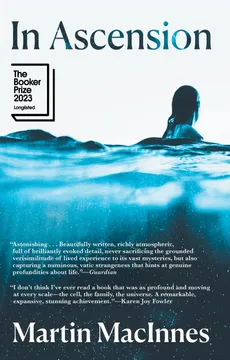


Plot Summary
Raised Below the Sea
Leigh grows up in Rotterdam, a city reclaimed from water, where her father Geert watches the tides and her mother Fenna disappears into mathematical work. Geert's own dream of becoming an architect collapsed after failed entrance exams; instead, he spends his life protecting the Netherlands from flooding as a hydraulic engineer. At home, his anger turns physical.
He beats Leigh, while her younger sister Helena learns to survive by staying quiet and keeping her distance. Fenna tends Leigh's painful growth spurts at night, massaging her legs and offering care she cannot give openly by day. Leigh grows tall, wary of taking up space, and learns that love and danger can arrive from the same hands.
Leigh's childhood makes physical growth both a biological fact and a moral risk. Her body expands beyond the proportions her father can tolerate, while the reclaimed ground beneath her home embodies a society sustained by constant, unseen labor. Geert's engineering gives him responsibility without the recognition he craves, and that thwarted identity curdles into violence. Fenna's tenderness is real but constrained, leaving Leigh to understand love through acts of bodily repair rather than speech. These conditions help explain Leigh's later attraction to microscopic life: she seeks a world where dependence is ordinary, not shameful.
The River's Living World
After Geert's death, Leigh and Helena take separate routes into adulthood. Helena moves abroad and builds a career in financial law; Leigh studies marine ecology, carrying Geert's water-management legacy into her own work without recognizing the inheritance. As a child, she had already found another way to look: a microscope revealed bacteria and amoebas living in ordinary water, while her swims in the Nieuwe Maas offered a temporary escape from home.
One swim, undertaken when despair nearly overcomes her, brings her face to face with a riverbed crowded with life. She returns to shore laughing, newly aware that she belongs to the living world she studies. The discovery deepens into a vocation for marine microbiology.
Leigh's scientific curiosity grows from a double need: to leave the house without leaving life, and to encounter herself without making her own history the only explanation. Microscopy gives her distance, while the river gives her immersion; together they establish a way of knowing that is neither detached observation nor simple identification. Her interest in microbial interdependence also quietly counters the family's isolation. Helena survives by separating herself from Leigh, but Leigh finds a larger belonging in organisms that exchange matter across boundaries. The science begins as refuge, then becomes a discipline capable of challenging the very idea of separateness.
The Skyward Promise
At twenty-three, Leigh collects algae from remote volcanic lakes in the Azores, enjoying work that lets her move by weather, terrain, and tide rather than family expectation. A sudden public announcement interrupts the quiet: engineers have achieved a propulsion advance that may transform space travel.
Leigh leaves the news unread until she reaches airport Wi-Fi, then finds a world speculating about what the technology might make possible. Later, in her doctorate's final year, her supervisor secures her a place as menial crew on the research ship Endeavour.
Leigh accepts because the voyage offers practical experience and a chance to study marine life. The ship's purpose is murky, but she boards eager to work near the ocean's oldest mysteries.
The propulsion announcement is less a promise of escape than a change in scale. Leigh's private vocation is suddenly adjacent to a technological upheaval whose implications no one can yet measure. Her decision to join Endeavour remains grounded in ordinary ambition: she wants research experience, not a cosmic destiny. That contrast matters. The novel's extraordinary events arrive through work, contracts, and professional opportunity, not through a chosen-one revelation. Leigh's scientific life is repeatedly redirected by institutions that know more than she does, exposing how curiosity can make a person both a participant in discovery and a resource to be managed.
A Ship Bound for Depths
Aboard Endeavour, Leigh serves meals, cleans cabins, and prepares dives while trying to identify the ship's researchers. She meets Amy Delacroix, a NASA engineer who designed the small autonomous submersible Scintilla, and Stefan, the expedition leader, whose fascination with ocean life matches her own.
Their conversations reveal that corporate mining interests helped fund the voyage, even as researchers debate the damage seabed extraction could cause. The stated target is a newly detected hydrothermal vent, but the reason it escaped earlier surveys is unclear.
Stefan explains that instruments sent to investigate were lost, and the world trade organization has restricted shipping around the site. As Endeavour heads into open water, scientific curiosity and commercial pressure travel together.
The ship's mixed purpose gives the expedition its central ethical tension before the vent appears. Research is not independent of extraction: the same data that might illuminate life's beginnings can also guide miners toward valuable metals. Leigh, positioned low in the ship's hierarchy, overhears debates while serving food, a literal form of invisibility that lets her register what official accounts smooth over. Amy represents technological caution, Stefan speculative wonder, and the mining consultant Nick Freeman economic realism. Their different interests converge on one location, but no shared vocabulary resolves what responsibility should follow discovery.
Thirty-Six Kilometres Down
When Endeavour reaches the restricted coordinates, the crew first uses sounding wire to map the vent's perimeter. Karlsson's team secretly tests the projected center and returns with a depth reading of thirty-six kilometres, three times deeper than the Mariana Trench.
The reading cannot be trusted, but it changes the crew's sense of safety: the instruments seem unable to describe the water accurately, and the ship appears to be pushed back from the site. After debate, Stefan orders Endeavour across the boundary.
No one volunteers to enter the water until Leigh raises her hand. During the dive, she feels herself carried into an immense, brightly alive ocean, then surfaces alone. The other divers and the zodiac are gone, and the ship is distant.
The impossible measurement turns a technical anomaly into a psychological presence. The crew begins to imagine the vent as something that resists them, a shift that reveals how quickly scientific procedure can acquire superstition when instruments fail. Leigh's decision to dive is not simple bravery: the water has long been both refuge and research subject, so entering it repeats the movement that once kept her alive. Her altered perception blurs observation and surrender. The scene asks whether a scientist can encounter the unknown without converting it immediately into either data or threat.
The Sub Goes Dark
Leigh's dive leaves her feverish, nauseated, and unsteady, but Stefan persuades the dive team to return to the water rather than alarm the rest of the ship. Scintilla continues downward while the divers repeatedly enter the upper layers, compelled to return despite their illness. The sub's video feed fails, then reappears with images of barren mineral formations and a new radar reading: the vent may extend another two hundred kilometres.
The crew cannot tell whether the instruments are measuring the seafloor or generating an error. Scintilla reaches 17.2 kilometres before contact is lost. The reading surpasses any known ocean depth, but the sub and its samples are trapped below, leaving the expedition with data that cannot be verified.
The illness makes discovery bodily before it becomes intellectual. Leigh and the others experience the vent not merely through screens but through fever, appetite, altered balance, and an involuntary desire to return. Stefan's decision to suppress discussion protects the mission, yet also suppresses evidence that might warrant stopping it. The machine's failure sharpens the novel's recurring problem of mediation: a reading is never the thing itself, and the deeper the unknown, the less confidence the instruments deserve. Yet the crew's dependence on those instruments persists, because their ambitions have already outrun direct human access.
Stefan Enters the Water
After Scintilla disappears, Endeavour prepares to return to port, with fuel and food problems reinforcing the decision. Before departure, a glow appears on the water. The crew recovers Scintilla's detached light and several burned exterior fragments, evidence that the sub encountered extreme heat from outside. The inner data modules remain missing, so the vent's true base and contents are still unknown.
As the ship moves away, Amy discovers that Stefan's diving gear is gone. Endeavour turns back and launches a search, but neither Stefan nor his body is found. Leigh understands his disappearance as a choice to return to the place that had drawn them all in. She leaves the expedition carrying no answer about what lives below.
The recovered light offers a cruelly partial resolution: the machine's destruction suggests contact with a real, active furnace, but the evidence needed to interpret it has vanished. Stefan's disappearance repeats the expedition's defining asymmetry, the desire to approach what cannot be safely understood. His decision is not presented as a clean scientific sacrifice; it is entangled with obsession, grief, and the intoxicating experience of the water. For Leigh, the search fails to restore a body or a conclusion. The vent remains both a physical location and an open question that will continue shaping her choices.
A Red Oval in Space
After quarantine, Amy helps Leigh secure a job at ICORS, the international institute formed to exploit the propulsion breakthrough. Leigh moves to California to develop resilient algae crops for a classified mission, hoping to make her research practical in microgravity.
Project director Uria initially gives her few details, but later takes her into a guarded auditorium and reveals Datura, a huge red oval moving through the solar system. Its surface bears enormous, repeated geometric carvings, and it behaves unlike any known asteroid.
Datura had appeared around the time of the propulsion breakthrough, which was reportedly inspired by vivid dreams. Leigh's work with algae, and the secrets surrounding the mission, now seem connected to the strange events she witnessed aboard Endeavour.
Datura alters the novel's scale without abandoning its material concerns. Leigh is not recruited as an astronomer or a visionary, but as a specialist in food, the practical infrastructure that keeps explorers alive. The red object's patterned surface introduces intentionality while withholding a readable message. Uria's controlled revelation also makes knowledge a form of institutional power: Leigh's labor has already been shaped by a mission she was not allowed to understand. The scene transforms professional recognition into unease, because being trusted with more information also means becoming more deeply implicated.
Voyager's Impossible Signal
Leigh connects Datura's repeated ovals with the Cassini-shaped vent she encountered on Endeavour. At Goldstone Observatory, Uria reveals a second anomaly: Voyager 1 has sent a repeated nineteen-digit signal from a position far beyond where it should be, close to the Oort cloud.
The signal carries no readable content, but ICORS believes it is linked to Datura and the propulsion technology. The planned mission will travel outward to investigate. Uria gives Leigh full clearance and makes her algae research central to the flight's food system.
Meanwhile, Leigh's mother, Fenna, grows increasingly forgetful and disoriented. Helena urges Leigh to take the signs seriously, but Leigh is reluctant to leave the work that has finally made her feel essential.
The Voyager signal reframes the propulsion breakthrough as a response to contact, but its blankness refuses the comforts of translation. Leigh is drawn to the mission because it may expose the origins of life, yet her growing commitment also offers a socially acceptable way to postpone the intimate demands of family. Uria recognizes Leigh's scientific value and her emotional vulnerabilities, even as she recruits her into a project whose risks remain opaque. The parallel between an unreachable probe and Fenna's fading communication is pointed: Leigh can pursue a signal across the solar system more confidently than she can answer a call from home.
Family Left on Earth
Leigh's algae work advances, but genetic changes are introduced without her approval until she halts the laboratory and forces Uria to explain. One proposed gene comes from an archaeal sample recovered on Endeavour, bringing the deep-sea expedition into the space program directly.
Leigh accepts the change under tighter oversight, then becomes a reserve crewmember for Proscenium 1. She trains with pilot Tyler and optical engineer Karius, first in weightlessness and then in underwater ship simulations.
At home, Fenna falls, gets lost at her university, and begins showing lapses that her daughters cannot dismiss. Helena handles appointments and visits while Leigh postpones returning to Rotterdam, afraid that leaving the mission would cost her place in the only work that feels fully her own.
Leigh's technical objection to the gene transfer is also a struggle over authorship: she insists that responsibility must accompany expertise. Yet her growing authority does not make her more available to her family. She understands systems and dependencies in the laboratory while treating Fenna's decline as a problem that can wait for a clearer signal. The contrast is psychologically precise. Work offers measurable tasks and a future-facing identity; caregiving demands attention without guaranteeing control. Helena's practical labor exposes the cost of Leigh's avoidance, even as Leigh tells herself that the mission's demands are exceptional.
Kourou Without Warning
After years of preparation, the California team expects to remain a backup while the primary crew launches from China. Instead, an attack compromises the Xichang site, and the primary crew can no longer participate. Leigh, Tyler, and Karius are removed from California under armed escort and flown to French Guiana.
At Kourou, officials isolate them in a filtered accommodation unit while they wait for details. The Institute refuses to confirm what happened to the Chinese crew, and the three reserves are told to stay mission-ready. Their training has been treated as a simulation of a simulation; now it has become the real mission. Leigh still has no chance to return to Fenna, and the launch timetable abruptly contracts.
The attack converts Leigh's long-running preference for work over family into an irreversible situation. Until now she could imagine that the mission was hypothetical, that there would be time to repair what she had postponed. Kourou removes that buffer. The institution's secrecy protects operational security but also makes the crew's lives feel administered rather than chosen. Tyler's distress over leaving his family and Karius's withdrawal make the cost visible, while Leigh's isolation is more complicated: she has no one nearby to say goodbye to, partly because she has spent years making herself unavailable.
Earth Shrinks to Blue
Once Proscenium 1 launches, the crew undergoes its first extreme acceleration and survives. Earth recedes through the ship's artificial porthole, provoking fever, exhaustion, and episodes of despair as their bodies register the planet's disappearance. Leigh opens the garden module and teaches Tyler and Karius to seed the first algae pouches, each timed to yield food in a monthly cycle.
The crop gives them shared work and a way to mark time. Control's transmissions grow less useful as the signal delay lengthens, and the crew learns to manage its own routines. Tyler struggles to trust the ship's automated systems, while the three astronauts begin adjusting to life inside a sealed vessel with no ordinary window onto home.
The garden is both a survival system and a deliberately constructed emotional environment. Leigh designed it to make ecological dependence tangible, so the crew can see that waste, breath, and food belong to one cycle rather than separate stages. Its presence does not erase Earth-loss; it gives that loss a form they can work with. The false porthole similarly holds two truths together: they can see the planets, but only through a mediated image. As distance grows, the crew's ability to rely on Control diminishes, and the small practices they build together become more consequential than the mission's grand rhetoric.
The Garden Eats First
The algae grows faster than Leigh's Earth trials predicted, allowing the crew to compensate for food stores they have consumed too quickly. Tyler becomes attached to the first crop, which he believes helps him recover after accidentally slicing his arm while dismantling a laptop.
With the ship's medical support many light-hours away, Leigh and Karius seal the wound using protein paste and the craft's antenna technology. Their improvised treatment works, and the ordeal makes them more dependent on one another.
Meanwhile, the garden's growth accelerates further, and the crew increasingly treats the plants as partners rather than supplies. As Nereus passes the outer planets, the astronauts grow tired, isolated, and less able to trust their own perceptions.
The garden's hypergrowth unsettles the boundary between tool and organism. It feeds the crew, but it also consumes their recycled waste and responds to the ship's unusual conditions in ways Leigh cannot explain. Tyler's injury makes the crew's interdependence concrete: expertise is no longer a job title but a matter of keeping another person's blood inside his body. Leigh's practical competence becomes a form of care, though she remains cautious about reporting what the algae may be doing. The chapter's central unease is reciprocal dependence: the astronauts cultivate the crop, yet the crop may be changing the environment that sustains them.
Two Billion Years Away
As Nereus crosses the heliopause, the ship shudders and loses its secondary systems. Fine dark dust coats the cabin, recorded memories disappear from the crew's computers, and Karius's star readings place them more than two billion years in the past.
The life-support system continues, but the astronauts weaken as their bodies soften and their speech and memory falter. The algae grows at an impossible rate, while gravity later returns and Tyler loses the strength to stand.
With clocks and communications dead, Leigh tends to both men and records messages for their families. She connects their condition to the illness after the Endeavour dive and to the archaea used in the crop, but cannot determine what has happened or whether the ship can reach home.
The blackout dismantles the technologies that had made the mission legible. Nereus still carries its crew, but no longer tells them where or when they are, and the missing files erase the personal archives they brought as proof of continuity. The reported two-billion-year displacement is not a puzzle the characters can solve through better procedure; it is an assault on their assumptions about biological time. Leigh turns to care when scientific explanation fails, tending bodies rather than instruments. The garden's growth becomes both a resource and a frightening sign that life can continue under conditions the crew cannot comprehend.
Helena Follows the Island
Years after Nereus is declared lost, Helena challenges the Institute's refusal to release mission records and becomes an advocate for families whose relatives disappear on commercial asteroid jobs.
A letter from Maria, daughter of mission director Uria, offers a lead: Ascension was meant to receive the returning crew. Helena travels there with Maria and finds an island built for transient workers, not families or long lives. On Green Mountain, they discover a secluded house stocked with food, clothes, and Leigh's marine microbiology books, evidently prepared for the crew's recovery.
Helena cannot find Leigh, but the house makes the mission's planned return tangible. That night, turtles arrive on the beach to nest, restoring a migration route once believed broken.
Helena's investigation changes the meaning of loyalty. She refuses the Institute's clean account not because she expects a body to be returned, but because a life deserves a witness who knows its texture. Her legal work expands from personal grief to the families of workers lost in space, turning private uncertainty into public responsibility. The house on Ascension is not proof of survival; it is proof that someone expected the crew to come home and made a place for them. The turtles' return offers no explanation, but their repeated journey gives Helena a living image of continuity without certainty.
The Sea Receives Leigh
The narrative returns to Nereus as the surviving systems carry the crew back toward Earth. Leigh, Karius, and Tyler have been ravaged by the journey; in the re-entry capsule, Tyler and Karius die as the vessel breaks through the atmosphere. Leigh wakes among damaged equipment and algae that has spread through the capsule, consuming and transforming what remains.
Outside, Earth is a drowned ocean world, and the moon hangs too close. She forces the hatch open, leaves the capsule, and dives into the sea as Nereus burns across the sky. Leigh's final movement is not a rescue or a reunion. It is a surrender to the living water that has shaped her life, and a passage into another cycle.
The ending refuses the conventional reward of return. Leigh reaches Earth, but not the home she left, and the crew's survival has narrowed to one body entering an ocean that may be the planet's only remaining landscape. Her death is not stated in a clinical register; the scene frames her final dive as both dissolution and participation in continued life. That ambiguity completes the book's challenge to the idea of an independent self. Leigh has spent her career tracing matter through organisms, food, and memory. At the last threshold, she becomes part of the process she studied rather than an observer standing outside it.
Analysis
In Ascension treats exploration as an extension of the same problem Leigh faces at home: how to live with dependence without pretending it can be controlled. Water threatens Rotterdam, yet engineers keep the city habitable through continual intervention. Cells survive through exchanges that no organism fully commands. Nereus is built on the same principle, recycling water, air, waste, and algae inside a sealed vessel. The system's apparent self-sufficiency is an illusion; it relies on living processes the crew barely understands.
Leigh's scientific interest in origins also becomes a way of approaching personal history. She wants to study the beginnings of life without being reduced to the violence of her childhood, but the novel refuses a clean division between past and present. Her father's actions shape her habits, while her mother's care remains real despite its limits. Helena, by contrast, insists on practical responsibility and resists Leigh's tendency to turn memory into a private mythology. Their estrangement is not a simple failure of affection. Each sister has learned a different survival strategy, and neither can fully inhabit the other's account.
The space program magnifies these tensions. Its institutions claim that unprecedented technology can open a new frontier, but secrecy, commercial extraction, and irreversible risk shape the mission from the start. Datura and the Voyager signal provoke humanity to respond before it knows what is being asked. That uncertainty is not resolved by better instruments. The novel's most consequential discoveries repeatedly exceed the systems designed to interpret them.
The algae garden offers a countermodel to mastery. It sustains the crew because it is vulnerable, responsive, and entangled with their bodies. Its growth may be frightening, but it exposes a fact the mission's engineering cannot erase: survival is never solitary. Leigh's final movement into the ocean completes this logic without turning it into consolation. The ending offers continuity through transformation, not a promise that loss can be undone. Life persists by changing form, and human meaning depends on recognizing that we are already part of the processes we try to observe.
Review Summary
In Ascension receives mixed reviews, with some praising its ambitious scope and philosophical depth, while others find it slow-paced and emotionally distant. The novel follows marine biologist Leigh from ocean expeditions to space exploration, blending sci-fi with literary fiction. Readers appreciate MacInnes' ability to capture the wonder of life at various scales and his exploration of themes like isolation and ecological concerns. However, some criticize the lack of character development and excessive scientific detail. The ending is described as both brilliant and frustratingly ambiguous.
People Also Read









Characters
Leigh Hasenbosch
Microbial life-seekerLeigh is a Dutch marine microbiologist whose work on algae grows from childhood fascination with microscopic life and the relief she finds in water. Tall, observant, and often uncomfortable in ordinary social space, she tends to retreat into research when family life becomes difficult. Her father Geert's violence and her mother's restrained care leave her alert to bodily vulnerability, though she resists reducing her adult choices to childhood causes. She is ambitious, scientifically rigorous, and prone to treating distance as independence. Her central tension is between studying interdependence as a fact of life and avoiding the reciprocal obligations of intimacy.
Helena Hasenbosch
Practical younger sisterHelena is Leigh's younger sister, a clear-eyed and self-possessed woman who builds a life across oceans from her childhood home. As a child she survives Geert's volatility by observing, adapting, and avoiding the behaviors that draw his anger. As an adult she works in financial law and is often the sibling who handles practical family needs. Her calm can look like indifference, but it is also a defense against being overwhelmed. Helena values action over nostalgic interpretation, and her relationship with Leigh is marked by love, frustration, distance, and the long effort to understand what each sister remembers differently.
Fenna Hasenbosch
Mathematician motherFenna, Leigh and Helena's mother, is a gifted mathematician who inhabits an inward world of abstractions and speaks sparingly about her work. Her migraines create a household organized around silence, while her wordless care for Leigh's growing pains offers a rare form of tenderness. Fenna is neither conventionally demonstrative nor easy for her daughters to read. She tries to preserve her independence and avoid becoming a burden, even when her health makes that increasingly difficult. Her difficulty with emotional communication reflects a broader habit of retreating from the unstable demands of living things into the order she finds in mathematics.
Geert Hasenbosch
Water-board engineerGeert is Leigh and Helena's father, a hydraulic engineer responsible for helping protect the Netherlands from flooding. He once hoped to become an architect, and the failure of that ambition shadows his working life. He is disciplined, vigilant, and deeply fearful of complacency, qualities that might have served his family well but instead often harden into explosive control. His violence toward Leigh shapes the sisters' childhood and their different strategies for survival. Geert's public labor is essential to the country, yet he cannot recognize himself as a builder, which leaves his daughters to understand his contradictions after he is gone.
Stefan
Expedition leaderStefan leads Endeavour's expedition to the newly detected Atlantic vent. He is curious, charismatic, and quick to speculate about what the discovery might mean for the history of life. His easy rapport with Leigh allows her to speak freely despite their difference in rank. Stefan's enthusiasm gives the expedition momentum, but it can also push him beyond caution. He treats the ocean as a place of profound possibility and sees the mission as more than a technical survey, drawing Leigh toward the vent's mysteries.
Amy Delacroix
Submersible engineerAmy is a French-Canadian engineer who helped design Scintilla, the autonomous submersible used at the vent. Experienced in aerospace engineering and accustomed to being underestimated by male colleagues, she is direct, technically capable, and generous toward junior researchers. She becomes a mentor to Leigh and later helps bring her into the space program. Amy respects scientific curiosity but keeps a clear eye on engineering limits, making her a counterweight to Stefan's appetite for speculation and Leigh's longing to push further.
Uria
Mission directorUria directs the US projects for ICORS and has experience across several space agencies. She is energetic, multilingual, perceptive, and skilled at getting people to act without mistaking warmth for complete openness. Uria recruits Leigh because the algae project matters to the mission, but she also seems to recognize personal qualities that remind her of her own daughter. Her leadership is shaped by urgency and secrecy: she listens closely, yet controls when information is released. The demands of the mission complicate her relationships both with Leigh and with her family.
Tyler
Pilot and mission captainTyler is an American pilot and engineer selected to command Proscenium 1. Earnest, competitive, and invested in systems that can be tested and controlled, he approaches uncertainty by trying to classify it. His faith gives him a language for experiences that exceed his technical explanations, though he does not expect everyone to share it. Tyler is a husband and father, and his concern for his family shapes his understanding of what the mission asks him to risk. He can be both stubbornly self-reliant and deeply dependent on the people beside him.
Karius
Optics specialistKarius, often called K, is a Serbian optical engineer and experienced astronaut with several tours aboard the International Space Station. A careful observer and skilled linguist, he is deliberate in how much of himself he shares. His humor can be dark, and his independence sometimes makes him seem emotionally remote. He prefers evidence to grand explanations, yet he is not immune to awe or fear. Karius's technical skill and restraint become valuable in close quarters, where trust must be built without the ordinary privacy or distance of life on Earth.
Maria
Uria's daughterMaria is Uria's daughter, a former pharmaceutical worker who retrains as a high-school teacher and raises a family in California. She grows up feeling that her mother's work takes precedence over their relationship, a resentment she later understands more fully. Her connection to Uria gives Helena access to a personal route into the history of Proscenium 1. Maria is candid about grief and family disappointment, and her willingness to accompany Helena reflects both her own need to understand her mother's final years and her recognition of what Leigh means to Helena.
Erika
Family cousin and helperErika is Fenna's cousin and a steady presence in the family. She helps Helena monitor Fenna and provides information the sisters struggle to obtain directly from their mother. Erika is practical without being intrusive, offering care through visits and observations when Fenna's independence makes more direct intervention difficult.
Felix
Shipboard colleagueFelix is Leigh's cabin-mate aboard Endeavour and another young researcher. He helps her adjust to the ship's routines and offers companionship during the long voyage. His jokes and practical presence give Leigh a small point of familiarity amid a crew whose members often remain socially distant.
Dr Anderson
Expedition physicianDr Anderson monitors the Endeavour divers after their unexplained illness. He takes their symptoms seriously enough to examine them but cannot identify a cause, reflecting the limits of medical practice when the environment itself is unknown. His cautious assessments help frame the crew's decision to continue diving.
Dana
Leigh's former partnerDana is Leigh's partner in Amsterdam before Leigh accepts the California position. Their relationship has become a comfortable but tentative arrangement, with separate homes and little shared future planning. Dana's muted response to Leigh's departure confirms that both women sense the relationship is already nearing its end.
Plot Devices
The Atlantic vent
Origin hidden belowThe newly detected vent disrupts the expedition's equipment and expectations, drawing Leigh and Stefan into a depth no instrument can reliably measure. It links the novel's ocean research to the space mission through an archaeal sample later used in the algae crop. The vent's extreme heat, strange readings, and effects on divers suggest that life and physical reality may be stranger than conventional models allow. It functions not as a solved mystery but as the first site where human knowledge loses confidence in its own tools.
Archaeal gene
Ancient life carried forwardA gene recovered from an archaeal organism at the Endeavour vent is introduced into one of Leigh's algae strains to improve resilience during the spaceflight. The transfer ties the deep-sea expedition to Proscenium 1 and gives the crop a history older than complex life. As algae grows beyond laboratory expectations, Leigh considers whether the gene or the mission environment has changed the organism. The crop becomes both food and a living record of the vent, linking the crew's bodies to the early biological processes they hoped to study.
Datura and Voyager
A signal without wordsDatura is a carved, oval interstellar object whose patterns resemble repeated versions of itself. Voyager 1 later sends an empty, repeated signal from far beyond its expected location. ICORS treats the phenomena as connected and builds a mission around investigating the source. Together, the object and the signal turn space exploration into a reply to an unknown presence. Their meaning remains uncertain, keeping the novel's central contact question open: whether an encounter must be understood to count as communication.
The algae garden
Food becomes companionshipLeigh designs a compact garden of algae pouches to provide nutrition and structure during a long mission. Crops mature in recurring cycles, giving the crew a visible measure of time and a shared responsibility. The garden also recycles water and bodily waste, making the crew's dependence on other life materially clear. When the algae grows far faster than expected, it becomes a source of food and an unresolved biological change. The garden is at once an agricultural system, a psychological support, and a possible participant in the events affecting Nereus.
The false porthole
A window made of dataNereus is sealed behind layers of water and steel, so its apparent porthole displays a live camera feed rather than opening onto space. The image is accurate, but its mediation remains impossible to forget once Earth begins to disappear. The device gives the crew a view while reminding them that access to reality depends on screens, sensors, and transmission. Later, when the ship loses its systems, the porthole and the crew's memories become fragile forms of evidence about where they are and what has happened.
Download PDF
Download EPUB
.epub digital book format is ideal for reading ebooks on phones, tablets, and e-readers.








